

 Tiếng Việt
  English
  日本語
日本語  简体中文
简体中文  한국어
한국어 This article examines the impact of the 2025 administrative restructuring in Vietnam on the economic situation.

23/07/2026
Tin tức & Báo cáo mới nhất / Vietnam Briefing
Bình luận: Không có bình luận.

Bài viết này xem xét tác động của việc tái cấu trúc hành chính năm 2025 đối với tình hình kinh tế và môi trường đầu tư. Việc chuyển đổi sang hệ thống hành chính hai cấp nhằm mục đích đơn giản hóa các thủ tục hành chính và nâng cao hiệu quả. Mặc dù dự kiến sẽ có nhiều cơ hội tăng trưởng và đầu tư, nhưng cũng có thể phát sinh những thách thức như sự không nhất quán về mặt pháp lý và việc thực hiện không đồng đều giữa các vùng.
Vì sao cải cách hành chính cấp tỉnh phải được tiến hành
Since the reunification of North and South Vietnam after the Vietnam War, administrative reorganizations have been implemented several times to align with socio-economic development goals. In 1975, approximately 72 provincial-level units existed, but in 1976, they were consolidated into 38 to centralize and streamline administration[1]. Over the following decades, Vietnam adopted a decentralized approach to promote regional development, gradually reestablishing provinces. The number increased to 53 in 1991, 61 in 1997, 64 in 2003, and 63 in 2008. However, throughout this period, the three-tier administrative structure- provinces/ centrally administered cities, districts, and communes- remained unchanged.
According to Resolution 18-NQ/TW[2] , while the administration has undergone significant reform efforts, it remains limited in efficiency and retains complexity. Key underlying factors are also identified. Political-administrative organizations have not kept pace with modern demands, partly due to differing perceptions and responsibilities among organizations regarding the need for reform. Furthermore, there is a lack of consistency in organizational structure, personnel management, and decision-making, with room for improvement in situational awareness, leadership, and incentives. Persistent challenges such as legal overlap, inadequate personnel policies, and insufficient audit and evaluation capabilities hinder the simplification of the administrative system. These challenges have prompted the government to adopt more efficient and practical approaches to restructure the public administration system and provide better services to citizens.
Local Administration Restructuring: Introduction of a Two-Tier System
Tổng quan
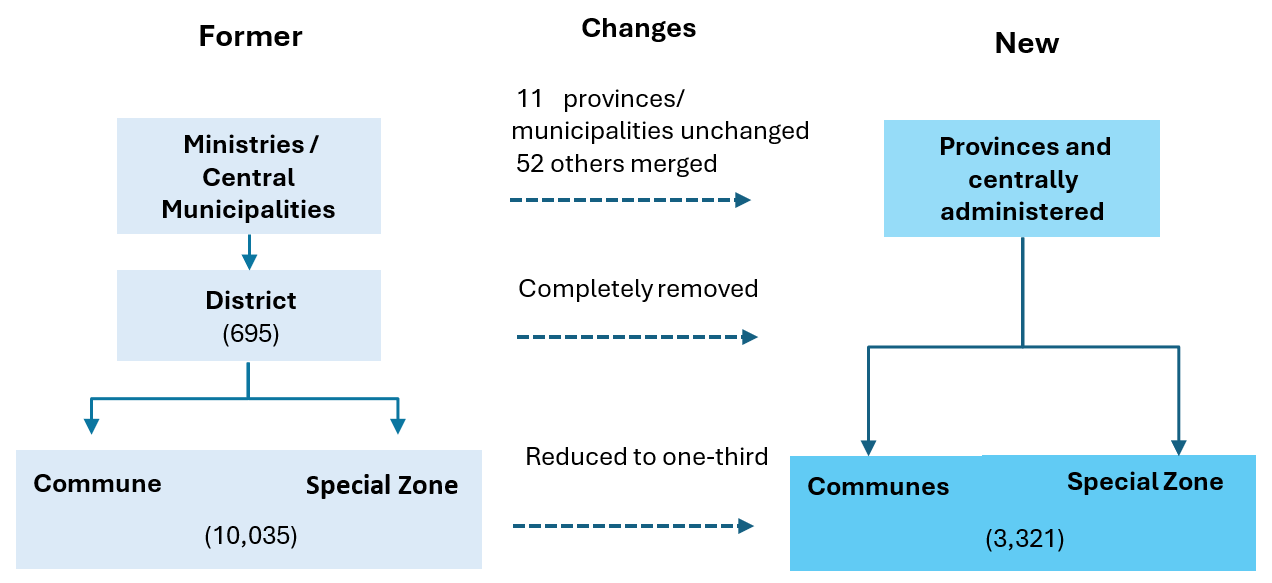
In early 2025, following multiple rounds of discussion, a reorganization of public administration was decided upon, introducing a two-tier local system to reduce fragmentation and duplication of tasks.
Overview of Local Administrative Reorganization (Simplified Display)
Nguồn: B&Company
This new structure consists of 34 provincial-level administrative units and 3,321 communes, with intermediate-level units abolished. For example, an address previously written as “Le Duan Street, Cua Nam Commune, Hoan Kiem District, Hanoi City” is now written as “Le Duan Street, Hoan Kiem Commune, Hanoi City.”
– Provinces/Cities: Primary regional administrative entities that issue resolutions and directives to manage and supervise lower-level operations, overseeing commune-level administration.
– Commune Level: Composed of communes and special wards, this executive layer bears responsibility for autonomously implementing policies within the framework set by the central government and provincial/ municipal governments. It manages local socio-economic development and reports to provinces/cities. Hanoi City has a total of 126 commune units, while Ho Chi Minh City has 168.
Provinces and Cities After Reorganization
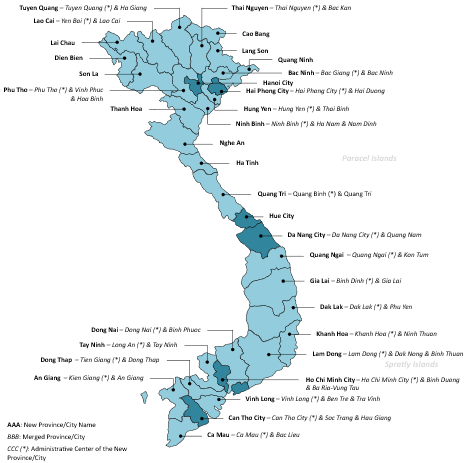
The 34 new provinces and cities were formed by consolidating the former 63 based on criteria such as area, population, culture, geography, and national defense. They officially commenced operations on July 1, 2025.
Map of Vietnam after Provincial/Municipal Reorganization
Nguồn: B&Company
| AAA: New Province/City Name
BBB: Previous Province/City Name CCC (*): Provincial capital location |
In terms of area, Lam Dong Province (merged with Binh Phuoc and Dak Lak) becomes Vietnam’s largest at 24,000 km², while Hung Yen Province (merged with Thai Binh) becomes the smallest at 2,500 km². Regarding population, Ho Chi Minh City, after merging with Ba Ria-Vung Tau and Binh Duong, becomes the most populous city with approximately 14 million people. In terms of population density, Hanoi is the highest, exceeding 2,600 people per km². The province with the smallest population is Lai Chau, with approximately 500,000 residents.
Area and Population of New Provinces and Cities (2024 Data)
| 6 thành phố trực thuộc trung ương | |||
| STT | Tỉnh/Thành phố | Dân số
(Ngàn người) |
Tổng diện tích
(Km2) |
| 1 | Thành phố Hà Nội | 8,718 | 3,360 |
| 2 | Thành phố Huế | 1,236 | 4,947 |
| 3 | Thành phố Hồ Chí Minh | 13,609 | 6,773 |
| 4 | Thành phố Hải Phòng | 4,103 | 3,195 |
| 5 | Thành phố Đà Nẵng | 2,819 | 11,860 |
| 6 | Thành phố Cần Thơ | 3,207 | 6,361 |
| 28 Tỉnh | |||
| STT | Tỉnh/Thành phố (Dự kiến) | Dân số
(Ngàn người) |
Tổng diện tích
(Km2) |
| 7 | Lai Châu | 496 | 9,069 |
| 8 | Điện Biên | 657 | 9,540 |
| 9 | Sơn La | 1,331 | 14,110 |
| 10 | Lạng Sơn | 814 | 8,310 |
| 11 | Quảng Ninh | 1,397 | 6,208 |
| 12 | Thanh Hóa | 3,764 | 11,115 |
| 13 | Nghệ An | 3,442 | 16,487 |
| 14 | Hà Tĩnh | 1,330 | 5,994 |
| 15 | Cao Bằng | 559 | 6,700 |
| 16 | Tuyên Quang | 1,731 | 13,796 |
| 17 | Lào Cai | 1,657 | 13,257 |
| 18 | Thái Nguyên | 1,695 | 8,375 |
| 19 | Phú Thọ | 3,664 | 9,361 |
| 20 | Bắc Ninh | 3,509 | 4,719 |
| 21 | Hưng Yên | 3,208 | 2,515 |
| 22 | Ninh Bình | 3,819 | 3,943 |
| 23 | Quảng Trị | 1,584 | 12,700 |
| 24 | Quảng Ngãi | 1,862 | 14,833 |
| 25 | Gia Lai | 3,153 | 21,577 |
| 26 | Khánh Hòa | 1,882 | 8,556 |
| 27 | Lâm Đồng | 3,324 | 24,233 |
| 28 | Đăk Lăk | 2,831 | 18,096 |
| 29 | Đồng Nai | 4,428 | 12,737 |
| 30 | Tây Ninh | 2,959 | 8,537 |
| 31 | Vĩnh Long | 3,367 | 6,296 |
| 32 | Đồng Tháp | 3,397 | 5,939 |
| 33 | Cà Mau | 2,141 | 7,942 |
| 34 | An Giang | 3,679 | 9,889 |
Nguồn: B&Company tổng hợp
Impact on the Economy
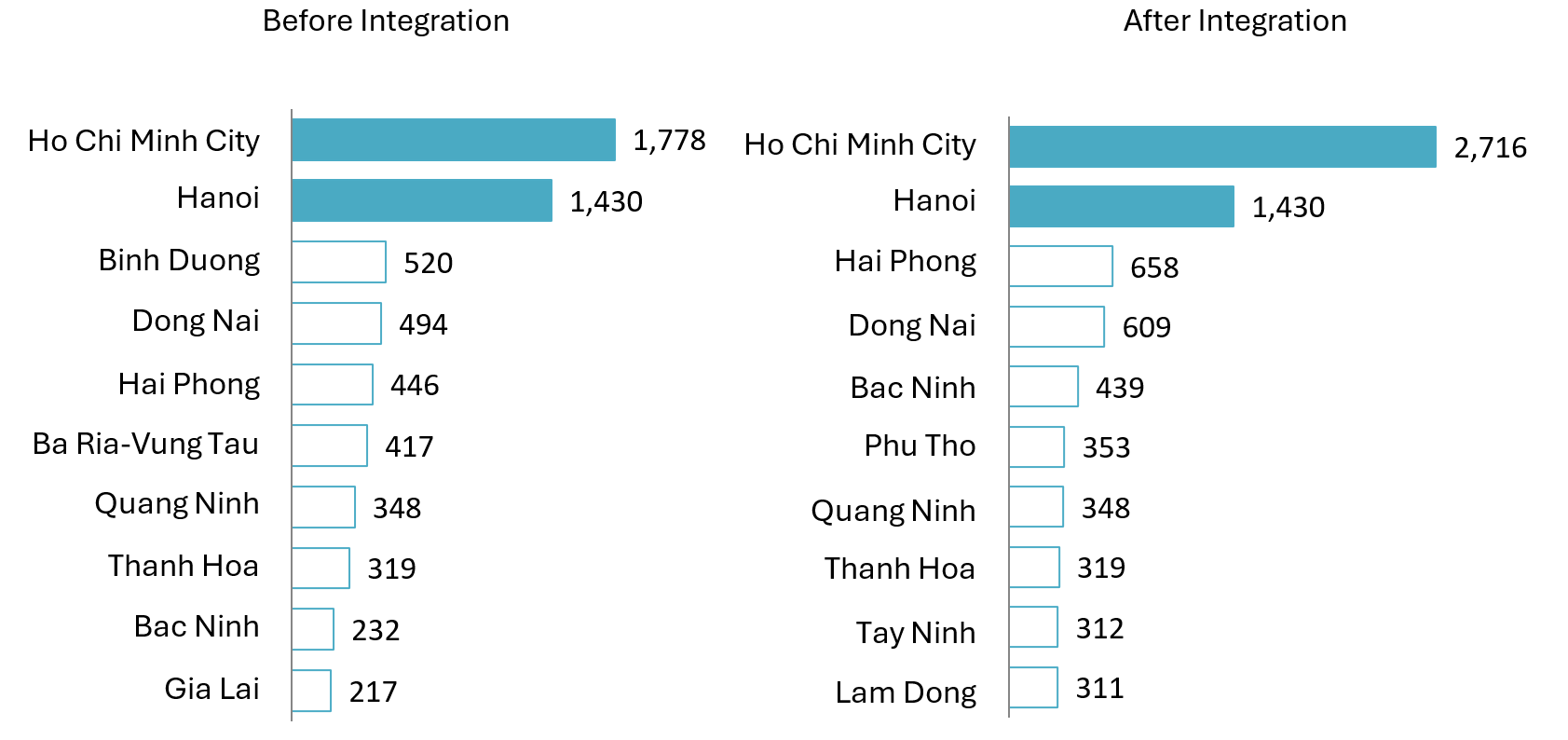
Historically, regional gross domestic product (GRDP) showed Ho Chi Minh City at 1,800 trillion VND and Hanoi at 1,400 trillion VND, together accounting for about one-third of the total. Most other provinces and cities had GRDP below 500 trillion VND, with only 10 exceeding 200 trillion VND.
The provincial integration will strengthen regional strengths by creating large, dynamic economic centers and promoting economic concentration. The new Ho Chi Minh City, merged with Binh Duong and Ba Ria-Vung Tau, will become the first megacity, marking a significant milestone in urban development. Beyond its role as a commercial and financial center, it will become a major Asia-Pacific economic hub, combining Binh Duong’s industrial strength with Ba Ria-Vung Tau’s oil, gas, logistics, and maritime tourism infrastructure. Its economic scale will exceed 2,700 trillion VND, double that of Hanoi and accounting for about a quarter of the national total. Ho Chi Minh City’s economic structure will shift, with the share of the industrial sector increasing from 22% to 35%, while services decrease from 65% to 52%. Meanwhile, GRDP will also see significant increases in other cities due to integration, such as Haiphong (48%), Da Nang (85%), and Can Tho (112%).
Top 10 Provinces/Cities by GRDP (2024 Data)
Unit: Trillion Dong
Nguồn: B&Company tổng hợp
Đọc thêm
Triển vọng kinh tế các tỉnh Đông Nam Bộ sau khi sáp nhập đơn vị hành chính cấp tỉnh
Bài viết liên quan


































Đăng nhập / Đăng ký
ĐĂNG KÝ NHẬN BẢN TIN