

 简体中文
简体中文  English
  日本語
日本語  Tiếng Việt
  한국어
한국어 This article examines the impact of the 2025 administrative restructuring in Vietnam on the economic situation.

237 月2026
最新消息及报道 / 越南简报
评论: 没有评论.

本文探讨了2025年行政区划调整对经济形势和投资环境的影响。向两级行政体系过渡旨在简化行政程序,提高效率。尽管预计会带来增长和投资机遇,但也可能出现法律不一致和区域间执行不力等挑战。.
省级行政改革为何必须推进
Since the reunification of North and South Vietnam after the Vietnam War, administrative reorganizations have been implemented several times to align with socio-economic development goals. In 1975, approximately 72 provincial-level units existed, but in 1976, they were consolidated into 38 to centralize and streamline administration[1]. Over the following decades, Vietnam adopted a decentralized approach to promote regional development, gradually reestablishing provinces. The number increased to 53 in 1991, 61 in 1997, 64 in 2003, and 63 in 2008. However, throughout this period, the three-tier administrative structure- provinces/ centrally administered cities, districts, and communes- remained unchanged.
According to Resolution 18-NQ/TW[2] , while the administration has undergone significant reform efforts, it remains limited in efficiency and retains complexity. Key underlying factors are also identified. Political-administrative organizations have not kept pace with modern demands, partly due to differing perceptions and responsibilities among organizations regarding the need for reform. Furthermore, there is a lack of consistency in organizational structure, personnel management, and decision-making, with room for improvement in situational awareness, leadership, and incentives. Persistent challenges such as legal overlap, inadequate personnel policies, and insufficient audit and evaluation capabilities hinder the simplification of the administrative system. These challenges have prompted the government to adopt more efficient and practical approaches to restructure the public administration system and provide better services to citizens.
Local Administration Restructuring: Introduction of a Two-Tier System
概述
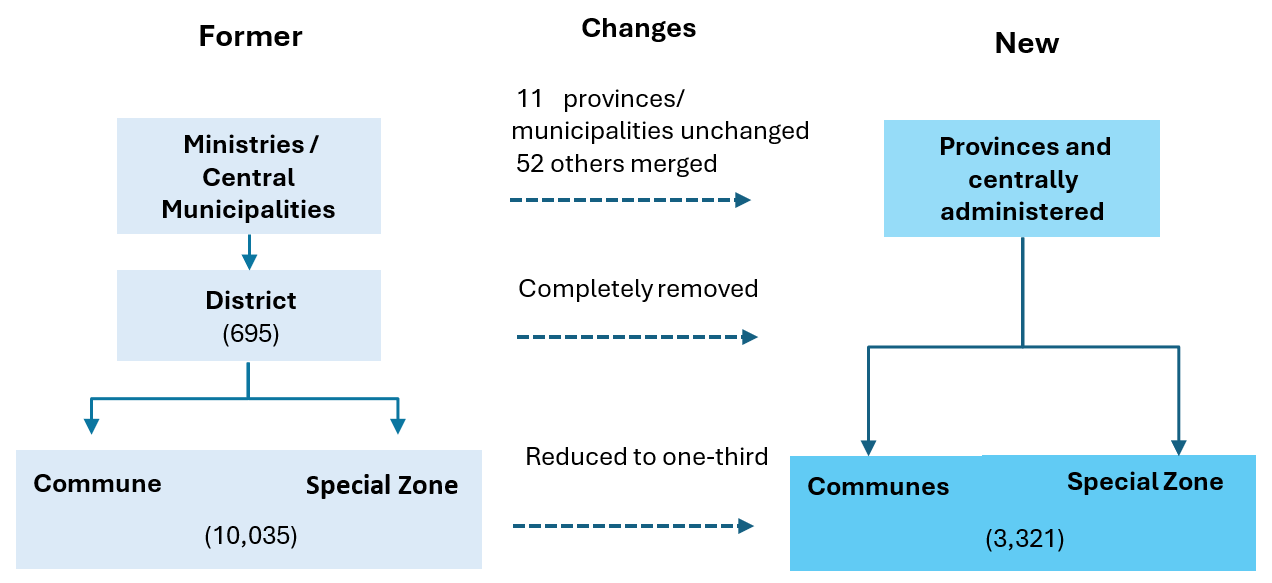
In early 2025, following multiple rounds of discussion, a reorganization of public administration was decided upon, introducing a two-tier local system to reduce fragmentation and duplication of tasks.
Overview of Local Administrative Reorganization (Simplified Display)
来源:B&Company
This new structure consists of 34 provincial-level administrative units and 3,321 communes, with intermediate-level units abolished. For example, an address previously written as “Le Duan Street, Cua Nam Commune, Hoan Kiem District, Hanoi City” is now written as “Le Duan Street, Hoan Kiem Commune, Hanoi City.”
– Provinces/Cities: Primary regional administrative entities that issue resolutions and directives to manage and supervise lower-level operations, overseeing commune-level administration.
– Commune Level: Composed of communes and special wards, this executive layer bears responsibility for autonomously implementing policies within the framework set by the central government and provincial/ municipal governments. It manages local socio-economic development and reports to provinces/cities. Hanoi City has a total of 126 commune units, while Ho Chi Minh City has 168.
Provinces and Cities After Reorganization
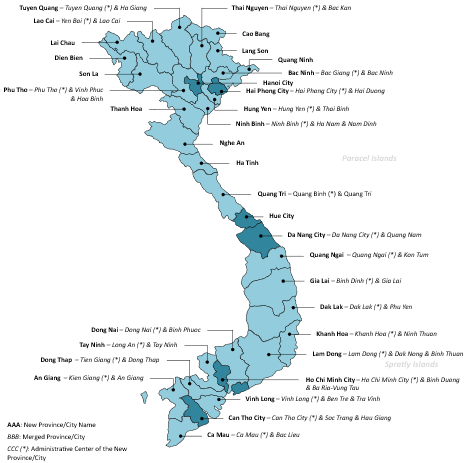
The 34 new provinces and cities were formed by consolidating the former 63 based on criteria such as area, population, culture, geography, and national defense. They officially commenced operations on July 1, 2025.
Map of Vietnam after Provincial/Municipal Reorganization
来源:B&Company
| AAA: New Province/City Name
BBB: Previous Province/City Name CCC (*): Provincial capital location |
In terms of area, Lam Dong Province (merged with Binh Phuoc and Dak Lak) becomes Vietnam’s largest at 24,000 km², while Hung Yen Province (merged with Thai Binh) becomes the smallest at 2,500 km². Regarding population, Ho Chi Minh City, after merging with Ba Ria-Vung Tau and Binh Duong, becomes the most populous city with approximately 14 million people. In terms of population density, Hanoi is the highest, exceeding 2,600 people per km². The province with the smallest population is Lai Chau, with approximately 500,000 residents.
Area and Population of New Provinces and Cities (2024 Data)
| 6个中央直辖城市 | |||
| 不。 | 省/市 | 人口
(千人) |
总面积
(公里2) |
| 1 | 河内市 | 8,718 | 3,360 |
| 2 | 顺化市 | 1,236 | 4,947 |
| 3 | 胡志明市 | 13,609 | 6,773 |
| 4 | 海防市 | 4,103 | 3,195 |
| 5 | 岘港市 | 2,819 | 11,860 |
| 6 | 芹苴市 | 3,207 | 6,361 |
| 28个省 | |||
| 不。 | 省/市 (暂定的) | 人口
(千人) |
总面积
(公里2) |
| 7 | 莱州 | 496 | 9,069 |
| 8 | 奠边府 | 657 | 9,540 |
| 9 | 山罗 | 1,331 | 14,110 |
| 10 | 谅山 | 814 | 8,310 |
| 11 | 广宁省 | 1,397 | 6,208 |
| 12 | 清化 | 3,764 | 11,115 |
| 13 | 義安省 | 3,442 | 16,487 |
| 14 | 河静省 | 1,330 | 5,994 |
| 15 | 高平 | 559 | 6,700 |
| 16 | 宣光 | 1,731 | 13,796 |
| 17 | 老街 | 1,657 | 13,257 |
| 18 | 太原 | 1,695 | 8,375 |
| 19 | 富寿 | 3,664 | 9,361 |
| 20 | 北宁省 | 3,509 | 4,719 |
| 21 | 兴安 | 3,208 | 2,515 |
| 22 | 宁平 | 3,819 | 3,943 |
| 23 | 广治 | 1,584 | 12,700 |
| 24 | 广义省 | 1,862 | 14,833 |
| 25 | 嘉莱 | 3,153 | 21,577 |
| 26 | 庆和省 | 1,882 | 8,556 |
| 27 | 林同 | 3,324 | 24,233 |
| 28 | 多乐省 | 2,831 | 18,096 |
| 29 | 同奈 | 4,428 | 12,737 |
| 30 | 西宁 | 2,959 | 8,537 |
| 31 | 永隆 | 3,367 | 6,296 |
| 32 | 同塔 | 3,397 | 5,939 |
| 33 | 金瓯 | 2,141 | 7,942 |
| 34 | 安江 | 3,679 | 9,889 |
资料来源:B&Company 的综合报告
Impact on the Economy
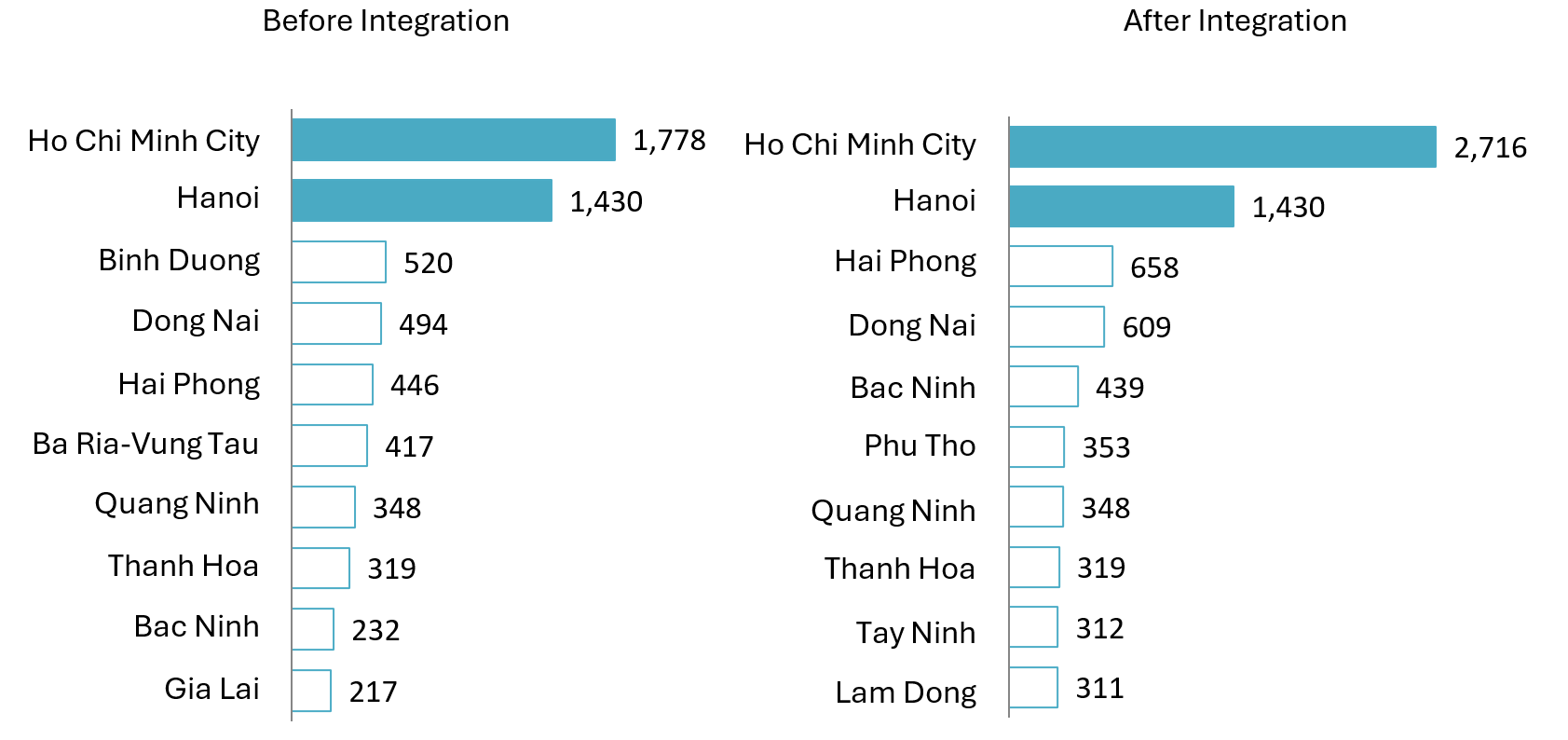
Historically, regional gross domestic product (GRDP) showed Ho Chi Minh City at 1,800 trillion VND and Hanoi at 1,400 trillion VND, together accounting for about one-third of the total. Most other provinces and cities had GRDP below 500 trillion VND, with only 10 exceeding 200 trillion VND.
The provincial integration will strengthen regional strengths by creating large, dynamic economic centers and promoting economic concentration. The new Ho Chi Minh City, merged with Binh Duong and Ba Ria-Vung Tau, will become the first megacity, marking a significant milestone in urban development. Beyond its role as a commercial and financial center, it will become a major Asia-Pacific economic hub, combining Binh Duong’s industrial strength with Ba Ria-Vung Tau’s oil, gas, logistics, and maritime tourism infrastructure. Its economic scale will exceed 2,700 trillion VND, double that of Hanoi and accounting for about a quarter of the national total. Ho Chi Minh City’s economic structure will shift, with the share of the industrial sector increasing from 22% to 35%, while services decrease from 65% to 52%. Meanwhile, GRDP will also see significant increases in other cities due to integration, such as Haiphong (48%), Da Nang (85%), and Can Tho (112%).
Top 10 Provinces/Cities by GRDP (2024 Data)
Unit: Trillion Dong
资料来源:B&Company 的综合报告
阅读更多
相关文章




























登录 / 注册
订阅新闻通讯