省级行政单位合并后的北中部和中部沿海省份经济展望

2025 年行政单位合并后,越南中北部和中部沿海地区的经济将迎来转型。
Da Nang

136 月2025

B&Company

最新消息及报道 / 越南简报

评论: 没有评论.

B&Company是自2008年以来第一家专注于越南市场研究和投资咨询的日本公司。.

在本“越南简报”栏目中,B&Company 的青年研究人员将及时提供有关越南工业趋势、消费趋势和社会运动的信息。.

本文使用英语撰写,其它语言版本使用自动翻译。请参考英文版以获得准确内容。尽管我们努力确保原始信息的准确性,但请分别检查每条信息。对信息的解释与未来展望是每位研究者的个人观点。.

The economic landscape of Vietnam’s North Central and Central Coastal[1] region is poised for transformation following the 2025 administrative unit mergers. This strategic adjustment, set to take effect by August 15 per Conclusion No. 157-KL/TW[2], signed on May 25, aims to improve governance, streamline resource allocation, and foster regional connectivity for long-term development.

Overview of the North Central and Central Coastal after the 2025 Administrative Unit Mergers

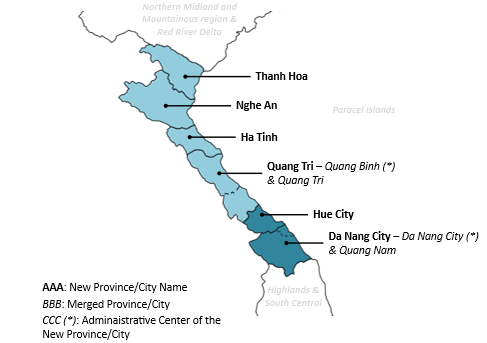
Vietnam’s North Central and Central Coastal region is a major industrial-service-urban coastal center of the country and plays an important role in the development of Central Vietnam. Under Decision No. 759/QĐ-TTg[3], key changes include the merger of Quang Binh and Quang Tri provinces and the consolidation of Da Nang City and Quang Nam into a single centrally-governed city. The remaining provinces, including Thanh Hoa, Nghe An, Ha Tinh, and Hue City, maintain their administrative boundaries but are still influenced by broader regional policies.

The North Central and Central Coastal provincial-level administrative units after the 2025 mergers

The North Central and Central Coastal provincial-level administrative units

来源:B&Company Vietnam

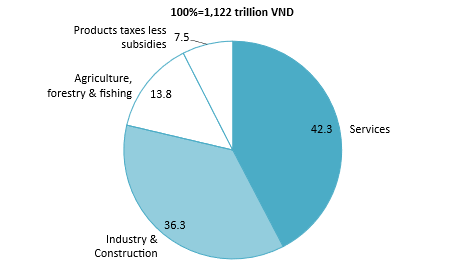
The North Central and Central Coastal is a dynamic region due to its strategic position, long coastline, and abundance of natural resources. The region accounted for 10% of Vietnam’s total GRDP at 1,123 trillion VND, with a growth rate of nearly 9% in 2024. After the merger, the region has a mix of large and small economy localities, with Thanh Hoa leading the region with its 2024 GRDP of around 320 trillion VND, followed by Da Nang City, which overtakes Nghe An due to its merger with Quang Nam at a GRDP of 280 trillion VND. Hue City, without any mergers, posted the lowest GRDP in the region and the lowest among all centrally-governed cities, at 80 trillion VND.

Socio-economic indicators in 2024 of the North Central and Central Coastal provinces after the administrative mergers

不。. 省份 人口

单位千人)

总面积(单位:平方公里)2) 地区生产总值

(单位:十亿越南盾)

增长率

(单位:%)

1 清化 3,764  11,115  318,752

 12.2

2 岘港市 2,819  11,860  279,907  7.3
3 河江 3,442  16,487  216,943  8.0
4 广治 1,584  12,700  113,688  6.6
5 哈潭 1,330  5,994  112,855  7.5
6 顺化市 1,236  4,947  80,000  8.2
全部的 14,175  63,103  1,122,145  8.8

来源: 第60-NQ/TW号决议, 第759/QD-TTg号决定、统计总局(GSO)、省级统计局、B&Company 综合

Regional Economic Characteristics and Investment Situation of the North Central and Central Coastal

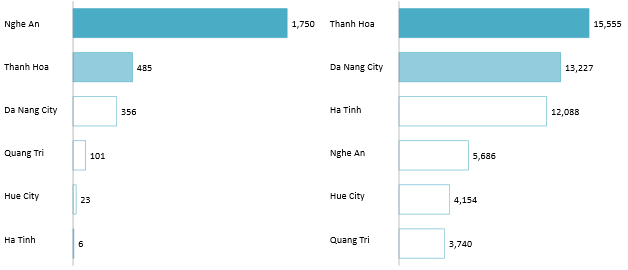
The North Central and Central Coastal region of Vietnam holds a strategic geo-economic position as a transitional zone connecting Northern Vietnam, the Central Highlands, and the East-West economic corridor, linking Laos, Thailand, and Myanmar to the Pacific Ocean. The region’s geographic diversity, bordered by mountains to the west and the East Sea to the east, shapes its development orientation toward a balanced mix of industry, services, and agriculture. The region also acts as a critical transportation and energy corridor for the country, with major highways, railway lines, and seaports facilitating regional integration. These locational strengths have attracted increasing investment into infrastructure, processing and manufacturing industries, renewable energy, and tourism, setting the stage for deeper participation in national and global value chains.

登录或免费注册以继续阅读。

相关文章

订阅新闻通讯