
Impact of Provincial Restructuring on the Economy and Investment (Part 2)

This article examines the impact of the 2025 administrative restructuring in Vietnam on the investment environment.

297 月2026

B&Company

最新消息及报道 / 越南简报

评论: 没有评论.

B&Company-Vietnam industry reports

B&Company 是第一家自 2008 年起在越南专门从事市场研究和投资咨询的日本公司。.

在本“越南简报”栏目中,B&Company 的青年研究人员将及时提供有关越南工业趋势、消费趋势和社会运动的信息。.

本文以英文撰写,其他语言版本为自动翻译版本。请以英文版本为准。尽管我们力求确保原始信息的准确性,但请您自行核实每条信息。文中的解读和未来展望均为各研究者的个人观点。.

This article continues examining the impact of the 2025 administrative restructuring on the investment environment. The transition to a two-tier administrative system aims to simplify administrative procedures and enhance efficiency. While growth and investment opportunities are anticipated, challenges such as legal inconsistencies and uneven implementation across regions may also arise.

省级行政改革为何必须推进

Since the reunification of North and South Vietnam after the Vietnam War, administrative reorganizations have been implemented several times to align with socio-economic development goals. In 1975, approximately 72 provincial-level units existed, but in 1976, they were consolidated into 38 to centralize and streamline administration[1]. Over the following decades, Vietnam adopted a decentralized approach to promote regional development, gradually reestablishing provinces. The number increased to 53 in 1991, 61 in 1997, 64 in 2003, and 63 in 2008. However, throughout this period, the three-tier administrative structure- provinces/ centrally administered cities, districts, and communes- remained unchanged.

According to Resolution 18-NQ/TW[2] , while the administration has undergone significant reform efforts, it remains limited in efficiency and retains complexity. Key underlying factors are also identified. Political-administrative organizations have not kept pace with modern demands, partly due to differing perceptions and responsibilities among organizations regarding the need for reform. Furthermore, there is a lack of consistency in organizational structure, personnel management, and decision-making, with room for improvement in situational awareness, leadership, and incentives. Persistent challenges such as legal overlap, inadequate personnel policies, and insufficient audit and evaluation capabilities hinder the simplification of the administrative system. These challenges have prompted the government to adopt more efficient and practical approaches to restructure the public administration system and provide better services to citizens.

Local Administration Restructuring: Introduction of a Two-Tier System

概述

In early 2025, following multiple rounds of discussion, a reorganization of public administration was decided upon, introducing a two-tier local system to reduce fragmentation and duplication of tasks.

Overview of Local Administrative Reorganization (Simplified Display)
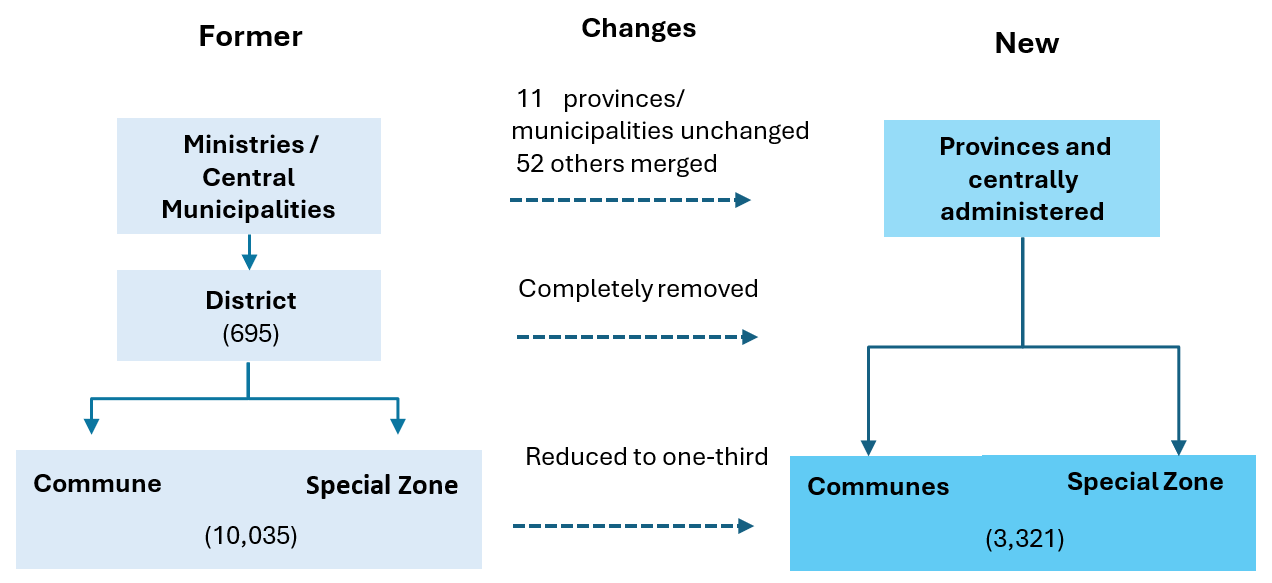
Overview of Local Administrative Reorganization (Simplified Display)

来源:B&Company

This new structure consists of 34 provincial-level administrative units and 3,321 communes, with intermediate-level units abolished. For example, an address previously written as “Le Duan Street, Cua Nam Commune, Hoan Kiem District, Hanoi City” is now written as “Le Duan Street, Hoan Kiem Commune, Hanoi City.”

– Provinces/Cities: Primary regional administrative entities that issue resolutions and directives to manage and supervise lower-level operations, overseeing commune-level administration.

– Commune Level: Composed of communes and special wards, this executive layer bears responsibility for autonomously implementing policies within the framework set by the central government and provincial/ municipal governments. It manages local socio-economic development and reports to provinces/cities. Hanoi City has a total of 126 commune units, while Ho Chi Minh City has 168.

Provinces and Cities After Reorganization

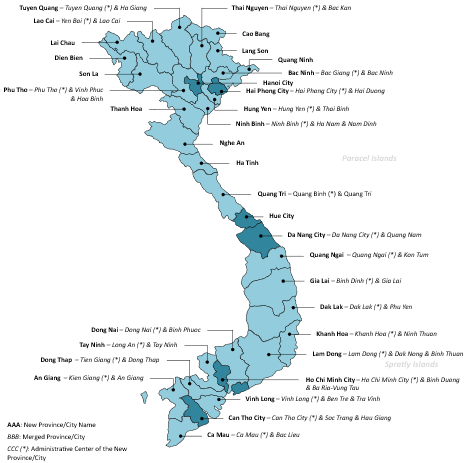
The 34 new provinces and cities were formed by consolidating the former 63 based on criteria such as area, population, culture, geography, and national defense. They officially commenced operations on July 1, 2025.

Map of Vietnam after Provincial/Municipal Reorganization

Vietnam’s Provinces after Restructuring

来源:B&Company

 AAA: New Province/City Name

BBB: Previous Province/City Name

CCC (*): Provincial capital location

In terms of area, Lam Dong Province (merged with Binh Phuoc and Dak Lak) becomes Vietnam’s largest at 24,000 km², while Hung Yen Province (merged with Thai Binh) becomes the smallest at 2,500 km². Regarding population, Ho Chi Minh City, after merging with Ba Ria-Vung Tau and Binh Duong, becomes the most populous city with approximately 14 million people. In terms of population density, Hanoi is the highest, exceeding 2,600 people per km². The province with the smallest population is Lai Chau, with approximately 500,000 residents.

Area and Population of New Provinces and Cities (2024 Data)

6个中央直辖城市
不。 省/市 人口

(千人)

总面积

(公里2)

1 河内市  8,718  3,360
2 顺化市  1,236  4,947
3 胡志明市  13,609  6,773
4 海防市  4,103  3,195
5 岘港市  2,819 11,860
6 芹苴市  3,207  6,361
28个省
不。 省/市 (暂定的) 人口

(千人)

总面积

(公里2)

7 莱州  496  9,069
8 奠边府  657  9,540
9 山罗  1,331 14,110
10 谅山  814  8,310
11 广宁省  1,397  6,208
12 清化  3,764 11,115
13 義安省  3,442 16,487
14 河静省  1,330  5,994
15 高平 559  6,700
16 宣光  1,731 13,796
17 老街  1,657 13,257
18 太原 1,695  8,375
19 富寿 3,664  9,361
20 北宁省  3,509  4,719
21 兴安 3,208  2,515
22 宁平 3,819 3,943
23 广治 1,584 12,700
24 广义省 1,862 14,833
25 嘉莱 3,153 21,577
26 庆和省 1,882 8,556
27 林同  3,324 24,233
28 多乐省  2,831 18,096
29 同奈  4,428 12,737
30 西宁  2,959  8,537
31 永隆  3,367  6,296
32 同塔  3,397  5,939
33 金瓯  2,141  7,942
34 安江  3,679  9,889

资料来源:B&Company 的综合报告

Impact on foreign investment

The merger presents new opportunities for both foreign and domestic investors.

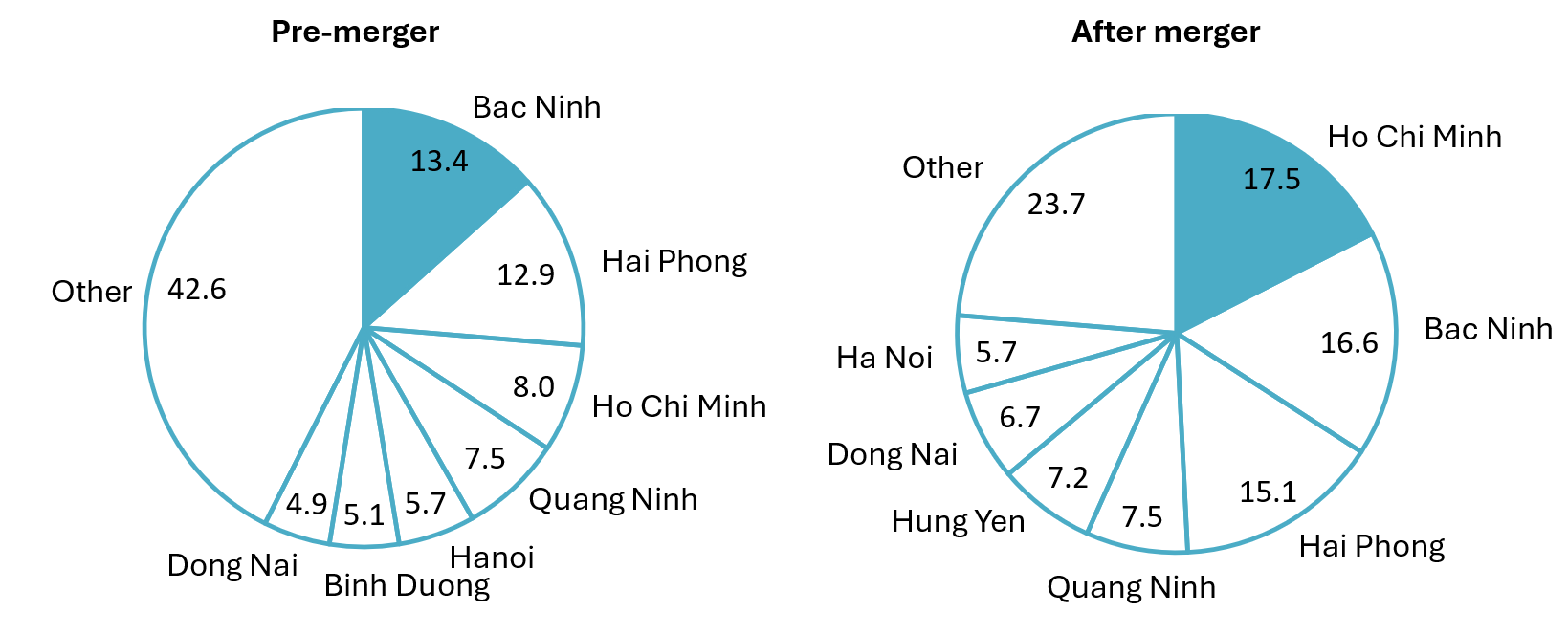
Registered FDI (2024 data)

100% = 38.23 billion USD
Registered FDI (2024 data)

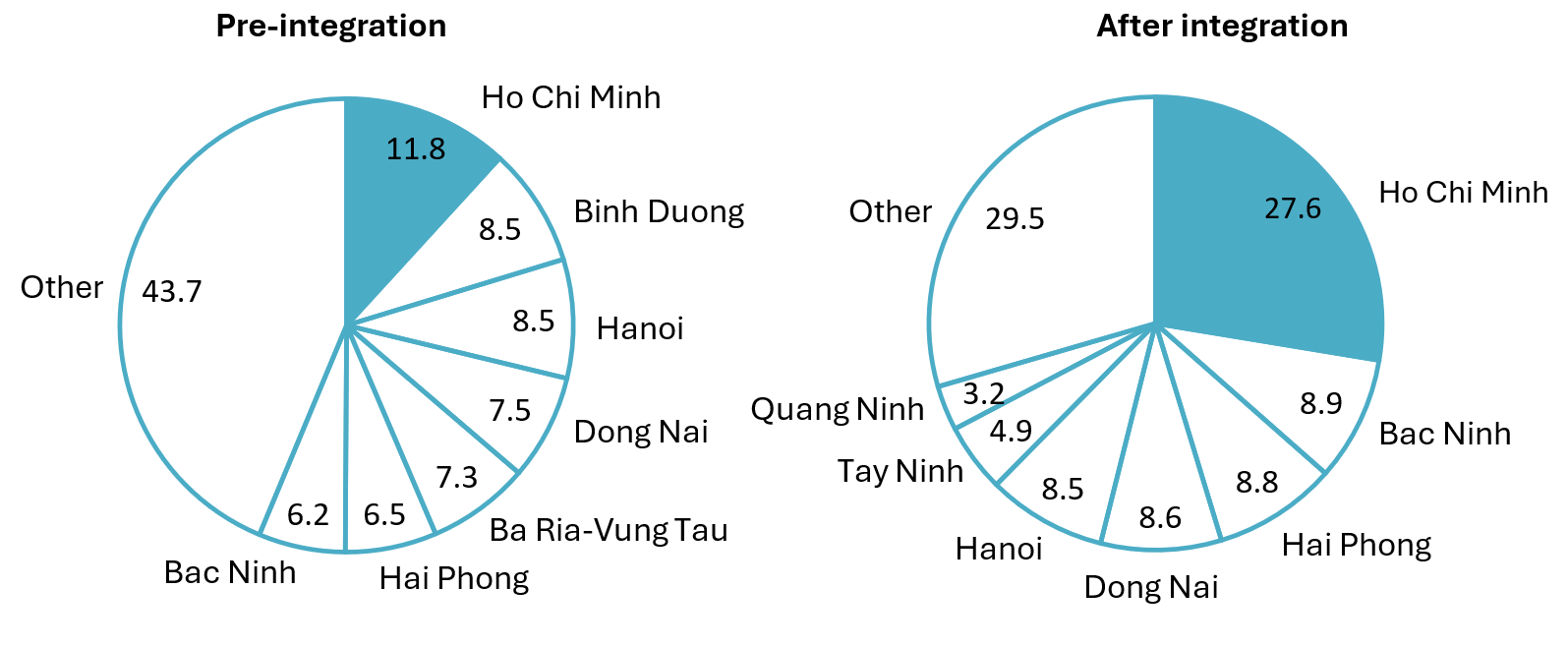
Cumulative Registered FDI Since 1988

100% = 500.5 billion USD
Cumulative Registered FDI Since 1988

B&Company的综合分析

In the South, Ho Chi Minh City is the primary investment destination, accounting for 28% of cumulative FDI after its merger with Binh Duong and Ba Ria-Vung Tau. The new city now has a diverse industrial ecosystem in finance, high technology, and logistics, making it an attractive destination for investment. Ho Chi Minh City aims to attract investment of 8-10 million USD per hectare, prioritizing high-tech and environmentally conscious projects while modernizing its industrial model for sustainable growth. Meanwhile, Dong Nai (after merging with Binh Phuoc) and Tay Ninh (after merging with Long An) are emerging as major investment destinations in metropolitan adjacent areas.

In the North, Bac Ninh and Hai Phong lead in both registered FDI capital for 2024 and total accumulated FDI since 1988, particularly after merging with Bac Giang and Hai Duong, respectively. This opens many opportunities for regions like Bac Giang. While Bac Ninh has long attracted major foreign investors like Samsung and Canon, Bac Giang’s business environment has also improved, successfully attracting global giants such as HanaMicron and Foxconn.

Infrastructure Development

One objective of provincial integration is to strengthen infrastructure and connectivity, improve logistics access (such as highways, ports, and airports), and promote efficient development.

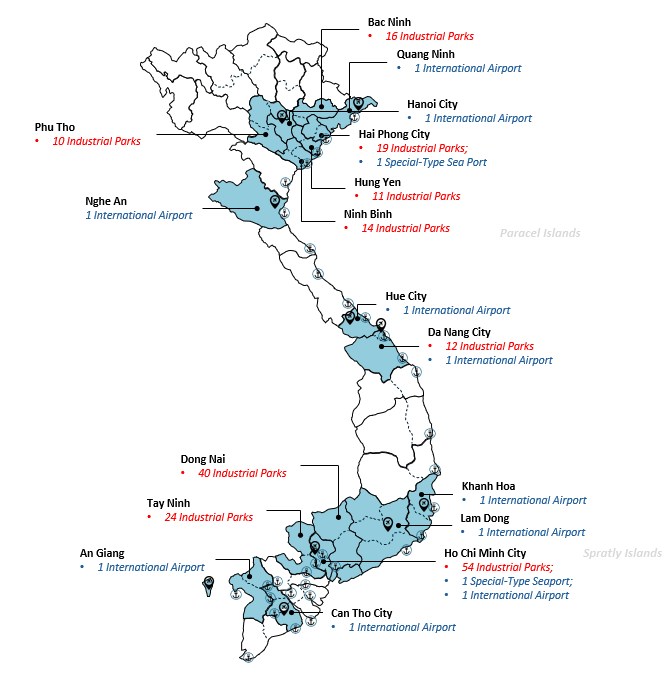
– The creation of large-scale industrial hubs in the Southeast and Red River Delta regions is being promoted, increasing demand for manufacturing. Ho Chi Minh City is expected to have over 54 industrial parks[3] , followed by Dong Nai (40) and Tay Ninh (24). In the Red River Delta, Hai Phong, Bac Ninh, and Ninh Binh are becoming major industrial centers, while Da Nang is increasing its presence with 12 industrial parks.

– Strengthening management of large-scale industrial zones will enhance corporate flexibility, boost regional competitiveness, and attract domestic and foreign investment. Increased land availability will facilitate factory site selection and alleviate shortages in high-demand areas[4].

– The distance between industrialized provinces and major airports/seaports will be reduced, improving trade connectivity. Haiphong’s super-class port and the airports in Hanoi and Quang Ninh will support industrial growth in the north, while Ho Chi Minh City will benefit from improved access to Ba Ria-Vung Tau.

– Inland provinces previously at a logistical disadvantage (such as Dak Lak) will see improved access to seaports and maritime transport, promoting regional economic development and reducing logistics costs for inland enterprises.

Key Economic and Industrial Infrastructure After Integration

B&Company的综合分析

机遇与挑战

Simplifying administrative procedures and creating large economic zones will significantly improve the business environment. Reducing bureaucratic obstacles and enabling swift decision-making will decrease the time and cost required to obtain permits and licenses, enhancing regulatory predictability and government efficiency. Direct links between ministries and communes will improve infrastructure planning, create integrated markets, and reduce administrative barriers for foreign investors.

According to Dr. To Hoai Nam, Permanent Vice Chairman of the Vietnam Association of Small and Medium Enterprises (VINASME), provincial integration will create new opportunities for business development in the long term, forming a business environment particularly favorable for the scaling up of SMEs. When smaller administrative units are integrated into larger, planned regions, infrastructure such as transportation, trade, and supply chains improves, enabling access to broader markets for manufacturing, trade, and services.

Challenges exist. Experts note the consolidation process triggers changes in government authorities, tax laws, business licenses, and land ownership documents, leading to delays and increased costs. Businesses must update registration information, correct addresses, and navigate new bureaucratic procedures. Incentive policies and regulations (tax systems, land use rules, business support) may change or become inapplicable, increasing uncertainty. Discrepancies may arise, potentially leading to disputes over ongoing projects or public assets. Integration could intensify competition, and an increase in the number of companies might cause imbalances in the allocation of local resources. From a logistics perspective, companies are expected to face challenges due to inconsistencies in outdated vehicle registrations, transport permits, and road infrastructure. Without swift adjustments to administrative and legal systems, disruptions to transportation, distribution, and supply chains may occur. To mitigate these risks, a clear roadmap and coordinated policy implementation are essential during the integration process.[5]

阅读更多


越南7月1日正式实施省级重组及双层地方治理模式

[1]  VnExpress (2025) <使用权>

[2]  Resolution No. 18-NQ/TW <使用权>

[3]  GSO (2023) <使用权>

[4]  VIR (2025) <使用权>

[5] Green Business & Economy Magazine (2025) <使用权>

相关文章

订阅新闻通讯