
政令249/2025/ND-CP:科学技術、イノベーション、デジタル変革分野の人材を誘致するためのベトナムの新たな政策枠組み

政令第249/2025/NĐ-CP号は、高レベルの科学技術分野の人材不足に対処するための重要な一歩となります。

Vietnam attracting technological talents

2026年2月11日

B&Company

最新ニュースとレポート / ベトナムブリーフィング

コメント: コメントはまだありません.

B&Company-Vietnam industry reports

B&Companyは、2008年からベトナムにおいて市場調査および投資コンサルティングを専門とする日本の初の企業です。.

この「Vietnam Briefing」セクションでは、B&Companyの若手研究者たちがベトナムの産業動向、消費者動向、社会運動に関するタイムリーな情報を提供します。.

この記事は英語で書かれ、他の言語バージョンには自動翻訳が使用されています。正確なコンテンツのために、英語版をご参照ください。原情報の正確性を確保するよう努めていますが、各情報については別途確認してください。解釈や将来の展望は各研究者の個人的な意見です。.

Vietnam’s Decree No. 249/2025/NĐ-CP represents a significant step to address shortages in high-level scientific and technological human resources amid intensifying global competition for talent. By introducing flexible recruitment mechanisms, market-oriented compensation, professional autonomy, and comprehensive family support, the decree shows Vietnam’s commitment to innovation and digital transformation. Challenges remain in practical application, yet its impact on talent availability, research capacity, and innovation ecosystems will be relevant considerations for foreign investors operating in Vietnam.

Vietnamese context and situation

Imperative from government orientation

Vietnam has clearly articulated that science, technology, innovation and digital transformation are foundational drivers for national development. The Resolution 57-NQ/TW designates these areas as the foremost strategic breakthrough for socioeconomic progress, modernization and global integration. The resolution aims to leverage innovation and digital transformation to enhance productivity, upgrade production structures, and prevent development stagnation in the face of the Fourth Industrial Revolution[1]. To achieve the target stated in the resolution, human resources are identified as one of the most valuable assets.

Shortage of high-quality human resources

Vietnam has seen progress in participation in higher education and workforce expansion. From 2015 to 2023, the number of people engaged in scientific research and technological development increased steadily with a CAGR of 3.53%. The proportion of experts having a PhD is on the rise [2].

Number of people engaged in scientific research and technological development in Vietnam (2015-2023)
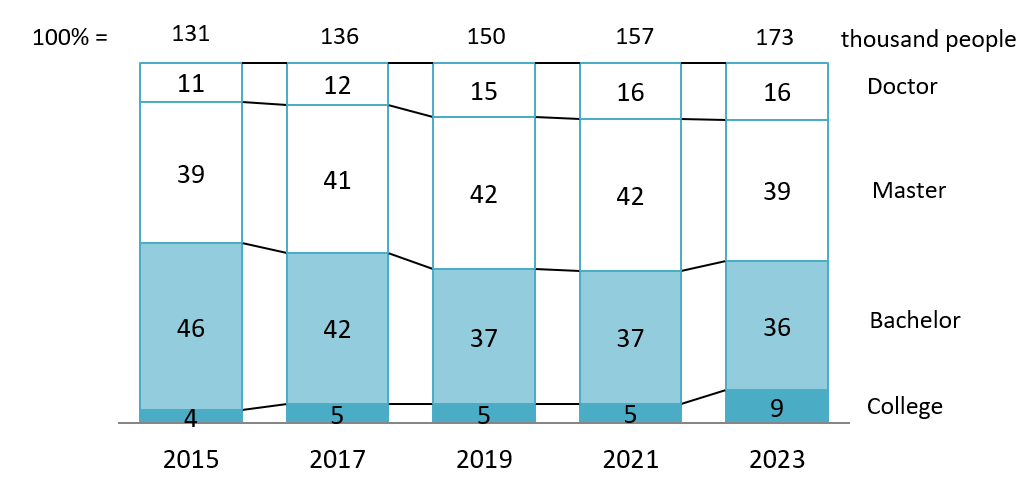

Number of people engaged in scientific research and technological development in Vietnam (2015-2023)

出典: 国立統計局

However, Vietnam continues to face significant shortages in high-quality scientific and technological human resources. In the information technology sector alone, Vietnam is projected to need about 700,000 IT workers by 2025, but domestic institutions currently produce only a fraction of that number with adequate job-ready capabilities[3].

Moreover, multiple assessments highlight that while enrollment in tertiary programs in STEM has grown, many graduates lack practical skills and industry-aligned competencies. Because of the imbalance between training programs and the practical needs of the labor market, only about 30% of IT graduates meet the requirements of businesses[4].

Global competition for talents

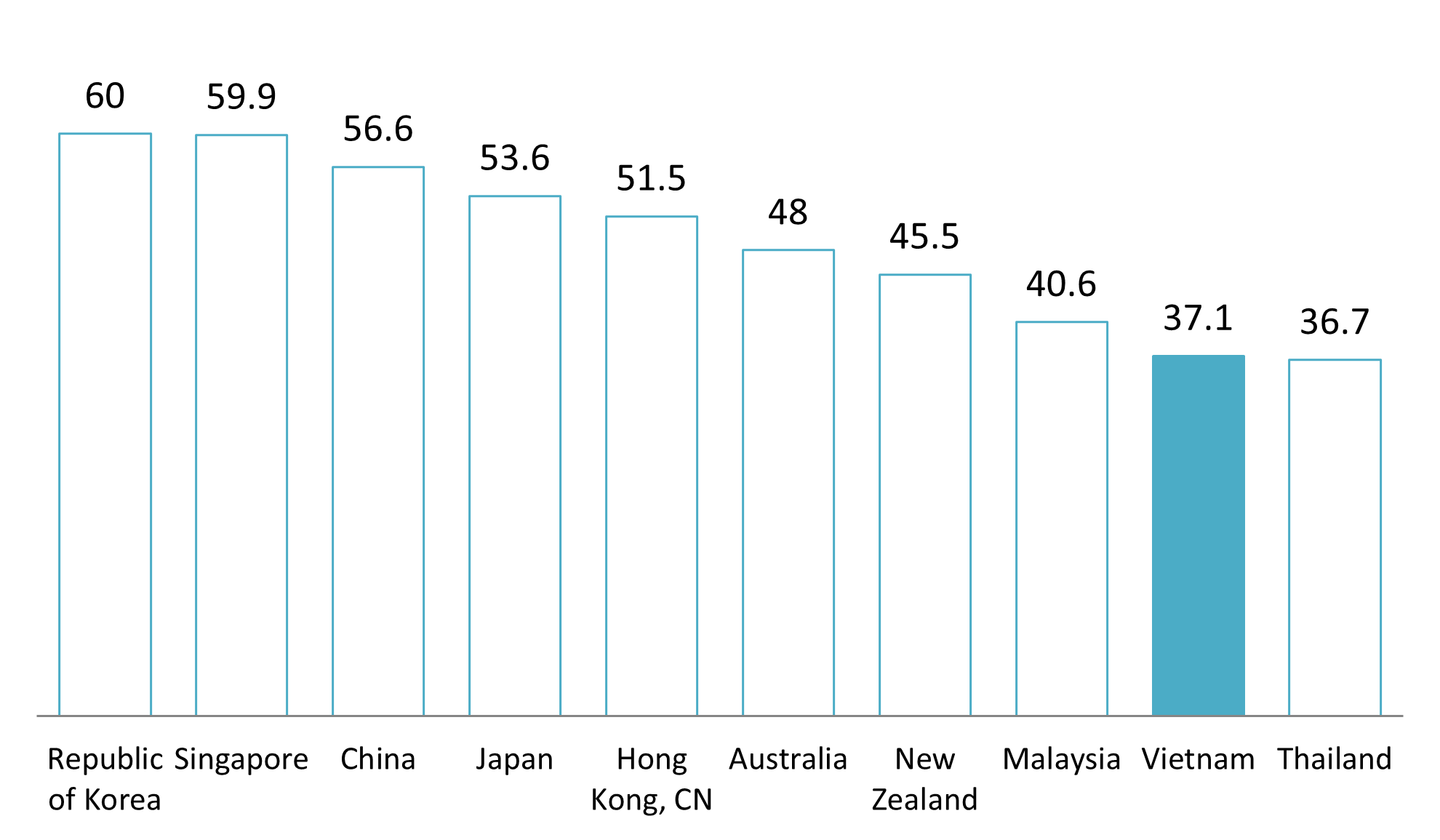
Vietnam’s geographical position in East and Southeast Asia places it at the crossroads of some of the world’s most dynamic innovation ecosystems. In 2025, Vietnam ranked 44th in the global list and ranked 9th among South East Asia, East Asia, and Oceania region, behind neighboring innovative economies such as China, South Korea, Japan, Singapore and Hong Kong [5].

This proximity presents both opportunities and intense competition for highly skilled talent, as these economies attract and retain experts through their innovation capacity, established research ecosystems, and deeper integration into global value chains.

Top 10 Global Innovation Index (GII) 2025 in South East Asia, East Asia, and the Oceania region

Unit: GII score
Top 10 Global Innovation Index (GII) 2025 in South East Asia, East Asia, and Oceania region

出典: World Intellectual Property Organization

At the same time, Vietnam faces the challenge of brain drain. According to World Bank, about 65% of Vietnam’s talent currently resides and works abroad, particularly in high-growth sectors and advanced technology markets[6]. This situation is reinforced by a long-standing vicious cycle: many high-performing graduates pursue doctoral studies abroad and do not return, while those who remain in Vietnam often encounter constraints such as limited research funding and outdated laboratory infrastructure. Vietnam faces difficulty when competing with the economic incentives and resources offered by regional neighbors: not only higher salaries, but also foreign innovative hubs provide talents with deeply developed R&D environments and global networks.

The issuance of Decree 249/2025/ND-CP

In response to the context, Decree No. 249/2025/NĐ-CP on mechanisms and policies for attracting experts in science, technology, innovation and digital transformation for the public sector was issued.

Highlights of Decree 249/2025/ND-CP

Aspect 記事 コンテンツ
主題 2 Decree 249 applies to experts in science, technology, innovation, and digital transformation, including:

– Vietnamese citizens residing overseas

– Foreign nationals

Rights and Responsibilities of an expert 5 – Autonomy in technical and technological decision-making

– Proactive authority to mobilize and utilize human resources

– Proactive discretion over the use of funds and resources

– Eligibility for financial support for international surveys and scientific exchanges to update advanced technologies

Salary, bonus, working conditions, and welfare 8 – Competitive salaries, determined based on expertise, role, and contractual agreement

– Performance-based annual bonuses

– Additional income may be earned from the commercialization of scientific, technological, innovative, and digital transformation outputs

– Settlement allowance (one month’s salary) for accommodation, travel, and essential expenses

– Support for housing and transportation

– Covered overseas research and international exchange expenses

– Healthcare, leave, and vacation benefits

– Recognition and rewards

Policies for experts upon completion of tasks 9 – Foreign experts may benefit from relaxed eligibility conditions when applying for Vietnamese citizenship.

– Vietnamese experts may be exceptionally recruited and appointed to civil service and leadership positions without meeting standard requirements on age, titles, political theory, or prior experience.

Welfare for family members 8, 10 – Family members are included in support for annual leave, vacation cost and round-trip airfare paid

– Support in school placement and tuition fees for children under 18 attending public institutions

– Annual health care package for the family (not exceeding 1% of the total annual salary under the employment contract)

– Support in job placement and conditions to access suitable employment opportunities

– Multiple-entry visas and temporary residence cards granted in accordance with the expert’s working duration

Source: B&Company, summarized from Decree 249/2025/ND-CP

One of the most significant aspects of the decree is the degree of professional autonomy granted to experts[7]. Equally important is the market-oriented compensation framework. Unlike traditional public-sector regimes constrained by rigid salary scales, Decree 249 allows salaries to be fully negotiated based on expertise, role, and market conditions.

Moreover, after completing their assigned duty, experts can be assigned to leadership and management positions in public service units without being bound by age, functional planning, political theory qualifications, or consecutive tenure as before[8].

Furthermore, by extending support to family members, the policy recognizes that talent attraction is not solely an individual decision but a household-level one.

Challenges and limitations of the Decree

The decree’s success depends heavily on implementation capacity at the ministerial, sectoral, and local levels. Many public agencies lack prior experience in negotiating market-based salaries, managing performance-based contracts, or evaluating high-level international experts[9].

Despite significant autonomy being granted on paper, in practice, administrative controls may still limit actual decision-making . If legacy approval processes, procurement rules, or internal hierarchies are not reformed in parallel, experts may experience a gap between formal authority and effective autonomy.

While Decree 249 offers strong incentives, non-financial integration challenges remain for experts. Language barriers and differences in working culture may affect foreign experts’ ability to operate efficiently. Even Vietnamese experts can encounter cultural shock when relocating to the public sector. Without a transition phase and support from talent management systems, experts may spend excessive time navigating cultural complexities rather than focusing on core technical work[10].

Conclusion and implication

The decree reflects Vietnam’s determination to strengthen its national science, technology, innovation, and digital transformation capacity.

For foreign investors, this creates long-term opportunities. A stronger public-sector research base and more globally connected experts can enhance technology transfer, raise local absorptive capacity, and improve the quality of collaboration with Vietnamese partners. Investors in high-tech manufacturing, R&D centers, digital services, and advanced industries should monitor how Decree 249 translates into improvements in research infrastructure, regulatory sophistication, and talent ecosystems. Those are factors that directly affect project feasibility and innovation outcomes even outside the public sector.

At the same time, foreign investors may also face emerging challenges. As Vietnam intensifies competition for top talent (both domestically and internationally) private firms may experience tighter labor markets and upward pressure on wages for highly skilled professionals. Investors should therefore pay attention to talent competition and workforce development strategies as Vietnam transitions toward a more innovation-driven growth model.


*この記事の情報を引用したい場合は、著作権を尊重するために、元の記事へのリンクとともに出典を明記してください。.

B&Company

2008年よりベトナムで市場調査を専門とする初の日本企業として、業界レポート、業界インタビュー、消費者調査、ビジネスマッチングなど、幅広いサービスを提供しています。さらに、ベトナム国内の90万社以上の企業を網羅したデータベースを構築し、パートナー企業の探索や市場分析にご活用いただけるようになりました。.

ご不明な点がございましたら、お気軽にお問い合わせください。.

info@b-company.jp + (84) 28 3910 3913

詳細を読む

ベトナム労働市場の最新情報:2026年1月1日より地域最低賃金が引き上げられる

ベトナムのIT人材市場 - 外資系企業との連携機会

[1] Dan Tri, Vietnam will develop through innovation and digital transformation (https://dantri.com.vn/khoa-hoc/viet-nam-se-la-quoc-gia-phat-trien-bang-doi-moi-sang-tao-va-chuyen-doi-so-20241225113651366.htm)

[2] National Statistics Office, Number of people engaged in scientific research and technological development (https://www.nso.gov.vn/en/px-web/?pxid=E1332&theme=Education)

[3] VN Economy, Vietnam’s information technology sector is currently facing a shortage of 200,000 workers compared to demand (https://vneconomy.vn/nganh-cong-nghe-thong-tin-viet-nam-dang-thieu-hut-200-000-nhan-luc-so-voi-nhu-cau.htm)

[4] Dan Tri, Vietnam is facing a serious shortage of highly skilled talents (hhttps://dantri.com.vn/cong-nghe/viet-nam-thieu-hut-nghiem-trong-nhan-luc-trinh-do-cao-20250326132608030.htm)

[5] World Intellectual Property Organization, Global Innovation Index 2025: Innovation at a Crossroads (https://www.wipo.int/web-publications/global-innovation-index-2025/assets/80937/2000EN%20Global%20Innovation%20Index%202025%20-%20Full%20-%20v8.pdf)

[6] World Bank, Accelerating the development of high-tech talent in Vietnam (https://documents1.worldbank.org/curated/en/099142309042522486/pdf/IDU-743c96bd-3fe7-4755-88a6-903c94bc5f08.pdf)

[7] Vietnam Education, Decree 249 opens a smooth “highway” for talented individuals and experts to enter the public sector (https://giaoduc.net.vn/nghi-dinh-249-mo-duong-cao-toc-thong-thoang-cho-nhan-tai-chuyen-gia-vao-khu-vuc-cong-post254772.gd)

[8] Phap Luat Magazine, Without formal planning, scientific experts can become leaders in government agencies. (https://plo.vn/khong-can-quy-hoach-chuyen-gia-khoa-hoc-co-the-lam-lanh-dao-trong-co-quan-nha-nuoc-post871402.html)

[9] Vietnam Education, Decree 249 opens a smooth “highway” for talented individuals and experts to enter the public sector (https://giaoduc.net.vn/nghi-dinh-249-mo-duong-cao-toc-thong-thoang-cho-nhan-tai-chuyen-gia-vao-khu-vuc-cong-post254772.gd)

[10] Vietnam Education, To effectively attract science and technology experts to the public sector, a “two-tiered filter” system needs to be established (https://giaoduc.net.vn/de-thu-hut-chuyen-gia-khcn-vao-khu-vuc-cong-hieu-qua-can-xay-dung-bo-loc-hai-tang-post254940.gd)

関連記事

ニュースレターを購読する