
0311 月2025
精彩内容 / 精彩内容 JP / 精彩内容 vi / 行业评论 / 最新资讯及报告
评论: 没有评论.
Japanese companies are becoming increasingly prominent in Vietnam. According to B&Company, there were approximately 1.08 million active companies in the country as of 2023, of which approximately 20,000 are foreign-invested (FDI) companies. While FDI companies account for only about 2% of the total, they are also a driving force behind the economy, generating 28% of the country’s total net revenue. By country, South Korean companies accounted for the largest number, with approximately 5,500 companies, followed by Japan and China.
Composition of foreign companies by country in Vietnam in 2023 (%)
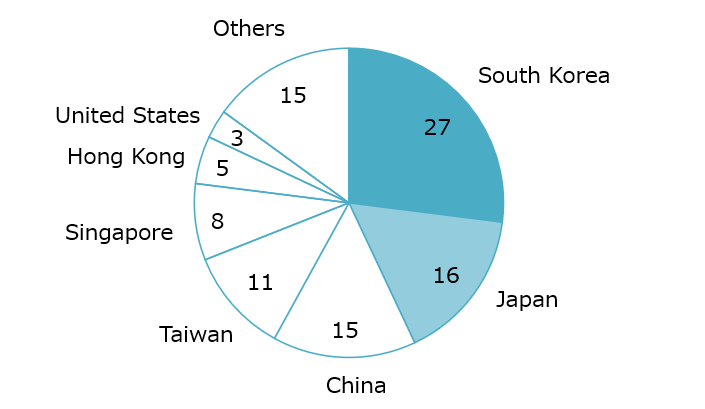
来源:B&Company
Japanese companies continue to expand despite the COVID-19 pandemic, with two polarized regions
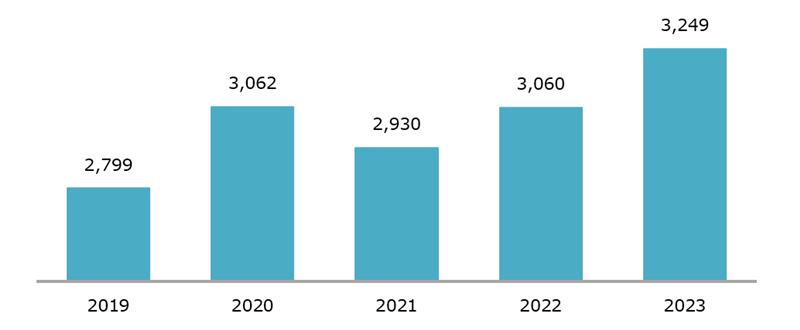
Even with the stagnation caused by the COVID-19 pandemic, the number of Japanese companies entering the country steadily increased between 2019 and 2023. Behind this is a trend in which Japanese companies, seeking to break away from their reliance on domestic demand, have repositioned Vietnam as a growth market.
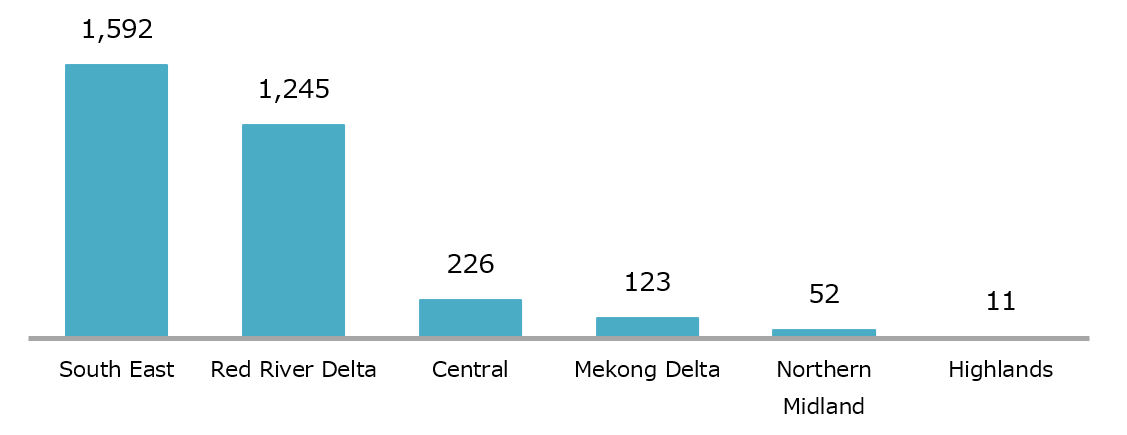
By region, expansion is concentrated in the northern provinces of Hanoi, Vinh Phuc, and Thanh Hoa, and the southern provinces of Ho Chi Minh City, Binh Duong, and Dong Nai. Both areas have well-developed transportation infrastructure and port facilities, making them highly convenient export bases. In addition to manufacturing, logistics, retail, and IT-related industries are also accumulating.
Trends in Japanese companies operating in Vietnam (companies)

来源:B&Company
Areas in Vietnam of Japanese companies in 2023 (companies)

来源:B&Company
Japan lags behind South Korea in large-scale investments and is adopting a “diversified investment” approach
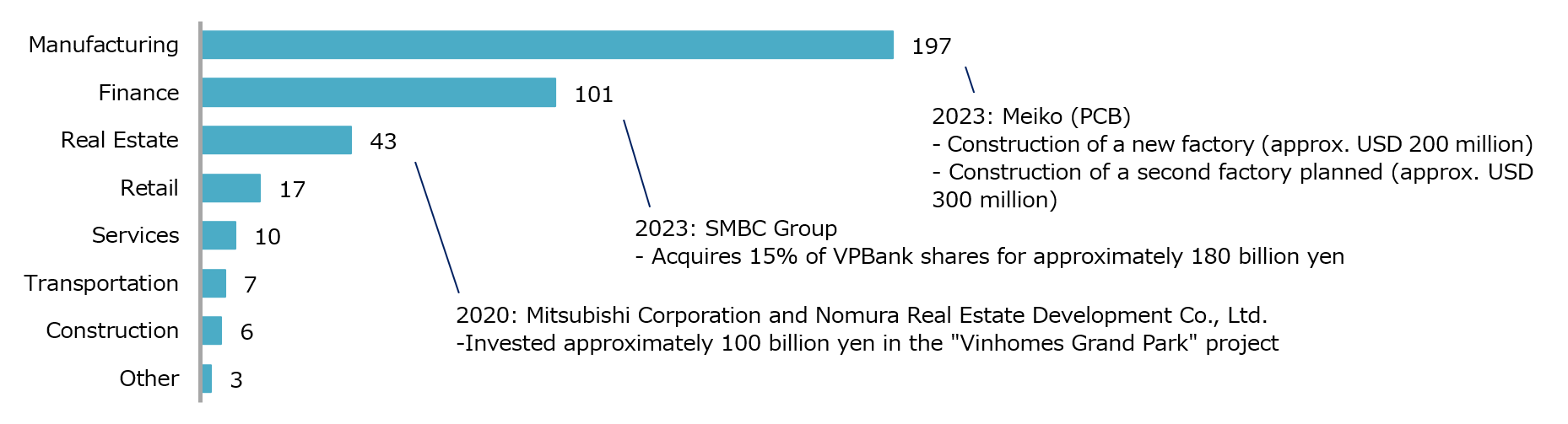
On the other hand, South Korean companies are one step ahead in terms of the scale of large-scale investment projects. Since 2005, South Korean companies have made multiple factory investments worth over USD 1 billion, mainly in the manufacturing industry. In contrast, Japanese companies’ investments tend to be more diversified and cross-sectoral, spanning manufacturing, finance, real estate, and retail.
This difference stems from differences in strategy. Japanese companies aim to diversify their investments across ASEAN, while South Korea focuses its capital on Vietnam as a “strategic core base.” This has resulted in differences in the speed at which industrial clusters are formed.
日本 → Vietnam Cumulative investment amount (10 billion yen: 2005-2023)

来源:B&Company
New trends: Japan-Vietnam cooperation deepens in semiconductors, renewable energy, and digital transformation
The economic partnership between Japan and Vietnam is growing stronger every year. With a government-to-government cooperation framework as a backdrop, Japanese companies are expected to accelerate their activities in new fields such as semiconductors, digital transformation (DX), and renewable energy.
For Japanese companies, Vietnam is no longer simply a “low-cost manufacturing base.” Its importance as a strategic base for developing next-generation industries is increasing. As the restructuring of the regional supply chain progresses, the role of Japanese companies is at a turning point, shifting from quantity to quality.
*如果您希望引用本文中的任何信息,请善意地引用来源,并附上原文链接,以尊重版权。.
| B&Company
自2008年以来,我们是首家专注于越南市场调研的日本公司。我们提供广泛的服务,包括行业报告、行业访谈、消费者调查和商业配对。此外,我们近期还建立了一个包含超过90万家越南企业的数据库,可用于寻找合作伙伴和分析市场。. 如有任何疑问,请随时与我们联系。. info@b-company.jp + (84) 28 3910 3913 |