

 English
  日本語
日本語  Tiếng Việt
  简体中文
简体中文  한국어
한국어 This article examines the regulatory landscape, market development, key players, and investment opportunities shaping government AI in Southeast Asia.

15Sep2026
Highlight content / Highlight Content JP / Highlight content vi / Latest News & Report
Comments: No Comments.
Artificial intelligence (AI) is becoming a strategic technology for governments across Southeast Asia as countries move from digital government toward AI-enabled public services. While Singapore currently leads the region in government AI readiness, emerging ASEAN markets including Vietnam, Indonesia, Malaysia, and Thailand are developing AI capabilities through digital government programs, national AI strategies, and public-sector modernization initiatives. This article examines the regulatory landscape, market development, key players, and investment opportunities shaping government AI in Southeast Asia.
From Digital Government to AI-Enabled Public Services
Over the past decade, Southeast Asian governments have focused on digital transformation through online public services, electronic identification systems, and national databases. The next stage is integrating artificial intelligence (AI) into these foundations to improve administrative efficiency, automate repetitive processes, and provide more personalized public services.
Unlike enterprise AI applications, government AI focuses on large-scale public needs, including citizen assistance, document processing, healthcare analytics, urban management, public safety, and policy planning. AI enables governments to analyze large volumes of data, identify patterns, and support faster decision-making.
However, readiness differs significantly across Southeast Asia. Singapore has established itself as the regional leader, while other ASEAN countries are still strengthening their digital foundations.
Government AI Readiness Index 2024 (selected Southeast Asian countries)
Unit: Score (0 – 100)
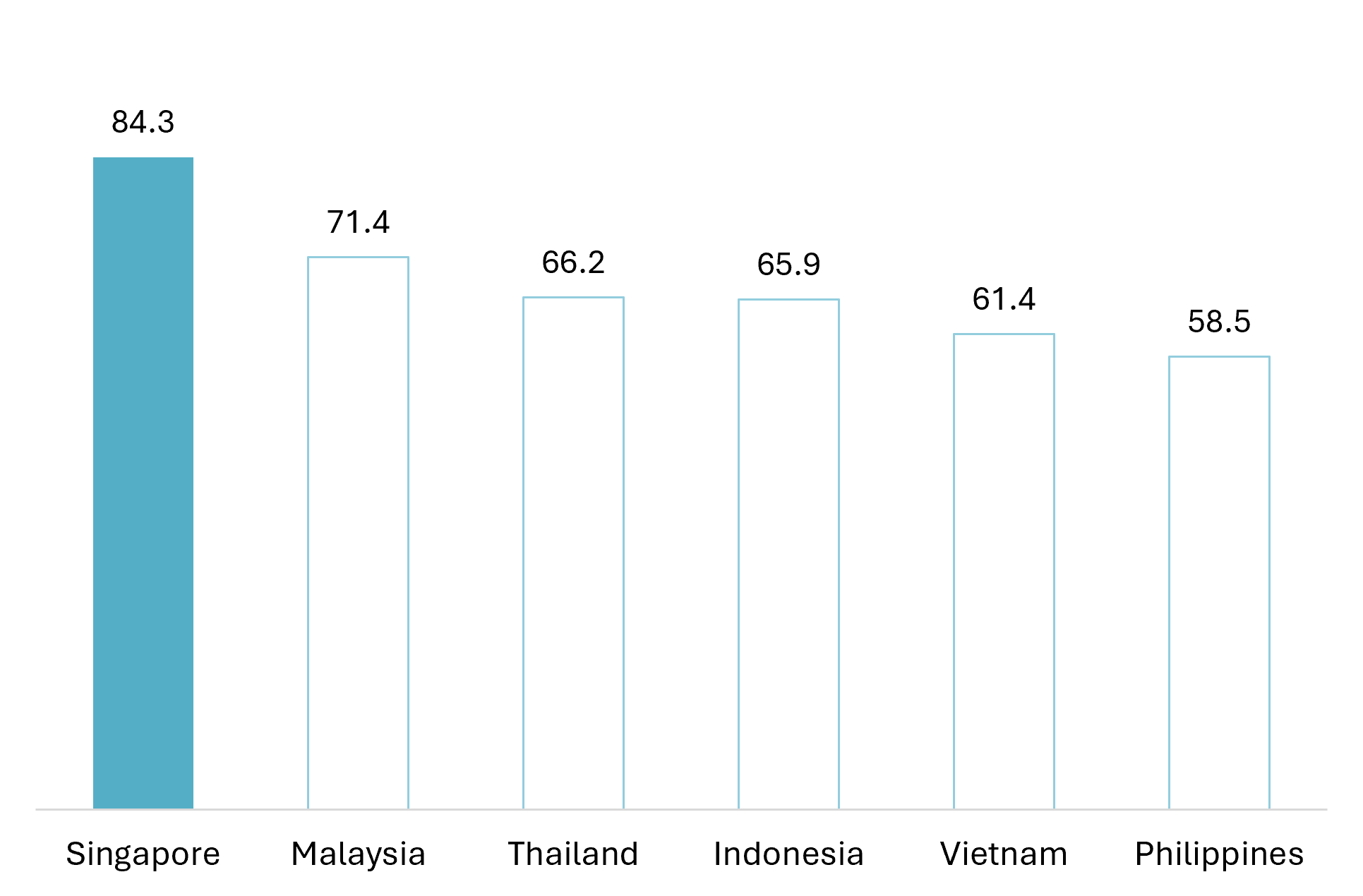
Sources: Oxford Insights
Note: The index measures government AI readiness based on three pillars: Government, Technology Sector, and Data & Infrastructure. Scores range from 0 to 100, with higher scores indicating stronger readiness for AI adoption in the public sector.
Singapore achieved the highest score in Southeast Asia at 84.3, supported by advanced digital infrastructure, strong government data management, and early AI governance initiatives. Malaysia, Thailand, Indonesia, Vietnam, and the Philippines are also progressing, although differences remain in infrastructure maturity, AI talent availability, and government digital capabilities.[1]
Regulation: Building Responsible AI Governance Frameworks
Government AI requires stronger governance than commercial AI because it involves sensitive citizen data and critical public services. ASEAN countries have therefore focused on developing responsible AI frameworks based on transparency, accountability, security, and human-centered design.
AI Governance Landscape and Investment Implications in Southeast Asia[2]
| Country | Key AI Regulation Strategy | Government AI Focus | Investment Implication |
| Singapore | National AI Strategy 2.0 (2023, updated 2026[3]), Model AI Governance Framework | Public-sector AI deployment, responsible AI | Open environment for foreign technology providers |
| Vietnam | National Strategy on Research, Development and Application of AI until 2030 (Decision No. 127/QĐ-TTg)[4], Digital Technology Industry Act (June 2025)[5] | Digital government, smart cities, AI data centers, and AI system development as special priority areas alongside semiconductors | Fast-tracked licensing for R&D and innovation centers, with tax, land, and credit incentives via the National Innovation Center (NIC) for AI data, demonstration, and chip design projects |
| Indonesia | AI Ethics Guidelines (Circular No.9/2023)[6], upcoming AI regulation | Responsible AI adoption, digital economy | Large market potential but regulatory framework still developing |
| Malaysia | National AI Action Plan 2026 – 2030[7] | Public-sector AI adoption, AI ecosystem development, responsible AI governance | Creates opportunities for foreign technology providers through government AI projects, infrastructure development, and ecosystem partnerships |
| Thailand | Thailand national AI strategy and action plan (2022- 2027)[8] | Public services, healthcare, smart cities | Opportunities through government-supported innovation programs |
Source: National Governments, B&Company’s synthesis
The ASEAN Guide on AI Governance and Ethics provides regional principles for responsible AI development, including fairness, explainability, privacy protection, and accountability.
However, the framework is non-binding, meaning each country continues to develop its own regulatory approach.[9]
Singapore has taken the most proactive approach through its National AI Strategy 2.0 and Model AI Governance Framework, emphasizing practical adoption through government pilots rather than restrictive regulation. Its Government on Commercial Cloud framework allows agencies to use commercial cloud providers while maintaining security requirements.[10][11]
Vietnam has positioned AI as a strategic technology through the National Strategy on Research, Development and Application of Artificial Intelligence until 2030, focusing on AI applications in public administration, healthcare, agriculture, and smart cities.[12]
Other ASEAN markets are developing similar frameworks. Indonesia introduced AI ethics guidelines through the Ministry of Communication and Informatics, while Malaysia and Thailand are developing national AI roadmaps emphasizing responsible adoption and government-industry cooperation.
Market Overview: Government AI Development Driven by Digital Transformation
A standalone government AI market size is difficult to measure because spending is generally included within broader digital government, cloud computing, cybersecurity, and IT modernization budgets.
Digital Government Index: Southeast Asia average vs OECD average
Unit: Score (0 – 1)
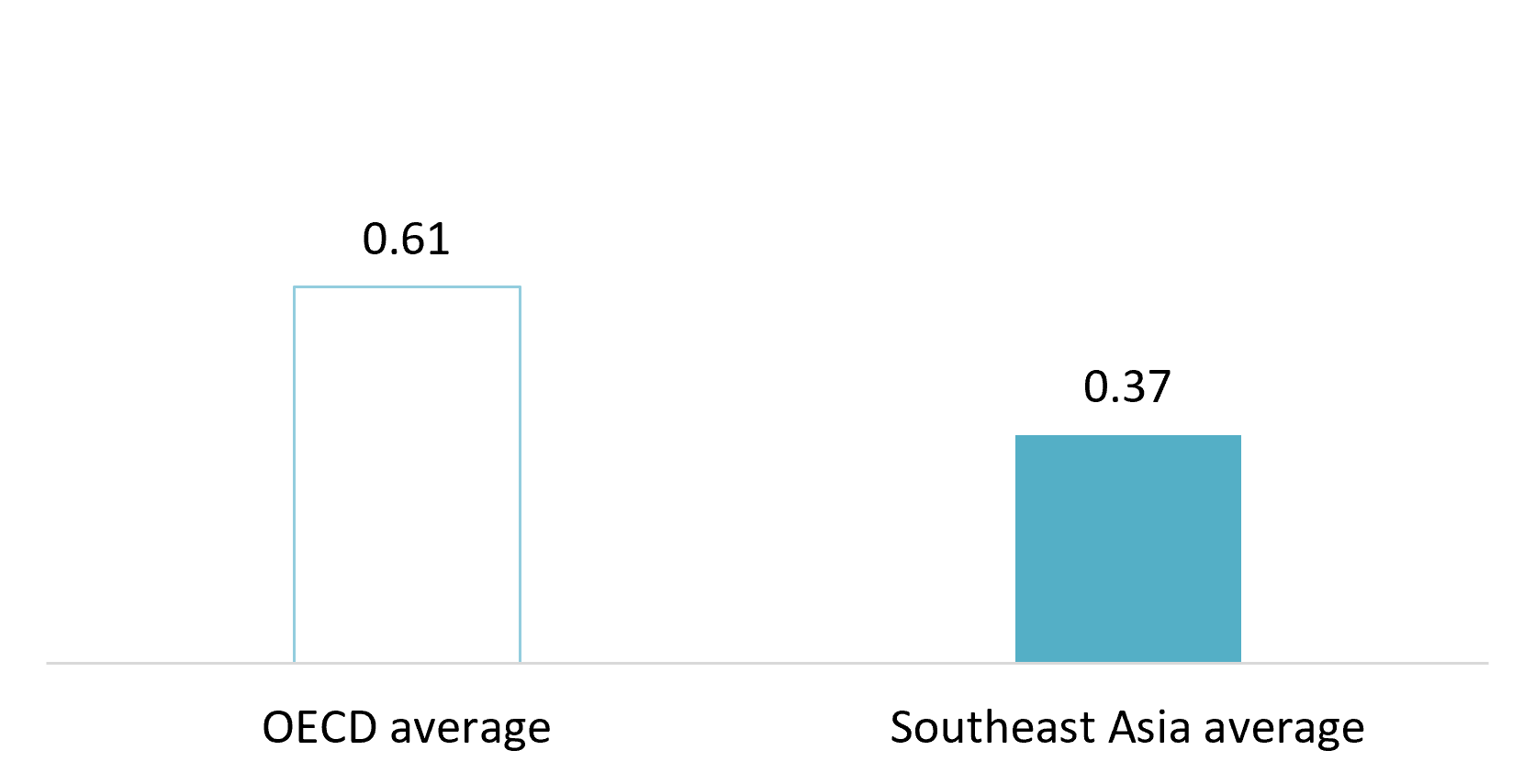
Source: OECD & ADB
Note: The Digital Government Index measures government capacity in areas including digital strategy, public-service delivery, data governance, and digital infrastructure. A higher score indicates a higher level of digital government maturity.
The opportunity, however, is expanding as ASEAN governments continue upgrading their digital infrastructure. According to OECD and ADB, Southeast Asian countries achieved an average Digital Government Index score of 0.37, compared with 0.61 among OECD countries, indicating significant room for improvement in digital maturity and data accessibility[13]. That gap is exactly why the opportunity spans more than AI software – it runs across the full stack governments need to reach AI readiness in the first place. Rather than a generic list of use cases, the layers below map to actual deployments already running in the region, not hypothetical categories:
Rather than conceptual proofs-of-concept, government AI adoption across ASEAN is concentrating within five distinct operational layers, combining citizen-facing touchpoints with foundational national data infrastructure:
Major Government AI Application Areas & Deployment Architecture
| Layer | Functional Scope | Representative Southeast Asian Deployments |
| Citizen-Facing AI | Conversational interfaces, virtual assistants, predictive routing, automated query resolution | • Singapore: Pair Chat and other AI assistants supporting public officers in drafting, research, and administrative tasks.
• Vietnam: Multilingual chatbots on provincial administrative portals. |
| Back-Office Automation | OCR, document parsing, civil registry verification, subsidy fraud detection | • Indonesia: Automated document verification (SPBE) & digital social assistance
• Philippines: BIR automated tax record reconciliation |
| Smart-City & Surveillance Systems | Computer vision traffic optimization, automated ticketing, perimeter security, urban IoT telemetry | • Vietnam: AI traffic-violation cameras (Hanoi, HCMC)
• Thailand: BMA AI traffic control & surveillance network |
| Data & Sovereign Cloud | Hyperscale data centers, sovereign cloud partitions, federated data exchanges, GPU clusters | • Singapore: Government on Commercial Cloud (GCC 2.0)
• Thailand: Gulf Edge sovereign cloud (with Google Cloud) • Vietnam: Viettel & FPT AI data centers |
| Systems Integration & Legacy Modernization | Enterprise-wide agency integration, legacy database containerization, security compliance, cross-ministry data pipelines. | • Singapore: NCS end-to-end integration and modernization rollouts across public service boards
• Regional: State-owned telecom and IT providers modernizing departmental legacy silos. |
Source: Intel[14], B&Company’s synthesis
Local Integrators and Global Technology Providers
Government AI initiatives in Southeast Asia rarely function through direct procurement of off-the-shelf foreign software. Instead, public sector deployment hinges on joint delivery models pairing international technology vendors with entrenched domestic systems integrators:
Global Technology Providers (Infrastructure & Foundational Models): Multinational firms (e.g., Google Cloud, Microsoft, AWS, NVIDIA) supply core computational architecture, GPU-accelerated infrastructure, enterprise foundation models, and cloud-native AI development pipelines. However, regional data sovereignty mandates, strict public procurement laws, and public sector national security protocols frequently prevent these providers from acting as prime contractors on sovereign workloads.
Domestic Integrators & State-Backed Champions (Localization & Delivery): Local enterprises-such as Singapore’s NCS, Vietnam’s Viettel and FPT, Thailand’s Gulf Edge/PTT Digital, and Indonesia’s Telkom/INA Digital consortium-act as the necessary execution layer. These entities hold sovereign clearances, operate domestic data centers, and adapt foundational AI engines into localized vernaculars (e.g., Bahasa Indonesia, Vietnamese, Thai), ensuring compliance with local data localization regulations.
Market Trends: Three Key Developments Shaping Government AI
AI Copilots Transforming Public Administration
Governments are moving from simple digital portals toward AI-assisted administration. Singapore provides an example of this transition: around 80% of its 150,000 public officers have used Pair Chat, a government-provided generative AI chatbot designed to support daily work tasks. In addition, public officers have created more than 20,000 task-specific AI bots for applications such as answering HR queries and providing guidance on budget and procurement processes.[15]
Smart Cities Become a Major AI Entry Point
Urbanization across Southeast Asia is creating demand for AI applications in traffic optimization, environmental monitoring, public safety, and infrastructure management. Hanoi’s rollout is the most concrete evidence to date: 1,837 AI-connected cameras deployed since December 2025 logged over 19,300 traffic violations and lifted intersection throughput by 4-18% within three months.[16]
Officers work at the Hanoi Smart Traffic Control Center
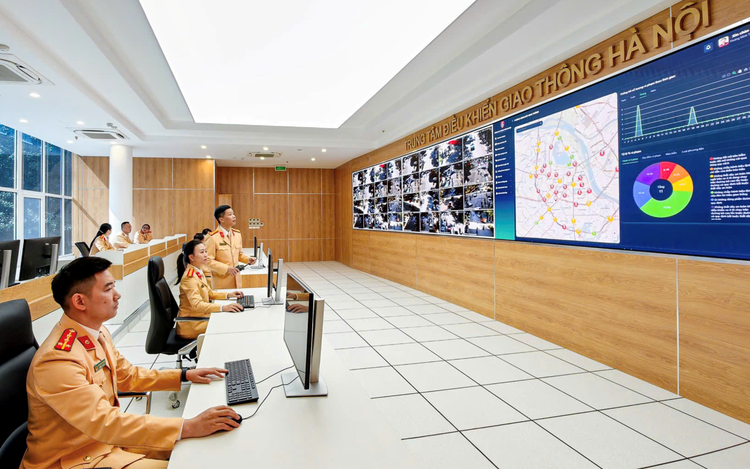
Sources: Tuoi Tre News
Growth of Sovereign AI Infrastructure
As governments handle increasingly sensitive data, demand is rising for secure cloud environments, local data processing capability, and cybersecurity solutions.
Rack systems at FPT’s newly inaugurated Data Center in Saigon Hi-Tech Park
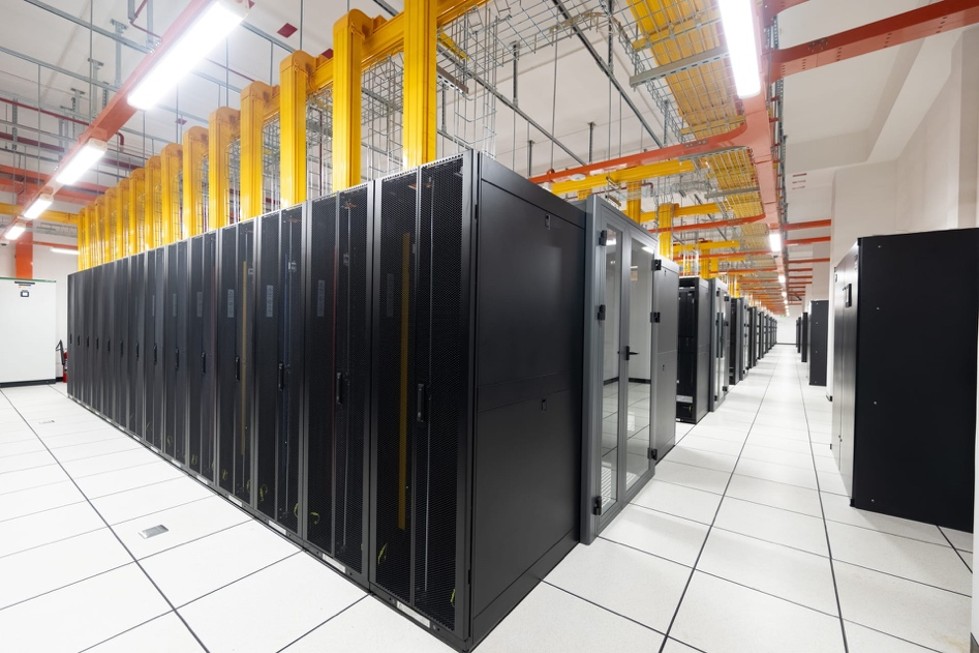
Source: FPT
Implications for Foreign Investors
Government AI presents opportunities across multiple segments, including AI infrastructure, cloud services, cybersecurity, smart-city solutions, and digital government platforms. However, foreign investors face several challenges. Regulatory requirements differ across ASEAN markets, government procurement processes are complex, and local partnerships are often essential. The most effective strategy is therefore not direct technology export, but cooperation with domestic technology companies that understand government requirements and local regulations. For example, global cloud providers can combine infrastructure capabilities with local system integrators, while AI solution providers can collaborate with telecom operators or government technology firms to improve market access.
Conclusion
Southeast Asia’s government AI market is entering an implementation phase. Singapore currently leads the region, but emerging markets such as Vietnam, Indonesia, Malaysia, and Thailand are rapidly developing AI ecosystems. Future growth will depend not only on AI technology itself, but also on digital infrastructure, data governance, cybersecurity, and local implementation capabilities. Companies that combine advanced AI solutions with strong regional partnerships will be best positioned to participate in Southeast Asia’s transition toward intelligent public services.
Read more
Southeast Asia EV transition creates new opportunities for regional players
B&Company featured on VTV’s Vietnam Today: Insights on Vietnam’s AI-integrated home appliance market
https://b-company.jp/bcompany-on-vtvs-vietnam-today-about-ai-in-the-fashion-and-garment-industry/
* If you wish to quote any information from this article, please kindly cite the source along with the link to the original article to respect copyright.
| B&Company
The first Japanese company specializing in market research in Vietnam since 2008. We provide a wide range of services including industry reports, industry interviews, consumer surveys, business matching. Additionally, we have recently developed a database of over 1,000,000 companies in Vietnam, which can be used to search for partners and analyze the market. Please do not hesitate to contact us if you have any queries. info@b-company.jp + (84) 24 3978 5165 |
References:
[1] Oxford Insights (2024), Government AI Readiness Index 2024. https://oxfordinsights.com/wp-content/uploads/2024/12/2024-Government-AI-Readiness-Index-2.pdf
[2] National AI policy documents of Indonesia, Malaysia and Thailand.
[3] Government of Singapore, “Update to Singapore’s National AI Strategy: Refreshed Priorities to Harness AI for the Public Good”. https://www.mddi.gov.sg/newsroom/update-to-singapore-s-national-ai-strategy–refreshed-priorities-to-harness-ai-for-the-public-good-factsheet
[4] Government of Vietnam, Decision No. 127/QĐ-TTg. https://vanban.chinhphu.vn/default.aspx?pageid=27160&docid=202565
[5] Government of Vietnam, Digital Technology Industry Act. https://thuvienphapluat.vn/van-ban/Cong-nghe-thong-tin/Law-71-2025-QH15-Digital-Technology-Industry-668801.aspx
[6] Government of Indonesia, “Ethical guidelines on use of artificial intelligence (AI) in Indonesia”. https://www.hbtlaw.com/insights/2024-02/ethical-guidelines-use-artificial-intelligence-ai-indonesia
[7] Government of Malaysia, “National AI Action Plan 2026 – 2030”. https://www.ai.gov.my/
[8] Government of Thailand, “National AI strategy and action plan (2022 – 2027)”. https://www.ai.in.th/en/about-ai-thailand/
[9] ASEAN (2024), ASEAN Guide on AI Governance and Ethics. https://asean.org/book/asean-guide-on-ai-governance-and-ethics/
[10] Smart Nation Singapore (2023), National AI Strategy 2.0. https://www.smartnation.gov.sg/initiatives/artificial-intelligence/
[11] Government Technology Agency of Singapore (GovTech), Government on Commercial Cloud. https://www.developer.tech.gov.sg/products/categories/infrastructure-and-hosting/gcc/overview
[12] Prime Minister of Vietnam (2021), Decision No.127/QD-TTg: National Strategy on Research, Development and Application of Artificial Intelligence until 2030.
[13] OECD & Asian Development Bank (2025), Government at a Glance: Southeast Asia 2025. https://www.oecd.org/en/publications/government-at-a-glance-southeast-asia-2025_bc89cb32-en.html
[14] Intel, The Future of Artificial Intelligence (AI) in Government. https://www.intel.com/content/www/us/en/government/artificial-intelligence.html
[15] Government of Singapore , “MDDI’s response to PQ on Progress of Adopting AI Tools within Public Service”, https://www.mddi.gov.sg/newsroom/mddi-s-response-to-pq-on-progress-of-adopting-ai-tools-within-public-service/
[16] Việt Nam News Tuổi Trẻ, “AI traffic cameras in Hanoi detect over 19,300 violations in 3 months” https://news.tuoitre.vn/ai-traffic-cameras-in-hanoi-detect-over-19300-violations-in-3-months-103260324095149105.htm
[1] Oxford Insights (2024), Government AI Readiness Index 2024. https://oxfordinsights.com/wp-content/uploads/2024/12/2024-Government-AI-Readiness-Index-2.pdf
[2] National AI policy documents of Indonesia, Malaysia and Thailand.
[3] Government of Singapore, “Update to Singapore’s National AI Strategy: Refreshed Priorities to Harness AI for the Public Good”. https://www.mddi.gov.sg/newsroom/update-to-singapore-s-national-ai-strategy–refreshed-priorities-to-harness-ai-for-the-public-good-factsheet
[4] Government of Vietnam, Decision No. 127/QĐ-TTg. https://vanban.chinhphu.vn/default.aspx?pageid=27160&docid=202565
[5]Government of Vietnam, Digital Technology Industry Act. https://thuvienphapluat.vn/van-ban/Cong-nghe-thong-tin/Law-71-2025-QH15-Digital-Technology-Industry-668801.aspx
[6] Government of Indonesia, “Ethical guidelines on use of artificial intelligence (AI) in Indonesia”. https://www.hbtlaw.com/insights/2024-02/ethical-guidelines-use-artificial-intelligence-ai-indonesia
[7] Government of Malaysia, “National AI Action Plan 2026 – 2030”. https://www.ai.gov.my/
[8] Government of Thailand, “National AI strategy and action plan (2022 – 2027)”. https://www.ai.in.th/en/about-ai-thailand/
[9] ASEAN (2024), ASEAN Guide on AI Governance and Ethics. https://asean.org/book/asean-guide-on-ai-governance-and-ethics/
[10] Smart Nation Singapore (2023), National AI Strategy 2.0. https://www.smartnation.gov.sg/initiatives/artificial-intelligence/
[11] Government Technology Agency of Singapore (GovTech), Government on Commercial Cloud. https://www.developer.tech.gov.sg/products/categories/infrastructure-and-hosting/gcc/overview
[12] Prime Minister of Vietnam (2021), Decision No.127/QD-TTg: National Strategy on Research, Development and Application of Artificial Intelligence until 2030.
[13] OECD & Asian Development Bank (2025),
Government at a Glance: Southeast Asia 2025. https://www.oecd.org/en/publications/government-at-a-glance-southeast-asia-2025_bc89cb32-en.html
[14] Intel, The Future of Artificial Intelligence (AI) in Government. https://www.intel.com/content/www/us/en/government/artificial-intelligence.html
[15] Government of Singapore , “MDDI’s response to PQ on Progress of Adopting AI Tools within Public Service”, https://www.mddi.gov.sg/newsroom/mddi-s-response-to-pq-on-progress-of-adopting-ai-tools-within-public-service/
[16] Việt Nam News Tuổi Trẻ, “AI traffic cameras in Hanoi detect over 19,300 violations in 3 months” https://news.tuoitre.vn/ai-traffic-cameras-in-hanoi-detect-over-19300-violations-in-3-months-103260324095149105.htm
Related article






























Log in / Register
SUBSCRIBE NEWSLETTER