

 English
  日本語
日本語  Tiếng Việt
  简体中文
简体中文  한국어
한국어 For businesses in Southeast Asia, holiday impact determines operational viability, working capital requirements, and competitive positioning.

06Feb2026
Latest News & Report / Vietnam Briefing
Comments: No Comments.
Southeast Asia represents a market of 680 million consumers[1], yet it remains one of the world’s most fragmented regions when it comes to holiday calendars. Unlike the synchronized Christmas-New Year shutdown in Western markets, Southeast Asia’s five economies, Vietnam, Thailand, Indonesia, Malaysia, and the Philippines, observe different major holidays driven by diverse religious and cultural traditions. Understanding major holidays in this region extends far beyond marketing calendar planning. These festivals fundamentally impact supply chain operations, labor availability, port congestion, and most critically, cash flow dynamics. For businesses investing in Southeast Asia, holiday impact analysis determines operational viability, working capital requirements, and competitive positioning.
The Big Three: Categorizing Major Holidays by Business Impact
Public holidays in Southeast Asia vary widely, from 9 to 27 days, creating uneven operational downtime risks that businesses must account for in regional planning. On average, the country with the highest number of public holidays is Indonesia, with approximately 27 days, of which Eid al-Fitr (the festival that marks the end of Ramadan) is the longest holiday, lasting about 10 days.
Comparing holidays in some Southeast Asian countries
| Feature | Vietnam | Indonesia | Thailand | Malaysia | Philippines |
| Primary Holiday | Tet (Lunar New Year) | Eid al-Fitr (Lebaran) | Songkran | Hari Raya Puasa | Christmas & New Year |
| Typical Date | Late Jan to Mid Feb
Shifts ±10-15 days year-on-year (Lunar calendar) |
Varies across Feb – May (by cycle)
Moves 10-11 days earlier each year (Islamic lunar calendar) |
April 13 – April 16 (Fixed to Gregorian calendar) | Varies across Feb – May (by cycle)
Moves 10-11 days earlier each year (Islamic lunar calendar) |
Dec 24 – Jan 2
(fixed to the Gregorian calendar) |
| Official Duration | 7-10 days | 10-12 days | 5-7 days | 2-5 days | 10+ days (informal) |
| Production Impact | Total Shutdown: Factories close; Need 2 weeks+ to reach 100% capacity post-Tet. | Total Shutdown: National “Cuti Bersama” (joint leave) halts manufacturing | Partial: Heavy industry pauses; Tourism/F&B peaks. | Moderate: Rolling shifts often maintained. | Slowdown: “Ber-months”[2] mentality affects efficiency from Oct. |
| Supply Chain Risk | Congested ports and retail-heavy logistics. Customs slow. | Inland logistics (trucking) stops entirely. | Main highways congested; Ports remain open. | Infrastructure is highly resilient during holidays. | Congested ports and retail-heavy logistics. |
| Labor Turnover | Peak season for job-hopping post-bonus. | High turnover after receiving “THR” (Bonus). | Relatively stable labor force. | Low turnover compared to neighboring countries. | Moderate turnover post-January. |
B&Company’s synthesis
Lunar New Year Cluster: Vietnam’s Tet
Vietnam’s Tet (Lunar New Year) creates Southeast Asia’s longest continuous productivity gap. The 2026 Tet centers on February 14, but the operational impact extends 8 weeks. Factories close for 7-14 days minimum, with actual disruption reaching 20-25 days when accounting for pre-holiday slowdowns and post-holiday ramp-up. The mass migration to hometowns phenomenon sees millions of workers departing urban workplaces up to two weeks before official holidays. Port activities at Hai Phong and Ho Chi Minh City experience severe congestion in the two weeks preceding Tet as businesses rush shipments before the shutdown. The country also welcomed 12.5 million tourists during the Lunar New Year holiday, with many localities recording trillion-VND revenues[3].
Vietnamese people shopping for Tet
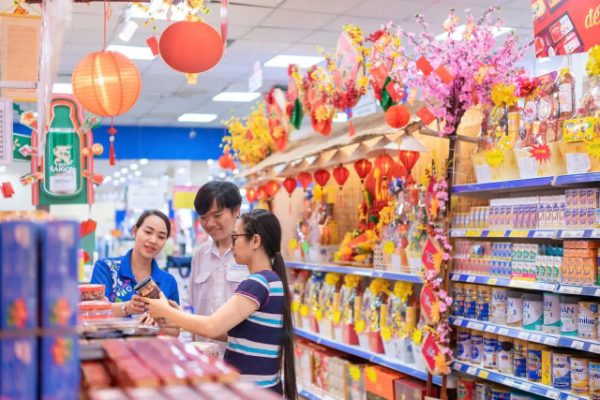
Source: VnEconomy
Total Tet 2026 spending is projected to reach USD 153.4 billion, representing a 7.2% increase compared to 2025[4]. Consumer spending during Tet remains heavily concentrated in traditional categories. NielsenIQ confirms that Vietnam’s fast-moving consumer goods (FMCG) sector has maintained stable growth over the past three years, with Tet accounting for approximately 20% of annual FMCG revenue within this compressed period. Vietnamese behavior follows a three-phase pattern: planning and early purchases begin 40+ days before Tet, intensive buying occurs 10-20 days prior, and post-Tet shifts to self-reward spending on medical services, spa treatments, and personal indulgences.
Tet causes a significant operational slowdown across Vietnam. Unlike other regional holidays where business activity merely decelerates, many sectors experience widespread pauses, often requiring 15-20 days (including pre-Tet, during Tet and post-Tet period) of reduced operational capacity with near-zero productivity.
Religious Festival Cluster
Ramadan and Eid al-Fitr
Indonesia and Malaysia share Ramadan and Eid al-Fitr (Hari Raya Idul Fitri in Indonesia/Hari Raya Aidilfitri in Malaysia) as their primary commercial seasons, while the Philippines centers on Christmas. Despite religious differences, these holidays fundamentally alter consumption patterns for extended periods.
Ramadan in Indonesia and Malaysia transforms operations for an entire month. In Indonesia, money circulation during the Eid period (which follows Ramadan and overlaps the spending surge) would reach about USD 8.33 billion in 2025[5]. The Hari Raya Idul Fitri holiday period is also known as Lebaran, a holiday that celebrates the conclusion of the fasting month of Ramadan. In Indonesia, Lebaran 2025 typically results in around 10 days off, combining 2 official holidays, government-designated joint leave days, and weekends, making it the longest break of the year despite joint leave being mandatory only for civil servants.
Indonesian Muslims take part in the evening mass prayers called “Tarawih” on the first night of the holy fasting month of Ramadan

Source: Asharq AI-awsat
During Ramadan month, prior to Lebaran, working hours shift dramatically, with many businesses adopting 9 am-4 pm schedules to accommodate fasting employees. Consumer shopping inverts, with peak retail activity occurring 5 pm-9 pm after iftar (the evening meal to break the fast during Ramadan). Restaurants close during daylight but experiencea surge in demand in the evenings. This creates complex logistics, as capacity adjustments cannot be treated as a typical “holiday rush”; rather, the demand surge occurs daily over a 30-day period and takes place outside normal operating hours.
The final 10 days of Ramadan represent peak commercial intensity. Indonesia’s “mudik” is similar to Vietnam’s Tet migration, with 146.5 million people traveling in 2025[6], creating logistics paralysis. Malaysia’s “balik kampung” follows similar patterns but with less severe disruption.
The Indonesian government provides Tunjangan Hari Raya (THR) mandated bonuses equal to one month’s salary before Lebaran. In 2025, the government disbursed IDR 50 trillion in early THR for civil servants[7]. This creates predictable liquidity injections 2-3 weeks before Lebaran, enabling businesses to time promotions accordingly.
Christmas in the Philippines
Christmas creates Southeast Asia’s longest commercial season. The “ber months” see Christmas marketing beginning in September, extending through New Year, an unprecedented four-month window. For specific long weekends, Holy Week (Maundy Thursday to Easter Sunday) often creates a four-day break, while extended year-end breaks around Christmas and New Year also offer significant time off, sometimes spanning a week or more.
Filipino Christmas

Source: Expat.com
The peak holiday period typically runs from 24 December to 2 January, during which airports and seaports operate under severe congestion. An estimated one million arrivals enter Manila each December to make it in time for Noche Buena dinner. Beyond homebound travel, major tourist destinations such as Boracay, Cebu, and Baguio also record sharp spikes in visitor numbers (for example, Boracay welcomed 227,828 visitors in December 2025 alone)[8]. December is likewise the peak month for inbound remittances, typically accounting for approximately 9-10% of annual inflows, reaching about USD 3.7 billion in December 2024 alone[9].
Water Festival Cluster: Thailand’s Songkran
Thailand’s Songkran (April 13-16), which is Thailand’s traditional New Year festival, evolved into one of Southeast Asia’s largest tourism events. The 2025 celebration attracted 666,180 international arrivals during peak week, a 10.73% increase week-over-week[10]. Most factories in major industrial zones (such as those in Rayong and Ayutthaya) shut down completely for at least five days. Workers commonly use annual leave to extend the holiday to nine or ten days.
The Thailand Songkran festival
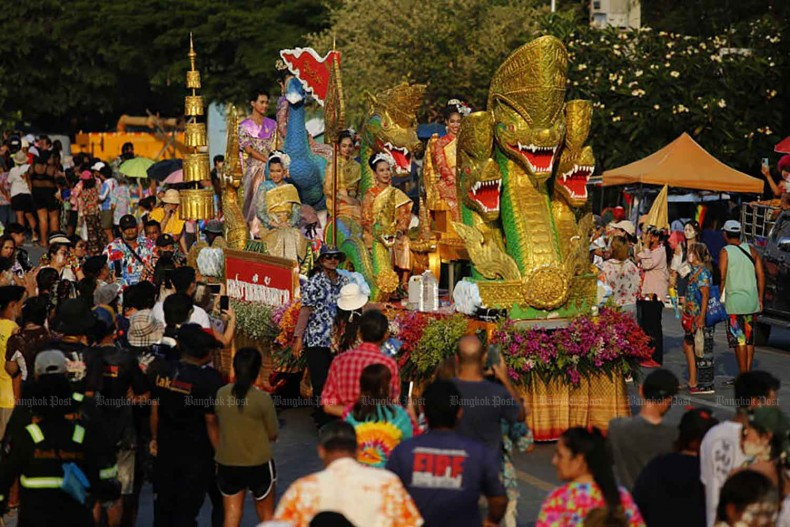
Source: Vietnamplus
Songkran’s impact differs fundamentally. Rather than shutting production or redistributing consumption hours, Songkran creates massive but brief capacity surges in hospitality while causing short-term disruption elsewhere. Hotels reach full occupancy with premium pricing. Transportation operates at maximum capacity, with flights and trains fully booked weeks in advance. Business operations face a brief but total work stoppage. Road transportation becomes unreliable due to water festivities. The 4-5 day weekend creates predictable logistics gaps. Unlike Tet’s extended disruption or Ramadan’s month-long behavioral shift, Songkran is brief but absolute.
Business Impact: Quantifying Operational Realities
Labor & Productivity: The 15-20 Day Challenge
Southeast Asian holiday labor impact far exceeds Western equivalents. Vietnam and Indonesia face the most severe challenges. In Vietnam, official public-sector and business closures typically last 7-10 days during Tet; however, manufacturing facilities, particularly labor-intensive factories, often experience extended shutdowns of 15-20 days, with production capacity gradually normalizing only 25-30 days after the holiday begins due to workforce return delays. Indonesia’s Lebaran sees similar patterns, factories shut 7-10 days, but workers extend leave or fail to return promptly, creating weeks-long staffing shortages. Businesses remaining operational during major holidays pay 200-300% wage premiums. For labor-intensive industries, these premiums may eliminate profit margins significantly.
Thailand’s Songkran and Malaysia’s Hari Raya typically result in shorter and more manageable disruptions compared to other regional holidays. A key differentiating factor is infrastructure and population distribution. In Malaysia, stronger transportation networks and a more evenly distributed urban-rural population help limit prolonged workforce absence. In Thailand, while Songkran often triggers a near-complete 4-5 day operational shutdown, business activity generally rebounds quickly once the holiday ends.
Consumer Spending: Volume, Timing, and Category Shifts
Demand for goods during the Tet (Lunar New Year) holiday is expected to rise by more than 72% compared to the annual average[11]. Indonesia’s Ramadan-Lebaran represents a similar concentration. Filipinos were found to spend 331% of their monthly income, an average of PHP 37,106, during the holidays[12].
After Tet, categories like healthcare, beauty services, and dining surge as consumers shift from obligatory family spending to self-reward purchases. Conversely, post-holiday crashes occur elsewhere. After the Philippines Christmas, retail sales in January-February drop significantly as consumers recover from debt. Approximately 60% of Filipino families incur debt funding Christmas celebrations, creating 2-4 month hangovers[13].
Vietnam and the Philippines remain heavily oriented toward physical gifts, food hampers, clothing, and electronics. Thailand and Malaysia show stronger experiential spending, travel, dining, and entertainment, which impacts inventory management differently. Physical goods require significant pre-holiday inventory builds (creating cash pressure), while experiential services face capacity constraints.
In 2025, Vietnam’s e-commerce reached 42% year-over-year growth[14], yet traditional trade still captures 84% of Tet shopping[15]. The Philippines experienced an average annual e-commerce growth of 40% in the Christmas season[16]. Ramadan traditions also influence shoppers’ behaviors throughout the day. During the fasting period in Malaysia in 2025, eCommerce transactions were lower at 71%, compared to 76% for the period prior to Ramadan[17]. However, after breaking fast, there is an increase in eCommerce sales to 29 percent, from 24 percent pre-Ramadan[18].
Supply Chain & Logistics: Managing Predictable Disruption
Vietnam and Indonesia experience severe port congestion 2-3 weeks before Tet and Lebaran. At Hai Phong and Ho Chi Minh City ports, container volumes surge 40-60%. Vessel waiting times extend from the normal 2-3 days to 7-10 days. This creates ripple effects – late shipments, missed delivery windows, emergency air freight at 5-10x ocean costs. International businesses in Southeast Asia require 15-25% higher safety stock than operations in Europe or North America. A manufacturer supplying just-in-time must maintain a minimum of 3-4 weeks’ buffer before Tet or Lebaran.
Mudik and balik kampung create temporary transportation system failures. Java’s highways during Lebaran and Vietnam’s north-south corridors during Tet become impassable for commercial logistics. Journey times are extending from 6-8 hours to 15-20 hours. Trucking companies often refuse bookings during these periods, effectively shutting down road freight for 7-10 days.
Strategic Recommendations for Investors
The Six-Month Planning Horizon
Southeast Asian operations demand a minimum six-month forward visibility for major holidays. Tet planning for business needs to begin in August-September. Lebaran preparation requires October-November to start. The Philippines’ Christmas needs a June-July initiation. This extended timeline is for fundamental operational decisions, supplier contracts with holiday shutdown clauses, labor agreements with clear policies, logistics contracts specifying pre-holiday deadlines, financial facilities to fund inventory builds and bonuses. Companies beginning Tet planning in December or Lebaran preparation in February demonstrate operational immaturity likely to result in disruptions, missed revenue, or cash crunches.
Localizing HR Policies: Beyond Compliance
Southeast Asian labor markets during major holidays operate on cultural logic. Worker expectations to return home for Tet, Lebaran, or Christmas are non-negotiable. Leading manufacturers now offer “early leave, early return” bonuses, paying premiums for workers to depart 2-3 days later and return 2-3 days earlier. A 5-7 day operational extension can mean 15-20% more production time. These bonuses (typically 20-30% monthly salary) cost far less than lost production. Flexible holiday scheduling provides another tool. Allowing workers to choose between lunar (Tet) or solar (Christmas/New Year) holidays enables partial operations. In Malaysia, sophisticated manufacturers stagger shutdowns around Hari Raya, Chinese New Year, and Deepavali, maintaining 60-70% capacity year-round.
Multi-Country Diversification: Strategic Advantage
Companies operating across multiple markets leverage holiday calendar fragmentation as a competitive advantage. When Vietnam shuts down for Tet, Thailand and the Philippines operate normally. When Indonesia celebrates Lebaran, Vietnam and Thailand maintain capacity. For retail and consumer businesses, holiday calendar diversification creates year-round revenue, peaks during Vietnam’s Tet (January-February), Indonesia’s Lebaran (March-April), Thailand’s Songkran (April), and the Philippines Christmas (September-December), smoothing revenue across all quarters.
Conclusion
Southeast Asia’s fragmented holiday calendar represents one of the region’s most underestimated business challenges and most significant competitive advantages. Unlike markets with synchronized holidays, Southeast Asia offers no “slow season” – there is always opportunity somewhere in the region.
As Southeast Asia’s economy continues growing and integrating with global supply chains, understanding holiday impacts becomes more important. The region’s cultural diversity isn’t diminishing, it’s strengthening as prosperity allows fuller tradition celebration. Businesses that master holiday operations don’t just survive, they capture market share from competitors who treat Southeast Asian holidays as unfortunate interruptions rather than the predictable, manageable, and profitable rhythms they represent.
* If you wish to quote any information from this article, please kindly cite the source along with the link to the original article to respect copyright.
| B&Company
The first Japanese company specializing in market research in Vietnam since 2008. We provide a wide range of services including industry reports, industry interviews, consumer surveys, business matching. Additionally, we have recently developed a database of over 900,000 companies in Vietnam, which can be used to search for partners and analyze the market. Please do not hesitate to contact us if you have any queries. info@b-company.jp + (84) 28 3910 3913 |
Read more
Hospitality & Tourism Recovery: Comparing Thailand’s and Vietnam’s Strategies (2023–2025)
[1] https://www.bain.com/about/media-center/press-releases/sea/e-conomy-sea-2025/
[2] “Ber-months” refers to the period from September to December, named after the months ending in “-ber,” and is commonly associated with the peak holiday and shopping season, especially in the Philippines.
[3] https://thongke.tourism.vn/index.php/news/items/243
[4] https://marketingai.vn/xu-huong-tieu-dung-tet-194251120163212657.htm
[5] https://jakartaglobe.id/business/eid-travel-and-spending-decline-in-2025-government-pushes-stimulus
[6] https://www.straitstimes.com/asia/se-asia/hari-raya-exodus-in-indonesia-comes-early-amid-work-from-anywhere-policy
[7] https://expatindonesia.id/2025/weaker-ramadan-spending-puts-pressure-on-economy/
[8] https://www.panaynews.net/year-end-tourism-boom-boracay-island-caps-2025-with-record-december-surge-tops-227000-visitors/
[9] https://www.bsp.gov.ph/SitePages/MediaAndResearch/MediaDisp.aspx?ItemId=7426
[10] https://thailand.prd.go.th/en/content/category/detail/id/2078/iid/382627
[11] https://en.vneconomy.vn/tet-shopping-demand-to-surge-72-above-annual-average.htm
[12] https://businessmirror.com.ph/2021/12/01/filipinos-spend-331-of-monthly-income-on-christmas/
[13] https://www.finmerkado.ph/post/hidden-cost-of-filipino-christmas
[14] https://en.vneconomy.vn/e-commerce-in-upward-trend-1250945.htm
[15] https://nielseniq.com/global/en/insights/analysis/2025/winning-vietnams-tet-holiday-optimizing-fmcg-growth-for-the-next-season/
[16] https://business.inquirer.net/496955/pinoys-urged-to-practice-responsible-spending-during-christmas-season
[17] https://malaysian-business.com/wptest/2026/01/20/online-retail-and-travel-purchases-in-malaysia-increase-in-the-lead-up-to-ramadan/
[18] https://malaysian-business.com/wptest/2026/01/20/online-retail-and-travel-purchases-in-malaysia-increase-in-the-lead-up-to-ramadan/
Related article












Log in / Register
SUBSCRIBE NEWSLETTER