

 English
  日本語
日本語  Tiếng Việt
  简体中文
简体中文  한국어
한국어 Following years of heavy investment in EV manufacturing, Vingroup has begun restructuring its industrial business to improve capital efficiency.

11Aug2026
Latest News & Report / Vietnam Briefing
Comments: No Comments.
Current business situation
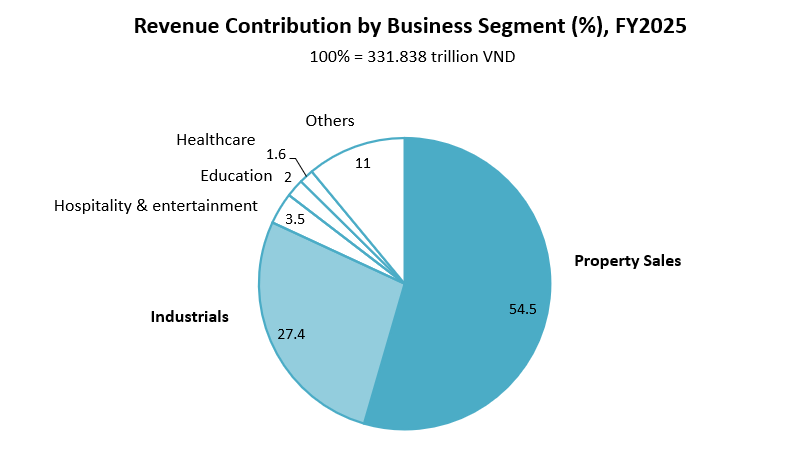
Vingroup has evolved into one of Vietnam’s most diversified private conglomerates, with operations spanning property, industrials, hospitality, education, healthcare and other service businesses. In FY2025, property and industrials were the Group’s two largest business segments by revenue, together accounting for more than 80% of consolidated revenue. However, the two segments showed markedly different profitability, reflecting their distinct roles within Vingroup’s business portfolio.
Source: Audited Financial Statement FY2025 of Vingroup
Property remained Vingroup’s largest business segment in FY2025, contributing 54.5% of consolidated revenue, equivalent to approximately VND 180.7 trillion. This reflects the continued strength of Vinhomes’ residential development business and confirms that real estate remains the Group’s largest operating segment. Meanwhile, the industrials segment accounted for 27.4% of total revenue, making it Vingroup’s second-largest business by scale. Therefore, Vingroup’s business activities continue to be anchored by property and industrial operations, even though they had invested in multiple industries.
Source: Audited Financial Statement FY2025 of Vingroup
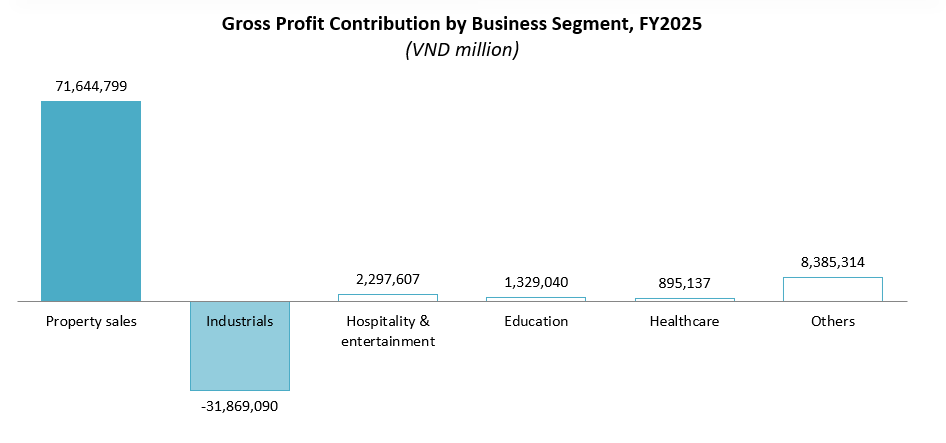
Property generated approximately VND 71.6 trillion in gross profit in FY2025, far exceeding all other businesses and demonstrating its role as the Group’s primary profit and cash flow generator. In contrast, the industrials segment recorded a gross loss of nearly VND 31.9 trillion, reflecting production costs that remain elevated relative to VinFast’s current manufacturing scale — a pattern the company’s own management has identified as the primary driver of margin improvement going forward, with scale and unit cost optimization cited as the main levers toward profitability[1]. Although industrials have become Vingroup’s second-largest business by revenue, it has yet to achieve sustainable profitability. This contrast indicates that Vingroup currently operates with a dual-engine business model: property provides the financial foundation through stable earnings, while industrials represent the Group’s long-term growth investment despite its current losses.
Strategic transition toward EV & Technology
Asset-light restructuring of VinFast
Following years of heavy investment in electric vehicle (EV) manufacturing, Vingroup has begun restructuring its industrial business to improve capital efficiency. In May 2026, VinFast announced a corporate restructuring plan under an asset-light operating model, including the proposed sale of its Vietnam manufacturing subsidiary while retaining its intellectual property, product development capabilities and sales network. According to the company, the restructuring aims to streamline operations, improve the financial structure and reduce future capital expenditure requirements[2].
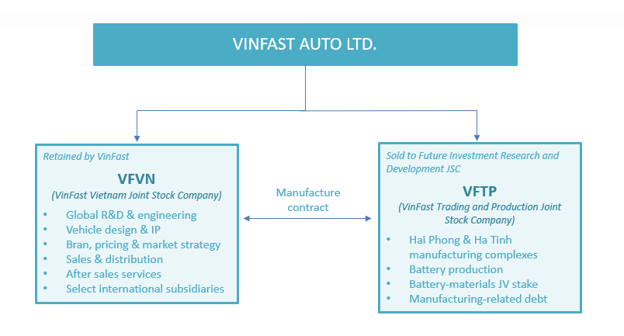
VinFast split its business into two companies: VFVN and VFTP
B&Company’s synthesis
VinFast split its business into two companies: VFVN kept R&D, vehicle design, intellectual property, sales, after-sales service, and several international subsidiaries, and VFTP kept the Vietnam factories (Hai Phong and Ha Tinh factory complexes), battery production, a stake in a battery-materials joint venture, and the debt tied to those factories. VinFast then sold its shares in VFTP to an investor group led by Future Investment Research and Development JSC, for about VND 13.31 trillion. The deal closed on 30 June 2026. VFVN now buys vehicles from VFTP under a non-exclusive contract, priced at roughly cost-plus 105% — a target margin near 5% over production cost — for an initial five-year term that renews automatically for three more years[3]. Compared with the previous model, where VinFast directly owned and operated its manufacturing assets, the new structure separates manufacturing from core business activities, which allows the company to reduce asset intensity while maintaining control over its core technologies and customer-facing operations.
The restructuring is expected to deliver three main benefits. First, it reduces financial pressure on both VinFast and Vingroup. By transferring manufacturing assets and related liabilities to VFTP, the transaction reduces the financial burden associated with factory ownership and manufacturing investment, as VND 182 trillion of manufacturing debt has been moved off Vingroup’s books[4], thereby improving VinFast’s balance sheet and easing Vingroup’s capital requirements for its industrial business. Secondly, the asset-light model also allows VFVN to focus on higher value-added activities, such as product development, technology, branding and sales, supporting the company’s target of achieving profitability from 2027. At the same time, VinFast stated that the restructuring will not affect customers, as vehicle quality, warranty policies, after-sales services and the nationwide sales network will continue to operate as normal under the VinFast brand[5].
Despite its potential benefits, restructuring also presents several challenges. Reuters reported that analysts have raised governance and transparency concerns because the transaction involves investor groups with links to President Pham Nhat Vuong and the whole Vingroup ecosystem, making the deal more complex for investors to evaluate. In addition, while transferring manufacturing assets and debt supports VinFast’s asset-light strategy and improves its balance sheet, the restructuring does not guarantee sustainable profitability. VinFast’s long-term financial performance will still depend on its ability to increase vehicle sales, improve operating efficiency and execute its international expansion strategy[6].
Continued expansion of the EV ecosystem
The international expansion of Green SM has accelerated over the past two years. Following launches in Laos, Indonesia, the Philippines, India and Kazakhstan, the company entered Europe in July 2026 by introducing its first fully electric taxi service in Copenhagen, Denmark. According to Green SM, Denmark was selected because of its strong EV adoption, supportive transport policies and high demand for sustainable mobility solutions. The service currently operates VinFast VF 6 and VF 8 vehicles and follows the same company-owned fleet model used in other international markets[7].
The overseas expansion has also started to contribute to the Group’s business performance. According to Vingroup’s 2025 financial disclosures, GreenSM (GSM) companies generated approximately VND 19.9 trillion in revenue during the year, with Indonesia and the Philippines contributing more than VND 5 trillion after launching operations[8]. Although mobility services remain much smaller than Vingroup’s property business, these results indicate that the EV ecosystem is gradually establishing commercial operations outside Vietnam while supporting the international deployment of VinFast vehicles.
Overall, these developments suggest that Vingroup’s EV strategy is evolving beyond vehicle manufacturing. Rather than relying solely on automobile sales, the Group is simultaneously expanding complementary mobility services that strengthen the adoption of VinFast vehicles and enhance the visibility of its EV ecosystem in international markets.
Conclusion
In summary, with the asset-light restructuring of VinFast and the global rollout of Green SM establishing the strategic groundwork, Vingroup’s pivot now transitions fully from strategic repositioning to operational execution. To evaluate whether this ecosystem transformation will deliver long-term shareholder value, market focus will pivot to three core tracking metrics: (1) progress toward gross profit breakeven through unit-cost optimization, (2) organic international market adoption beyond internal fleet absorption, and (3) end-user revenue conversion from mobility services like Green SM. Ultimately, meeting these operational benchmarks will determine the financial sustainability of Vingroup’s long-term technology bets.
Read more
Analysis of the industries and revenues of companies within the Vingroup ecosystem
* If you wish to quote any information from this article, please kindly cite the source along with the link to the original article to respect copyright.
| B&Company
The first Japanese company specializing in market research in Vietnam since 2008. We provide a wide range of services including industry reports, industry interviews, consumer surveys, business matching. Additionally, we have recently developed a database of over 1,000,000 companies in Vietnam, which can be used to search for partners and analyze the market. Please do not hesitate to contact us if you have any queries. info@b-company.jp + (84) 24 3978 5165 |
[1] https://vinfastauto.us/investor-relations/news/vinfast-reports-preliminary-and-unaudited-fourth-quarter-and-full-year-2025
[2] https://www.reuters.com/world/asia-pacific/vietnam-ev-maker-vinfast-says-it-will-undergo-corporate-restructuring-2026-05-13/
[3] https://www.sec.gov/Archives/edgar/data/1913510/000118518526001801/vfsex99-5.htm
[4] https://nguoiquansat.vn/thuong-vu-ban-mang-san-xuat-mo-ra-trien-vong-tai-dinh-gia-vinfast-va-vingroup-291767.html
[5] https://cafef.vn/lanh-dao-vinfast-noi-gi-ve-nghi-van-tu-bo-nganh-o-to-188260513172732651.chn
[6] https://www.reuters.com/world/asia-pacific/vietnamese-ev-maker-vinfasts-move-shift-7-billion-debt-raises-red-flags-2026-05-21/
[7] https://dantri.com.vn/o-to-xe-may/green-sm-ra-mat-dich-vu-taxi-thuan-dien-tai-dan-mach-20260731103429094.htm
[8] https://cafef.vn/hang-nghin-chiec-xanh-sm-tien-quan-sang-indonesia-philippines-dem-ve-cho-vingroup-bao-nhieu-tien-188260202080956961.chn
Related article



































Log in / Register
SUBSCRIBE NEWSLETTER