

 English
  日本語
日本語  Tiếng Việt
  简体中文
简体中文  한국어
한국어 Motorbikes have long been central to everyday mobility in Vietnam, serving as the primary mode of private transport for millions of people.

17Jul2026
Latest News & Report / Vietnam Briefing
Comments: No Comments.
Motorbikes have long been central to everyday mobility in Vietnam, serving as the primary mode of private transport for millions of people. However, the market is entering a new phase as electric two-wheelers gain momentum, supported by changing consumer preferences, broader product offerings, improving battery ecosystems and growing participation from both traditional manufacturers and EV-focused players.
Overview of Vietnam’s motorbike market
Vietnam is one of the world’s largest motorbike markets, with around 84 million motorcycles currently registered nationwide as of the first half of 2026[1]. By May 2026, approximately 1.57 million two-wheelers had been sold, up 20% year-on-year[2].
Traditional manufacturers continue to maintain a strong presence. In Q2/2026, the five members of the Vietnam Association of Motorcycle Manufacturers (VAMM) – Honda, Yamaha, Suzuki, Piaggio, and SYM – sold 638 thousand units, up 4.4% year-on-year but lower than the 729 thousand units recorded in Q1. However, VAMM figures should not be interpreted as representing the gasoline-powered segment alone, as member product portfolios also include electric models such as Honda’s ICON e: and Yamaha’s NEO’S[3].
VAMM Motorbike Sales by Quarter, Q1/2025 – Q2/2026
Unit: Thousand units
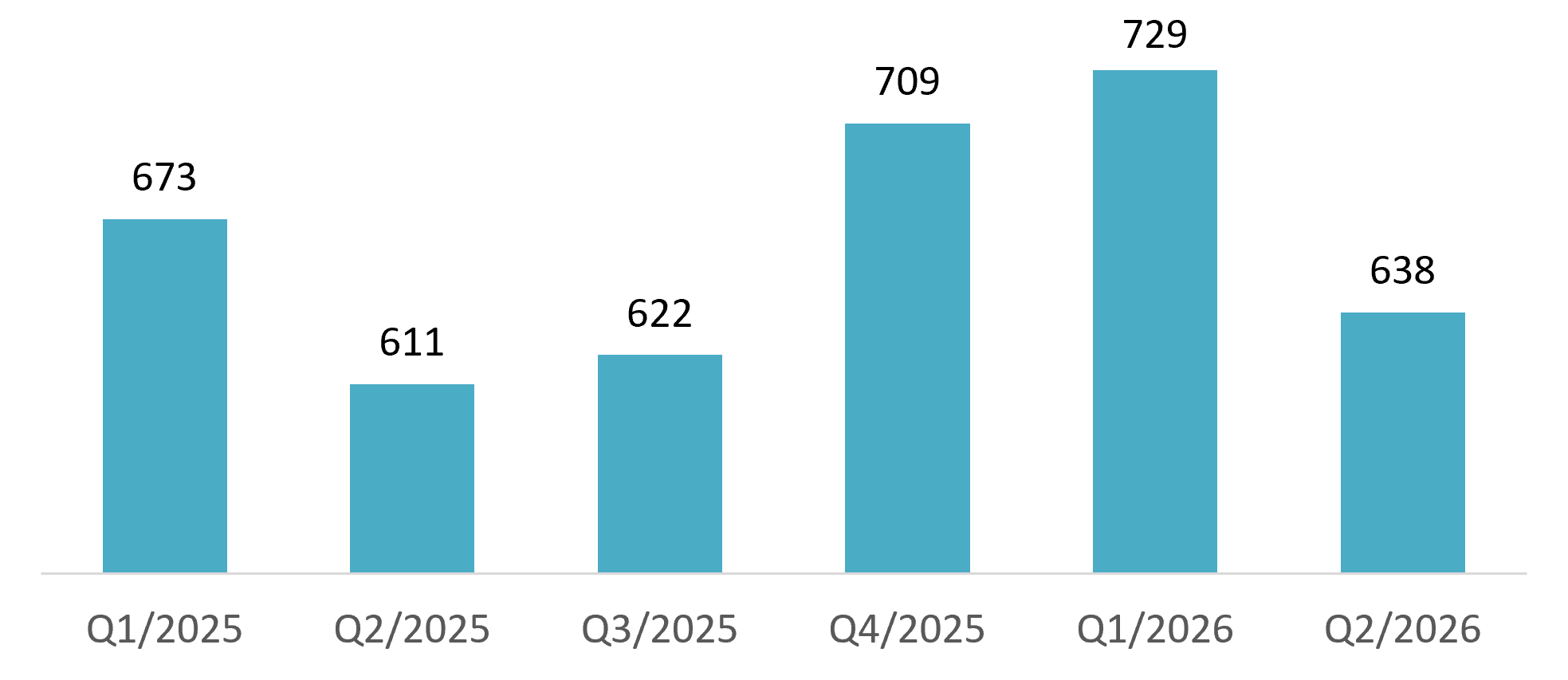
Source: VAMM
However, emerging EV players are reshaping a market long dominated by Japanese brands. VinFast, Vietnam’s leading electric motorbike brand, delivered 143,136 units in Q1 2026, up 219% year-on-year. In March alone, the company delivered more than 93,000 electric motorbikes to dealers nationwide and captured 17% of the total motorbike market[4]. Other electric motorbike makers also recorded rapid growth, including Yadea (+74%), Pega (+41.3%), and DK Bike (+130.8%)[5].
Shift toward electric motorbikes
Electric motorbikes in Vietnam are moving beyond a niche segment previously associated mainly with students and short-distance travel. They are becoming increasingly popular among workers, families, and frequent riders in major cities.
According to a September 2025 survey by Asia Plus Inc. of 200 consumers, 54% said they would choose an electric motorbike for their next purchase, compared with 24% preferring gasoline models. In Hanoi, the share choosing electric vehicles reached 60%[6].
Dealer observations in late 2025 and early 2026 also showed stronger demand for electric models, while many traditional gasoline models faced price cuts or slower sales[7] [8]. Key drivers include:
– Lower operating costs: For students, workers, and especially delivery riders traveling 20–30 km per day, gasoline costs can account for 15–20% of monthly income. Electricity costs for the same distance may be only around one-tenth as much, allowing users to save more for other living expenses.[9]
– Policy expectations are encouraging earlier switching: Plans to develop low-emission zones and gradually restrict high-emission vehicles in major cities are affecting new vehicle purchase decisions. In Hanoi, measures to restrict high-emission vehicles and promote electric mobility in areas within Ring Road 1 are expected to take effect from July 2026.[10] [11]
– EVs are becoming more competitive in price, design, and practical use: Many electric motorbikes are now available in the mainstream VND 20–30 million price range, with more diverse designs aimed directly at urban mobility needs. Manufacturers are also improving driving range, battery quality, speed, and convenience. These improvements are helping EVs move beyond the image of being suitable only for short trips. The expansion of electrical product lineups by traditional manufacturers such as Honda and Yamaha further strengthens confidence that electrification is a long-term industry trend[12].[13]
– A more complete ecosystem is reducing previous barriers: Sales and after-sales networks are expanding, while charging stations, battery-swapping cabinets, battery rental models, and new energy services are gradually addressing concerns over charging time and continuous operationFor example, Honda Vietnam has launched an authorized dealer network for CUV e: and UC3, with battery-swapping stations operating from 4 June 2026 and charging stations from 1 July 2026, prioritized at electric-vehicle HEAD dealers in Hanoi, Ho Chi Minh City and other provinces[15] [16]
Once-quiet EV showrooms are now bustling with customers
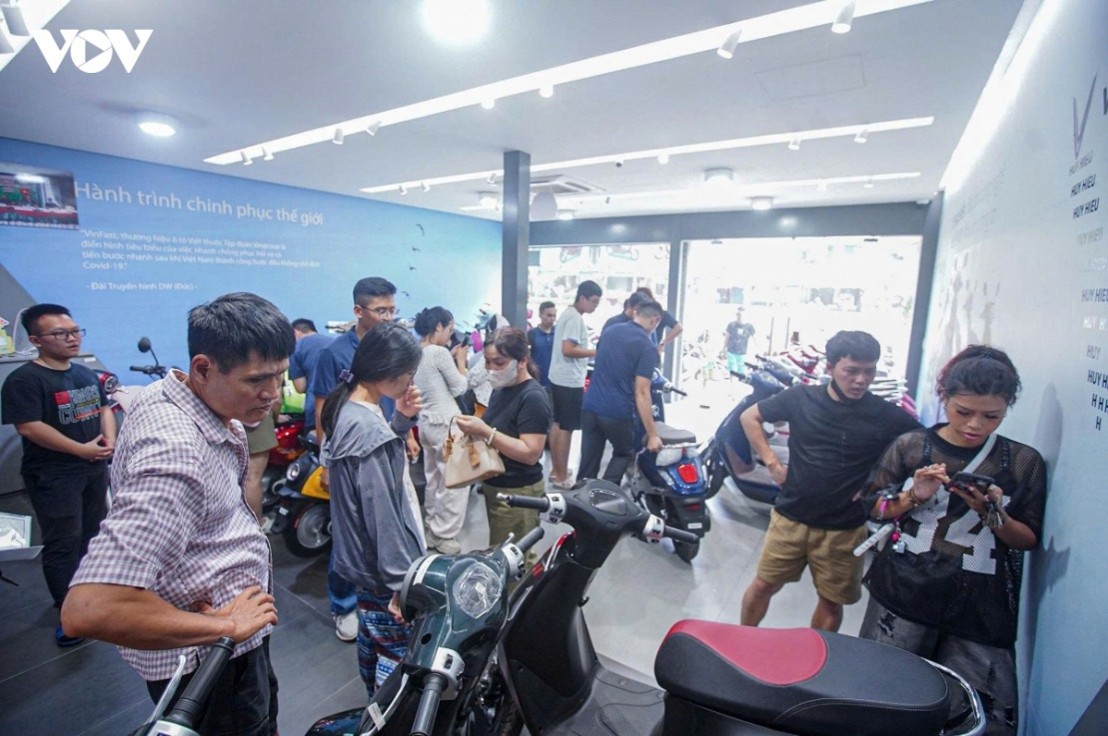
Source: VOV.vn
Leading industry players are also adapting to the electric two-wheeler trend
Vietnam’s shift toward electric two-wheelers is broadening the competitive landscape, as both traditional manufacturers and EV-focused players expand their products and supporting services.
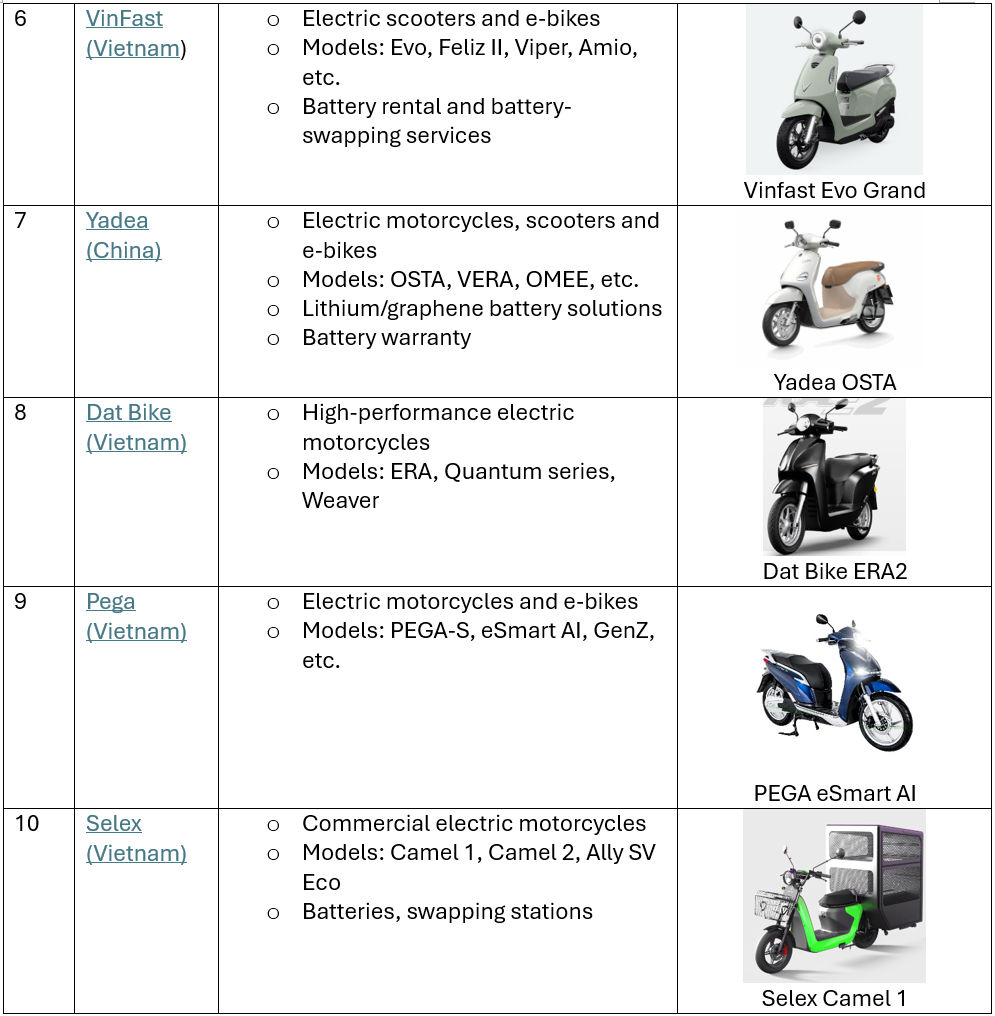
Table 1: Key two-wheeler players and their electric mobility offerings in Vietnam
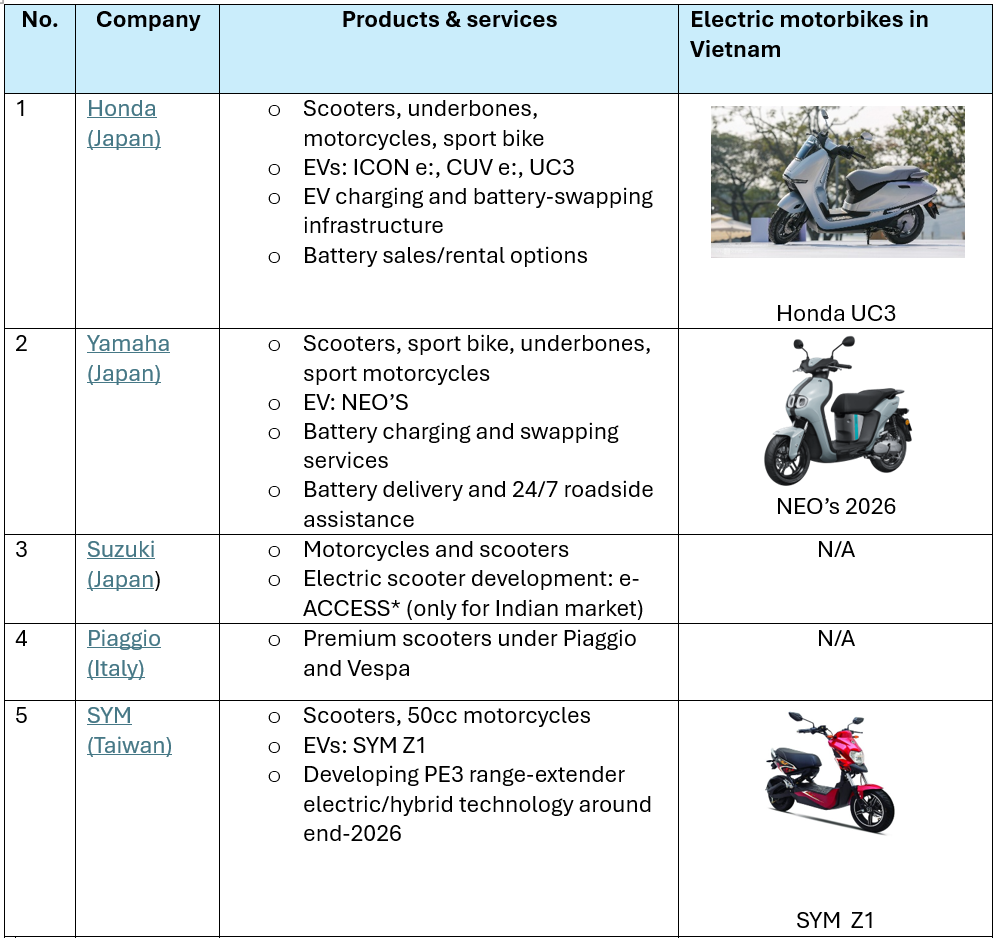
Source: B&Company’s Synthesis
Vietnam’s two-wheeler market is becoming increasingly diversified as both established manufacturers and EV-focused players expand their presence in electric mobility. Traditional brands such as Honda and Yamaha are introducing electric models and related battery services, while EV-focused companies such as VinFast, Yadea, Dat Bike and Selex are competing through broader model portfolios, battery technology and charging or swapping ecosystems. The transition remains uneven, however, with some conventional manufacturers still having limited EV offerings in Vietnam.
Business Implication
The shift toward electric two-wheelers is creating opportunities beyond vehicle sales alone. First, less mainstream alternative toward mass-market urban mobility, increasing the importance of mainstream pricing, practical driving range, total-cost-of-ownership advantages and accessible financing.
Second, competitive advantage is increasingly likely to depend on the broader ownership ecosystem rather than the vehicle alone. Charging availability, battery swapping, battery rental, digital services and after-sales coverage are becoming important differentiators. The expansion of such services by both established manufacturers and EV-focused players suggests that market entrants may need partnerships across energy, retail, property and charging station infrastructure.
Third, commercial electric two-wheelers still have significant room for growth, particularly in delivery and ride-hailing, where demand is great but electrification remains at an early stage. High-mileage users can benefit from lower operating costs, creating opportunities in fleet sales, leasing, battery-as-a-service and platform partnerships. Current partnerships already show this direction: Selex has worked with Ahamove to deploy 1,000 electric motorbikes for delivery operations[17], while Grab has partnered with Selex[18] and Dat Bike[19] to support driver-partners in switching to electric motorcycles.
Fourth, electrification will require traditional manufacturers and dealer networks to adapt their business models. As electric vehicles require fewer routine mechanical maintenance items than ICE motorcycles, part of the traditional after-sales revenue base may come under pressure. New capabilities in battery diagnostics, electrical systems, software support, charging, and subscription services could therefore become increasingly important.
Finally, the transition is unlikely to proceed uniformly across the country. Hanoi and Ho Chi Minh City are likely to be important early markets as urban environmental policies become more concrete. Vietnam’s motorcycle emissions restriction roadmap begins in Hanoi from July 2027 before expanding to other major cities and provinces, supporting a geographically phased approach to EV launches, infrastructure investment and fleet partnerships
Conclusion
Vietnam’s motorbike market remains large and highly competitive, but electrification is becoming increasingly visible in consumer demand, product offerings and supporting infrastructure. The shift is being driven by a combination of lower operating costs, changing policy expectations, improving EV products and expanding charging and battery-swapping ecosystems. For businesses, this transition creates opportunities across vehicles, batteries, infrastructure, financing and commercial fleet solutions, while requiring traditional players to adapt their product portfolio.
Read more
From RON95 to E10: Vietnam’s Biofuel shift and its impact on fuel retail and mobility
Electric motorcycles in Vietnam: Can they replace Gasoline bikes?
* If you wish to quote any information from this article, please kindly cite the source along with the link to the original article to respect copyright.
| B&Company
The first Japanese company specializing in market research in Vietnam since 2008. We provide a wide range of services including industry reports, industry interviews, consumer surveys, business matching. Additionally, we have recently developed a database of over 1,000,000 companies in Vietnam, which can be used to search for partners and analyze the market. Please do not hesitate to contact us if you have any queries. info@b-company.jp + (84) 24 3978 5165 |
[1] https://vnexpress.net/hon-2-1-trieu-oto-xe-may-dang-ky-moi-nua-dau-nam-5094742.html
[2] https://www.motorcyclesdata.com/2026/06/16/vietnam-motorcycles/
[3] https://vamm.vn/vamm-cong-bo-doanh-so-ban-hang-quy-1-2026-tai-viet-nam/
[4] https://cafef.vn/nguoi-viet-do-xo-mua-xe-may-dien-vinfast-ghi-nhan-luong-don-hang-cao-nhat-tu-truoc-den-nay-188260609072047526.chn
[5] https://thanhnien.vn/nhu-cau-xe-dien-gia-tang-thi-truong-xe-may-viet-nam-lap-ky-luc-moi-185260418112034451.htm
[6] https://laodong.vn/xe/xe-may-dien-dang-tro-thanh-xu-huong-o-cac-do-thi-lon-tai-viet-nam-1667141.ldo
[7] https://vov.vn/o-to-xe-may/xu-huong-chuyen-doi-tu-xe-xang-sang-xe-dien-cua-nguoi-dan-ha-noi-tang-chong-mat-post1279491.vov
[8] https://tuoitre.vn/nld/xu-huong-chuyen-doi-sang-xe-may-dien-196251214205508528.htm
[9] https://vov.vn/o-to-xe-may/xu-huong-chuyen-doi-tu-xe-xang-sang-xe-dien-cua-nguoi-dan-ha-noi-tang-chong-mat-post1279491.vov
[10] https://vov.vn/o-to-xe-may/ha-noi-thi-diem-vung-phat-thai-thap-tu-17-nguoi-dan-di-xe-can-luu-y-gi-post1308353.vov
[11] https://vov.vn/o-to-xe-may/xu-huong-chuyen-doi-tu-xe-xang-sang-xe-dien-cua-nguoi-dan-ha-noi-tang-chong-mat-post1279491.vov
[12] https://www.honda.com.vn/xe-may/su-kien/honda-viet-nam-lan-dau-tien-ra-mat-mau-xe-may-dien-moi-honda-uc3-tai-viet-nam-cong-bo-chinh-sach-ban-hang-moi-danh-cho-mau-xe-may-dien-cuv-e-va-bat-dau-trien-khai-he-thong-tram-sac-pin-va-tram-doi-pin
[13] https://tuoitre.vn/xe-may-dien-yamaha-neo-s-2026-ra-mat-viet-nam-gia-giam-gan-13-trieu-xuong-ngang-honda-vision-20260609081908035.htm
[14] https://vov.vn/o-to-xe-may/xu-huong-chuyen-doi-tu-xe-xang-sang-xe-dien-cua-nguoi-dan-ha-noi-tang-chong-mat-post1279491.vov
[15] https://www.honda.com.vn/xe-may/su-kien/honda-viet-nam-mo-ban-hai-mau-xe-may-dien-honda-cuv-e-va-honda-uc3-trien-khai-he-thong-tram-doi-pin-va-tram-sac-pin-tai-cac-thanh-pho-lon
[16] https://www.honda.com.vn/xe-may/danh-sach-cua-hang?head_type=1
[17] https://selex.vn/en/ahamove-pioneers-with-1000-selex-electric-motorbikes-leading-the-green-delivery-trend-in-vietnam/
[18] https://www.grab.com/vn/press/others/grab-viet-nam-va-selex-ky-thoa-thuan-hop-tac-nham-thuc-day-phat-trien-giao-thong-xanh/
[19] https://news.laodong.vn/kinh-doanh/grab-viet-nam-va-dat-bike-hop-tac-ho-tro-tai-xe-cong-nghe-chuyen-doi-xanh-1600733.ldo
Related article




















Log in / Register
Continue without an account
Log in / Register
SUBSCRIBE NEWSLETTER