

 English
  日本語
日本語  Tiếng Việt
  简体中文
简体中文  한국어
한국어 Waste-to-energy and industrial recycling solutions are emerging but remain limited in scale, creating chances for investment and innovation.
02Feb2026
Latest News & Report / Vietnam Briefing
Comments: No Comments.
Vietnam’s industrial waste is growing rapidly as industrialization accelerates, while landfill and basic incineration remain the main treatment methods. Technology-based solutions such as waste-to-energy and industrial recycling are emerging but remain limited in scale due to high costs and technical constraints, creating opportunities for further investment and innovation.
The Current Situation of Vietnam’s Industrial Waste Recycling Technology
Vietnam’s rapid industrial expansion over the past decade has significantly increased the volume of industrial waste, placing growing pressure on the country’s waste management system. Each year, Vietnam generates tens of millions of tons of industrial waste, yet only around 70% is formally collected and treated. The remaining portion is often landfilled or handled through informal channels, creating persistent risks to soil quality, groundwater, and public health.
In practice, landfilling is still the dominant solution for industrial waste. For many factories, especially small and medium-sized ones, landfill disposal remains the most accessible and cost-effective option. However, this approach comes with long-term environmental consequences, including greenhouse gas emissions. Incineration is also used to reduce waste volume, but without advanced emission-control systems, it can generate secondary pollution rather than solve the problem.
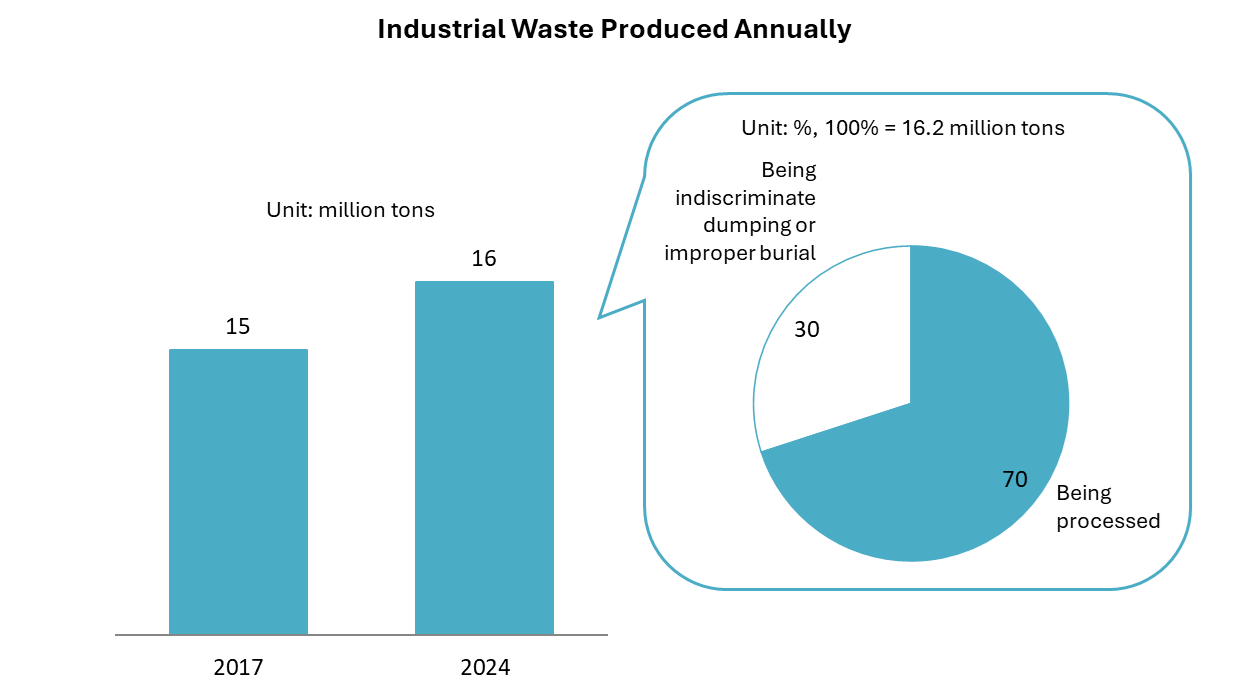
Source: B&Company
Although Vietnam has established industrial zones with waste collection systems, the amount of industrial waste needed to be treated still outgrows the treatment capacity tremendously. Many centralized facilities are outdated and overloaded, while waste streams themselves are becoming more complex, containing both hazardous and non-hazardous materials from sectors such as manufacturing, electronics, chemicals, and food processing. This complexity makes recycling and recovery far more challenging.
As a result, applications of modern technology in industrial waste treatment are one of the top priorities. While some enterprises have begun applying this technology, the scale remains limited due to high investment cost (up to 1 – 2 million USD for initial cost) and a lack of technical skills. Furthermore, policy implementation gaps and insufficient enforcement of environmental regulations mean that many companies do not fully comply with waste treatment standards, reducing the effectiveness of existing systems.
Current Recycling Technologies Applied to Industrial Waste
In response to industrial waste pressure, Vietnam has begun exploring new recycling methods and technologies that can extract value and reduce environmental impact.
For example, Waste-to-Energy (WtE) technologies convert non-recyclable solid waste into electricity or heat using controlled thermal processes. In Vietnam, WtE has become a core part of the country’s strategy to tackle waste as landfill capacities reach their limits. Large projects, such as the Nam Son Waste-to-Energy plant in Hanoi—one of the largest in the world—illustrate how industrial and municipal waste can serve as feedstock for power generation. Vietnam now has around 20 WtE projects under development or operation [4], including the Waste Treatment Plant of EB Environmental Energy Company with a capacity of 400 tons/day in Can Tho City [5]. WtE not only reduces the volume of industrial waste sent to landfills but also aligns with broader circular-economy goals by producing energy from residuals.
The Waste Treatment Plant of EB Environmental Energy Company in Can Tho City
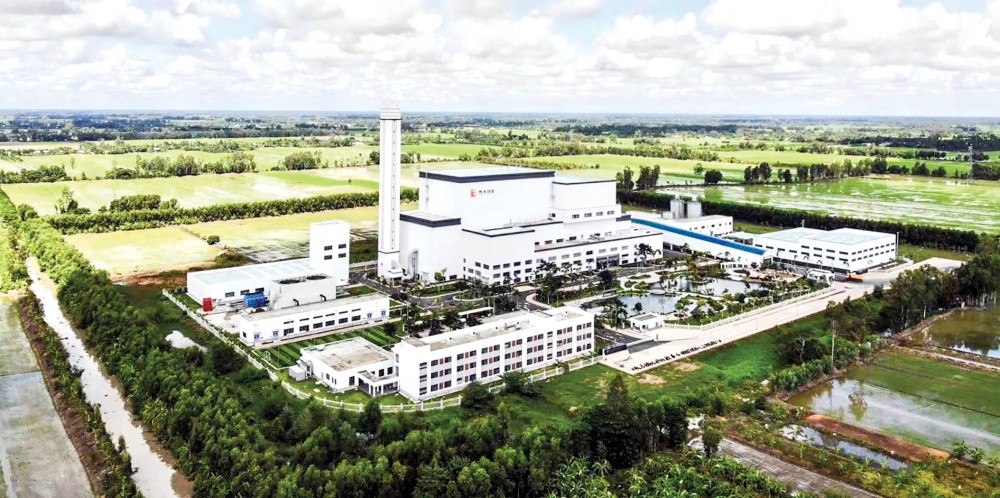
Source: Can Tho Online
Despite this progress, the adoption of WtE varies widely, and many projects remain in planning or early construction stages. Challenges include high capital costs, strict emissions control requirements, and necessary integration with robust sorting and pretreatment systems before burning can safely occur.
Another successful case of WtE is the Soc Son waste-to-energy plant at the Nam Sơn Waste Treatment Complex in Hanoi. The plant had been officially connected to the national power grid in 2022, marking a major step in Vietnam’s application of industrial waste recycling technology. The plant is capable of burning up to 4,000 tons of dry waste a day, with its first generator producing 15 MW of electricity, and plans to reach 75 MW once all incinerators are operational. Approximately 50 MW of this power is supplied to the national grid, while the remainder supports onsite operations. Approved by Hanoi authorities in 2017 with an investment of VND 7 trillion (nearly US$30 million), the facility is designed to treat a significant share of the capital’s waste and reduce dependence on landfill disposal [10].
The Soc Son Waste-to-Energy Plant

Source: VNTY
The Market Players
The development and application of industrial waste recycling technologies in Vietnam are being driven by a combination of government agencies, domestic enterprises, and foreign-invested corporations, rather than by a single dominant actor. This reflects the complex nature of industrial waste, which often requires coordinated solutions across policy, infrastructure, and technology.
On the policy side, the Vietnamese Government plays a central role in steering technological adoption. National strategies on environmental protection and the circular economy set clear targets, including the goal of recycling 60–70% of industrial waste by 2030 [8]. These policy commitments have encouraged local authorities and industrial zones to seek technology-based solutions instead of relying solely on landfill disposal. However, implementation remains uneven across regions, and many projects are still at pilot or early deployment stages [9]
Domestic enterprises are gradually becoming more active, particularly in sectors where waste can be directly converted into economic value. Recycling companies in plastics, metals, and industrial by-products are investing in sorting lines, pre-treatment systems, and energy recovery solutions to comply with stricter regulations and reduce disposal costs. At the same time, industry associations such as the Vietnam Waste Recycling Association (VWRA) are helping standardize practices and connect businesses with technology providers [11].
Foreign-invested companies and multinational corporations are also key drivers of emerging technologies. Through public–private partnerships and sustainability initiatives, global firms such as Dow, SCG Group, and Unilever have collaborated with Vietnamese authorities to promote advanced waste treatment models, circular packaging solutions, and industrial recycling roadmaps. These collaborations often introduce international technical standards and operational know-how into Vietnam’s industrial waste sector, accelerating technological learning and adoption [7]
Implications for Foreign Direct Investment (FDI) Enterprises
Vietnam’s industrial waste sector presents clear opportunities for foreign direct investment, particularly for companies with expertise in environmental engineering and advanced treatment technologies. Despite growing waste volumes, Vietnam’s current industrial waste management system remains constrained by limited technological depth, especially in areas such as chemical recycling, high-efficiency waste-to-energy systems, and treatment of complex industrial residues. This gap creates space for foreign firms to position themselves as technology providers or strategic partners, supporting local operators and industrial zones in upgrading their waste treatment capacity.
At the same time, Vietnam’s commitment to circular economy development and its 2030 targets for industrial waste recycling provide a favorable policy backdrop. For FDI enterprises, investing in industrial waste treatment and recycling technologies not only addresses regulatory compliance but also aligns with long-term sustainability objectives across regional supply chains. As manufacturing in Vietnam continues to expand, demand for reliable, technology-driven waste solutions is expected to grow steadily, strengthening the business case for early movers.
Vietnam’s approach to industrial waste management is at a turning point. While landfill and basic treatment methods still dominate, rising waste volumes and stricter environmental requirements are pushing the country toward more technology-based solutions. Current applications such as mechanical recycling and waste-to-energy provide a foundation, but they remain insufficient to fully address the complexity of industrial waste streams. Emerging technologies, policy support, and collaboration between domestic and foreign stakeholders will be critical in bridging this gap. As Vietnam continues its industrialization journey, the ability to transform industrial waste from an environmental burden into a recoverable resource will define the next stage of sustainable growth.
* If you wish to quote any information from this article, please kindly cite the source along with the link to the original article to respect copyright.
| B&Company
The first Japanese company specializing in market research in Vietnam since 2008. We provide a wide range of services including industry reports, industry interviews, consumer surveys, business matching. Additionally, we have recently developed a database of over 900,000 companies in Vietnam, which can be used to search for partners and analyze the market. Please do not hesitate to contact us if you have any queries. info@b-company.jp + (84) 28 3910 3913 |
REFERENCES:
- https://b-company.jp/implementation-of-waste-sorting-at-source-in-vietnam-starting-in-2025/
- https://kinhtedothi.vn/de-rac-thai-cong-nghiep-khong-con-la-ganh-nang
- https://vietnamnews.vn/environment/377027/co-processing-solution-for-industrial-waste.html
- https://vietnamnet.vn/en/vietnam-embraces-circular-economy-to-tackle-waste-crisis-and-drive-green-growth-2420792.html
- https://b-company.jp/from-trash-to-treasure-vietnams-waste-to-energy-revolution/
- https://scp.gov.vn/tin-tuc/t11474/hoat-dong-tai-che-chat-thai-dien-tu-o-viet-nam-va-mot-so-khuyen-nghi
- https://vn.dow.com/en-us/news/plastic-waste-mgnt-vietnam.html
- https://vir.com.vn/vietnam-sets-2030-target-to-recycle-70-per-cent-of-industrial-waste-136423.html
- https://www.vietnam-briefing.com/news/turning-challenges-into-opportunities-investing-in-waste-disposal-management-in-vietnam.html
- https://thanglong.chinhphu.vn/english/biggest-waste-to-energy-plant-hooks-up-to-national-grid-110220729094724593.htm
- https://thanhnien.vn/bien-ganh-ve-chai-thanh-cong-nghiep-tai-che-viet-nam-185251223161706345.htm
Related article



















Log in / Register
SUBSCRIBE NEWSLETTER