

 English
  日本語
日本語  Tiếng Việt
  简体中文
简体中文  한국어
한국어 Low-carbon or green transition in Vietnam is moving from net-zero commitments toward implementation, with growing support from Japan.

03Sep2026
Highlight content / Highlight Content JP / Highlight content vi / Industry Reviews / Latest News & Report
Comments: No Comments.
Abstract
Vietnam’s low-carbon transition is moving from net-zero commitments toward implementation, with growing implications for businesses across the economy. Japan supports this process through ODA, corporate investment, the Joint Crediting Mechanism (JCM), the Asia Zero Emission Community (AZEC), and green finance. This article reviews Vietnam’s policy framework, major areas of bilateral cooperation, and potential opportunities for Japanese companies.
Vietnam’s Net-Zero Policy: Shaping the Foundation for a Low-Carbon Market
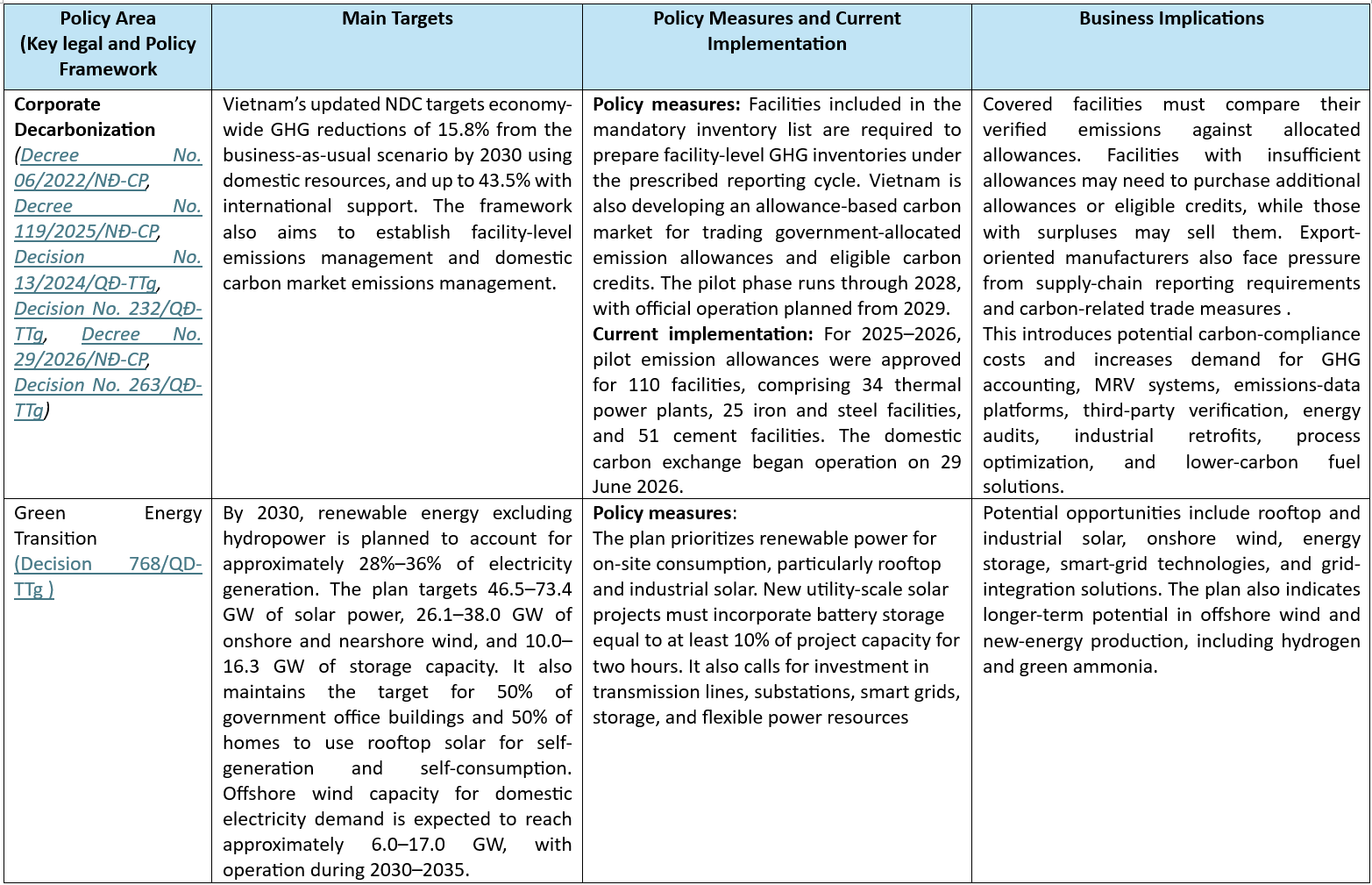
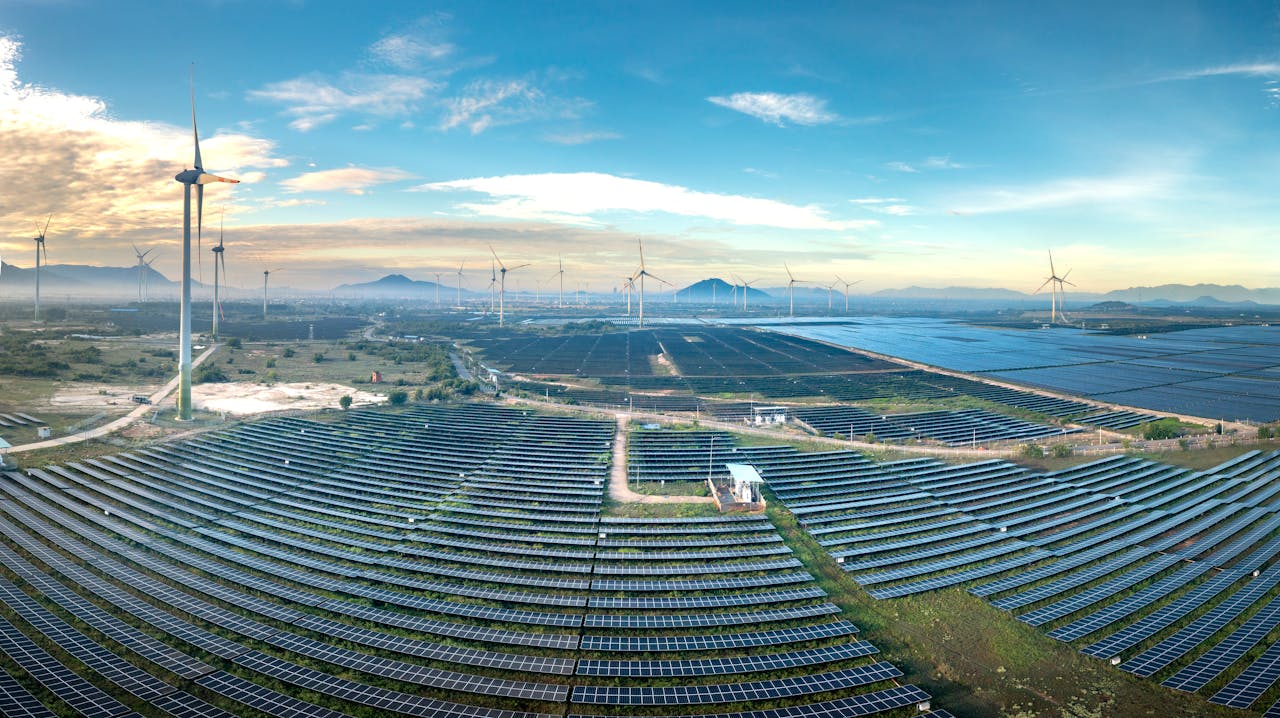
Vietnam has introduced a range of policies to support its net-zero target. Among these, corporate decarbonization and the green energy transition have particularly direct impacts on businesses by strengthening emissions-management requirements and promoting investment in cleaner energy and related infrastructure.
B&Company’s synthesis
Carbon management is shifting from general reporting to the allocation and trading of compliance instruments. Large emitters must manage verified emissions against assigned allowances, making decarbonization an operational and financial requirement. This may create opportunities for Japanese companies with industrial optimization capabilities, including high-efficiency utility equipment, plant retrofits, and energy-audit services.
Notable Low-Carbon Cooperation Projects Between Vietnam and Japan
Vietnam and Japan are advancing low-carbon cooperation primarily through the Joint Crediting Mechanism (JCM) and the Asia Zero Emission Community (AZEC). JCM is a bilateral project and carbon-crediting mechanism, while AZEC is a broader regional platform for policy cooperation, technology demonstration, project development, finance, and business partnerships.
The Joint Crediting Mechanism (JCM)
– Nature: Under the principle of “Technology Contribution – Credit Exchange,” the Japanese government typically funds up to 50% of equipment costs, Vietnamese companies operate the facilities, and resulting CO₂ reductions are converted into credits shared between the two countries.
– Implementation Status: Since 2013, 48 projects in Vietnam have been selected under the Japanese Ministry of the Environment’s JCM Financing Programme. Their combined estimated reduction amounts to approximately 454,615 tCO₂ per year. These are ex-ante project estimates and should not be interpreted as carbon credits already issued or verified reductions already achieved [1].
– Key Sectors: The portfolio covers renewable energy, energy efficiency, transport, waste treatment, and F-gas recovery and destruction.
– Participants: JCM involves government agencies from both countries, state-owned enterprises and public utilities, private companies, financial institutions, local authorities, and research or technical organizations.
List projects under the JCM mechanism [2]
| Sector | No. Projects | Project introduction | Estimated GHG reduction
(tCO₂/year) |
| Renewable energy | 23 | · Utility-scale solar, rooftop solar for factories and commercial facilities, biomass boilers and biomass power plants, onshore wind, and small hydropower | 362,863 |
| Energy-efficiency improvement | 20 | · High-efficiency transformers, air-conditioning systems, chillers, boilers, kilns, pumps, LED lighting, production equipment, and factory energy-control systems.
· Most focus on reducing electricity or fuel consumption in industrial facilities, buildings, and public utilities |
30,260 |
| Transport | 2 | · Eco-driving using digital tachographs and a modal shift from truck transport to cargo shipping using freshness-preservation refrigerated containers | 10,427 |
| Waste handling and disposal | 1 | · The portfolio includes a waste-to-energy plant that generates electricity while reducing emissions associated with conventional waste disposal | 41,804 |
| F-gas recovery and destruction | 2 | · Collection schemes and dedicated destruction or decomposition facilities for used fluorocarbons | 9,261 |
| Total | 48 | 454,615 |
Source: B&Company’s synthesis
Asian Zero Emissions Community (AZEC)
– Nature: This is a Japan-led, large-scale, multilateral strategic alliance. The mechanism does not focus on the buying and selling of carbon credits but rather on shaping policies and green standards and providing substantial funding for the development of clean energy infrastructure.
– Implementation Status: 34 cooperation items, covering MOUs, MOAs, research, demonstration, and implementation initiatives.
– Key Sectors: focuses mainly on low-carbon agriculture, food systems, agricultural carbon credits, and MRV, alongside corporate carbon management, circular infrastructure, and CCS.
List of projects under the AZEC initiative
| Sector | Cooperation items by type | Project introduction |
| Clean energy, storage, and agrivoltaics | – 3 MOUs | – Cooperation focuses on solar-sharing systems that combine agricultural production with solar power generation and battery storage.
– The MOUs also provide a basis for joint research, technology introduction, and potential development into JCM projects. |
| Low-carbon agriculture, fisheries, and food systems | – 2 MOUs
– 2 research initiatives – 2 demonstrations or pilot trials – 3 commercial or implementation collaborations |
– Activities cover methane reduction in rice cultivation, improved fertilizer efficiency, regenerative agriculture, sustainable fisheries, and lower-emission sugar and coffee supply chains.
– The portfolio ranges from research and field trials to commercial supply-chain cooperation and technology implementation. |
| Agricultural carbon-credit generation and MRV | – 8 MOUs
– 4 MOAs |
– 8 MOUs support the development of agricultural carbon-credit projects, emissions-calculation systems, and satellite-based monitoring.
– 4 MOAs commission research institutes and universities to measure methane reductions in rice paddies across different regions of Vietnam. |
| Corporate carbon management and enabling finance | – 7 MOUs | – The MOUs cover corporate GHG accounting, emissions visualization, IoT-based energy monitoring, agricultural digital platforms, decarbonization support for industrial-park tenants, business matching, and financing cooperation. |
| Circular economy and low-carbon infrastructure | – 2 technical cooperation and standardization initiatives | – Cooperation promotes recycled-asphalt and roadbed-recycling technologies.
– Activities include technology dissemination, technical assessment, development of implementation roadmaps, and support for adoption under Vietnamese technical standards. |
| Carbon capture and storage | – 1 MOU | – The MOU establishes a cooperation framework for the technical assessment and early-stage formation of a CCS project involving Japanese and Vietnamese energy-sector organizations. |
Source: B&Company synthesis
Strategic Outlook: Shaping the Low-Carbon Business Market in Vietnam
Vietnam’s green transition is moving from policy development toward implementation, driven by mandatory GHG inventories for designated high-emitting facilities, the pilot carbon market, and investment in renewable energy and grid infrastructure. However, progress will still depend on regulatory clarity, transmission capacity, financing, and project bankability.
Japan supports this transition through complementary frameworks. JCM enables project-level measurement and crediting of emission reductions, while AZEC promotes broader cooperation in policy, finance, carbon markets, supply-chain decarbonization, infrastructure, and project development.
For Japanese companies, near-term opportunities extend beyond large-scale energy projects to industrial energy efficiency, self-consumption solar, carbon management, waste and resource recovery, and green finance. Success will require factors such as strong local partners, reliable emissions data, viable off-takers, and workable regulatory and financing structures.
Read more
From rice fields to carbon credits: Japan–Vietnam cooperation in the next phase of decarbonization
From fuel inflation to green transition: Southeast Asia after the oil shock
* If you wish to quote any information from this article, please kindly cite the source along with the link to the original article to respect copyright.
| B&Company
The first Japanese company specializing in market research in Vietnam since 2008. We provide a wide range of services including industry reports, industry interviews, consumer surveys, business matching. Additionally, we have recently developed a database of over 1,000,000 companies in Vietnam, which can be used to search for partners and analyze the market. Please do not hesitate to contact us if you have any queries. info@b-company.jp + (84) 24 3978 5165 |
[1][2] GEC. List of projects under the JCM Financing – program by MOEJ (FY2013-2026) (as of July 14, 2026)
Related article
























Log in / Register
SUBSCRIBE NEWSLETTER