

 English
  日本語
日本語  Tiếng Việt
  简体中文
简体中文  한국어
한국어 The article examines how the Middle East conflict is affecting Vietnam’s key export industries through logistics costs, shipping times, and more.

17Apr2026
Latest News & Report / Vietnam Briefing
Comments: No Comments.
Abstract
This article examines how the Middle East conflict is affecting Vietnam’s key export industries through higher logistics costs, longer shipping times, and rising supply-chain uncertainty. Aimed at business leaders, exporters, and market observers, it highlights the impact on textiles, electronics, and wood products, while outlining the broader implications for trade resilience and competitiveness.
A regional conflict with global trade consequences
The Middle East conflict has become more than a regional security issue. With maritime transport carrying more than 80% of global merchandise trade, disruptions in key shipping routes can quickly affect production costs, delivery schedules, and trade flows worldwide. Reuters reported in late March 2026 that major carriers were still grappling with shipping risks in the region, while IMF Managing Director Kristalina Georgieva warned on April 6 that the conflict could lead to higher inflation and slower global growth.[1] [2] [3] [4]
The effects are already visible in Vietnam’s economy. Reuters reported that Vietnam’s consumer prices rose 4.65% year-on-year in March 2026, with transport costs up 10.81% as higher global energy prices filtered through the economy. Vietnam’s Ministry of Industry and Trade has also warned that the conflict could raise fuel, freight, and insurance costs for domestic businesses, while disruptions around major shipping and aviation routes could affect both sea and air cargo.[5] [6]
For Vietnam, the issue is not simply whether the Middle East is a major export destination. The more important question is whether the country’s export sectors can remain competitive when shipping times are lengthened, inputs become more expensive, and delivery schedules become less predictable. This is especially relevant for textiles and garments, electronics, and wood products, three of Vietnam’s most important export industries. In 2025, textile and garment exports were estimated at US$39.64 billion, electronics exports reached about US$107.75 billion, and wood and wood product exports climbed to US$17.2 billion.[7]
Export value of some Vietnamese sectors in 2025
Unit: % ; 100% = $475.06 billion
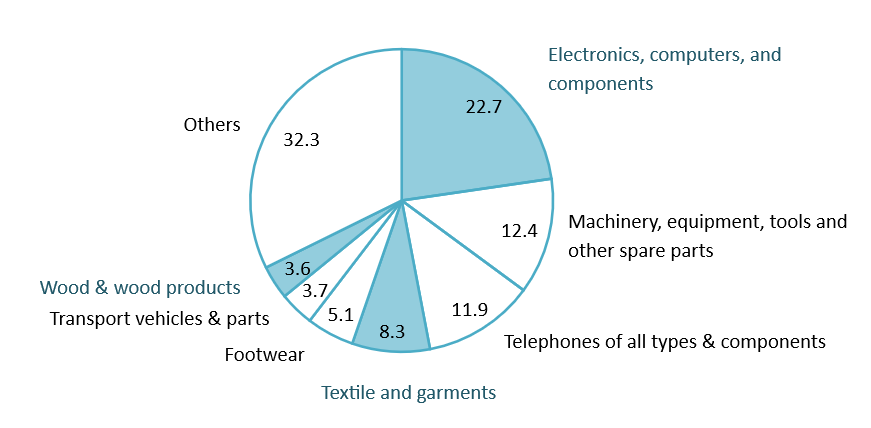
Source: B&Company’s synthesis from the Department of Vietnam Customs
Sector analysis: uneven pressures across Vietnam’s export pillars
Textiles and garments: the most immediate commercial pressure
Among Vietnam’s major export sectors, textiles and garments are showing the clearest commercial impact. This is a low-margin, buyer-driven industry in which delivery timing often matters almost as much as price. Longer shipping times can disrupt seasonal sales calendars, increase working-capital pressure, and weaken buyer confidence. The Vietnam Textile and Apparel Association (VITAS) has warned that rerouting vessels via the Cape of Good Hope is extending delivery times by around 14 to 20 days, while freight rates to the US and EU have risen two to three times. Shipments to the US East Coast have also faced additional war-risk surcharges of around US$2,000 to US$4,000 per container.[8] [9]
The impact is already visible at the company level. Dony Garment said Jordan accounts for nearly 20% of its export revenue, with most shipments moving through the Red Sea. While the company had not yet faced cancellations, it was bracing for possible delays of 15 to 20 days, enough to disrupt retailers during peak shopping periods if the situation continues. This illustrates why the main concern for garment exporters is not only higher freight costs, but also the risk of missing narrow selling windows in overseas markets.[10]
A garment factory in Vietnam
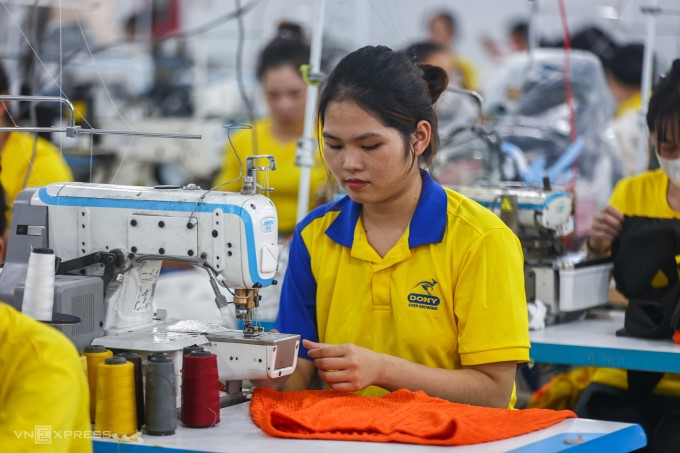
Source: VnExpress
At a recent business forum in Ho Chi Minh City, Pham Van Viet, chairman of Viet Thang Jean, said the cost of shipping a 40-foot container was expected to rise to around US$4,500 to US$5,500 after multiple surcharges were added. He also noted that the prices of chemicals and processing materials had increased by roughly 18%. Some firms are responding by splitting orders into smaller batches to reduce disruption risk, but that solution also raises costs. For garment exporters, the conflict is therefore creating pressure on three fronts at once: transport costs, input costs, and delivery reliability.[11]
Electronics: a supply-chain synchronization risk
Electronics face a different kind of vulnerability. The sector is less exposed to freight costs alone than to disruptions in tightly synchronized supply chains. Many electronics manufacturers in Vietnam rely on imported parts, components, and materials arriving on time from multiple markets. When transit times lengthen or route reliability declines, the effects can be felt not only in exports but also in production continuity.
An electronics factory in Vietnam
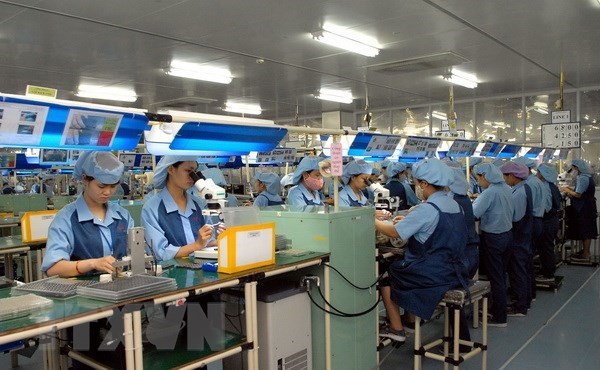
Source: MOIT
According to HEPZA, some companies in Ho Chi Minh City’s export processing and industrial zones that import materials from Europe are already facing shortages because of longer shipping times. In some cases, firms have had to switch to air freight to keep production on schedule, sharply increasing logistics costs. HEPZA also warned that electronics and component producers face risks of shortages in imported chips and semiconductor components from Europe, while higher transport expenses are pushing up product prices and squeezing margins.
This matters because electronics are now Vietnam’s largest export group. With exports of computers, electronic products, and components reaching roughly US$107.75 billion in 2025, even modest disruptions can have significant macroeconomic consequences. At the same Ho Chi Minh City business forum, local authorities said the sector’s expected growth had been revised down from 14% to around 9%, the steepest downgrade among the industries discussed. This suggests that, for electronics, the conflict is exposing a structural weakness: Vietnam is highly competitive in assembly and exports but remains vulnerable when imported inputs arrive late or unpredictably.[12]
Wood and furniture: cost pressure and market uncertainty
Wood products are under pressure for a different reason. As a bulky export category, the sector is highly sensitive to changes in shipping costs, especially when buyers in key markets are already cautious. Vietnam’s exports of wood and wooden products reached US$18.5 billion in 2025, while wooden furniture alone generated US$10.25 billion, nearly 60% of the sector’s total export value. At that scale, even moderate freight increases can materially affect competitiveness.
At the Ho Chi Minh City business forum, officials said the wood industry was being squeezed by both higher logistics costs and weakening global demand. This combination is especially challenging for exporters targeting the US and Europe, where buyers are highly sensitive to final delivered prices. For bulky and relatively lower-margin products, rising freight costs are difficult to absorb without hurting margins or forcing price renegotiation.
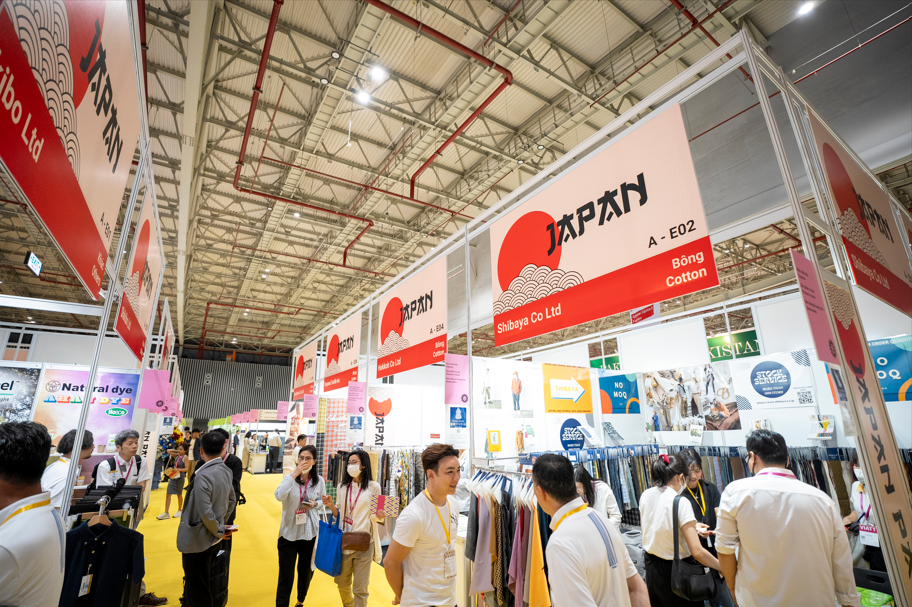
Industry leaders are already framing the challenge in strategic terms. Speaking at HawaExpo 2026 (Ho Chi Minh Export Furniture Fair in Vietnam), Vietnam’s Trade Promotion Agency said the Middle East conflict was increasing instability in supply chains, production costs, and logistics, forcing wood businesses to rethink market strategies. Nguyen Quoc Khanh, chairman of VIFOREST and chairman of AA Architecture Construction JSC, also identified market instability as one of the sector’s three main challenges, noting that newer markets, including parts of the Middle East, may bring higher risks in payments, logistics, and legal procedures. For wood exporters, the conflict is not merely a temporary freight issue; it is a reminder that market diversification must be backed by stronger control over shipping terms, payment discipline, and route planning.[13] [14] [15]
HawaExpo 2026 – Ho Chi Minh Export Furniture Fair in Vietnam

Source: HawaExpo
Why indirect risks matter more than direct market exposure — and what exporters should do next
For Vietnam, the Middle East conflict matters less because of direct trade exposure to the region and more because of its indirect effects on the wider export system. Vietnam’s key industries depend heavily on global shipping routes, imported inputs, energy costs, and reliable delivery schedules to major markets such as the US and Europe. As a result, the main risks are not limited to lost orders from the Middle East, but extend to longer transit times, higher logistics and insurance costs, input price volatility, and greater uncertainty in fulfilling contracts. In short, the conflict is making Vietnam’s export operations more fragile overall.
For Vietnamese exporters, the priority now is to strengthen resilience through sector-specific action. Textile and garment companies should improve planning discipline by building more realistic lead times into order management, negotiating more flexible delivery terms with buyers, and broadening their supplier base to reduce dependence on any single source of materials. Electronics manufacturers should focus on supply-chain visibility and continuity by identifying critical components, qualifying backup suppliers earlier, and preparing contingency plans for time-sensitive inputs. Wood and wood product exporters, meanwhile, should protect commercial stability by tightening shipment planning, reviewing payment and contract terms more carefully, and working more closely with buyers to align delivery schedules with market demand. Across all three sectors, the broader strategic priority is the same: move beyond cost competition alone and strengthen capabilities in logistics flexibility, supplier diversification, contract management, and customer communication.
Recent developments since early April have opened some room for de-escalation, including the 8 April U.S.-Iran ceasefire and follow-up talks, but operating conditions remain fragile. Reuters reported on 9 April that shipping through the Strait of Hormuz was still below 10% of normal levels, while attacks on Saudi energy infrastructure also disrupted oil flows. For Vietnamese manufacturers and exporters, this means the situation should not yet be treated as a return to normal. Firms should continue to monitor oil prices, freight rates, insurance premiums, and route conditions closely, while maintaining conservative lead-time assumptions and regularly reviewing delivery, surcharge, insurance, and force-majeure terms.[16] [17]
Conclusion
The Middle East conflict is not just a short-term disruption for Vietnam’s exporters. It is a reminder that in a more volatile trade environment, resilience is becoming just as important as cost competitiveness. For textiles, electronics, and wood products alike, future performance will depend not only on production capacity but also on how effectively firms manage uncertainty across logistics, sourcing, contracts, and customer relationships.
Read more
* If you wish to quote any information from this article, please kindly cite the source along with the link to the original article to respect copyright.
| B&Company
The first Japanese company specializing in market research in Vietnam since 2008. We provide a wide range of services including industry reports, industry interviews, consumer surveys, business matching. Additionally, we have recently developed a database of over 900,000 companies in Vietnam, which can be used to search for partners and analyze the market. Please do not hesitate to contact us if you have any queries. info@b-company.jp + (84) 28 3910 3913 |
[1] UNCTAD: Review of Maritime Transport <Access>
[2] UNCTAD (2025): Review of maritime transport 2025 <Access>
[3] Reuters (2026): Western powers were unable to secure shipping in the Red Sea. Hormuz will be harder <Access>
[4] Reuters (2026): Middle East war means ‘all roads’ lead to higher prices, slower growth, IMF chief says <Access>
[5] Reuters (2026): Vietnam Q1 growth slows as costlier Middle East energy tests 2026 target <Access>
[6] Vietnam.vn (2026): Businesses are seeking ways to adapt to the disruptions arising from the Middle East conflict <Access>
[7] Department of Vietnam Customs (2026): Vietnam’s Goods Export and Import Situation in December and 2025 <Access>
[8] Vietnam.vn (2026): Businesses are seeking ways to adapt to the disruptions arising from the Middle East conflict <Access>
[9] VnEconomy (2026): Textile and garment industry expected to fulfil export target in spite of mounting challenges from global disruptions <Access>
[10] Vietnamnet (2026): VN exporters face rising costs, delays as Middle East tensions disrupt Red Sea <Access>
[11] Vietnam.vn (2026): Businesses are seeking ways to adapt to the disruptions arising from the Middle East conflict <Access>
[12] The Investor (2026): HCMC businesses bear rising logistics costs amid Middle East conflict <Access>
[13] VnEconomy (2026): A milestone in wood and wooden product exports, but challenges remain <Access>
[14] Vietnam.vn (2026): Businesses are seeking ways to adapt to the disruptions arising from the Middle East conflict <Access>
[15] Vietnamnet (2026): Businesses seek “survival momentum” amid global geopolitical turbulence <Access>
[16] Reuters (2026): Hormuz at near standstill as Iran warns ships to keep to its waters <Access>
[17] Reuters (2026): Saudi Arabia says attacks cut oil output and East-West Pipeline flow <Access>
Related article



























Log in / Register
SUBSCRIBE NEWSLETTER