

 English
  日本語
日本語  Tiếng Việt
  简体中文
简体中文  한국어
한국어 This examines the evolution of Vietnam’s carbon market framework through key legal documents, highlighting how it is designing the market.
18May2026
Latest News & Report / Vietnam Briefing
Comments: No Comments.
Abstract
Vietnam is gradually strengthening the legal foundation for its domestic carbon market through multiple layers of policy development covering emissions management, compliance mechanisms, market infrastructure, and international carbon exchange regulations. Rather than creating a fully operational carbon trading market immediately, Vietnam is currently focused on building the institutional and regulatory foundations necessary for future market operation. This article examines the evolution of Vietnam’s carbon market framework through key legal documents while highlighting how the country is designing the market in a way that leverages existing financial infrastructure and prepares for potential participation in international carbon mechanisms.
Policy Layers in the Development of Vietnam’s Carbon Market
Vietnam’s carbon market framework has been developed through multiple layers of policies and regulations covering emissions management, compliance mechanisms, trading infrastructure, and international carbon exchange mechanisms.
| Policy group | Legal document | Legal instrument title | Effective date | Main role |
| Legal foundation | Law No. 72/2020/QH14[1] | Law on Environmental Protection | 1-Jan-22 | Introduced the concept of organizing and developing a domestic carbon market into Vietnam’s legal system |
| Supporting compliance decisions | Decision 01/2022/QĐ-TTg | Promulgating the List of Sectors and Facilities Required to Conduct Greenhouse Gas Inventories | 18-Jan-22 | Issued the list of facilities required to conduct greenhouse gas inventories |
| Compliance and emissions management framework
|
Decree 06/2022/NĐ-CP[2] | Regulations on Greenhouse Gas Emission Reduction and Ozone Layer Protection | 7-Jan-22 | Established greenhouse gas inventory, MRV, emissions quota allocation, and carbon credit management mechanisms |
| Decree 119/2025/NĐ-CP[3] | Amending and Supplementing a Number of Articles of Decree No. 06/2022/ND-CP | 1-Aug-25 | Added more flexible compliance mechanisms and regulations on carbon credit usage | |
| Decree 83/2026/NĐ-CP[4] | Amending and Supplementing a Number of Articles of Decree No. 06/2022/ND-CP and Decree 119/2025/NĐ-CP | 23-Mar-26 | Further amended greenhouse gas mitigation and ozone layer protection mechanisms | |
| Market development roadmap | Decision 232/QĐ-TTg[5] | Approval of the Scheme for the Establishment and Development of the Carbon Market in Vietnam | 24-Jan-25 | Defined the pilot and official implementation roadmap for the carbon market |
| Trading infrastructure | Decree 29/2026/NĐ-CP[6] | Regulations on the Domestic Carbon Exchange
|
15-Apr-26 | Established registration, trading, depository, and settlement mechanisms for domestic carbon transactions |
| International carbon linkage | Decree 112/2026/NĐ-CP[7] | On the International Exchange of Greenhouse Gas Emission Reduction Results and Carbon Credits | 19-May-26 | Regulated international exchange of emissions reductions and carbon credits under international mechanisms |
B&Company’s synthesis
From Climate Commitments to the Need for a Carbon Market
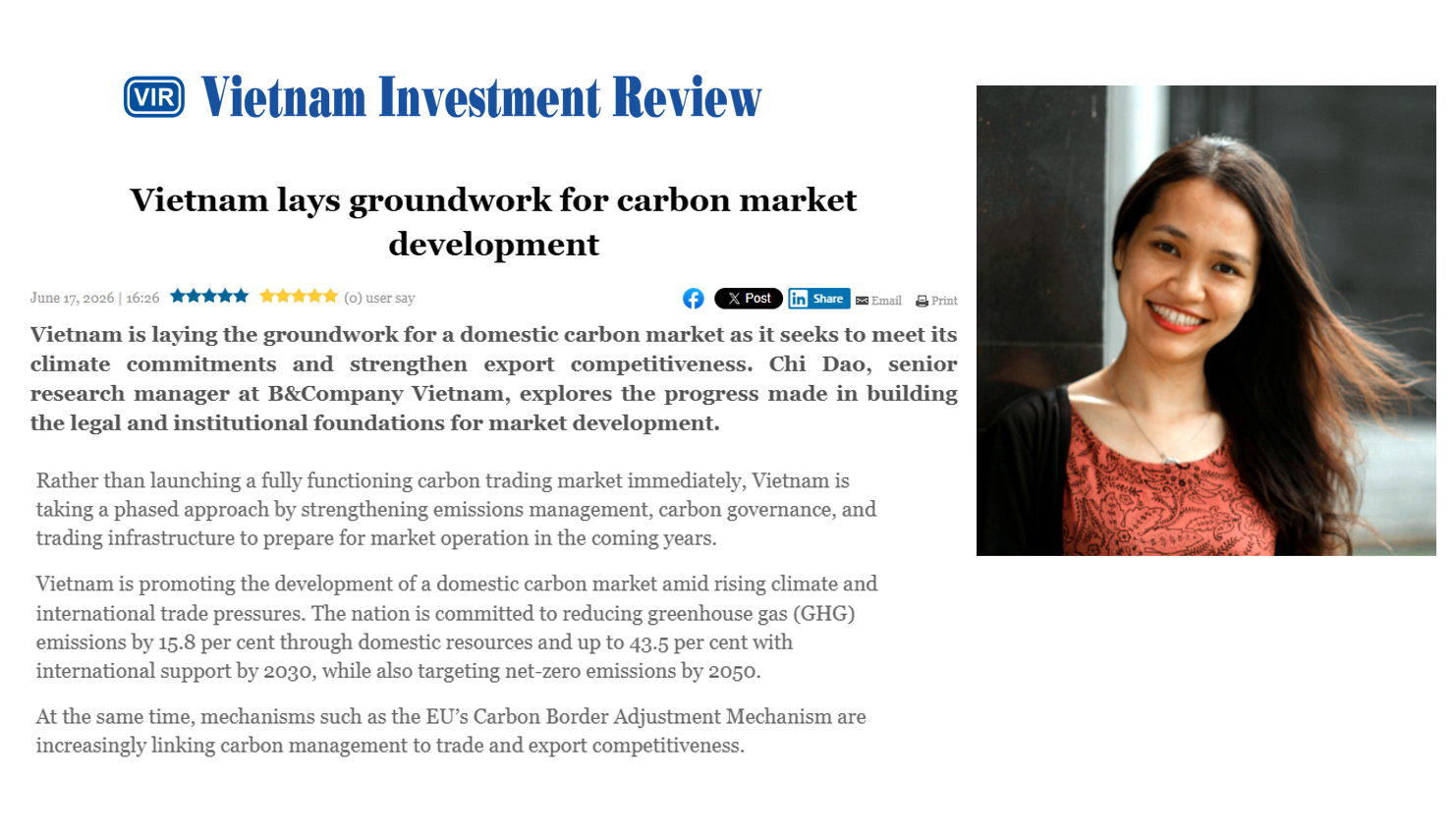
Vietnam is promoting the development of a domestic carbon market amid rising climate and international trade pressures. Under its updated NDC submitted in 2022, Vietnam committed to reducing greenhouse gas emissions by 15.8% through domestic resources and up to 43.5% with international support by 2030, while also targeting net-zero emissions by 2050. At the same time, ESG requirements and mechanisms such as the EU’s Carbon Border Adjustment Mechanism (CBAM) are increasingly linking carbon management to trade and export competitiveness.
However, at the current stage, Vietnam is primarily building the legal and institutional foundation for the carbon market rather than a fully operational trading market. As a result, the current focus is less on transaction volume and more on establishing a comprehensive legal structure for emissions management, carbon trading, and compliance mechanisms.
Building the Legal Foundation for the Carbon Market
The process began with the 2020 Law on Environmental Protection (Law No. 72/2020/QH14), which for the first time introduced the concept of developing a domestic carbon market in Vietnam. Although largely directional, the law established the legal basis for later mechanisms involving emissions quotas and carbon credits.
Building on this foundation, Decree 06/2022/NĐ-CP established the core framework for greenhouse gas management, including greenhouse gas inventories, MRV systems, emissions quota allocation, and carbon credit management for major emitting facilities. This marked a shift from emissions reporting toward compliance-based emissions management.
In parallel, Decision 01/2022/QĐ-TTg defined the list of sectors and facilities required to conduct greenhouse gas inventories across major emitting industries. This effectively created the initial compliance boundary for future emissions regulation and carbon market participation.
Vietnam later refined this framework through Decree 119/2025/NĐ-CP and Decree 83/2026/NĐ-CP, which introduced greater flexibility in quota management and carbon credit usage. However, carbon credit usage remains capped to ensure that actual emissions reduction remains the primary compliance mechanism rather than offset reliance. Together, these revisions show that Vietnam’s carbon governance framework is still evolving alongside implementation capacity and market conditions.
From Market Roadmap to Trading Infrastructure
Alongside emissions management rules, Vietnam also established a phased roadmap for carbon market development. Decision 232/QĐ-TTg defines a pilot phase from 2025 to 2028 before full market operation begins in 2029, reflecting a gradual approach focused on capacity building and system testing. In practice, the pilot phase is expected to remain relatively policy-driven due to limited participation and administrative quota allocation.
The market transaction framework was later formalized through Decree 29/2026/NĐ-CP on the domestic carbon exchange. The decree establishes the core infrastructure required for carbon transactions, including registration, trading, ownership transfer, settlement, and registry management.
A notable feature of Vietnam’s approach is the decision to leverage existing securities infrastructure rather than establish a separate environmental exchange system. Under this structure, the Ministry of Agriculture and Environment manages the national carbon registry, while the Hanoi Stock Exchange (HNX) and the Vietnam Securities Depository and Clearing Corporation (VSDC) operate trading, depository, and settlement functions.
This structure suggests that carbon units are gradually being standardized under centralized regulatory management, although they are not yet treated as financial assets in the same sense as stocks or bonds. Over time, this framework may allow carbon to increasingly influence compliance costs, capital allocation, and industrial competitiveness.
Preparing for International Carbon Linkage
In addition to the domestic market, Vietnam has also started building a legal framework for international carbon exchange. Decree 112/2026/NĐ-CP on the international exchange of greenhouse gas emissions reductions and carbon credits represents an important step in this direction.
While earlier regulations primarily focused on domestic mechanisms, Decree 112 signals Vietnam’s longer-term orientation toward participation in cross-border carbon mechanisms under Article 6 of the Paris Agreement. The decree also introduces principles related to Article 6.2 cooperation, including the international transfer of emissions reductions, accounting requirements for corresponding adjustments, and mechanisms intended to prevent double counting in emissions reporting and carbon credit usage. This suggests that Vietnam is gradually aligning its carbon market governance framework with internationally recognized carbon accounting and emissions transfer standards.
From a policy perspective, this indicates that Vietnam is not only developing a domestic carbon market but is also gradually preparing for future integration with international carbon credit flows and cross-border trading mechanisms.
The Next Challenge Lies in Implementation
Although the legal foundation has been substantially strengthened, the greatest challenge now lies in implementation capacity. A carbon market can only function effectively if emissions data are reliable, MRV systems operate consistently, and regulatory oversight remains effective. In addition, during the early stages, the number of participating industries and enterprises will remain limited, meaning market liquidity is likely to remain relatively low.
As a result, the current stage can be viewed as a transition from legal framework development toward testing actual operational capacity.
Conclusion
Vietnam has largely established a relatively comprehensive regulatory architecture for its carbon market through multiple layers of policy development, ranging from emissions management and compliance mechanisms to market infrastructure and international carbon exchange regulations.
As the market remains in its pilot stage, the significance of current regulations lies less in immediate trading scale than in the establishment of the institutional foundation necessary for carbon to be managed, priced, and traded within Vietnam’s broader economic governance system.
Over time, this framework may gradually reshape compliance costs, investment decisions, and export competitiveness across emissions-intensive industries.
Read more
The Vietnamese Government Approves Project to Develop Carbon Market
* If you wish to quote any information from this article, please kindly cite the source along with the link to the original article to respect copyright.
| B&Company
The first Japanese company specializing in market research in Vietnam since 2008. We provide a wide range of services including industry reports, industry interviews, consumer surveys, business matching. Additionally, we have recently developed a database of over 1,000,000 companies in Vietnam, which can be used to search for partners and analyze the market. Please do not hesitate to contact us if you have any queries. info@b-company.jp + (84) 28 3910 3913 |
[1] https://thuvienphapluat.vn/van-ban/Tai-nguyen-Moi-truong/Luat-so-72-2020-QH14-Bao-ve-moi-truong-2020-431147.aspx
[2] https://thuvienphapluat.vn/van-ban/Tai-nguyen-Moi-truong/Nghi-dinh-06-2022-ND-CP-giam-nhe-phat-thai-khi-nha-kinh-va-bao-ve-tang-o-don-500104.aspx
[3] https://thuvienphapluat.vn/van-ban/Tai-nguyen-Moi-truong/Nghi-dinh-119-2025-ND-CP-sua-doi-Nghi-dinh-06-2022-ND-CP-giam-nhe-phat-thai-khi-nha-kinh-625021.aspx
[4] https://thuvienphapluat.vn/van-ban/Tai-nguyen-Moi-truong/Nghi-dinh-83-2026-ND-CP-sua-doi-Nghi-dinh-06-2022-ND-CP-giam-nhe-phat-thai-khi-nha-kinh-bao-ve-tang-o-don-698699.aspx
[5] https://thuvienphapluat.vn/van-ban/Tai-nguyen-Moi-truong/Quyet-dinh-232-QD-TTg-2025-phe-duyet-De-an-phat-trien-thi-truong-cac-bon-tai-Viet-Nam-641620.aspx
[6] https://thuvienphapluat.vn/van-ban/Tai-nguyen-Moi-truong/Quyet-dinh-232-QD-TTg-2025-phe-duyet-De-an-phat-trien-thi-truong-cac-bon-tai-Viet-Nam-641620.aspx
[7] https://thuvienphapluat.vn/van-ban/Tai-nguyen-Moi-truong/Nghi-dinh-112-2026-ND-CP-trao-doi-quoc-te-ket-qua-giam-nhe-phat-thai-khi-nha-kinh-va-tin-chi-cac-bon-699909.aspx
Related article
































Log in / Register
SUBSCRIBE NEWSLETTER