

 English
  日本語
日本語  Tiếng Việt
  简体中文
简体中文  한국어
한국어 This reviews where cooperation is expanding and how Japanese companies can contribute to recent Japan-Vietnam cooperation in water-related climate risks
03Aug2026
Latest News & Report / Vietnam Briefing
Comments: No Comments.
Water-related climate risks are becoming a larger infrastructure challenge for Vietnam. Floods, landslides, reservoir operation, riverbank erosion and saltwater intrusion affect roads, agriculture, industrial zones, urban development and local livelihoods. Recent Japan–Vietnam cooperation shows a more integrated approach, combining rural infrastructure finance, hydraulic technology exchange, satellite monitoring and private-sector disaster prevention solutions. This article reviews where cooperation is expanding and how Japanese companies can contribute.
Why water resilience matters for Vietnam
Vietnam’s climate risks are closely linked to water. The northern mountainous region faces flash floods and landslides. Central Vietnam is exposed to typhoons, river flooding and reservoir-operation risks. The Mekong Delta faces tidal flooding, sea-level rise and saltwater intrusion. Major cities also face stronger drainage pressure as urbanization expands.
These risks have direct economic consequences. The World Bank estimated that climate change impacts cost Vietnam about USD 10 billion in 2020, equivalent to 3.2% of gross domestic product. Without proper adaptation and mitigation, climate change could cost Vietnam around 12–14.5% of gross domestic product annually by 2050.
For this reason, climate-resilient infrastructure is no longer only about disaster response. It is part of Vietnam’s long-term development agenda. Roads, irrigation systems, embankments, water supply facilities, dams, sluice gates and monitoring systems all affect whether communities and businesses can continue operating after extreme weather events.
A more integrated Japan–Vietnam cooperation framework
Japan has long supported Vietnam through official development assistance, urban infrastructure and disaster risk reduction. Recent agreements suggest that cooperation is becoming more specialized.
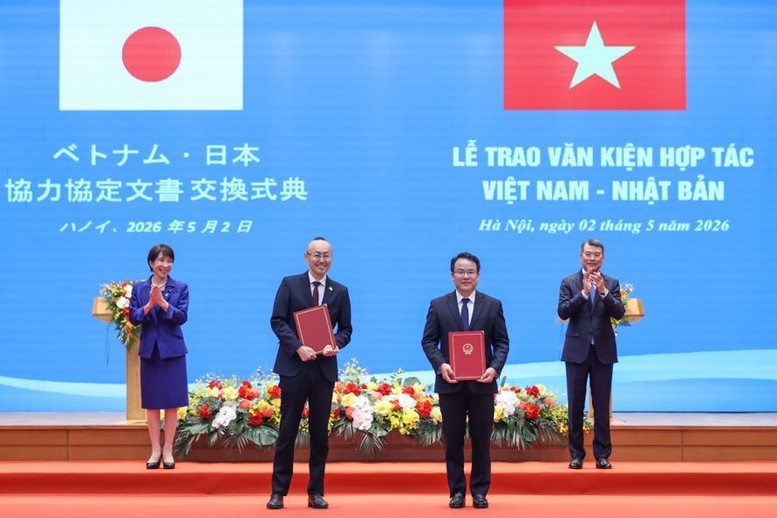
On May 2, 2026, Vietnam and Japan exchanged several cooperation agreements related to climate resilience and water management. These included loan agreements for disaster-resilient rural development and climate-resilient infrastructure in northern mountainous provinces, a memorandum of understanding on technological and technical exchanges in the hydraulic field, and an agreement on satellite data exchange between the Vietnam National Space Center and the Japan Aerospace Exploration Agency.
Minister Le Minh Hung and Minister Takaichi Sanae witnessed the exchange of the Loan Agreement for the Disaster-Resilient Rural Development Project between the Government of Vietnam and the Japan International Cooperation Agency (JICA)
Source: vneconomy
The important point is that these agreements cover different parts of the same problem. Climate-resilient infrastructure is not only about building more concrete assets. It also requires finance, data, hydraulic technology, monitoring systems and private-sector solutions.
| Cooperation layer | Main focus | Example |
| Infrastructure finance | Roads, irrigation, embankments, water supply | Japan International Cooperation Agency loans |
| Hydraulic technology | Dams, reservoirs, river-basin management | Japan–Vietnam hydraulic technical exchange |
| Monitoring and data | Satellite data, flood monitoring, agriculture and forestry data | Japan Aerospace Exploration Agency and Vietnam National Space Center |
| Private-sector solutions | Warning systems, dredgers, filtration, disaster supplies | Kochi Prefecture solutions introduced by B&Company |
B&Company’s synthesis
Rural infrastructure: small assets, large impact
One clear example is the Japan International Cooperation Agency’s 2026 loan package for northern and mountainous Vietnam. On May 1, 2026, the agency signed loan agreements with Vietnam for two projects focused on disaster resilience and climate-adaptive infrastructure.
The first project, the Project for Disaster Resilient Rural Development, has a maximum loan amount of JPY 21.59 billion. It aims to strengthen climate resilience and disaster adaptation through small-scale infrastructure such as roads, irrigation and embankments. The project covers 90 planned subprojects, including 41 road subprojects, 29 irrigation subprojects and 20 riverbank protection subprojects.
The second project, the Project for Development of Climate Adaptive Infrastructure to Support Production for Ethnic Minority Communities in the Northern Mountain and Midland Area, has a maximum loan amount of JPY 17.666 billion. It covers roads, irrigation and water supply facilities in northern mountainous areas.
This shows a practical direction for Japan–Vietnam cooperation. Climate-resilient infrastructure does not always mean mega-dams or large urban projects. In mountainous areas, a safer bridge, a protected riverbank, a repaired canal or a reliable water supply facility can directly affect income, market access and safety.
Dams, reservoirs and data-driven water control
Water control also depends on how dams, reservoirs and river basins are operated. This is especially relevant in central Vietnam, where typhoons and heavy rainfall can quickly create flood risks.
Physical assets such as dams, dikes, canals and embankments remain essential. However, climate change increases uncertainty. Rainfall can become more intense, flood peaks can arrive faster, and different objectives such as hydropower, irrigation and flood control may conflict during extreme weather.
Digital tools can support better decisions. Real-time rainfall gauges, river water-level sensors, reservoir data, weather forecasts, flood simulation, remote-control gates and command centers can help authorities respond earlier. The value comes not only from hardware, but from connecting data with operating rules and public communication.
Satellite data: from observation to early action
Satellite data is becoming another important layer of cooperation. In April 2026, the Japan Aerospace Exploration Agency concluded a modification to its agreement with the Vietnam National Space Center on satellite data exchange. The agreement was formally exchanged on May 2, 2026.
The cooperation builds on the use of Advanced Land Observing Satellite-2 data and adds data from Advanced Land Observing Satellite-4. Japan Aerospace Exploration Agency states that this is expected to strengthen monitoring of increasingly frequent flood disasters in Vietnam. The same cooperation also supports disaster management, agriculture, forestry and research on rice-paddy water monitoring for methane reduction.
For flood and water management, satellite data can help monitor inundated areas, river basins, landslides and post-disaster damage. It is especially useful when ground access is difficult after storms or floods.
Urban flood control: lessons from Can Tho
Although not a Japan-funded project, the Can Tho Urban Development and Resilience Project is a useful example of where Vietnam’s flood-control market is moving. The World Bank-funded project built flood defenses along the Can Tho and Khai Luong rivers, including tidal sluice gates, ship locks, upgraded canals and river embankments. It protected about 420,000 residents across 2,500 hectares of the urban core.
The project also deployed a Flood Risk Management Information System with 60 sensors at flooding hotspots. These sensors feed real-time data into a central command center, while the system also supports simulations using historical data and weather forecasts.
This example shows that flood control is no longer only a civil-engineering issue. The next generation of flood infrastructure combines hard assets, sensors, software, operations and maintenance. For Japanese companies, opportunities may exist not only in construction, but also in monitoring equipment, control systems, consulting, training and data services.
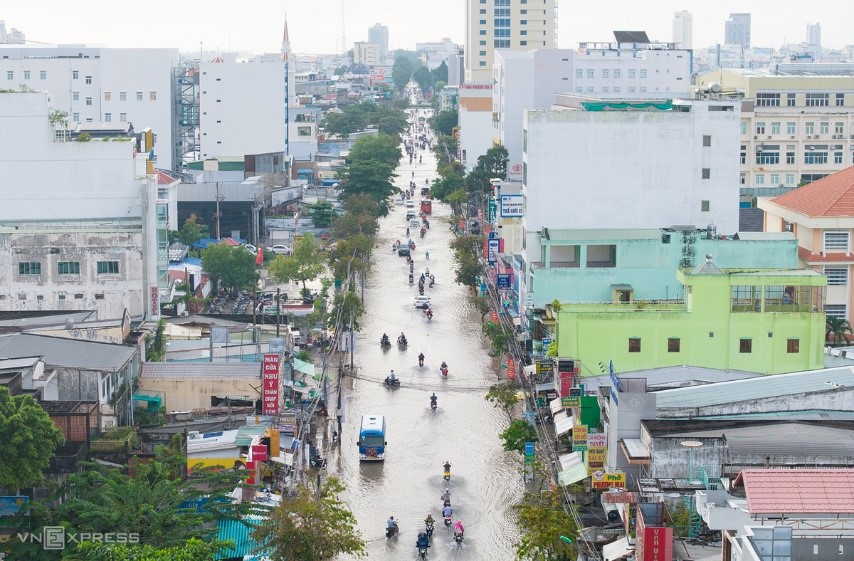
Flood in Can Tho
Source: Vnexpress
Where Japanese companies can contribute
Japanese companies can contribute at several points in the climate-resilient infrastructure value chain. The opportunity is not limited to construction. It also includes monitoring, control, maintenance and emergency response.
| Vietnam’s need | Potential Japanese solution | Possible users |
| Flash flood and landslide warning | Water-level sensors, landslide measurement, alert systems | Provinces, disaster agencies, hydropower operators |
| River and canal maintenance | Dredging equipment, pollution-control fences | Urban authorities, industrial parks, water companies |
| Flood-resilient construction | Embankment materials, ground improvement, slope protection | Contractors, infrastructure owners, local governments |
| Post-disaster water safety | Portable filtration, sanitation and water treatment | Local authorities, relief agencies, communities |
| Data-driven management | Satellite data, flood simulation, command-center software | Central ministries, provinces, research institutes |
B&Company’s synthesis
B&Company’s article on disaster prevention solutions from Kochi Prefecture highlighted several relevant product groups, including water-level warning systems, landslide measurement and warning systems, disaster-resistant construction materials, amphibious dredgers, underwater pollution prevention fences, water filtration systems and solar-powered warning lights.
The key requirement is localization. Products that work in Japan may need different pricing, maintenance arrangements, Vietnamese-language manuals, local demonstrations and after-sales support in Vietnam.
B&Company experience and support
B&Company has practical experience in this field through the Kochi Vietnam Support Desk. Since 2024, B&Company Vietnam has operated the desk under the authorization and sponsorship of the Kochi Industrial Promotion Center.
In the 2025–2026 term, the Kochi Vietnam Support Desk introduced over 600 potential Vietnamese suppliers, partners, distributors and clients to Kochi companies. It also directly introduced and connected Kochi products with more than 100 Vietnamese companies, leading to around 40 online and in-person business discussions.
This experience is relevant because many Japanese small and medium-sized enterprises have strong technologies but limited knowledge of Vietnam’s procurement channels and implementation conditions. In disaster prevention and water-control infrastructure, business matching requires more than a company list. It requires understanding the actual user, budget source, technical requirements, procurement route and maintenance model.
B&Company supports Japanese companies, local governments and public-sector organizations through market research, partner search, business matching, local interviews, industry mapping and Vietnam market entry support. Based on its Kochi experience, B&Company can help Japanese companies assess where disaster-prevention and water-management technologies fit Vietnam’s practical needs.
Read more
Mekong Delta: Climate change impacts, solutions, and investment opportunities
*Cover photo: vneconomy
* If you wish to quote any information from this article, please kindly cite the source along with the link to the original article to respect copyright.
| B&Company
The first Japanese company specializing in market research in Vietnam since 2008. We provide a wide range of services including industry reports, industry interviews, consumer surveys, business matching. Additionally, we have recently developed a database of over 1,000,000 companies in Vietnam, which can be used to search for partners and analyze the market. Please do not hesitate to contact us if you have any queries. info@b-company.jp + (84) 24 3978 5165 |
Related article





Log in / Register
SUBSCRIBE NEWSLETTER