

 English
  日本語
日本語  Tiếng Việt
  简体中文
简体中文  한국어
한국어 The number of green-certified buildings in Vietnam has steadily increased over the past 14 years, with a significant development in 2024.
02Apr2025
Highlight content / Industry Reviews / Latest News & Report
Comments: No Comments.
Current status of green buildings in Vietnam and trends
The number of green-certified buildings in Vietnam has steadily increased over the past 14 years. While only one building was certified each year in 2010 and 2011, the number increased to 20 by 2012, 26 in 2017, 58 in 2020, and then 76 in 2023[1]. The year 2024 marks a significant advancement in the development of green buildings, with a total of 163 certified projects [2]
So far, the country has accumulated a total of 559 green-certified buildings with a combined floor area of 13.6 million sq.m. This figure far exceeds the original targets of 80 green buildings by 2025 and 160 by 2030[3] set forth in the National Energy Efficiency Program for 2019–2030 (VNEEP3), which aims to reduce energy consumption in the construction sector by 5–7% in the 2019–2025 period and 8–10% by 2030, while promoting the development of energy-efficient and green buildings nationwide[4][5]
Number of green buildings by certification systems in Vietnam (updated on December 31, 2024)
| EDGE | LEED | GREENMARK | OTHERS | TOTAL | |
| Number of Green certified buildings | 258 | 208 | 51 | 42 | 559 |
| Number of Green certified Apartment units | 18,182 | 1,285 | 9,759 | 2,158 | 31,384 |
| Number of Green certified Landed houses | 2,995 | – | 231 | 8 | 3,234 |
| Green certified GFA (sq.m) | 5,687,647 | 5,354,195 | 1,922,883 | 614,863 | 13,579,588 |
Source: EDGE Buildings, IFC, World Bank Group
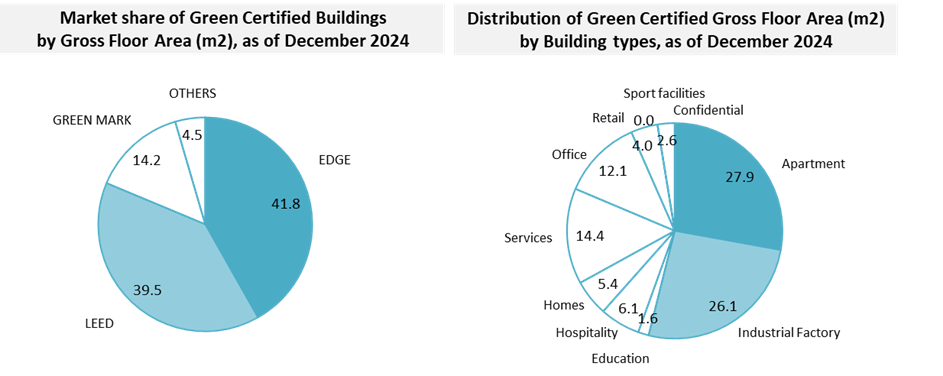
In Vietnam, the most widely adopted green building standards include Leadership in Energy and Environmental Design (LEED), World Bank’s Excellence in Design for Greater Efficiencies (EDGE), Singapore’s Green Mark, and LOTUS —a standard specifically designed for Vietnam[6]. Notably, over 80% of these projects are certified under LEED and EDGE.
The majority belong to the green apartment group, accounting for 27.9% of the total floor area, followed by industrial factories (26.1%). Beyond green apartments, the past two years have seen notable growth in green industrial buildings, with the total number of green factories reaching 163—tripling in just two years. Hoang Manh Nguyen, a member of the Vietnam Green Building Council, stated that there is significant demand for green buildings in green industrial parks, especially for factories that export products to developed countries. Many of these factories require certification to ensure their products can be exported and maintain operations.[7]
Rising opportunities in Vietnam’s green architecture
The Green Infrastructure Investment Opportunities (GIIO) report further underscores the global shift toward sustainable development, estimating nearly $100 trillion in green infrastructure investments worldwide between 2019 and 2030. Vietnam is no exception to this trend, as the country pushes towards net-zero emissions by 2050 while also being driven by rapid urbanization and strong economic growth [8]
As a milestone toward net-zero emissions, Vietnam has stated in its nationally Determined Contribution (NDC) its target to reduce 74.3 million tons of CO2 by 2030. Green building projects, therefore are playing a critical role in achieving this target, reinforcing the country’s commitment to sustainability while opening doors for investors, developers, and businesses seeking to capitalize on this fast-growing sector.[9]
Related article







Log in / Register
Continue without an account
Log in / Register
SUBSCRIBE NEWSLETTER