

 English
  日本語
日本語  Tiếng Việt
  简体中文
简体中文  한국어
한국어 With the risk of natural disasters expected to increase further, the demand for effective disaster prevention in Vietnam is growing stronger.
28Jul2025
Highlight content / Highlight Content JP / Highlight content vi / Industry Reviews / Latest News & Report
Comments: No Comments.
Status of natural disasters
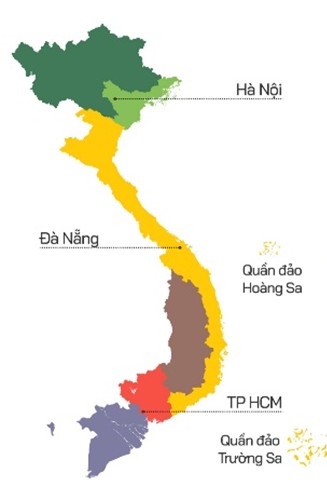
Vietnam is one of the countries with particularly high risks of natural disasters in the Asia-Pacific region. With a coastline stretching 3,300 km, it is frequently affected by various hydrometeorological disasters such as typhoons, floods, landslides, droughts, and coastal erosion. Among these, floods cause the most severe damage, resulting in significant economic and social losses.
Furthermore, Vietnam is ranked among the top countries in the world vulnerable to the impacts of climate change, with particularly severe effects from sea level rise in coastal and delta regions. On the other hand, the earthquake risk is relatively low, and tsunamis have not occurred in recent years.
[Figure 1] Geographic Features and Occurrence of Major Natural Disasters
 |
|
Source: B&Company
According to statistics from the past 14 years, the annual average number of deaths and missing persons due to natural disasters reaches approximately 250, resulting in economic losses equivalent to 0.5% to 1.5% of GDP.
The Vietnamese government points out that the frequency of natural disasters, which are difficult to predict, is increasing, and accordingly, the expansion of human casualties and economic losses has become a serious issue. In particular, 2024 was the most damaging year in recent years, with nine typhoons, one tropical cyclone, and 232 extreme weather events resulting in 514 deaths and economic losses of approximately VND 88 trillion.[1]
[Figure 2] Trends in Damage and Loss Amounts Due to Disasters
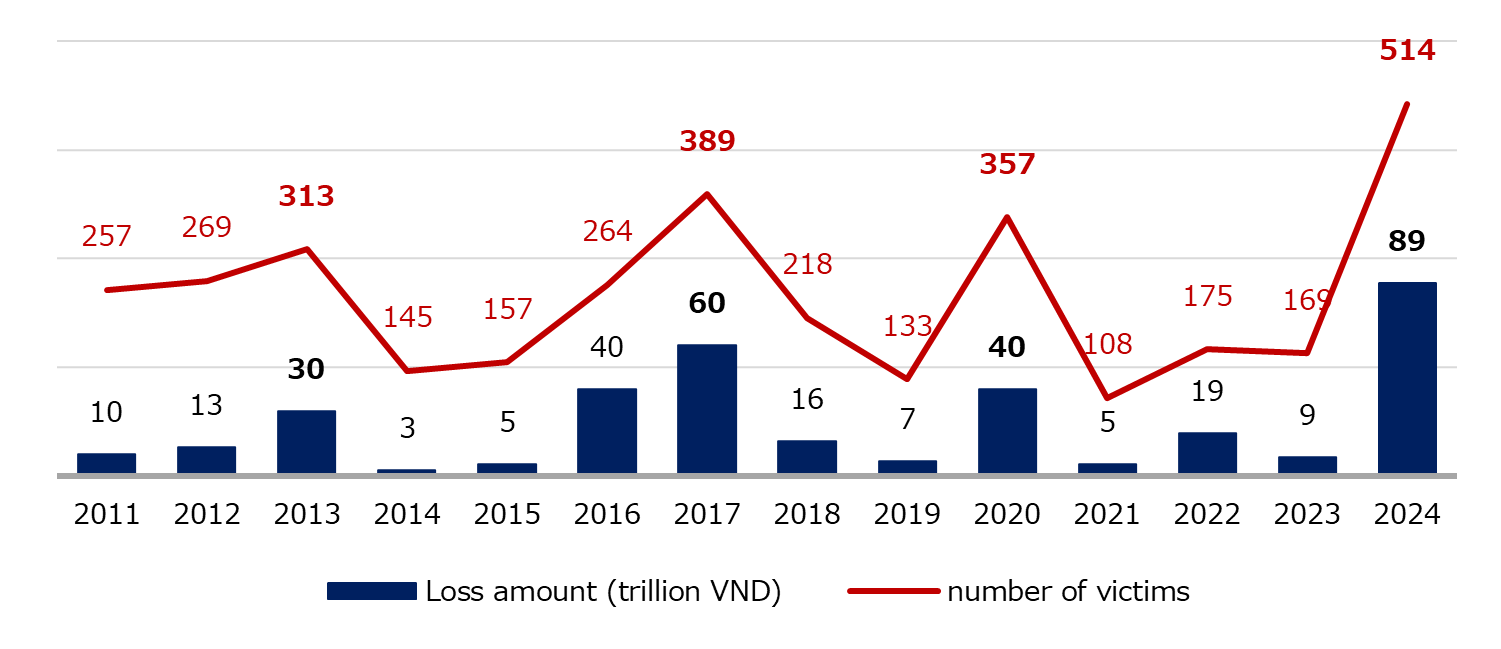
| 2013 | 15 typhoons (including the super typhoon “Haiyan”) occurred, with over 200 instances of thunderstorms and hail, and severe flooding and abnormal snowfall were also confirmed in the central region. |
| 2017 | 16 typhoons (Including damage of approximately 1 billion USD caused by “Damray”, severe flooding and landslides occurred and record high temperatures in Hanoi. |
| 2020 | There were 13 typhoons, 264 thunderstorms, 120 floods and landslides, record flooding in October, two magnitude 4 earthquakes, and severe drought and coastal erosion in the Mekong Delta. |
| 2024 | 1,340 disaster cases were reported, with widespread flooding and landslides occurring due to the large typhoon “Yagi” |
Source: B&Company
Among them, Typhoon “Yagi,” which made landfall in September 2024, was considered a once-in-70-year event and caused extensive and severe damage over a wide area. Additionally, the severe droughts in the Mekong Delta during 2015-2016 and 2020 resulted in saltwater intrusion occurring at levels exceeding the usual timing and extent, making it urgent to strengthen response capabilities going forward.
Initiatives for Disaster Prevention and Countermeasures
System construction for disaster prevention and recovery measures
The Vietnamese government is advancing the strengthening of a comprehensive disaster management system from the national to the local level, aiming to reduce disaster risks and improve emergency response capabilities. In 2023, based on the Civil Defense Law, the “Vietnam National Civil Defense Steering Committee (VNCIVDEF)” was established, integrating the functions of the existing National Steering Committee for Natural Disaster Prevention and Control (NSCNDPC) and the National Committee for Accident, Disaster Response, and Search and Rescue (VINASARCOM).
The committee is chaired by the Prime Minister and consists of ministers from various ministries, the Chief of Staff, representatives from the Vietnam Fatherland Front, the Women’s Union, the Ho Chi Minh Communist Youth Union, the Vietnam Red Cross, and other major social organizations, promoting effective disaster countermeasures through collaboration across a wide range of fields.
At the local level as well, private defense command centers are established at the provincial, district, and commune (basic local government) units, responsible for planning and implementing disaster prevention, management, and search and rescue activities, and responding according to the actual conditions of the region.
Enhancement of the Early Warning System (EWS)
Vietnam’s Early Warning System (EWS) has been significantly strengthened in recent years based on the national strategy for disaster risk management. Under the management of the Ministry of Agriculture and Environment, a monitoring system for various hazard factors such as meteorological, river, hydrological, seismic, and coastal data, has been established, focusing on forecasting and issuing warnings before disasters occur.
In particular, efforts are being made to advance the transition to “Impact-Based Forecasting and Warning (IbFW),” which emphasizes the impact on society and infrastructure. The Vietnam Meteorological and Hydrological Administration (VNMHA) is taking the lead in improving forecast accuracy and strengthening information-sharing systems through collaboration with regional mechanisms such as the Southeast Asia Flood Alert System (SeAFFGS) and international partners.
These initiatives align with the United Nations’ concept of “Early Warning Systems for All People,” and Vietnam aims to complete the establishment of a nationwide early warning network by 2027.
Challenges in Vietnam and Business Opportunities for Japanese Companies
As mentioned above, although Vietnam is making progress in developing a national disaster prevention system and early warning system, there are still issues that remain. In 2024, the powerful typhoon “Yagi” damaged more than 100,000 houses in Quang Ninh Province[2] and caused a bridge collapse in Phu Tho Province, highlighting the vulnerability of infrastructure in the northern region in particular[3].
Furthermore, there have been confirmed cases where the lack of adequate flood monitoring systems and drainage facilities led to the expansion of damage. Based on these circumstances, the government and humanitarian aid organizations also recognize the need for technological investments, including the latest disaster prevention equipment and the renewal of aging facilities.
Japan has been involved as an important partner for many years in the field of disaster resilience improvement in Vietnam. For example, the Japan International Cooperation Agency (JICA) supports the building of disaster-resilient communities in the central region of Vietnam, working on enhancing the response capabilities of local residents, strengthening early warning systems, and developing disaster information management platforms.
In addition, the Japan Disaster Prevention Platform is promoting the introduction of disaster prevention technologies through the “Japan-Vietnam Disaster Prevention Collaborative Dialogue,” and the Ministry of the Environment is conducting a demonstration test of an early warning system in Hanoi.
Going forward, continued cooperation leveraging Japan’s disaster prevention technology and expertise will be required, and it is also expected that business opportunities in the disaster prevention sector in Vietnam will expand for Japanese companies.
Based on the above situation, Vietnam is considered to be a significant potential market for disaster prevention and safety technology. With the risk of natural disasters such as typhoons, floods, and landslides expected to increase further, coupled with the severe damage caused by recent large typhoons, the demand for effective disaster prevention and mitigation measures is growing even stronger.
[Figure 3] Examples of disaster prevention-related equipment and technologies expected to see increased demand
| Early warning and surveillance field | A system capable of monitoring floods and landslides in real-time with high accuracy (particularly in high demand in the northern and central highland regions). |
| Typhoon Damage Mitigation and Disaster Resilience Enhancement | Prefabricated retaining walls, highly durable reinforced concrete structures, environmentally conscious soil stabilization technologies, etc. |
| Water and Environmental Technology | Amphibious vehicles, water pollution prevention barriers, water purification systems, and other technologies that contribute to recovery and securing drinking water during disasters |
| Emergency support materials | Warning lights, small generators, emergency food supplies, and other emergency response materials |
Source: B&Company
As the Vietnamese government promotes “building a disaster-resilient country,” the introduction of these disaster prevention-related technologies and products is required to be carried out with consideration for sustainability. International technical cooperation in the disaster prevention field is expected to contribute not only to enhancing disaster response capabilities within Vietnam but also to strengthening disaster prevention capacities throughout Southeast Asia.
[1] 出典:Voice of Vietnam(ベトナム国家ラジオ放送局)のニュース「Year 2024 Saw Extreme, Devastating Natural Disasters Causing Enormous Damage」(2024年12月)
[2] 出典:FPT Online(オンラインニュースメディア)のニュース「Quang Ninh Supports 100 million VND for Each Family Whose House was Collapsed by the Storm」(2024年7月)
[3] 出典:Center for Disaster Philanthropy(米国の災害対応・復興プラットフォーム)のニュース「2024 Super Typhoon Yagi」(2024年5月)
* If you wish to quote any information from this article, please kindly cite the source along with the link to the original article to respect copyright.
| B&Company
The first Japanese company specializing in market research in Vietnam since 2008. We provide a wide range of services including industry reports, industry interviews, consumer surveys, business matching. Additionally, we have recently developed a database of over 900,000 companies in Vietnam, which can be used to search for partners and analyze the market. Please do not hesitate to contact us if you have any queries. info@b-company.jp + (84) 28 3910 3913 |
Related article




















Log in / Register
SUBSCRIBE NEWSLETTER