

 English
  日本語
日本語  Tiếng Việt
  简体中文
简体中文  한국어
한국어 Vietnam, with its renewable energy resources, is positioning itself as a key player in the green hydrogen and green ammonia industries.

09Apr2025
Latest News & Report / Vietnam Briefing
Comments: No Comments.
As the global energy transition accelerates, green hydrogen and green ammonia are emerging as pivotal solutions for achieving carbon neutrality. Vietnam, with its abundant renewable energy resources, is positioning itself as a key player in the green hydrogen and green ammonia industries.
The demand for Green Hydrogen and Green Ammonia development in Vietnam
Vietnam’s current greenhouse gas (GHG) emissions pose significant threats to the country’s commitments to its Net-Zero targets by 2050. According to the Emissions Database for Global Atmospheric Research (EDGAR), Vietnam ranked 18th globally in GHG emissions with over 524 million tonnes of CO2eq in 2023, accounting for 1% of the global emission volume[1]. The power sector generated over 30% of the nation’s total emissions, with a CAGR of 12% from 2000 to 2023. The sector sees a heavy reliance on coal-fired thermal power[2], as reports from the International Energy Agency (IEA) highlight that coal was responsible for over 90% of its CO2 emissions in 2022 with a total emission volume of 127.3 million tonnes. With a plan to cut down emissions from the energy sector to only 101 million tonnes annually under the Net-Zero scenario[3], the country is under pressure to decarbonize the energy sector and to develop alternatives for traditional coal-fired plants.
Vietnam Greenhouse Gas emission by sector from 2000 to 2023
Unit: %
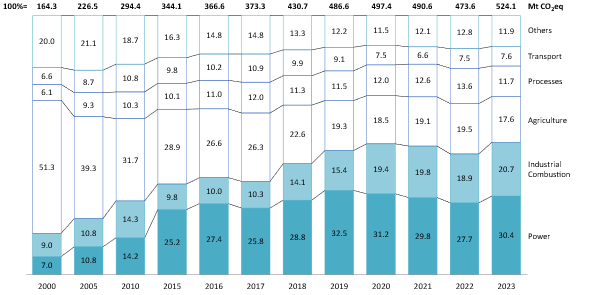
Source: B&Company Vietnam synthesis from EDGAR’s reports
The development of green hydrogen and green ammonia in Vietnam is emerging as a pivotal component of the country’s decarbonization efforts and transition to sustainable energy. Green hydrogen, produced through renewable energy, and green ammonia, synthesized via the Haber-Bosch process, are gaining traction as potential sustainable energy carriers to be used in the power industry and industrial combustion[4], the two leading sectors in terms of GHG emissions. These green alternatives also hold the potential to decarbonize hard-to-abate industries, such as cement, iron, and steel production[5]. With the current production of 500 thousand tonnes of grey hydrogen annually for these industries[6], transitioning to green hydrogen and green ammonia could cut the country’s greenhouse gas emissions by up to 6.5 million tonnes of CO2eq, further advancing its sustainability goals[7].
Current development status and growth potential of Green Hydrogen and Green Ammonia in Vietnam
Green hydrogen and green ammonia are primarily used in the chemical and manufacturing industries, with their role in the energy sector still in the experimental stage[8]. While this trend holds true in Vietnam, the country is currently undergoing significant developments in preparation for green hydrogen and ammonia production and application as part of its broader clean energy transition initiatives, driven by both domestic initiatives and global trends toward decarbonization.
Regarding green hydrogen, Vietnam is among the first 50 countries to announce its Hydrogen Energy Development Strategy in 2024 through Decision No. 165/QD-TTg signed in 2024[9]. Currently, 500 thousand tonnes of grey and brown hydrogen produced annually are used primarily in the oil refining (36%) and fertilizer manufacturing industries (64%), with only 0.5% allocated to other industries such as steel, food, and electronics[10].
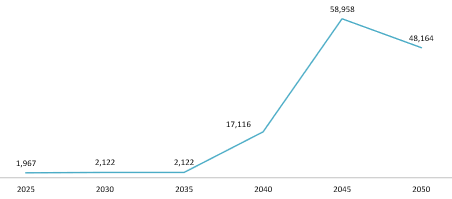
Under Decision No. 165/QD-TTg, the production of green hydrogen from renewable sources and from carbon capture/utilization (CCS/CCUS) technologies will be prioritized, with a national output of between 100 and 500 thousand tonnes in 2030 and between 10 and 20 million tonnes in 2050. Future applications will focus on electricity generation (69%) and transportation (28%), marking a significant shift toward sustainable energy solutions. With strong domestic production and rising global demand, the exportation of green hydrogen is highly possible, with a total value expected to reach over 7.6 million tonnes in 2050.
Table 1: Vietnam’s demand for hydrogen in 2030 and 2050 in different scenarios
Related article















Log in / Register
Continue without an account
Log in / Register
SUBSCRIBE NEWSLETTER