

 English
  日本語
日本語  Tiếng Việt
  简体中文
简体中文  한국어
한국어 Vietnam's agriculture has great potential to aid Net Zero by 2050 but would need new technologies and global partnerships to reduce GHG emissions.
06Feb2025
Latest News & Report / Vietnam Briefing
Comments: No Comments.
Vietnam’s agriculture sector holds significant potential to help the country achieve Net Zero emissions by 2050. However, it is currently a major contributor to the annual greenhouse gas (GHG) emissions, highlighting the need for emerging technologies and international partnerships to support the country’s environmental commitments.
Overview of Vietnam’s agricultural GHG emissions
Despite the country’s efforts, Vietnam is still recording rising yearly GHG emissions. According to the Emissions Database for Global Atmospheric Research (EDGAR), in 2023, the country released 524 million tonnes of CO2 equivalent (Mt CO2eq), an increase of 11% from the previous year and 5% from the 2020 base level[1]. This level of emissions makes Vietnam the second largest GHG emitter of the ASEAN and 17th globally. The majority of GHG emissions consisted of fossil CO2 making up over 71% of total emissions, followed by CH4 (22%), N20 (5%), and other F-gasses (2%). The increasing volume of annual GHG emissions poses significant threats to the nation’s development as Vietnam is among one of the most detrimentally impacted countries by climate change, especially for the Mekong River Delta[2].
Vietnam’s annual GHG emissions, from 2015 to 2023 (Unit: Mt CO2eq)
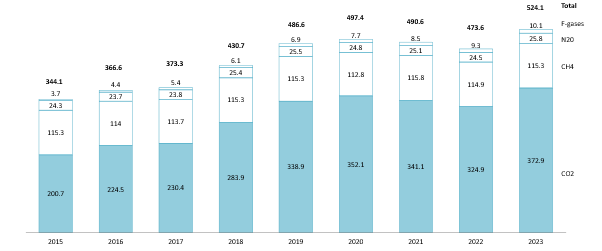
Source: EDGAR, B&Company synthesis
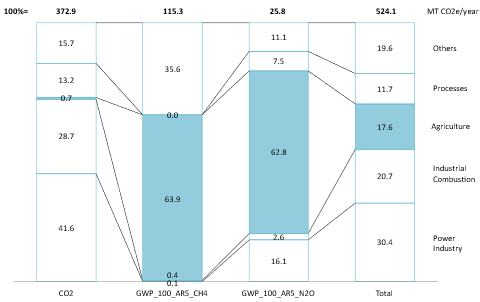
The agriculture sector is among the leading GHG emitters in Vietnam. The sector released 92.5 Mt CO2eq in 2023, accounting for 17.6% of the country’s total emissions[3]. While agriculture contributed less than 1% of the amount of released CO2, it made up nearly two-thirds of the total emitted CH4 and N2O, which have significantly higher global warming potential values[4]. The World Bank highlighted that such high emissions of CH4 and N2O can be attributed to three main sub-sectors, which are rice cultivation (48%), livestock (15%), and usage of fertilizers (13%)[5].
– Rice cultivation: Paddy fields are a significant source of methane (CH4), generated during the anaerobic decomposition of organic matter in flooded fields.
– Livestock production: Enteric fermentation in ruminants produces methane, while manure management contributes both CH4 and N2O emissions.
– Fertilizer use: Overapplication of synthetic nitrogen fertilizers leads to N2O emissions.
Vietnam’s structure of GHG emissions by category and economic sector in 2023 (Unit: %)
Related article





















Log in / Register
Continue without an account
Log in / Register
SUBSCRIBE NEWSLETTER