

 English
  日本語
日本語  Tiếng Việt
  简体中文
简体中文  한국어
한국어 Supported by strong digital growth and regulatory frameworks, Vietnam data center market is expected to expand rapidly in the coming decade.

14Apr2026
Highlight content / Highlight Content JP / Highlight content vi / Industry Reviews / Latest News & Report
Comments: No Comments.
Abstract
Vietnam is emerging as one of Southeast Asia’s most compelling data center destinations. A fast-expanding digital economy, rising AI adoption across industries, and a modernizing regulatory environment are collectively driving unprecedented investment in data infrastructure. Both domestic telecoms operators and international technology firms are accelerating their commitments, positioning Vietnam as a serious contender in the regional infrastructure race. Supported by strong digital growth and evolving regulatory frameworks, Vietnam’s data center market is expected to expand rapidly in the coming decade, playing a crucial role in enabling the country’s AI development strategy and digital transformation.
Market Landscape
Vietnam’s data center sector sits at an early but rapidly accelerating stage. Total operational capacity was projected to stand at 104 MW in 2025 [1], roughly one-tenth of Shanghai’s 1,071 MW and well behind Singapore’s 738 MW, yet the trajectory is steep. Planned additional capacity is expected to reach 589 MW after 2030, representing a 5.6-fold increase in total market size, with Ho Chi Minh City forecast to surge by 811% and the former Binh Duong province by 1,071%[2]. The Vietnam Internet Association (VIA) puts the ceiling higher, projecting that total capacity could approach 1,000 MW by the same period. This gap between current scale and pipeline volume is precisely what is attracting international capital.
Vietnam’s Data Center Operating Capacity (MW)
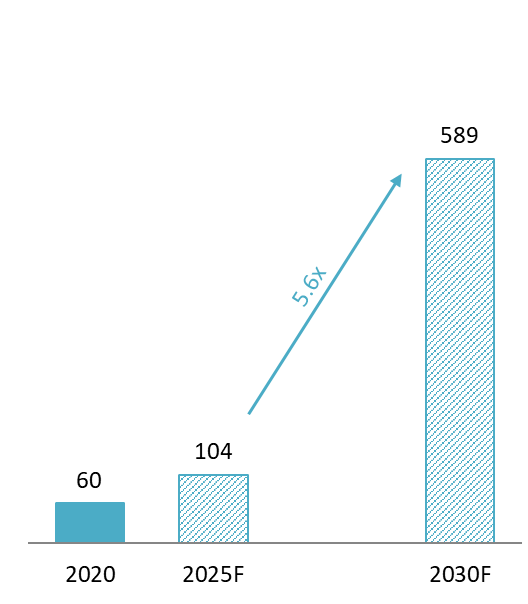
Source: CBRE Report 2025 [3]
Demand is being shaped by two converging forces: the broader digital economy and the specific, infrastructure-heavy requirements of AI. Vietnam had nearly 79 million internet users at the start of 2024, representing an internet penetration rate of 79.1% [4]. The platforms serving this user base — e-commerce, digital banking, streaming, and an expanding layer of AI-driven applications in manufacturing, finance, and retail — generate data volumes that existing infrastructure is not yet equipped to absorb at scale. Machine learning model training, large-scale inference, and enterprise cloud services all demand a class of high-density, low-latency facilities that Vietnam is only beginning to build. The CBRE Data Centre in Vietnam report identifies AI adoption as the primary structural driver of long-term demand growth for data center capacity.
Vietnam’s Internet Usage Status
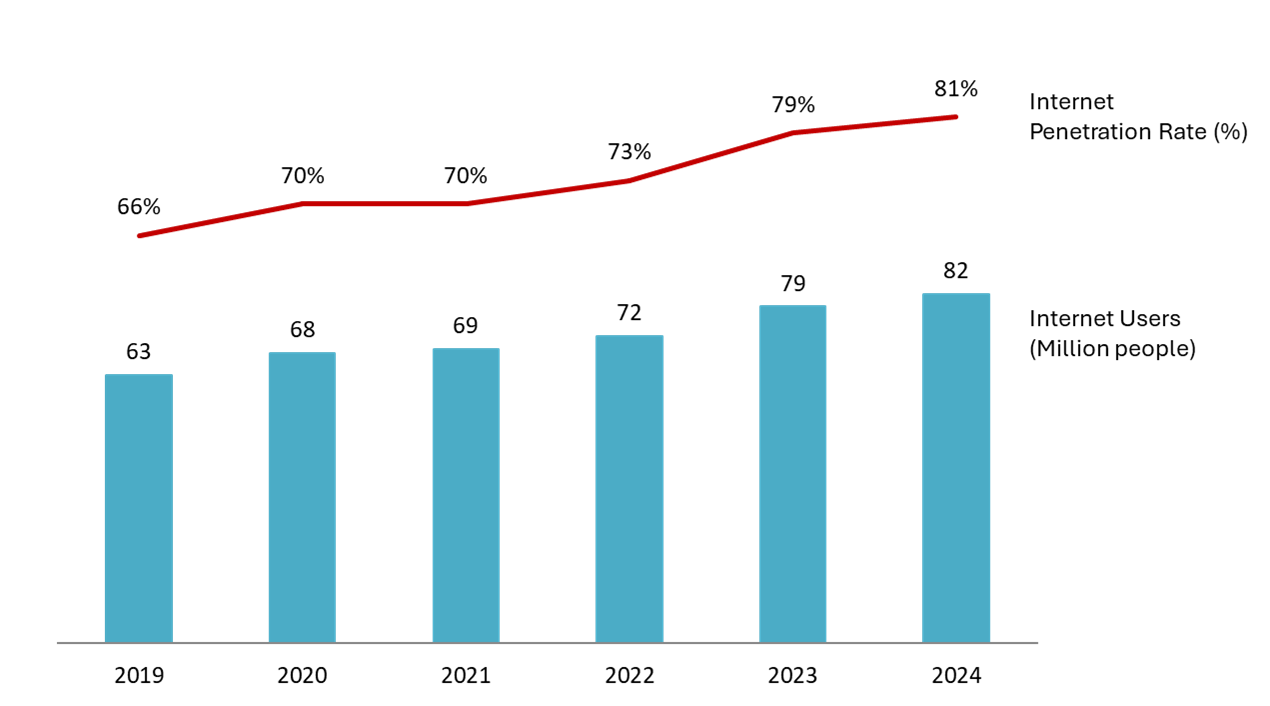
Source: CBRE Digital Report 2025, datareportal [5]
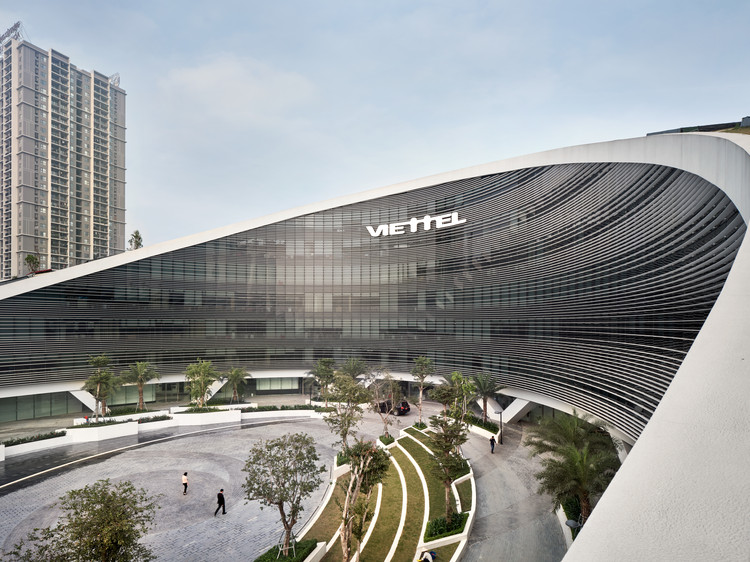
Vietnam currently has 41 active data centers with a total power capacity of 221 MW, with 12 data center investors in the market[6]. The market remains concentrated: five major players — predominantly state-owned telecom operators — account for 97% of total capacity, with Viettel IDC leading at a 41% share (42 MW), followed by VNPT at 25 MW. While this concentration reflects genuine barriers to entry, the regulatory landscape is shifting. The Vietnam Telecommunications Law, which took effect in July 2024, now allows foreign companies to fully own and operate data centers — a structural change that has directly catalyzed international interest from players including STT Telemedia Global Data Centres, Alibaba, and South Korea’s Hyosung Corporation.
Main Players of Data Centers in Vietnam
| Name | Owner | Areas (sqm) | Capacity (MW) | Shares in Vietnam (%) |
| Viettel IDC | State-owned enterprise | 47,500 | 42 | 41 |
| VNPT | State-owned enterprise | 52,200 | 25 | 24 |
| CMC Telecom | Joint Venture | 17,750 | 13 | 12 |
| FPT Telecom | Public Enterprise | 8,837 | 12 | 11 |
| VNG Cloud | Private Enterprise | 7,800 | 10 | 9 |
Source: CBRE Digital Report 2025 [3]
Drivers of Vietnam’s data center expansion
The rapid growth of Vietnam’s data center market is driven by several interconnected factors related to digital transformation, technology adoption, and national development strategies.
– Rapid digitalization across industries: Vietnam’s digital economy grew at an estimated rate of 20% in 2024, contributing 18.3% to GDP[7] – three times the country’s overall economic growth rate – making it the fastest-growing digital economy in Southeast Asia. Businesses across manufacturing, finance, retail, and logistics are adopting digital platforms at pace, generating data volumes that legacy infrastructure cannot absorb. The scale of this shift is most visible in commerce: Vietnam’s e-commerce sector reached USD 25 billion in 2024, with the country ranking third in Southeast Asia and online retail accounting for 9% of total retail sales — up from just 5.5% during 2016–2027[8]. Each of these transactions, purchases, and digital interactions generates data that must be processed, stored, and secured — creating compounding, structural demand for data center capacity and high-speed connectivity.
As companies digitalize their operations, demand for cloud computing services and enterprise data platforms continues to increase. This trend is creating strong demand for data center infrastructure capable of supporting large-scale data processing and high-speed connectivity.
– Increasing adoption of Artificial Intelligence: AI adoption is rapidly becoming the most infrastructure-intensive driver of data center demand. Vietnam also leads Southeast Asia in online media growth, with GMV forecasted to reach USD 6 billion in 2024, and AI-driven applications are being layered across e-commerce, logistics, and financial services at an accelerating rate7. Machine learning models require substantial computational power for both training and deployment, relying on specialized GPU hardware and large proprietary datasets that standard commercial cloud tiers are not designed to support. With a national strategy aimed at advancing the digital economy, Vietnam’s digital economy is projected to account for 20% of GDP by 2025 and 30% by 2030 [9] – a target that cannot be achieved without a corresponding expansion of AI-ready, high-density computing infrastructure.
– Competitive development costs: Compared with other major Asian technology hubs, Vietnam offers lower construction and operational costs for data center development. Land availability, competitive labor costs, and expanding energy infrastructure make the country an attractive destination for companies planning large-scale data center investments.
These advantages are encouraging both domestic telecommunications companies and foreign investors to expand infrastructure capacity in Vietnam.
Government Support for Digital Infrastructure
The Vietnamese government’s role in data center expansion goes beyond regulation — it is both a direct infrastructure builder and a strategic enabler of the country’s AI ambitions. On the investment side, the state has established Vietnam’s first National Data Center, retaining sovereign control over the core layer of national computing infrastructure and treating AI as foundational to the digital economy — comparable in national importance to electricity and telecommunications.
On the policy side, Resolution 57-NQ/TW, issued in December 2024, establishes the strategic framework driving private and foreign investment alongside state build-out. Large-scale and AI data centers are now classified as strategic technology projects, qualifying for fast-track licensing — cutting construction lead times by nine to twelve months — alongside preferential corporate income tax rates as low as 5%. These two tracks, direct state investment in sovereign infrastructure and an incentive-rich environment for commercial operators, collectively create the conditions necessary for Vietnam to meet its target of ranking among the top three Southeast Asian nations for AI research and development by 2030.
Impact of data center expansion on Vietnam’s AI ecosystem
The specific technical requirements of AI are forcing a fundamental rethink of what a data center must be. Le Hoai Nam, Chairman of the Vietnam Cloud Computing and Data Centre Club, has noted that AI data centers represent a major departure from traditional facilities, requiring high-speed internal connections, specialized hardware, and optimized designs for model training — making a re-evaluation of traditional design and infrastructure unavoidable[10]
Foreign players are responding with concrete commitments: NVIDIA partnered with FPT on a USD 200 million AI factory in Hanoi, operational since November 2024, while also collaborating with GreenNode to enhance AI infrastructure at the Tan Thuan data hub [11]. Viettel, meanwhile, is developing infrastructure incorporating approximately 800 supercomputers and 6,000 GPU cards in collaboration with NVIDIA [12] — positioning Vietnam to run AI workloads domestically rather than routing them through Singapore or Tokyo.
At the enterprise level, Vietnam’s domestic cloud market is projected to reach USD 2.5 billion by 2029[13], with cloud platforms serving as the primary AI delivery channel for small and medium businesses. By 2028, AI is expected to account for 15–20% of total data center energy consumption, up from 8% in 202310. The infrastructure race ahead is a multi-stage build — hyperscale hubs, secondary facilities, and an emerging edge layer serving manufacturing parks, hospitals, and smart city platforms nationwide.
All in all, due to the strong support from both revolutionary regulatory frameworks heading for the advancement of data centers from the government, and the international technology firms’ enthusiasm, Vietnam has grown to become the most promising data center destination across Southeast Asia. Vietnam’s data center boom is the opening sign of further infrastructure growth for the AI industry, which will determine how far the economy can grow in the future.
Read more
Data Center Situation in Vietnam – Viettel Builds One of Southeast Asia’s Largest Data Centers
* If you wish to quote any information from this article, please kindly cite the source along with the link to the original article to respect copyright.
| B&Company
The first Japanese company specializing in market research in Vietnam since 2008. We provide a wide range of services including industry reports, industry interviews, consumer surveys, business matching. Additionally, we have recently developed a database of over 900,000 companies in Vietnam, which can be used to search for partners and analyze the market. Please do not hesitate to contact us if you have any queries. info@b-company.jp + (84) 28 3910 3913 |
[1] https://en.vietnamplus.vn/vietnams-internet-economy-projected-to-hit-36-billion-usd-in-2024-post304420.vnp
[2] https://en.vietnamplus.vn/vietnam-emerges-as-new-hub-for-data-centres-post333814.vnp
[3] https://mktgdocs.cbre.com/2299/2d6ae82e-b3e4-4a86-9310-537316353f64-1371598786/251111_CBRE_-_Data_Centre_in_V.pdf
[4] https://en.vneconomy.vn/vietnams-data-center-capacity-set-to-near-1000mw-by-2030.htm
[5] https://datareportal.com/reports/digital-2024-vietnam
[6] https://www.uob.com.vn/assets/web-resources/business/pdf/en/industry-report/uobv-breaking-the-digital-frontier.pdf
[7] https://en.vneconomy.vn/digital-economy-contributed-18-3-to-gdp.htm
[8] https://vietnamnews.vn/economy/1666895/viet-nam-s-digital-economy-continues-to-record-double-digit-growth-report.html
[9] https://blogs.worldbank.org/en/eastasiapacific/digital-economy-vietnam-building-foundations-future-growth
[10] https://www.trade.gov/market-intelligence/vietnam-data-centers
[11] https://vietnamnews.vn/economy/1654395/fpt-and-nvidia-ink-mou-to-build-200m-ai-factory.html
[12] https://english.mst.gov.vn/new-wave-of-data-center-investment-in-viet-nam-197250217105023061.htm
[13] https://www.techsciresearch.com/report/vietnam-data-center-market/4990.html
Related article




































Log in / Register
SUBSCRIBE NEWSLETTER