
 English
  日本語
日本語  Tiếng Việt
  简体中文
简体中文  한국어
한국어 
18Oct2024
Industry Reviews / Latest News & Report
Comments: No Comments.
Overview of forestry in Vietnam
Vietnam’s forest area has remained relatively stable over the last five years. According to the General Statistics Office (GSO), by 2023, the total forest area reached 14.9 million hectares, marking an increase of 0.3 million hectares from the 14.7 million hectares recorded in 2019[1]. Natural forests dominate, consistently making up around 68-70% of the total forest coverage. Most newly planted forests are designated for production or protective reforestation purposes
In terms of forestry products, the production of exploited wood has been increasing, driven by the growing demand for raw materials in commercial production. The total exploited wood has reached 21.6 million m3 in 2023, rising from 16.4 million m3 in 2019[2] a compound annual growth rate (CAGR) of 7.2%. In 2018-2022, according to the General Statistics Office, Vietnamese private enterprises carried out most timber extraction, accounting for 88% of total exploited wood, while foreign companies only accounted for approximately 1% of the total[3].
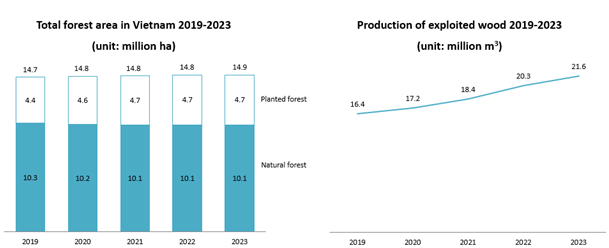
Source: GSO
Government digital transformation planning in forestry
According to Decision 523/QĐ-TTg on Vietnam’s Forestry Development Strategy 2021-2030, with a vision for 2050[4], the Vietnamese government aims to modernize and enhance the competitiveness of the forestry sector. This includes an integrated approach along the entire value chain—from forest development, conservation, and utilization to the processing and commercialization of forestry products. The ultimate goal is to increase forest value, sustainably manage natural resources, and promote sustainable forestry development. Two key areas of focus for information technology application are forest management and forestry product processing.
In forest management, the government seeks to strengthen the capacity of forest owners by establishing systems for forest resource monitoring and evaluation. This includes promoting the use of remote sensing technology and Geographic Information Systems (GIS), as well as IT solutions for forest management. Additionally, national forest resource surveys are conducted to preserve biodiversity. By 2030, the government aims for 100% of organizational forest owners to have the capability to monitor, manage, and prevent forest fires[5].
In terms of applying technology to forestry, the government is promoting integration across the entire product lifecycle, from raw material extraction to final processing. This initiative encourages the adoption of modern technologies at every stage of production, including seed selection, forest cultivation, and product processing. The primary objective is to enhance the productivity, quality, and overall value of forestry products through advanced technologies. Plans also include developing a national database for forest product processing and implementing IT systems to enhance forestry management. These efforts aim to modernize and optimize the sector and enhance efficiency at every step, from plantation to finished product.
Current situation
There have been many efforts in developing and applying digital transformation in forestry. Advanced technologies are transforming forest management and protection in Vietnam. These solutions are developed by the private sector, universities, or transferred from abroad and are applied in national parks and forests across Vietnam. Advanced technologies deliver real-time data that significantly enhance decision-making processes and allow for quicker responses to illegal activities and environmental threats[6].
In the forestry product production process in Vietnam, technologies are being integrated, particularly through digital timber traceability to comply with stricter export standards. The Vietnam Forest Science Institute has developed digital management software that supports legal timber traceability and maintains a comprehensive database for timber identification. However, due to the lack of a forest database, the forestry sector still faces challenges in tracing the origins of timber and accurately distinguishing between forest areas and industrial crop plantations.
Digital solutions in forestry
| Category | Solution | Introduction | Application |
| Forest management and protection | Spatial Monitoring and Reporting Tool (SMART)[7] | Enhancing forest patrols and improving early threat detection | Cat Tien National Park (Dong Nai), Xuan Lien Nature Reserve (Thanh Hoa), Pu Mat National Park (Nghe An), Phong Nha – Ke Bang National Park (Quang Binh), … |
| Forest Monitoring System (FMS)[8] | Tracking changes in forest coverage using satellite imagery | U Minh Ha National Park (Ca Mau), … | |
| Remote sensing technology [9] | Detecting deforestation and forest degradation | Ben En National Park (Thanh Hoa), U Minh Ha National Park (Ca Mau), … | |
| Forestry 4.0[10] | Custom software for updating data on over 70,000 hectares, documenting patrol activities, and monitoring changes down to individual trees. | Information about trees in 15 provinces, tree identification by Artificial Intelligence | |
| The forestry product production process | Timber identification [11] | Tracing and managing legal timber | Reducing the time needed for timber identification from 2-3 days to just 10-15 minutes per sample. |
Source: B&Company’s synthesis