

 English
  日本語
日本語  Tiếng Việt
  简体中文
简体中文  한국어
한국어 The ICT infrastructure in education in Vietnam reveals both promising progress and concerning gaps—especially the disparities between regions.

07Aug2025
Latest News & Report / Vietnam Briefing
Comments: No Comments.
According to Decision No. 749/QD–TTg, digital transformation in education is a national priority for Vietnam, with ambitious goals: by 2025, 50% of students and teachers will engage effectively in online learning, and by 2030, full digital integration is expected [1]. This positions digital education as the cornerstone of a more inclusive, knowledge-driven digital society powered by ICT in education. Yet, significant challenges remain—from inadequate infrastructure and limited funding to gaps in digital skills and institutional capacity.
Infrastructure and funding remain the most critical obstacles.
Comparison of ICT infrastructure and accessibility in education across regions
| Criteria | Major Urban Areas | Rural/Lowland Areas | Mountainous/Remote Areas |
| Internet connection at school | Common, relatively stable quality | Available, but speed and stability may be limited | Lacking and unstable, many school branches have no internet access |
| Classrooms with equipment (TV/projector) | High proportion, many schools are equipped with interactive displays | Moderate proportion, mainly basic projectors or TVs | Very rare, almost non-existent |
| Schools with computer rooms | Most schools have them, with a relatively sufficient number of PCs | The majority have, but with fewer and older computers | Very few schools have them; the equipment is outdated and lacks a maintenance budget |
| Students with personal devices | High proportion, mostly laptops and smartphones | Moderate, mainly shared smartphones within families | Very low, one of the biggest barriers to online learning |
| Households with broadband internet | High proportion | Moderate and gradually increasing | Low, many households cannot afford internet services |
Source: B&Company compilation
Technology infrastructure is a critical foundation that determines the success or failure of any digital transformation effort in education. In Vietnam, the overall picture of ICT infrastructure in education reveals both promising progress and concerning gaps—especially the stark disparities between regions.
On the positive side, there were 79.8 million Internet users in Vietnam at the beginning of 2025, with an online penetration rate of 78.8 percent. [2]. In major urban areas like Ho Chi Minh City, online learning during the COVID-19 pandemic reached over 95% participation across all levels, supported by modern facilities such as computer labs, interactive displays, and internet-connected classrooms [3].
However, behind those impressive numbers lies an uneven reality. Even schools with relatively good conditions report limited ICT infrastructure and unreliable connectivity [4]. At the height of the pandemic, more than 70,000 students in Ho Chi Minh City lacked devices or stable internet [5]. The digital divide is even more severe in mountainous and remote areas, where online learning remains a major challenge due to poor connectivity and a lack of devices.
This unequal reality is not coincidental; it stems from deep-rooted issues related to finance and infrastructure This gap stems from systemic issues in finance and infrastructure.
– Financial constraints: Many public schools in disadvantaged areas operate with limited budgets, which makes it difficult to invest in ICT equipment. At the same time, a significant number of families in these regions lack the financial means to purchase digital devices for their children.
– Infrastructure challenges: In remote areas, difficult terrain complicates the installation of mobile base stations and fiber optic cables, leading to unstable internet connections. For example, reports indicate that as of 2023, a notable percentage of villages in certain provinces still lacked mobile and internet coverage.
These combined factors create a substantial barrier for students in less-privileged regions, putting them at risk of being left behind in the journey toward educational digital transformation.
Quality and standardization of digital content are another pressing issue
The digital “toolbox” in Vietnam’s education sector is becoming increasingly diverse, including learning management systems (LMS), teaching support software, and digital learning resources. However, this ecosystem remains fragmented and spontaneously developed. Local solutions (e.g., VNPT E-Learning, Hocmai.vn, Moon.vn) are in use, there is no unified standard across institutions. Each school—or even departments within a school—may adopt different tools, creating major challenges in integration, data sharing, and large-scale management. The absence of a common technical standard continues to limit the system’s interoperability and wastes resources.
Teaching support software is also varied, from basic tools like PowerPoint to interactive apps such as Kahoot!, Quizizz, and Mentimeter. Recent developments in AI have introduced powerful tools like ChatGPT, Canva AI, and Gamma, enhancing lesson design and grading. However, despite policy support, the national digital learning repository (iGiaoDuc.vn) lacks sufficient high-quality content and teacher contributions, falling short of enabling true self-directed learning for students [6].
| Category | Tools / Platforms (Examples) | Characteristics / Challenges |
| Learning Management Systems (LMS) | VNPT E-Learning, Hocmai.vn, Mona eLMS | Diverse but fragmented; no common standard; limited integration across systems |
| Teaching Support Software | PowerPoint, Kahoot!, Quizizz, Mentimeter, Canva AI, ChatGPT, Gamma | Popular tools among teachers need training and better integration into pedagogy |
| Digital Learning Resources | iGiaoDuc.vn, school-developed content | Limited quantity and quality; lacks validation; not yet meeting student self-learning needs |
The human element: The heart of the challenge
The digital competency, mindset, and adaptability of teachers are critical factors in the success of educational digital transformation. Surveys show that while most teachers can use basic office software, only 10.4% feel confident applying technology in teaching. According to a 2023 nationwide survey by the Vietnam Institute of Educational Sciences, about 20% of teachers regularly use digital tools in the classroom, whereas nearly 15% have never or rarely used them. Furthermore, almost half of teachers in disadvantaged areas report being unable to access digital teaching materials, and 39% of secondary schools have not yet developed digital content [7].
In addition to skill gaps, psychological barriers—especially among older or tech-unfamiliar teachers—pose further challenges for implementation. Recognizing this, the Ministry of Education and Training has made improving teachers’ digital competency a top priority [8]. Current training programs focus on practical skills such as creating digital learning materials, organizing online classes, and using AI in education. However, the gap between “technical digital skills” and “digital pedagogical capacity” has not been effectively bridged. Many teachers know how to use digital tools but struggle to integrate them into their teaching methodology. Therefore, digital transformation in education requires more than just equipping schools with technology—it demands a fundamental shift in teacher training, from simply “how to use tools” to developing a mindset for designing effective digital lessons.
Students: Active individuals who need guidance
Today’s students are not only beneficiaries but also active participants in the digital transformation of education. Their learning habits and access to information are changing rapidly. According to a 2022 UNICEF survey, 82% of Vietnamese children aged 12 to 13 use the Internet daily, and this figure rises to 93% among those aged 14 to 15—presenting both an opportunity to develop flexible learning models and a major challenge in guiding students to use the Internet responsibly and effectively [9]. In terms of devices, a 2022 survey revealed that smartphones are the primary tool for online learning, alongside laptops and desktop computers—highlighting the need for content to be compatible across multiple platforms [10].
Rate of students using online learning devices (2022)
Unit: %, 100% = 341,830 students
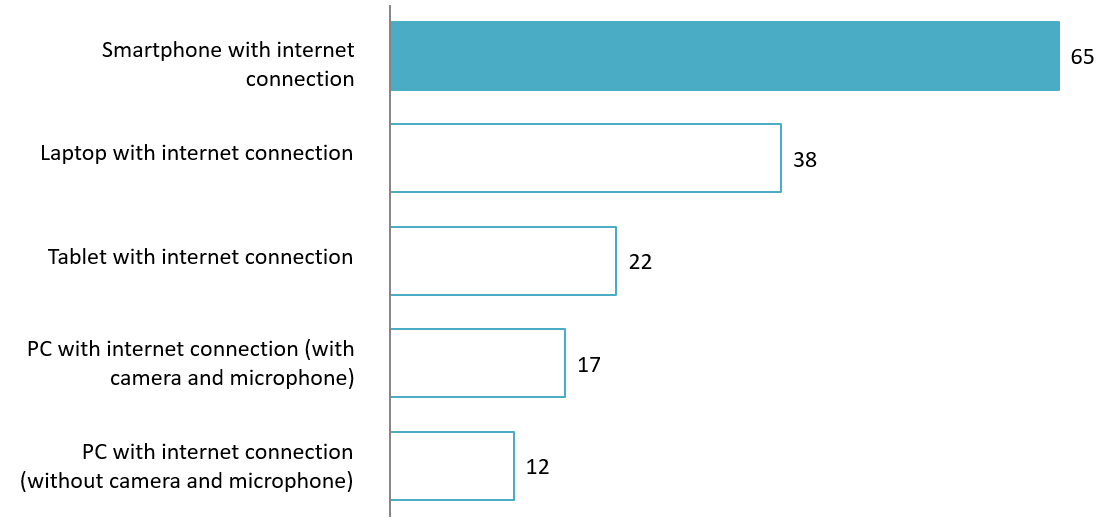
Source: The Vietnam Institute of Educational Sciences
However, time spent online does not equate to digital competency. Being part of a “digital-native” generation does not automatically mean students possess the essential digital skills needed for learning and work—such as critical thinking, online collaboration, or disciplined self-learning. Therefore, the role of schools must go beyond delivering knowledge to fostering students’ digital citizenship—including the ability to evaluate information, protect personal data, and interact ethically in digital environments. This foundation is essential for building a safe and effective digital learning ecosystem.
Conclusion
Vietnam’s education sector has made notable progress in digital transformation, particularly in policy development and raising awareness across all levels. Many schools have started adopting technology, and pilots like digital student records show promise. However, major gaps remain—especially in infrastructure, digital content, and teachers’ digital pedagogy. EdTech companies play a key role in driving progress. Their solutions should be:
– Affordable and accessible, especially for public schools with limited budgets and weak infrastructure;
– Based on flexible business models like freemium to maximize reach;
– Designed for equity, ensuring usability in both urban and remote areas.
Digital transformation is not just about digitizing lessons—it’s about creating a smart, inclusive, and learner-centered education system where all students have equal access to opportunities.
[1] Decision No. 749/QD-TTg of the Prime Minister: Approving the “National Digital Transformation Program to 2025, with a vision to 2030” <Access>
[2] Data Portal, Digital 2025: Vietnam <Access>
[3] Ho Chi Minh City Department of Education and Training Portal, Ho Chi Minh City: Over 95% of students participate in online learning <Access>
[4] UNESCO, Technology in education: a case study on Vietnam <Access>
[5] VnExpress, 77,000 students in Ho Chi Minh City face difficulties when studying online <Access>
[6] Vietnam Education E-magazine, Digital Learning Materials Warehouse of the Ministry, Departments, and Schools are underdeveloped <Access>
[7] VnExpress, Many teachers have never used technology to support teaching <Access>
[8] Ministry of Education and Training, Guidelines for Digital Transformation in Teaching and Assessment for the 2024–2025 Academic Year <Access>
[9] Dan Tri, Vietnamese children use social media for 5 to 7 hours a day <Access>
[10] Vietnam Institute of Educational Sciences, The Current Situation of Online Learning Among Vietnamese General Education Students During the COVID-19 Pandemic <Access>
* If you wish to quote any information from this article, please kindly cite the source along with the link to the original article to respect copyright.
| B&Company
The first Japanese company specializing in market research in Vietnam since 2008. We provide a wide range of services including industry reports, industry interviews, consumer surveys, business matching. Additionally, we have recently developed a database of over 900,000 companies in Vietnam, which can be used to search for partners and analyze the market. Please do not hesitate to contact us if you have any queries. info@b-company.jp + (84) 28 3910 3913 |
Related article








































Log in / Register
SUBSCRIBE NEWSLETTER