

 English
  日本語
日本語  Tiếng Việt
  简体中文
简体中文  한국어
한국어 With experience in education and labor market research, we propose core criteria for selecting educational institutions for the elderly care trainee.

08Jul2025
Latest News & Report / Vietnam Briefing
Comments: No Comments.
As Japan continues to face a serious shortage of workers in the elderly care sector, Vietnam has become one of the prioritized countries for sourcing technical interns. Selecting suitable partner universities and colleges for training and recruitment is a critical first step. Elderly care work is uniquely demanding, requiring not only physical stamina, discipline, adaptability, and empathy but also language proficiency and soft skills. Therefore, selecting partner institutions should not rely solely on reputation but must be carefully considered to ensure long-term suitability and effectiveness.
With B&Company’s experience in education and labor market research, as well as in implementing Japan-Vietnam cooperation projects across both government and private sectors, we propose the following three core criteria for selecting appropriate educational institutions for this intern program.
1. Location: Expanding partnerships to institutions outside Hanoi and Ho Chi Minh City
In the context of increasing demand for implementing trainee programs in the elderly care sector, choosing local institutions outside major cities is a strategic and cost-effective direction. Some provinces with a tradition of labor export can consider such as:
– North: Thai Nguyen, Bac Giang, etc.
– Central: Thanh Hoa, Nghe An, Ha Tinh, Quang Binh, Quang Tri, etc.
– South: Dong Thap, An Giang, Soc Trang, etc.
The key reasons are as follows:
– Student suitability: Students from economically underdeveloped regions often come from modest backgrounds. They tend to be hardworking, disciplined, and highly adaptable. These qualities align well with the specific requirements of the elderly care sector.
– A stable intake of students and optimized operational costs: Many local universities maintain stable enrollment and student retention, ensuring a reliable supply of incoming trainees for the program. Moreover, operational and organizational costs in these areas are typically lower, helping to optimize investment efficiency.
– Proactive international cooperation: Local universities, which have fewer international partnership opportunities compared to urban institutions, are often more open, flexible, and committed when working with foreign partners. This is a significant advantage in implementing long-term programs such as trainee dispatch initiatives.
According to the MEXT, most Japan-Vietnam university agreements as of 2020 were concentrated in Hanoi (56%) and Ho Chi Minh City (23%), while other provinces accounted for only 21%. Outside of Hanoi and Ho Chi Minh City, universities in the Central region accounted for 65% of the agreements, reflecting a trend of collaboration that is primarily concentrated in major urban areas. This indicates that there are still many opportunities to tap into the potential of local universities, which, despite having fewer chances for international cooperation, often demonstrate a stronger willingness to collaborate.
Number of inter-university exchange agreements between Japanese and Vietnamese universities by region
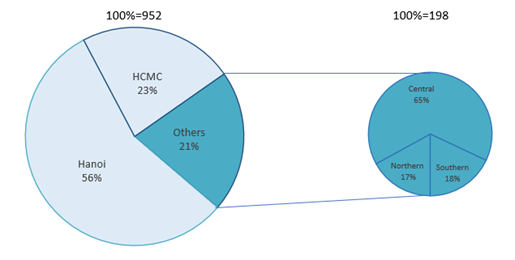
Sources: Ministry of Education, Culture, Sports, Science and Technology (MEXT), “Survey Results on Inter-University Exchange Agreements with Overseas Universities and Overseas Bases” (Revised edition as of April 30, 2020)
2. Academic Disciplines: Focus on practical orientation, not just major
Work in elderly care facilities in Japan requires not just technical knowledge, but also empathy, communication, adaptability, and soft skills. Therefore, the selection of institutions should be based on the overall training approach, not limited to a specific major.
While the program is open to all majors, priority should be given to fields related to human services, such as social work, hospitality, basic nursing, and rehabilitation, where students already have experience working with vulnerable groups. Institutions that offer Japanese language training or have previous cooperation with Japanese companies will also have a competitive edge in preparing students for work and cultural integration in Japan.
Key criteria to consider are as follows:
– At least 50% of the curriculum is focused on practical training
– Internship programs at service facilities or community organizations
– The curriculum includes professional ethics, soft skills, cultural etiquette, and a sense of discipline
– Previous participation in the technical intern or Tokutei Gino programs
– Open to all majors, with priority given to healthcare, tourism, hospitality, and culinary services
– Priority for schools with formal Japanese classes or ties to language centers, and experience working with Japanese partners in labor, education, or dispatch programs.
3. Implementation Capability and International Orientation
Successful deployment of intern programs requires strong coordination between institutions, enterprises, language training centers, and Japanese host organizations. Institutions with open-minded leadership, international collaboration experience, and active support departments ensure a quicker and more efficient collaboration process.
Key criteria to consider are as follows:
– Existing MOUs or student exchange experience with Japan, Taiwan, or Korea
– Active international relations or a career services office supporting overseas opportunities
– Experience organizing career seminars or foreign language training programs
– Willingness to sign long-term cooperation agreements (MOUs, MOCs, or dispatch contracts)
Key Guidelines for Working with Institutions:
– Prioritize institutions with dedicated leadership and prepare for a long-term cooperation roadmap: Engage directly with school leaders to present the program’s long-term benefits and sustainability. Avoid short-term, quantity-focused recruitment. Be transparent about student benefits (income, certifications, return opportunities) and how the program adds value to the institution.
– Develop a clear, detailed, and concrete plan for execution: Some institutions have previously failed to advance partnerships due to vague or prolonged planning stages. Meanwhile, institutions (especially local colleges and universities) have a strong need for detailed, semester-based action plans to effectively arrange training programs, organize internship schedules, and provide student advising.
– Engage students directly through effective communication: Beyond working with school leaders, organizing PR activities, career seminars, and student counseling sessions to boost interest and student initiative.
– Provide on-site support for Japanese language training: If a school lacks Japanese language capacity, offer free language classes or connect them with appropriate language training centers as a foundation for building the talent pipeline.
– Avoid rushed or pressured recruitment: Start with small-scale pilot cohorts to assess and adjust before scaling up.
Conclusion
Experience shows that many Vietnamese universities (especially non-public or local institutions) still lack experience in working with international partners. This often leads to challenges in communication, planning, and follow-through. Moreover, successful education and labor cooperation go far beyond signing agreements; they require long-term commitment and relationship building.
Therefore, an intermediary organization to “keep warm” relationships with universities is essential. This role includes internal and student-facing communication, coordination between institutions and businesses, organizing career guidance sessions, and closely monitoring implementation and feedback.
———–
B&Company, with our experience in education research, market consulting, and Japan–Vietnam business networking, can serve as a comprehensive support partner, helping identify suitable institutions, design practical implementation roadmaps, coordinate communication, and most importantly, ensure the sustainability of partnerships among all stakeholders.
* If you wish to quote any information from this article, please kindly cite the source along with the link to the original article to respect copyright.
| B&Company
The first Japanese company specializing in market research in Vietnam since 2008. We provide a wide range of services including industry reports, industry interviews, consumer surveys, business matching. Additionally, we have recently developed a database of over 900,000 companies in Vietnam, which can be used to search for partners and analyze the market. Please do not hesitate to contact us if you have any queries. info@b-company.jp + (84) 28 3910 3913 |
Related article

























Log in / Register
SUBSCRIBE NEWSLETTER