

 English
  日本語
日本語  Tiếng Việt
  简体中文
简体中文  한국어
한국어 The transfer of Japanese educational technology to Vietnam addresses the demand for skilled human resources from Japanese enterprises.

18Jun2025
Latest News & Report / Vietnam Briefing
Comments: No Comments.
The transfer of Japanese educational technology to Vietnam offers a significant opportunity to address the growing demand for skilled human resources from Japanese enterprises operating in the country. This initiative is driven by several key factors: Japan’s substantial investment in Vietnam, the evolving nature of industries requiring higher technical skills, and Vietnam’s commitment to educational reform and digital transformation.
Overview situation of Japanese companies in Vietnam
Vietnam has emerged as a strategic destination for Japanese enterprises due to its favorable investment climate and robust economic growth
– High Investment Intent: Among the 149 countries and territories investing in Vietnam, Japan is currently the third-largest foreign investor, following South Korea and Singapore1. Besides, a survey in 2024 by the Japan External Trade Organization (JETRO) revealed that 56.1% of Japanese businesses operating abroad plan to expand their operations in Vietnam within the next 1-2 years, marking the highest rate among ASEAN countries, exceeding the regional average of 46.3%.2
– Profitability Prospects: This survey also indicated that 64.1% of companies expect to be profitable in 2024, the first time in five years this percentage has exceeded 60%.3
Direction of business development over the next 1-2 years (By major countries of ASEAN)
Unit: %
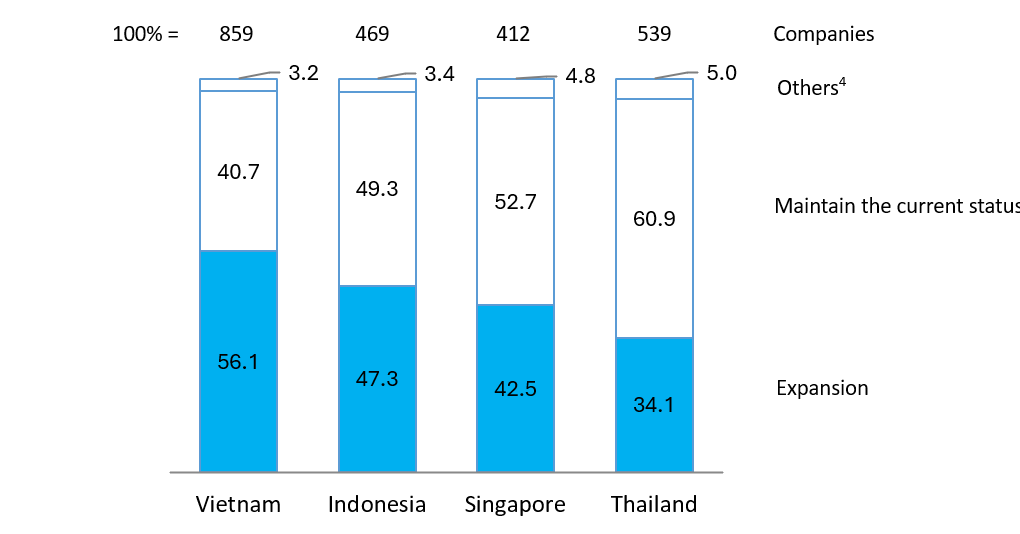
Source: Jetro
Key Investment Sectors
Japanese companies are diversifying their investments across various sectors:
– Manufacturing: According to Vietnam’s Ministry of Planning and Investment, manufacturing led Japanese FDI in 2023 with USD 23.5 billion, accounting for 64.2% of total FDI, up 39.9% year-on-year. 5
– Energy: Japan continues to be a key strategic partner for Vietnam across various sectors. In 2023 alone, newly registered FDI from Japan reached nearly 7 billion USD, making it the second-largest investor, after Singapore.6
Related article




































Log in / Register
Continue without an account
Log in / Register
SUBSCRIBE NEWSLETTER