

 English
  日本語
日本語  Tiếng Việt
  简体中文
简体中文  한국어
한국어 As Vietnam moves toward 2030 development goals, the education sector presents various opportunities for foreign investors, especially in M&A.
17Jan2025
Latest News & Report / Vietnam Briefing
Comments: No Comments.
Education plays a pivotal role in Vietnam’s socio-economic development, fostering innovation and preparing the workforce for the rising demand for high-skilled labor. As the nation moves toward its 2030 development goals, the education sector presents a wealth of opportunities for foreign investors, especially through M&A transactions.
Overview of Vietnam’s education system
Vietnam’s education system consists of formal education and continuing education, which is structured into multiple levels, designed to provide a comprehensive and inclusive educational pathway for its citizens[1], including:
– Preschool education includes junior kindergartens and senior kindergartens;
– General education consists of primary education, lower secondary, and upper secondary education, with primary education being the compulsory education stipulated under Vietnam’s Education Law;
– Vocational education offers training at the elementary level, intermediate level, or college level, as well as other vocational training programmes; and
– Higher education includes university education, master education, and doctoral education.
Over recent decades, Vietnam has made impressive strides in improving access to education and educational quality. The country has a near-universal primary education completion rate of over 98% with all provinces offering adequate education standards[2]. In the school year 2023-2024, there were 522 thousand classes in general education, including 280 thousand primary classes; 168 thousand lower secondary classes, and 74 thousand upper secondary classes[3]. The number of classes rose by 1% to accommodate growing enrollments, despite the steady decline in schools from 28,951 in 2015[4] to 25,783 in 2024 due to mergers or closures into multi-level[5]. The state management of vocational education has been innovated towards enhancing decentralization, strengthening autonomy and governance for institutions, and increasing the accountability of the heads of these institutions[6]. 2024 also saw remarkable progress in Vietnam’s university education as the training quality of 11 university-level institutions is recognized globally[7].
Education establishments in Vietnam in the school year 2024-2025 (Unit: %)
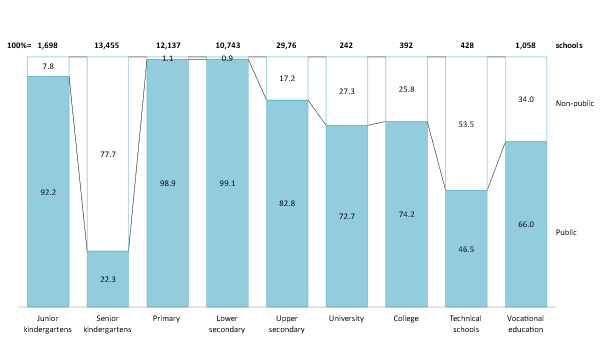
Source: GSO, MOE, B&Company synthesis
The situation of foreign direct investment in education sector in Vietnam
Related article













Log in / Register
Continue without an account
Log in / Register
SUBSCRIBE NEWSLETTER