

 English
  日本語
日本語  Tiếng Việt
  简体中文
简体中文  한국어
한국어 Major cold storage facilities are currently distributed in Ho Chi Minh City, Hanoi, and their satellite provinces, such as Tay Ninh and Bac Ninh.
22Sep2026
Latest News & Report
Comments: No Comments.
Refrigerated warehouse capacity is expanding quickly, driven by rising demand from agriculture, food processing, and modern retail. However, supply remains heavily concentrated in the South, and nationwide capacity is still insufficient. This report assesses the most promising provinces for future investment. (Refrigerated transport such as trucks is outside the scope, though a similar regional imbalance likely applies.)
Supply and Demand for Cold Storage Facilities
Cold storage facilities have expanded at a compound annual growth rate (CAGR) of 13% over the past decade. By 2024, there were 117 facilities nationwide with a total capacity of approximately 1.3 million pallets, maintaining a high average utilization rate of 80%[1]. Approximately 90 companies operate these facilities, with over half being small-scale operations handling less than 10,000 pallets. They are primarily located within industrial parks (IPs), leveraging stable power supply and convenient logistics infrastructure.
Vietnam cold warehouse capacity
(Unit: Thousand pallets)
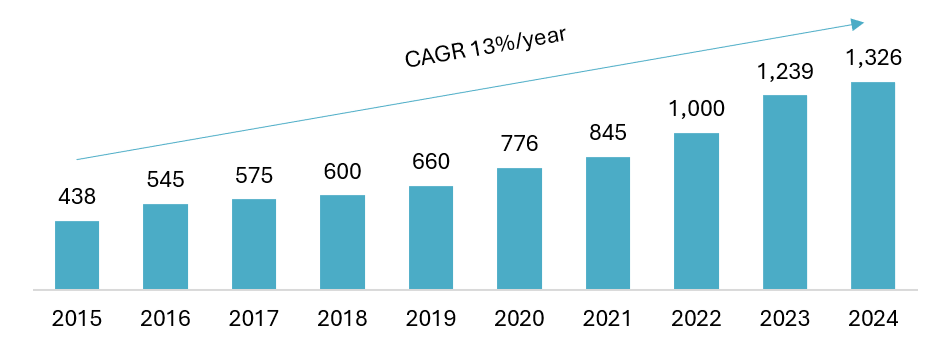
Source: Fiin Group, ScienceDirect
Current facility capacity stands at a mere 132 pallets per 10,000 people, significantly lower than Thailand (204), China (913), and Japan (1,592). The growth momentum from 2015 to 2024 is expected to continue, with a projected CAGR of 14% from 2024 to 2029[2].
Currently, the southern region accounts for approximately 87% of the national capacity, while the northern region holds 11% and the central region a mere 1%[3]. The south is a major food production area, concentrating on the cultivation and processing of aquatic products, fruits, and vegetables, and serving as a key hub for imports and exports. The concentration of cold storage facilities in the south necessitates transporting goods to the central and northern regions, leading to costs, delivery time delays, and risks of quality deterioration.
Major cold storage facilities are currently distributed in Ho Chi Minh City, Hanoi, and their satellite provinces: Tay Ninh and Dong Nai (South), and Hung Yen and Bac Ninh (North). Foreign companies from the US, Japan, South Korea, Singapore, and others are increasing their presence. While local firms hold a cost advantage, foreign companies excel in advanced technology and energy efficiency. Three of the top five companies are foreign-owned, accounting for about 15% of the market. Although foreign investment is restricted in many logistics sectors, warehousing allows 100% foreign ownership, suggesting continued foreign entry.
Major cold storage companies in Vietnam (data is updated as of 2023)
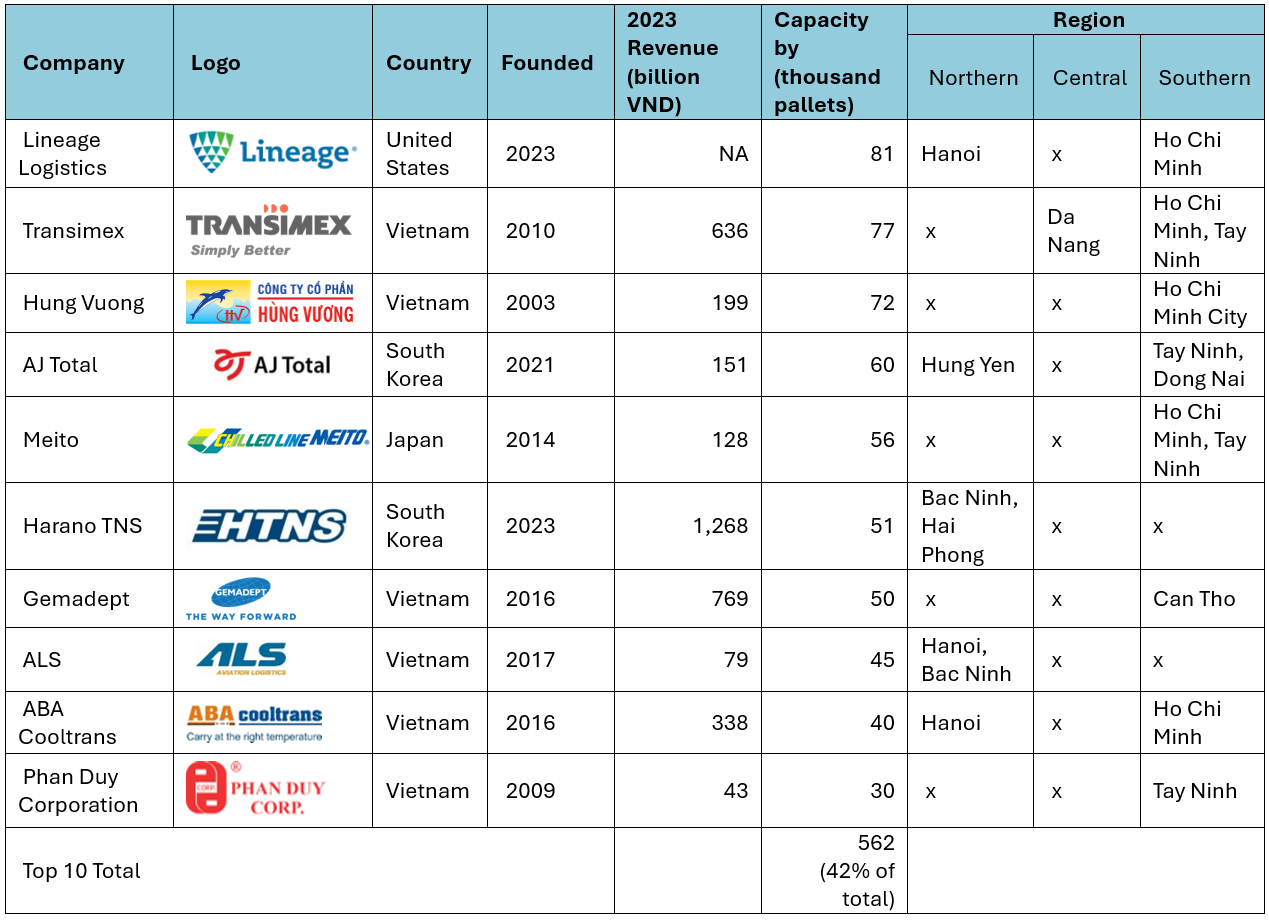
Source: B&Company’s analysis
Japanese Companies as Pioneers
Established in Ho Chi Minh City in 1996, the Japanese-led joint venture Konoike Vinatrans had a capacity of 15,000 pallets. Since then, Japanese companies have continued investing primarily in southern regions like Ho Chi Minh City and Tay Ninh Province, utilizing advanced cold chain technology and high operational standards.
In Ho Chi Minh City, Meito (30,000 pallets) and CLK Cold Storage (20,000 pallets) have been operational since 2014 and 2016, respectively. In recent years, Tay Ninh Province has become a particularly attractive investment destination. Large-scale investments by Japanese companies have followed in succession: a joint venture between Sojitz and Kokubu (26,000 pallets) in 2023, Nichirei (20,000 pallets) in 2024, and Meito’s second facility (26,000 pallets). Meanwhile, the top 10 companies mentioned above have seen successive entries by US and South Korean firms in the 2020s, creating a competitive landscape. For Japanese companies, the challenge lies in whether they can take the risk of making large-scale investments ahead of the curve.
Most recently, Yokorei opened a 18,000-pallet cold warehouse in March 2025. Covering 4.5 hectares with an investment of 52 million USD, it is considered Japan’s most advanced facility, equipped with automation systems and energy-saving technologies.
Yokorei Cold Warehouse in Tay Ninh
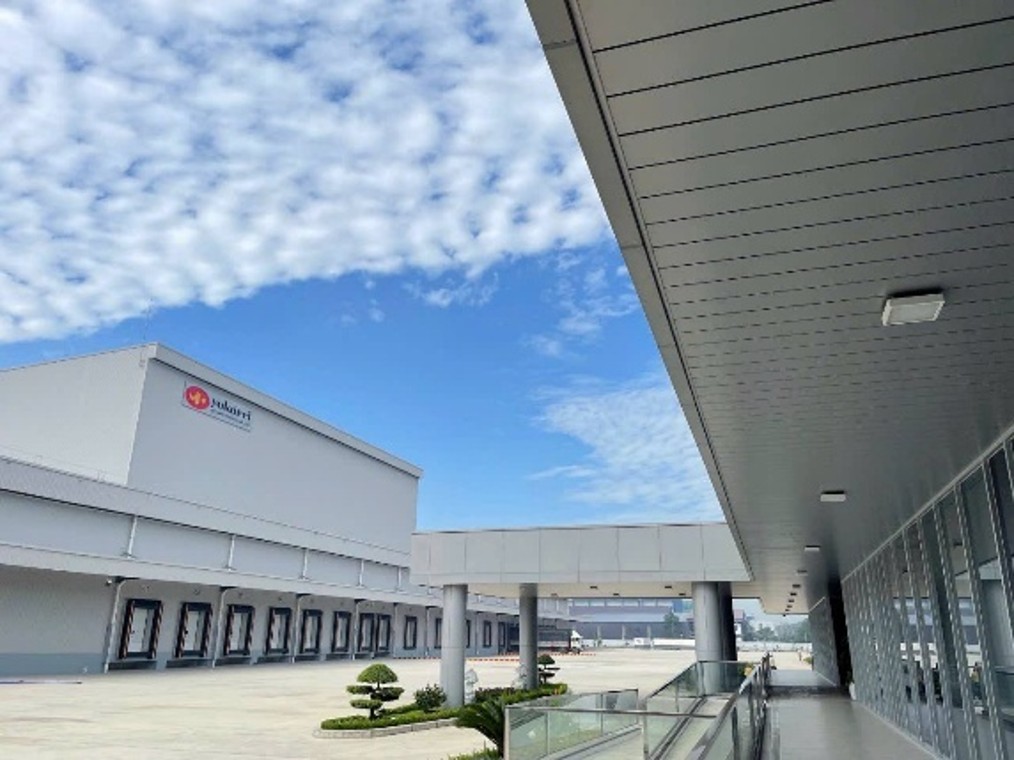
Source: Yokorei website
Tay Ninh Province’s appeal to investors stems not only from its strategic location adjacent to Ho Chi Minh City and connected to the agricultural production hubs of the Mekong Delta, but also from the strong relationships built by the former Long An Province (now integrated into Tay Ninh) with Japanese municipalities and institutions. Japan holds 161 FDI projects in Tay Ninh Province, totaling over 1.2 billion USD, ranking fourth among all investor countries in both project count and investment amount[4]. Japanese companies operating in the region represent potential customers for cold storage facilities.
Evaluation of Promising Regions
High storage costs are limiting the use of cold storage facilities. In Vietnam, logistics costs account for approximately 17% of GDP, significantly exceeding the developed country average of about 10%[5]. Cold storage facilities are located near ports, airports, and major cities, serving imports, exports, and modern retail. Promising provinces were evaluated based on future supply and demand aspects. For comparison with the table, the average industrial park land cost is 139 USD/m² in the South and 170 USD/m² in the North.
Evaluation of Key Provinces for Cold Storage Investment
(○: Positive, △: Neutral, X: Negative)
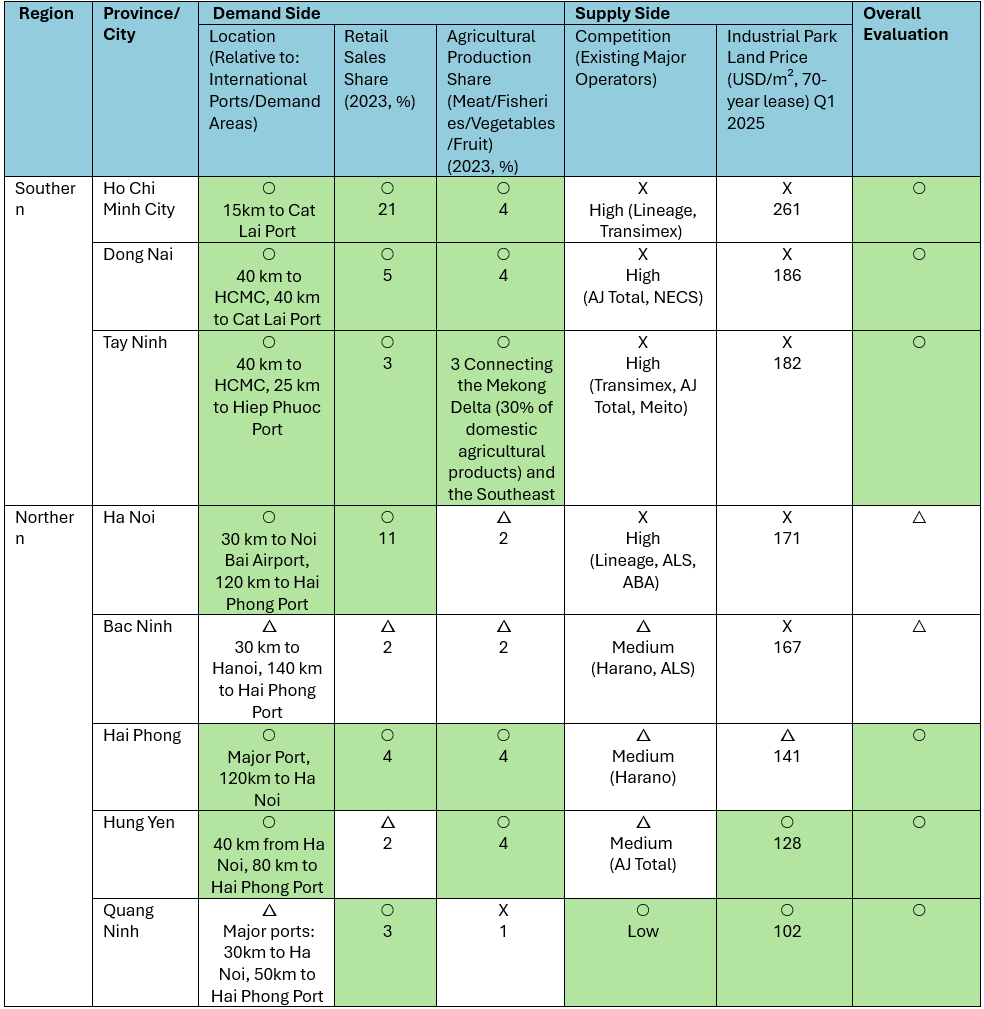
Source: B&Company’s analysis
The southern region shows promising prospects in Ho Chi Minh City, Dong Nai Province, and Tay Ninh Province. These provinces are strategically located near major ports, offering advantages for distribution, and possess high potential on the demand side. Tay Ninh Province serves as a key transit hub connecting the Mekong Delta (Vietnam’s primary agricultural production area) with the southeast, holding significant importance as a cross-regional frozen storage and distribution center.
The North faces less intense competition than the South, with Hai Phong City, Hung Yen Province, and Quang Ninh Province gaining attention as promising investment destinations for cold storage warehouses. Hung Yen Province is ideally situated along the main route connecting Haiphong Port and Hanoi, making it an ideal regional distribution hub. Foreign investment is also increasing in these areas. Following its first warehouse opening in Thai Nguyen Province, South Korea’s AJ Total established a 23,000-pallet facility in Hung Yen Province in 2022. Additionally, Harano TNS constructed a total of 51,000-pallet cold storage facilities in Bac Ninh Province and Hai Phong City in 2023.
In the central region and central highlands, development of cold storage facilities has not progressed significantly. However, Da Nang and Khanh Hoa boast thriving fisheries industries and serve as key transit hubs between the north and south, presenting potential as future investment destinations. Provinces such as Dak Lak and Lam Dong are expected to develop cold storage infrastructure to support fruit and vegetable production.
Demand for cold storage facilities is expected to continue growing.
– Agricultural and Aquatic Products: Vietnam is growing as a global supplier of rice, coffee, shrimp, and basa (pangasius), bolstered by free trade agreements like the EVFTA, CPTPP, and RCEP. To maintain this momentum, the government is promoting the development of logistics hubs and transportation infrastructure to strengthen the entire cold chain, from pre-cooling facilities at farms to cold storage warehouses at ports and border crossings.
– Pharmaceuticals: The pharmaceutical market is projected to grow at an annual rate of 5% from 2025 to 2030[6]. Vaccines and biopharmaceuticals (which gained importance post-COVID-19), requiring cold storage at 2–8°C or below, are driving demand for refrigeration and freezing facilities. While infrastructure remains limited at present, demand for GSP/GDP (Good Storage Practice/Good Distribution Practice)-compliant cold storage facilities is expected to expand as domestic vaccine manufacturing progresses. Although requiring significant investment and commanding high rents, this represents a promising sector.
As part of its logistics development strategy for 2025-2030, the government plans to establish guidelines for cold chain logistics centers and storage facilities that meet food safety standards, which is expected to simplify licensing procedures and accelerate projects. The government is also promoting greening in the logistics sector as part of its efforts to achieve net zero emissions by 2050. The national plan (Prime Minister’s Decision No. 496/QĐ-TTg dated June 11, 2024) calls for the phasing out of ozone-depleting substances and greenhouse gases in refrigeration, requiring the introduction of sustainable technologies such as low-GWP (global warming potential) refrigerants, environmentally friendly insulation materials, and solar power generation. Although this green transition involves initial costs, it is expected to enhance the competitiveness of the refrigeration and cold storage industry and provide an opportunity to improve compliance with international sustainable supply chain standards.
Read more
Cold chain Logistics in Vietnam: Investment of Japanese companies and opportunities for expansion
Challenges and opportunities in Vietnam’s Logistics sector for foreign investors
* If you wish to quote any information from this article, please kindly cite the source along with the link to the original article to respect copyright.
| B&Company
The first Japanese company specializing in market research in Vietnam since 2008. We provide a wide range of services including industry reports, industry interviews, consumer surveys, business matching. Additionally, we have recently developed a database of over 1,000,000 companies in Vietnam, which can be used to search for partners and analyze the market. Please do not hesitate to contact us if you have any queries. info@b-company.jp + (84) 24 3978 5165 |
[1] Fiin Group (2025) <Access>
[2] Research and Markets (2024) <Access>
[4] Ministry of Industry and Trade News (2025) <Access>
Related article



















Log in / Register
SUBSCRIBE NEWSLETTER