

 English
  日本語
日本語  Tiếng Việt
  简体中文
简体中文  한국어
한국어 Vietnam's digital economy is at a turning point, making it clear that digital will play a central role in the country's growth strategy.

18Sep2025
Highlight content / Industry Reviews / Latest News & Report
Comments: No Comments.
Vietnam’s digital economy is at a turning point[1]. The market size is expected to reach approximately 36 billion USD in 2024[2], accounting for over 18 % of GDP[3]. It is estimated that the GDP will expand to between USD 45 billion and USD 52 billion by 2025, accounting for around 25 % of GDP[4]. Furthermore, the target is to reach USD 90 billion by 2030, making it clear that digital will play a central role in the country’s growth strategy[5]. However, this growth is concentrated in core sectors such as e-commerce, fintech, and logistics, and structural restructuring is inevitable for sustainable development.
Growth of Vietnam’s digital economy
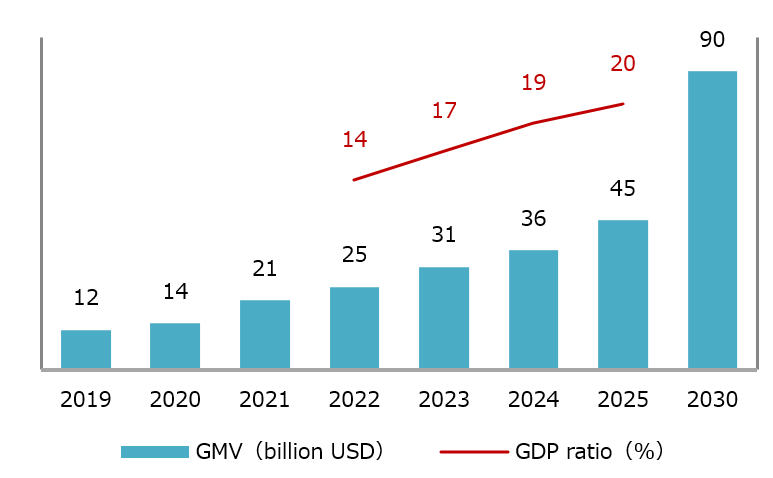
Source: e-Conomy SEA 2024, Ministry of Information and Communications (MIC)
E-commerce: Tax reform challenges growth
E-commerce remains the largest growth engine, accounting for approximately 60% of the total market (approximately USD 22 billion) by 2024[6]. Shopee, Lazada, and TikTok Shop are increasing their presence, with the growth rate reaching approximately 20% compared to the previous year[7].
However, a new government ordinance that will come into effect in July 2025 will require platform operators to pay tax on their behalf. This could lead to millions of small sellers withdrawing due to the increased burden. Large operators are expected to shift to corporate sellers while improving tax support tools, which will significantly change the industry structure.
Fintech: Sustaining growth requires restructuring the model
The number of e-wallet users is expected to reach 50 million by mid-2024, an increase of approximately 40% year-on-year[8]. MoMo (with a transaction share of approximately 68%) will maintain its leading position, followed by ZaloPay (about 53%)[9]. However, aggressive promotional expenses are putting pressure on profits, and many operators are still operating at a loss.
Furthermore, they will be forced to respond to intensifying competition with banking apps (VCB, Digibank, Techcombank, MB Bank, etc.) and stricter regulations. Growth based on traditional cashback schemes is reaching its limits, and personalized finance and vertical integration with insurance and asset management will be the key to their next revenue model.
Logistics: Decarbonization pressures drive business restructuring
The logistics sector continues to grow as the foundation of e-commerce, with related GMV reaching USD 21 billion in 2024[10]. However, environmental measures are urgently needed to achieve the government’s goal of becoming carbon neutral by 2050.
Major operators (GHN, GHTK, Viettel Post, Ahamove, Loship, etc.) have begun trialing electric delivery vehicles and carbon tracking, but a lack of charging infrastructure and high investment costs are hindering widespread adoption. In the future, establishing a system that meets ESG requirements, such as AI optimization and the development of green warehouses, will lead to a competitive advantage.
A change in quality will determine the future
Vietnam’s digital economy is shifting course from superficial expansion to deepening its quality. E-commerce is being forced to evolve toward “compliance and expertise,” fintech is being forced to evolve from “user acquisition to sustainable value creation,” and logistics is being forced to evolve from “growth to decarbonization and efficiency.”
The next generation of winners will be companies that not only grow in size but also can effectively integrate technological investments, governance, and ESG strategies.
[1] Digital economy: Economic activities based on digital technologies and platforms. This includes e-commerce, digital payments, fintech, logistics, online content, and data-driven services, and supports the production, distribution, and consumption of goods and services.
[2] Source: Government News, ” Viet Nam ‘s Digital Economy to Reach 36 BUSD This Year ” (November 2024)
[3] Source: Vietnam News, ” Digital Economy Expected to Reach 18.6 Percent of Vietnam’s GDP ” ( November 2024 )
[4] Source: Google, Temasek, Bain & Company ” e-Conomy SEA 2024 Report ” (November 2024)
[5] Source: US Department of Commerce, International Trade Administration, ” Vietnam Digital Economy ” (September 2024)
[6] Source: Google, Temasek, Bain & Company ” e-Conomy SEA 2024 Report ” (November 2024)
[7] Source: ASEAN Briefing ” Opportunities and Key Trends in Vietnam ‘s E-Commerce Future ” (December 2024)
[8] Source: Vietnam Investment Review, ” E-Wallet Firms Restructure for Best Interests of Customers ” (June 2024)
[9] Source: Vietnam Investment Review, ” E-Wallet Players Look to Take Hold of Market Gaps ” (August 2024)
[10] Source: The Hanoi Times, ” Vietnam ‘s Digital Economy Expected to Grow Big in 2024 ” (November 2024)
* If you wish to quote any information from this article, please kindly cite the source along with the link to the original article to respect copyright.
| B&Company
The first Japanese company specializing in market research in Vietnam since 2008. We provide a wide range of services including industry reports, industry interviews, consumer surveys, business matching. Additionally, we have recently developed a database of over 900,000 companies in Vietnam, which can be used to search for partners and analyze the market. Please do not hesitate to contact us if you have any queries. info@b-company.jp + (84) 28 3910 3913 |
Related article








































Log in / Register
SUBSCRIBE NEWSLETTER