

 English
  日本語
日本語  Tiếng Việt
  简体中文
简体中文  한국어
한국어 As Vietnam integrates further into the global economy, its labor must adapt to evolving demands driven by automation, globalization, and sustainability.
24Jan2025
Latest News & Report / Vietnam Briefing
Comments: No Comments.
Vietnam’s job market in 2024 reflects the nation’s dynamic economic growth, with thriving industries like technology, manufacturing, and tourism driving employment. Emerging trends such as digital transformation, green economy initiatives, and healthcare expansion are reshaping the labor landscape. As Vietnam integrates further into the global economy, its workforce must adapt to evolving demands driven by automation, globalization, and sustainability.
Vietnam Labor Landscape in Recent Years
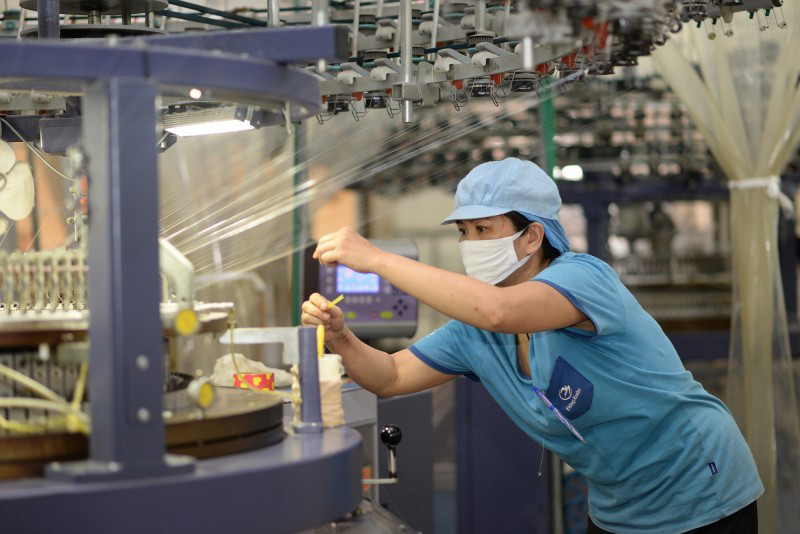
Vietnam remains in its “golden population structure” phase[1], with the labor force aged 15 and older reaching 53 million in 2024, maintaining a stable level of 67% of the total population over the past five years since 2019. The workforce is mainly from rural and suburban areas, accounting for 61%, while urban workers comprise the remaining 39%. The unemployment rate remained low at approximately 2% throughout the year[2]. However, youth unemployment (ages 15–24) remained consistently high throughout the year and showed an increase in trend compared to the same period in 2023[3].
Source: Kinhtetrunguong.vn
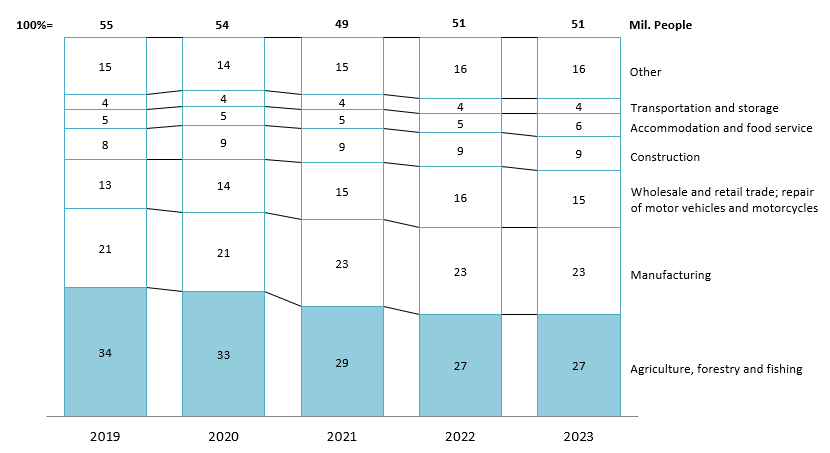
By the end of 2023, the agriculture, forestry, and fisheries sector continued to dominate Vietnam’s employment structure, accounting for 27% of total jobs. This was followed by the processing and manufacturing industry at 23%, retail and automobile repair at 15%, and construction at 9%[4]. Compared to five years ago in 2019, Vietnam’s employment structure has undergone a significant shift, gradually transitioning from agriculture to industrial and construction sectors
Vietnam’s number of employed people by economic activity from 2019 to 2023
Source: General Statistics Office of Vietnam
Additionally, the proportion of highly skilled workers in Vietnam remains low, with only 28% of the workforce holding formal training or certification, a small 1% increase from 2023. The increase in skilled workers has contributed to the average monthly wage in Vietnam rising to nearly 315 USD—an 8% increase from 2023[5]. This demonstrates that wages, while competitive, continue to attract companies seeking cost-effective labor solutions.
In 2024, a significant number of Vietnamese workers entered the labor export market, targeting popular destinations such as Japan, South Korea, China, and others. By the end of the year, Vietnam recorded over 150,000 workers participating in labor export, a figure consistent with the same period in 2023[6]. The primary sectors for labor export included manufacturing, construction, agriculture, and services (such as elderly care, patient care, and domestic work). Although labor export accounted for only 0.2% of the workforce, wages in these sectors were 160–500% higher than the national average in Vietnam. Due to these higher wages and relatively low skill requirements, this trend has become a popular employment option for many Vietnamese workers.
The Future of Jobs in Vietnam
Related article













Log in / Register
Continue without an account
Log in / Register
SUBSCRIBE NEWSLETTER