

 English
  日本語
日本語  Tiếng Việt
  简体中文
简体中文  한국어
한국어 Japan's trade dynamics within ASEAN have evolved considerably, with Vietnam emerging as one of the fastest-growing regional trade partners.
03Jun2026
Latest News & Report / Vietnam Briefing
Comments: No Comments.
Over the past decade, Japan’s overall trade structure has remained surprisingly stable despite major disruptions such as the US–China trade tensions, the COVID-19 pandemic, supply chain restructuring efforts, and the implementation of new regional trade agreements. From 2012 to 2025, ASEAN consistently accounted for approximately 15% of Japan’s total trading volume (imports + exports), while China maintained around 21%, with the remaining 64% coming from the rest of the world.
However, trade dynamics within ASEAN have evolved considerably, with Vietnam emerging as one of Japan’s fastest-growing regional trade partners. While Thailand has consistently remained Japan’s largest ASEAN trading partner in terms of total trade volume, Vietnam has recorded significantly stronger growth than most neighboring economies over the past decade with average annual growth rate of 10.6%, compared to other countries’ AAGR of 3.6%.
Japan’s trading volume (import + export) with ASEAN countries
Unit: Bil JPY
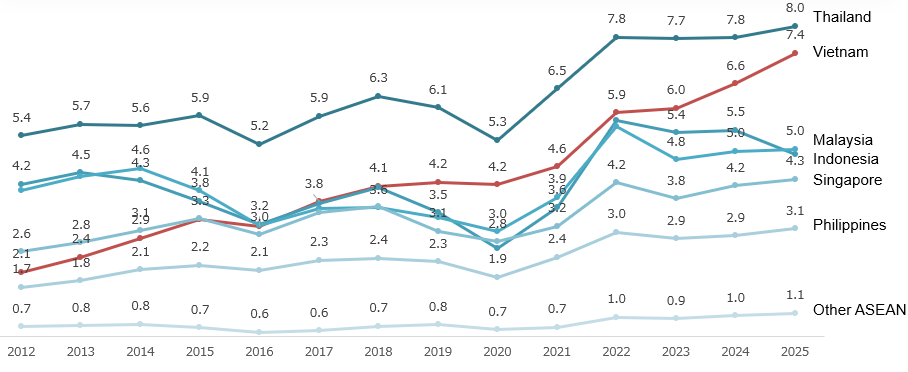
Source: B&Company synthesis (Japan Customs)
Contributing to Vietnam’s growing importance in Japan–ASEAN trade is the country’s participation in an extensive network of regional trade agreements such as VJEPA, AJCEP, CPTPP, and RCEP compared to many other ASEAN neighbors. As a result, Vietnam ranks among Japan’s leading trading partners in terms of import value utilizing EPA preferential schemes, second only to China and the highest within ASEAN. This indicates that preferential trade frameworks have played a critical role in strengthening Vietnam’s position as a manufacturing and export base within Japan-centered regional supply chains.
Japan’s imports using EPAs by regions and top countries
Unit: Bil JPY
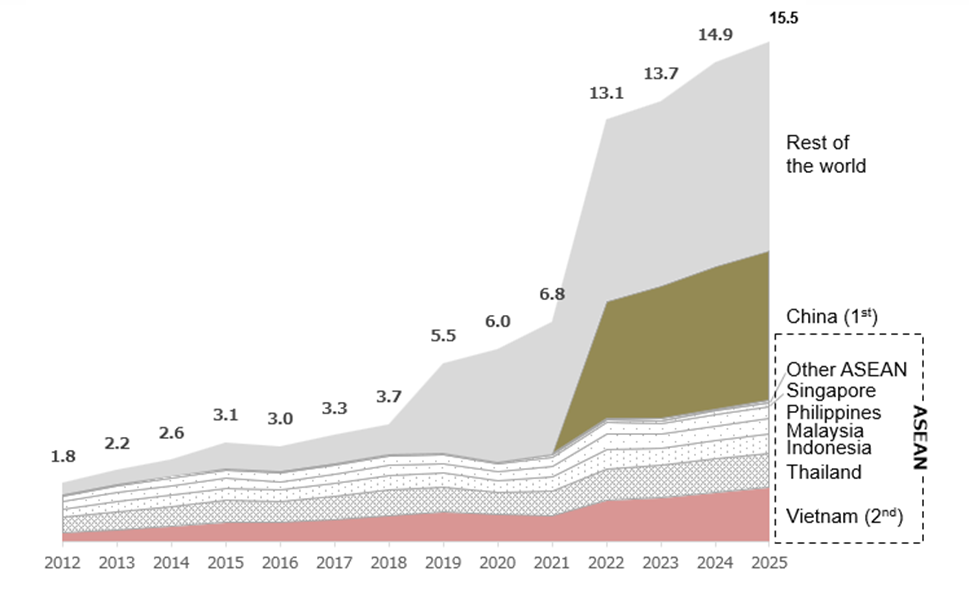
Source: B&Company synthesis (Japan Customs)
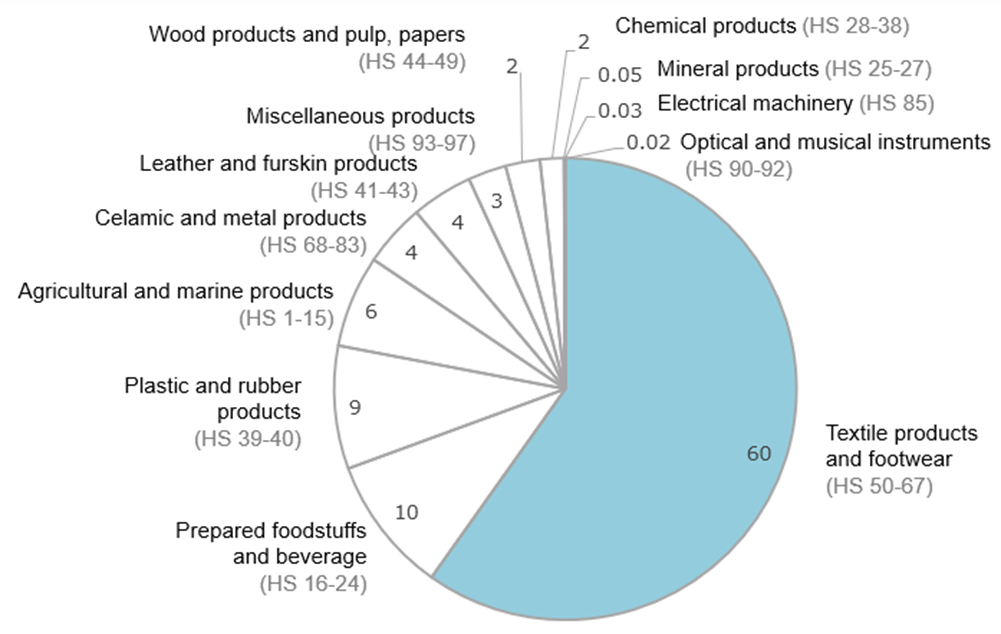
At the same time, the structure of Vietnam’s EPA utilization reveals a potentially important vulnerability. While Thailand’s preferential exports to Japan are relatively diversified across multiple industries, Vietnam’s EPA utilization remains heavily concentrated in textile- and apparel-related products (HS50–67), accounting for approximately 60% of total import value utilizing EPA schemes in 2025. While textile- and apparel-related products already represent one of Vietnam’s largest export categories to Japan, EPA utilization is even more heavily concentrated in these sectors. Electrical machinery (HS85) currently ranks as Japan’s largest import category from Vietnam, followed by industries such as machinery, wood products and paper, miscellaneous products, agricultural and marine products, plastics and rubber, prepared foodstuffs and beverages, chemical products, transport equipment, leather products, and optical instruments. However, compared to textile and apparel products, many of these sectors still account for a relatively limited share of imports utilizing EPA preferential schemes. This suggests that although Vietnam’s export structure to Japan has gradually diversified, the practical benefits derived from EPA frameworks remain concentrated primarily in labor-intensive industries such as garments, footwear, and textiles.
Use of FTAs in imports from Vietnam by sector in 2025
Unit: %, 100% = 1.7 Bil JPY
Source: B&Company synthesis (Japan Customs)
This issue becomes increasingly important in the context of the Regional Comprehensive Economic Partnership (RCEP), which entered into force for Japan in 2022. Historically, ASEAN exporters such as Vietnam benefited from tariff advantages over Chinese textile and footwear products in the Japanese market. However, RCEP gradually reduces tariffs on many Chinese exports as well, narrowing the preferential gap previously enjoyed by ASEAN suppliers. For example, in textile and footwear categories, average tariff rates applied to Chinese products under RCEP were still around 4.3% in 2022[1], compared to approximately 0.7% under AJCEP preferences applied to ASEAN exporters. However, these tariff gaps are scheduled to narrow progressively over time and are estimated to converge toward AJCEP levels by 2041. As a result, part of Vietnam’s historical advantage in labor-intensive exports may gradually weaken as Chinese products gain broader preferential access to the Japanese market under RCEP.
Importantly, this does not necessarily imply that Vietnam will lose its strategic importance within regional supply chains. Rather, the basis of competitiveness itself may be shifting. In the past, tariff advantages and labor costs were key drivers supporting Vietnam’s export growth. Going forward, however, Vietnam’s competitiveness in Japan’s supply chain will likely depend increasingly on factors such as supply chain integration, logistics efficiency, lead time, product quality, ESG compliance, automation capability, and the development of supporting industries. This transition will be particularly important as Vietnam aims to expand EPA utilization beyond traditional labor-intensive sectors into higher-value industries such as electronics, machinery, processed food, and chemical products. In the textile sector specifically, Vietnam may also need to accelerate investment in fabric production, dyeing, and higher-value manufacturing capabilities rather than remaining concentrated in cut-make-trim production.
For Japanese companies, these developments suggest that regional sourcing strategies may gradually evolve from simple low-cost optimization toward broader supply chain resilience and capability diversification. While Vietnam is likely to remain one of Japan’s key manufacturing and sourcing destinations in ASEAN, competition within the region may intensify as tariff advantages continue converging under existing EPAs. At the same time, the narrowing tariff gap between ASEAN and China may encourage Japanese firms to reassess the strategic roles of different production bases across Asia rather than relying primarily on tariff differentials. For Vietnamese manufacturers and policymakers, the challenge will therefore be not only maintaining export growth but also upgrading industrial capabilities in sectors where EPA utilization remains limited despite strong export performance.
Ultimately, Vietnam’s rise in Japan–ASEAN trade over the past decade has been remarkable. Yet the competitive environment that supported this growth is gradually evolving. As regional trade agreements continue to evolve and overlap, tariff advantages across Asia may gradually become less differentiated than before. In this environment, maintaining long-term competitiveness may depend not only on preferential market access, but increasingly on factors such as industrial capability, supply chain integration, operational efficiency, and higher-value manufacturing activities.
Note:
- – EPA = Economic Partnership Agreement
- – VJEPA = Vietnam–Japan Economic Partnership Agreement
- – AJCEP = ASEAN–Japan Comprehensive Economic Partnership
- – CPTPP = Comprehensive and Progressive Agreement for Trans-Pacific Partnership
- – RCEP = Regional Comprehensive Economic Partnership
How B&Company can support
With extensive experience supporting Japanese and international clients in Vietnam, B&Company provides research and advisory support across areas such as industrial analysis, supply chain assessment, supplier identification, and market entry evaluation. Combining regional market understanding with local business insights, B&Company supports companies in assessing manufacturing competitiveness and navigating evolving trade and sourcing environments in ASEAN.
Our support includes:
– Trade and industry research to support understanding of changing competitive dynamics across Vietnam, ASEAN, and Japan-related supply chains;
– Supply chain mapping and competitor benchmarking to identify shifts in sourcing strategies, manufacturing allocation, and industrial positioning;
– Market entry and investment feasibility studies for companies evaluating manufacturing expansion, supplier diversification, or localization strategies in Vietnam;
– In-depth interviews with manufacturers, exporters, industrial park operators, trading companies, and industry experts to understand operational realities beyond statistical data;
– Supplier search and industrial partner identification to support procurement and supply chain diversification initiatives;
– Access to extensive enterprise databases and local business networks across Vietnam to identify potential suppliers, manufacturers, and supporting industries.
As competitive advantages in the region continue evolving beyond tariff incentives alone, localized market intelligence and industry-specific insights may become increasingly important for companies evaluating long-term manufacturing and sourcing strategies in Asia.
[1] Institute for International Trade and Investment (2023) https://trungtamwto.vn/file/22807/fta-seminar1207yoshioka.pdf
Read more
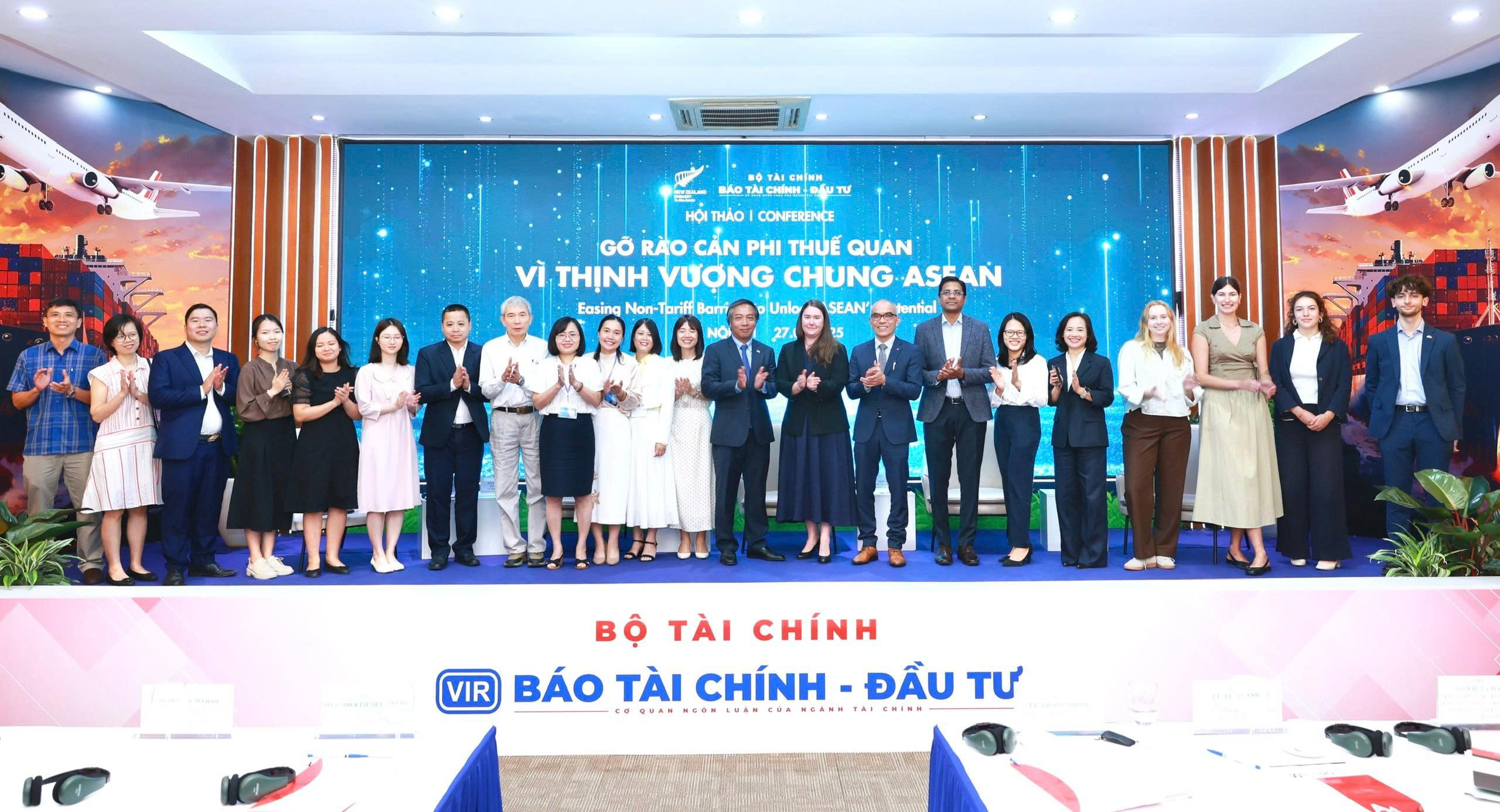
B&Company contributed at the ASEAN Non-Tariff Barrier Seminar
* If you wish to quote any information from this article, please kindly cite the source along with the link to the original article to respect copyright.
| B&Company
The first Japanese company specializing in market research in Vietnam since 2008. We provide a wide range of services including industry reports, industry interviews, consumer surveys, business matching. Additionally, we have recently developed a database of over 1,000,000 companies in Vietnam, which can be used to search for partners and analyze the market. Please do not hesitate to contact us if you have any queries. info@b-company.jp + (84) 28 3910 3913 |
Related article



















Log in / Register
SUBSCRIBE NEWSLETTER