

 English
  日本語
日本語  Tiếng Việt
  简体中文
简体中文  한국어
한국어 Apparel is a major industry in Vietnam, long remained among the top three global clothing exporters, reaching around 44 billion USD in 2024.

27Jul2026
Latest News & Report / Vietnam Briefing
Comments: No Comments.
Apparel is a major industry, having long remained among the top three global clothing exporters. Exports in 2024 reached approximately 44 billion USD, with primary destinations being the United States, the EU, Japan, and South Korea. Factories are concentrated around major cities in the north, south, and central regions. However, the production process primarily consists of CMT (Cut, Make, Trim), heavily reliant on imported materials such as fabrics and cotton. To increase added value, challenges include domestic production of materials, environmental compliance in production processes, and technological advancement. Trade agreement rules of origin will also likely become a driving factor in this movement.
Basic Statistics
| Indicators | Unit | 2020 | 2021 | 2022 | 2023 | 2024 |
| Textile and apparel exports | Billion USD | 35.2 | 39.0 | 44.0 | 40.3 | 44.0 |
| Textile and apparel retail sales | Billion USD | 8.4 | 7.2 | 8.3 | 9.4 | 10.2 |
| Number of raw textile material manufacturing companies[1] | Thousand companies | 5.2 | 5.0 | 4.8 | 5.8 | NA |
| Number of final textile products manufacturing companies[2] | Thousand companies | 9.8 | 10.0 | 9.7 | 12.4 | NA |
Source: General Statistics Office, B&Company Enterprise Database
Regulations
The government welcomes investment in the textile and apparel sector. Textile manufacturing allows 100% foreign ownership. The textile industry is classified as a priority investment sector, eligible for support and tax incentives if certain criteria are met. For example, large-scale textile dyeing projects in industrial parks may receive corporate income tax reductions or exemptions from import duties on equipment.
The Prime Minister’s Decision No. 1643/QĐ-TTg at the end of 2022, “Strategy for the Development of the Textile and Garment Industry 2030 – Vision 2035,” promotes sustainable growth and high value-added production. One goal is to reduce dependence on imported materials, aiming for 70% domestic production of fabrics and accessories by 2030. To achieve this, investment is required in textile production, high-quality yarn, fabric dyeing and finishing, and especially in businesses utilizing environmentally friendly technologies.
The government is also encouraging the establishment of textile industrial parks equipped with modern wastewater treatment facilities to attract dyeing and fabric-related businesses. Environmental regulations are becoming stricter for highly polluting processes. New dyeing and finishing factories must typically obtain an environmental impact assessment and be located in areas with centralized wastewater treatment facilities. Local authorities (such as Dong Nai Province and Nam Dinh Province) are also restricting or scrutinizing textile projects with potential pollution risks. This aligns with the national goal of pursuing clean production.
Market Overview
The textile and apparel industry is globally strong and a key driver of the country’s growth. Vietnam is currently the world’s third-largest textile and apparel exporter, following China and Bangladesh. Located at the crossroads of major maritime and economic corridors, Vietnam offers direct access to key international shipping routes, enabling efficient and low-cost transportation to major markets such as North America, Europe, Northeast Asia, and ASEAN countries. Furthermore, its proximity to China, the world’s largest supplier of textile raw materials, facilitates collaboration with companies in both production and consumption markets.
Exports showed remarkable recovery after the COVID-19 pandemic, reaching 40.3 billion USD in 2023[3], accounting for approximately 12.5% of the country’s total exports. In 2024, they grew to 44 billion USD despite a global slowdown in demand[4]. In the first five months of 2025, exports reached approximately 18 billion USD, a 10% increase compared to the same period in 2024[5]. In 2023, Vietnam was the second-largest apparel exporter to the US market and a major supplier to the EU, Japan, and South Korea.
The US accounted for about 38% of exports, followed by Japan (10.1%) and South Korea (8.2%)[6].
Textile and Apparel Exports
Unit: Billion USD
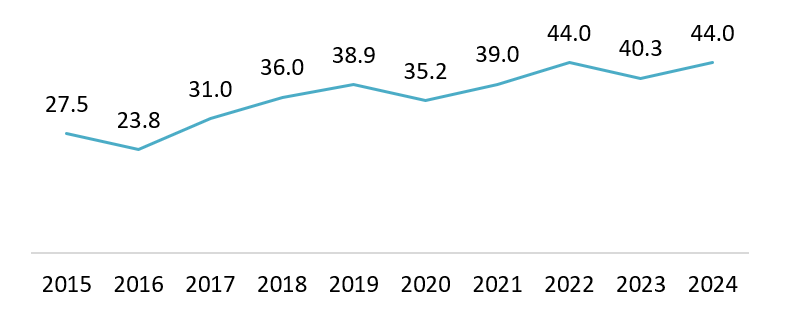
Source: General Statistics Office
Textile and Apparel Export Destinations (2024)
100% = 441 billion USD
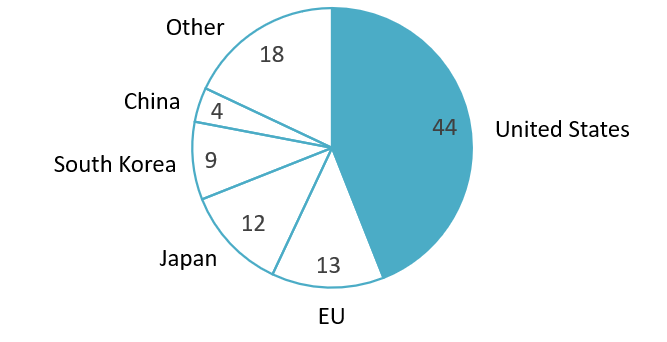
Source: General Department of Vietnam Customs
Production is concentrated in specific regions. The southern region (Ho Chi Minh City, Dong Nai, Binh Duong, and surrounding areas) has developed over decades into the largest apparel manufacturing hub, leveraging advanced port infrastructure like Saigon Port and Cai Mep Deep-Water Port, along with accumulated human resources. Important textile clusters also exist in the northern region (Nam Dinh, Hanoi, Hai Duong, etc.) and the central region (Thanh Hoa, etc.), with some specializing in yarn and fabric production. For example, Nam Dinh Province had over 6,000 textile and garment factories (including small rural workshops) as of 2025, contributing significantly to local employment.
The supply chain consists of three stages: Upstream (fiber/yarn production), midstream (fabric production/dyeing), and downstream (apparel manufacturing). The industry remains heavily reliant on downstream sewing and processing (CMT). Where is it sourced from? According to the Vietnam Textile and Apparel Association, of 3,800 textile factories, approximately 70% are sewing, 23% are spinning/weaving, and only 4% are dyeing/finishing.[7] Raw materials like fabric, yarn, and cotton are imported, accounting for 40% of inputs. Most cotton (99%) and the majority of fabric are sourced from China and South Korea. In 2024, fabric imports increased by 15% year-on-year, reaching approximately 15 billion USD, making it Vietnam’s third-largest import category. While China is the primary supplier, South Korea, Taiwan, Japan, and Thailand are also major sources.[8]
Competition
China remains the largest textile exporter, leveraging its vast labor force and skilled production techniques. Vietnam’s market share has remained stable between 5% and 5.2% from 2019 to 2023, showing resilience compared to other major exporters. Bangladesh surpassed Vietnam in 2021 and continues to grow, holding the second position. India also became a major player in 2023 with a 4.7% share. Turkey showed a sharp increase in 2023, reaching a 4.8% share, leveraging its strengths in sustainability and high-tech solutions in the textile sector.
Meanwhile, Vietnam is known for product diversity and quality. Unlike some competitors specializing in low-cost basic apparel, Vietnam produces a wide range of products, from basic T-shirts to high-value-added sportswear, suits, high-tech fabric garments, swimwear, and tailored suits. It employs approximately 3 million people, valued for their skills and productivity. Although labor costs are trending upward, they remain highly competitive. From 2020 to 2023, the industry’s average monthly wage was approximately 300 USD, positioning Vietnam as a mid-cost, high-quality production base between Bangladesh (95 USD), (145 USD), and China (330 USD)[9].
Textile and Apparel Factories
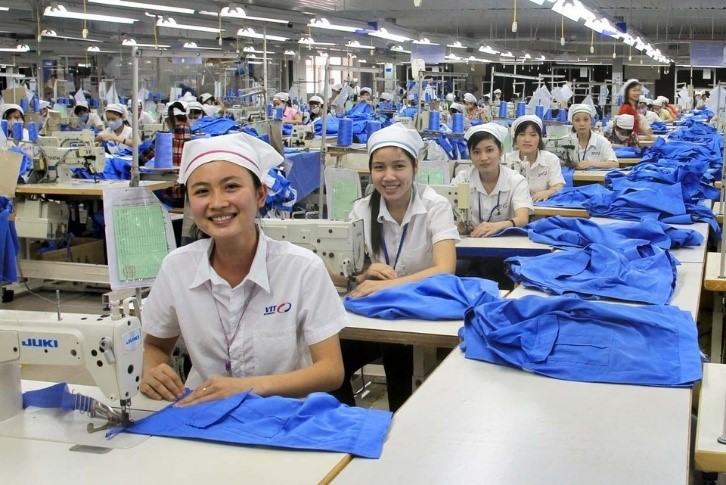
Source: Dantri
Global Share of Textile Exporting Countries
Unit: %
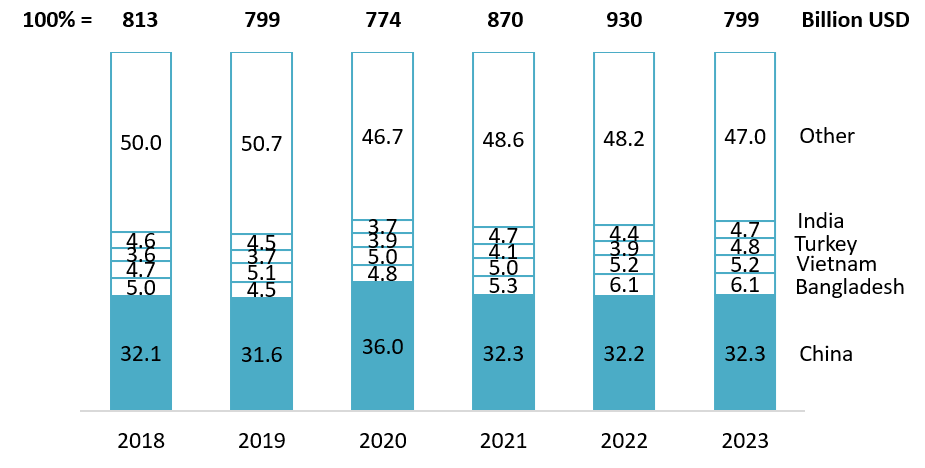
Source: World Population Review
Major Players
According to B&Company’s enterprise database, as of 2023, approximately 18,000 companies operate in Vietnam’s textile and garment industry. The breakdown is 62% micro-enterprises, 34% small and medium-sized enterprises (SMEs), and 4% large enterprises.[10] While many are small-scale, large enterprises also hold significant presence.
The total number of employees across these companies reaches about 1.8 million, averaging nearly 100 employees per company. This is approximately seven times the industry average of 15 employees, demonstrating the textile and garment industry’s extremely high employment absorption capacity as a labor-intensive sector. Furthermore, among the top 10 companies by sales, each employs roughly 5,000 or more people.
Major manufacturers include a mix of state-owned, private, and foreign-invested enterprises. Among the top companies, domestic firms dominate the CMT/export sector, while FDI companies are prominent in the materials sector.
List of Some Major Players
| No | Company | Established | Country | Headquarters | Status |
| 1 | Vietnam National Textile & Garment Group (Vinatex) | 1995 | Vietnam | Hanoi | Vietnam’s largest textile and garment group, a nationwide enterprise group spanning yarn, fabrics, and apparel |
| 2 | Viet Tien Garment (VGG) | 1977 | Vietnam | Ho Chi Minh City | Formalwear and contract manufacturing. A subsidiary of Vinatex |
| 3 | Garment 10 (Garco 10) | 1946 | Vietnam | Hanoi | Long-established exporter of shirts, suits, and uniforms. Originated as a military uniform factory |
| 4 | TNG Investment & Trading (TNG) | 1979 | Vietnam | Thai Nguyen | Manufactures apparel for global brands, along with related products |
| 5 | Thanh Cong Textile-Garment | 1976 | Vietnam | Ho Chi Minh City | Vertical Integration (Yarn – Fabric – Dyeing – Garments) |
| 6 | Song Hong Garment (MSH) | 1988 | Vietnam | Nam Dinh | Export of apparel, home textiles, and bedding |
| 7 | Duc Giang Garment (DUGARCO) | 1990 | Vietnam | Hanoi | Exports to global customers |
| 8 | Nha Be Garment (NBC) | 1973 | Vietnam | Ho Chi Minh City | Southern manufacturer with a diversified product line and nationwide locations |
| 9 | Texhong Hai Ha | 2006 | China | Quang Ninh | Global Cotton Yarn Group |
| 10 | Hyosung | 2007 | Korea | Dong Nai | Flagship spandex facility (also used for tire cord). “Fiber Value Chain,” biofiber business |
Source: B&Company
While industry leader Vinatex operates yarn, fabric, and garment factories across a wide region, Thanh Cong (TCM) offers integrated capabilities from spinning to sewing. In apparel, Viet Tien・Garment 10 (May 10 brand) is strong in office wear and fashion, ranking highly alongside brands like Viettien and San Sciaro (a Viettien brand). TNG represents the next generation as a global brand exporter: FOB (Free On Board)/ ODM (Original Design Manufacturing).
Market Trends
Free Trade Agreements (FTAs): An extensive FTA network is a key growth driver. The CPTPP and EVFTA have reduced tariffs to major markets, enhancing Vietnam’s competitiveness.
Vietnam joined the CPTPP in January 2019. In 2018, prior to its implementation, total textile and apparel exports amounted to approximately 36 billion USD, with exports to CPTPP member countries accounting for about 5.3 billion USD (approximately 14.7%). In contrast, textile and apparel exports for the first eight months of 2024 reached approximately 32 billion USD, with exports to CPTPP countries accounting for about 16% (approximately 5.1 billion USD in value)[11]. This demonstrates the CPTPP’s contribution to export growth.
On the other hand, FTAs impose “origin” requirements, necessitating the development of raw material industries. In recent years, investment in textile factories (particularly from China and Taiwan) has increased, aiming to meet origin rules and secure FTA tariff preferences.
Supply Chain Shifts: Geopolitical factors (US-China trade friction) and rising costs in China have shifted apparel production and investment from China to Vietnam. Many international brands have expanded sourcing in Vietnam.
Global brands like NIKE, Adidas, UNIQLO, H&M, ZARA, PUMA, Decathlon, and Gap partner with local factories to produce their products, positioning Vietnam as a key pillar supporting their global supply chains.
Examples of brands manufacturing in Vietnam
| Brand | Activities | Main Products | Target Market |
| NIKE | · Vietnam accounts for 28% of NIKE’s total production volume, making it the largest. It is estimated that approximately half of Nike’s shoes are produced in Vietnam.
· Vietnam is the largest manufacturing base for both footwear and apparel, employing approximately 500,000 people across 98 suppliers and about 160 factories, primarily centered in Ho Chi Minh City |
· Footwear
· Apparel · Accessories & Sporting Goods |
· North America
· European Countries · Asian Countries |
| Adidas | · Over the past decade, most of the production has shifted from China to Vietnam. In 2017, Vietnam produced 44% of Adidas’ shoes and became its largest sourcing country by 2024.
· There are approximately 50 partner factories, primarily located in Ho Chi Minh City, Dong Nai, and Binh Duong. |
· Footwear
· Apparel · Accessories & Sporting Goods |
· North America
· European Countries · Japan |
| UNIQLO | · For over 20 years, UNIQLO has sourced from Vietnam, developing the country into its second-largest manufacturing base in Asia after China.
· 45 Vietnamese companies and 240,000 workers are involved in producing UNIQLO products. Beyond pursuing low costs, we focus on long-term partnerships to enhance productivity, quality, and sustainability |
· Apparel
|
· Japan
· China · Southeast Asian Countries |
Source: B&Company Analysis
Sustainability and Compliance: Interest in sustainable and ethical production is growing. Governments and manufacturers are responding to stringent environmental and labor standards from export destinations (e.g., the EU’s Sustainable Textiles Strategy). From 2020 to 2025, many Vietnamese spinning mills and manufacturing plants invested in environmentally conscious technologies (solar energy, waterless dyeing, wastewater treatment, etc.) and obtained certifications such as OEKO-TEX and GOTS. The government’s “Textile and Garment Industry Development Strategy 2030” also emphasizes sustainability, aiming for a 15-20% reduction in water and energy consumption per unit across the entire industry.
However, overall, the introduction of sustainability initiatives has been slow, posing a risk to global trade[12] . Bangladesh is promoting a development strategy for domestic textile, fabric, and dyeing production, reducing its dependence on imports and strengthening its response to trade agreements, while also becoming a strong competitor due to low labor costs and investments in sustainability. To maintain its competitiveness, Vietnam needs to accelerate its transition to greener, higher value-added production and strengthen its technological capabilities to address growing challenges in both cost and sustainability. To close the gap with Bangladesh, Vietnam can increase its added value by placing greater emphasis on environmental standards and certification in manufacturing and by gradually strengthening the management of key raw materials, particularly fabrics. This is likely to be accompanied by the development of high-quality textile products and the strengthening of the entire value chain.
Value Chain Advancement: Vietnam is gradually shifting from pure CMT contracts to higher value-added models such as OEM and ODM. Major companies are investing in design, branding, and automation to gain more added value. The government is also encouraging advancement to avoid dependence on low-wage labor. By 2025, domestic companies are expected to increase their share of FOB and ODM orders. Meanwhile, several domestic brands are seeking to strengthen their presence in the domestic market.
* If you wish to quote any information from this article, please kindly cite the source along with the link to the original article to respect copyright.
| B&Company
The first Japanese company specializing in market research in Vietnam since 2008. We provide a wide range of services including industry reports, industry interviews, consumer surveys, business matching. Additionally, we have recently developed a database of over 1,000,000 companies in Vietnam, which can be used to search for partners and analyze the market. Please do not hesitate to contact us if you have any queries. info@b-company.jp + (84) 24 3978 5165 |
[1] Raw Material Production
[2] Production of Final Products (Garments)
[6] General Department of Vietnam Customs <Access>
[7] Vietnam briefing (2025) <Access>
[8] Vnbusiness (2024) <Access>
[9] Vietnam News (2024) <Access>
[10] Micro-enterprises: Annual sales under 3 billion VND; Small and medium-sized enterprises: Annual sales between 3 billion VND and under 200 billion VND; Large enterprises: Annual sales over 200 billion VND
Related article






Log in / Register
SUBSCRIBE NEWSLETTER