

 English
  日本語
日本語  Tiếng Việt
  简体中文
简体中文  한국어
한국어 This article explores the role of IDI in Vietnam's B2B market research and how foreign companies can use it in market-entry decisions.

09Oct2026
Latest News & Report
Comments: No Comments.
Abstract
Vietnam’s evolving business environment presents opportunities for foreign companies seeking new customers, suppliers, and business partners. However, understanding local purchasing behavior, distribution networks, and competitive conditions can be challenging when relying solely on publicly available information. In-depth Interview (IDI) is a qualitative research method that allows businesses to obtain firsthand insights from industry stakeholders. This article explores the role of IDIs in Vietnam’s B2B market research, their practical applications, the challenges involved, and how foreign companies can use interview findings to make more informed market-entry and expansion decisions.
Vietnam’s Business Environment and the Need for Deeper Market Insights
Vietnam continues to offer attractive opportunities for foreign companies seeking customers, suppliers, and business partners across a wide range of B2B sectors. The country’s manufacturing base has expanded steadily, foreign investment remains active, and local enterprises continue to play an important role in industrial supply chains and business services. At the same time, entering the market is not simply a matter of identifying companies from a database or industry report.
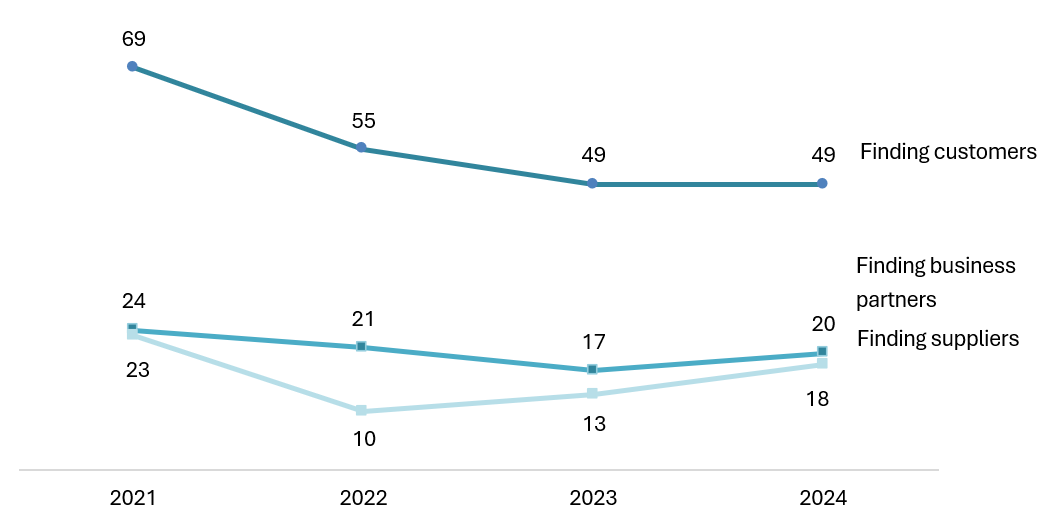
This challenge is reflected in survey findings on the operating environment in Vietnam. According to the Vietnam Provincial Competitiveness Index (PCI) 2024 Report, 49% of surveyed domestic private enterprises reported difficulty in finding customers in 2024, while 20% reported difficulty in finding business partners and 18% reported difficulty in finding suppliers[1].
Difficulties in Finding Customers, Business Partners, and Suppliers in Vietnam (2021–2024)
Unit: % of surveyed domestic private enterprises
Source: VCCI, PCI 2024 Report, Table 1.2
The trend suggests that while some difficulties have eased compared with 2021, market access and business matching remain relevant concerns for many enterprises. For foreign companies, this means that publicly available information may be useful for mapping the market, but it is often not enough to explain how potential customers or partners actually behave. With these challenges, relying solely on publicly available information may not be sufficient for foreign companies to fully understand Vietnam’s B2B market. In order to identify potential customers and business partners, companies need deeper insights into their actual needs, purchasing behavior, and decision-making processes. IDIs can help solve these information issues by providing firsthand insights from relevant industry stakeholders, supporting more informed market research and business decisions.
The Role of In-depth Interviews in B2B Market Research
IDIs are a qualitative research method involving detailed, one-on-one discussions with selected respondents. Unlike standardized surveys, IDIs typically follow a semi-structured format, allowing researchers to ask follow-up questions, clarify responses, and explore issues that emerge during interviews. This flexibility makes IDIs particularly useful for understanding complex business decisions and obtaining detailed information that may not be captured through conventional surveys[2].
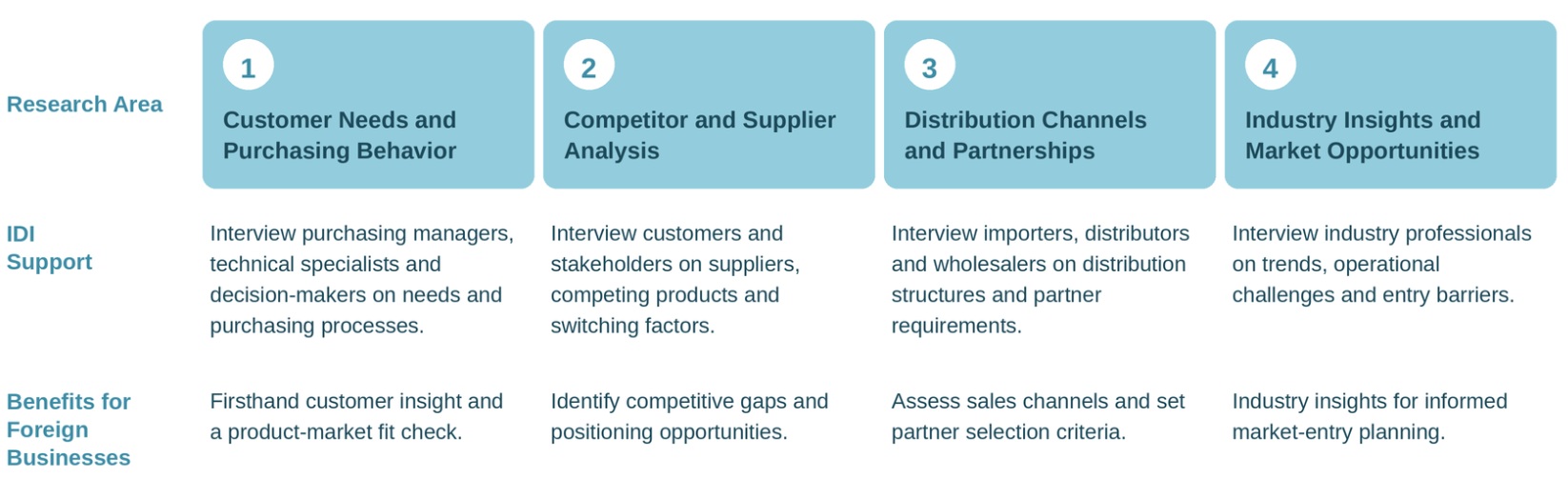
In-depth Interviews can be applied to different aspects of B2B market research, helping companies investigate specific business questions that cannot be fully addressed through secondary research. Depending on their objectives, foreign companies can use IDIs for four main purposes:
How In-depth Interviews Support B2B Market Research
| Role | Research Focus | Business Advantages |
| Customer Research | Customer needs, purchasing behavior, product requirements, and purchasing decisions. | Evaluate potential demand and adapt products or services to local market requirements. |
| Competitor Research | Customer perceptions of competing products, existing supplier relationships, and reasons for switching suppliers. | Identify competitive advantages, market-entry barriers, and differentiation opportunities. |
| Distribution Channel Research | Distribution practices, cooperation conditions, and expectations of importers, wholesalers, and distributors. | Identify suitable distribution channels and evaluate potential business partners. |
| Industry Expert Interviews | Industry developments, market practices, regulatory considerations, and emerging opportunities. | Understand industry-specific conditions, identify potential opportunities, and support market-entry planning. |
Source: B&Company analysis.
However, IDIs are not intended to generate statistically representative findings, as they typically involve a relatively small number of purposively selected respondents[3]. Interview results may also reflect individual experiences rather than broader market conditions. Therefore, IDIs are most effective when combined with secondary research and, where necessary, quantitative surveys. This approach allows businesses to examine specific market questions in greater depth while validating important findings through additional sources.
Practical Applications of In-depth Interviews in Vietnam’s B2B Market Research
Several studies in Vietnam demonstrate how IDIs can be applied across different B2B industries. Research in the textile, apparel, and logistics sectors has combined IDIs with quantitative surveys to investigate supplier selection criteria. Other studies have used IDIs to understand logistics service quality from different stakeholder perspectives and assess the market potential of new food products.
Examples of In-depth Interview Applications in Vietnam’s B2B Market Research
| Industry | Year | Research objective | IDI methodology | Key findings |
| Textile and apparel | 2019 | Identify supplier selection criteria | IDIs followed by a pilot survey of 31 companies and a quantitative survey of 282 respondents | Identified eight supplier selection criteria, including quality, cost, delivery, and business relationships. |
| Electronics and logistics | 2025 | Examine factors influencing logistics provider selection | IDIs with 8 logistics experts and a quantitative survey of 300 company representatives | Examined the importance of service quality, supplier reputation, cost competitiveness, and management capabilities. |
| Logistics | 2020 | Evaluate logistics service quality from different stakeholder perspectives | Individual IDIs with representatives from 14 companies in Hai Phong | Identified 14 service quality factors and differences between customers’ and service providers’ expectations. |
| Food industry | 2024 | Assess the market potential of introducing farmed lumpfish | Product testing and IDIs with 6 industrial buyers in Vietnam | Explored product perceptions, acceptance of unfamiliar food, and potential commercial applications. |
Source: B&Company’s synthesis
Business Implications and Opportunities for Foreign Companies
For foreign companies entering or expanding in Vietnam, In-depth Interviews can reveal business opportunities that may not be immediately apparent from secondary research. Insights into customer experiences, purchasing expectations, and existing market practices can help companies identify unmet needs, competitive gaps, and potential local partnerships. However, translating these insights into business opportunities requires careful analysis, validation, and practical testing.
To make effective use of IDI findings, foreign companies should focus on three key considerations:
– Identifying commercially relevant opportunities: A systematic analysis of interview responses can reveal recurring customer concerns, unmet requirements, and differences across market segments. Qualitative data analysis helps researchers identify common themes and interpret research findings.
– Evaluating commercial potential: Promising opportunities identified through IDIs should be assessed using secondary research, industry statistics, and additional interviews where necessary. The combination of existing market information and direct research provides a more comprehensive understanding of customer needs, market size, and competitive conditions[4].
– Testing and refining market-entry strategies: Companies can conduct product trials, pilot projects, or preliminary cooperation with local partners once potential opportunities have been evaluated. Testing critical business assumptions before committing substantial resources helps assess customer acceptance, identify implementation challenges, and refine market-entry strategies[5].
How B&Company can support Foreign Businesses in Vietnam
B&Company supports foreign companies seeking to understand Vietnam’s B2B market through In-depth Interviews with potential customers, distributors, industry experts, and other relevant stakeholders[6]. Combining local research expertise with industry knowledge and enterprise data, B&Company helps businesses investigate market conditions, identify potential opportunities, and obtain insights that may not be available through secondary research[7].
How B&Company’s IDI Services Support Foreign Businesses in Vietnam
Source: B&Company
Read more
Why Market research is essential before investing in Vietnam
* If you wish to quote any information from this article, please kindly cite the source along with the link to the original article to respect copyright.
| B&Company
The first Japanese company specializing in market research in Vietnam since 2008. We provide a wide range of services including industry reports, industry interviews, consumer surveys, business matching. Additionally, we have recently developed a database of over 1,000,000 companies in Vietnam, which can be used to search for partners and analyze the market. Please do not hesitate to contact us if you have any queries. info@b-company.jp + (84) 24 3978 5165 |
[1] https://pcivietnam.vn/uploads/EN-Bao-cao-dai/Layout-PCI-2024_EN_Final.pdf
[2] https://ask.ifas.ufl.edu/publication/WC338
[3] https://www.cdc.gov/field-epi-manual/php/chapters/qualitative-data.html
[4] https://www.sba.gov/counseling/plan-your-business/#market-research
[5] https://www.strategyzer.com/library/how-to-test-your-idea-start-with-the-most-critical-hypotheses
[6] https://b-company.jp/market-research/qualitative-research/
Related article













滋賀県ベトナムビジネス・サポートデスク-12.jpg)













Log in / Register
SUBSCRIBE NEWSLETTER