

 English
  日本語
日本語  Tiếng Việt
  简体中文
简体中文  한국어
한국어 Several meetings between Vietnam and the USA have been held, though the outcomes of the reciprocal tariff policy have not yet been disclosed.

27Jun2025
Latest News & Report / Vietnam Briefing
Comments: No Comments.
As the deadline for the tariff exemption approaches, Vietnam has proactively implemented measures, including policy reviews, trade negotiations, and sector preparations, aiming to minimize disruption and secure future growth. Several meetings between Vietnam and the USA has been held with some progress reported, though specific details or final outcomes about the reciprocal tariff policy have not yet been disclosed. As one of the six countries prioritized by the U.S. for bilateral talks during the 90-day suspension of retaliatory tariffs, Vietnam’s approach has been marked by a constructive stance, opting for dialogue over reciprocal taxes.
Overview
In early April, President Trump announced a retaliatory tariff list targeting a trade partner country. Among them, Vietnam faced the highest tariff rate of 46%, with reasons cited including non-transparent subsidies, relabeling for Chinese goods, and a large trade surplus due to low imports of U.S. goods compared to its exports to the U.S. The implementation of the reciprocal tariff was postponed for 90 days and is set to expire in July 2025. In the context of countries actively pursuing negotiations with the United States, Vietnam has also taken strong measures to promote cooperation with American partners in key sectors such as energy, agriculture, and defense. The final negotiation round just ended on June 12 and discussed a proposal for strategic cooperation that not only narrows the differences between Vietnam and the United States and expands the bilateral cooperation axis in high technology, textiles and footwear, retail [10].
No final decision on the reciprocal tariff rate has been announced following the negotiations yet. However, several agreements have already been established through the negotiation rounds between the two governments. Additionally, major companies from both countries have reached cooperation agreements that could bring significant changes to Vietnam, especially in the energy sector. Below are some key updates in the recent negotiations between the US and Vietnam (update until June 12th,2025):
Timeline of Vietnam–US negotiation progress
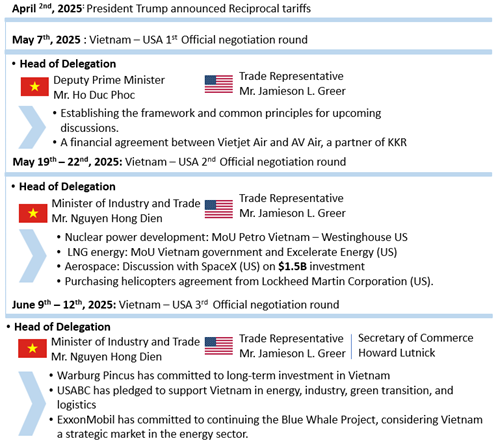
Source: B&Company’s compilation
In parallel with the agreements reached during this second round of negotiations, Vietnam has also taken prompt and drastic actions to control goods brought into Vietnam, to address US allegations of relabeling Vietnamese goods, and to distinguish the authenticity of Vietnamese products. Prime Minister Pham Minh Chinh directed the establishment of a special task force and launched nationwide operations targeting smuggling, trade fraud, counterfeit goods, and violations related to product origin and intellectual property rights. [5, 6]. The Ministry of Industry and Trade has recently issued Directive 09/CT-BCT to strengthen state management over the inspection and supervision of goods’ origin. It requires the Import-Export Department and relevant units to upgrade the eCoSys platform—an electronic certificate of origin (C/O) issuance system—by integrating anomaly detection, controlling issuance frequency, and enhancing data authentication capabilities [5]. This campaign sends a strong message of Vietnam’s political will and commitment to fair trade practices.
In addition, over the past months, Vietnam has implemented immediate import tariff reductions on a wide range of U.S. goods, open the pathway for US agricultural goods to Vietnam market. These measures took effect immediately and primarily cover products in key sectors of American export goods, such as agriculture, chemical materials, and energy.
Table of tax adjustments for some imported goods from the US
| Products | Current MFN tariff rates (%) | Adjusted rate (%) |
| Certain types of automobiles | 45 – 64 | 32 – 50 |
| Ethanol | 10 | 5 |
| Frozen chicken drumsticks | 20 | 15 |
| Pistachios | 15 | 5 |
| Almonds | 10 | 5 |
| Fresh apples | 8 | 5 |
| Sweet cherries | 10 | 5 |
| Raisins | 12 | 5 |
| Certain wood products | 20 – 25 | 0 |
| Liquefied natural gas (LNG) | 5 | 2 |
| Ethane | – | 0 |
| Corn kernels | 2 | 0 |
| Soybean meal | 1 – 2 | 0 |
* MFN: Most Favored Nation
Related article



























Log in / Register
Continue without an account
Log in / Register
SUBSCRIBE NEWSLETTER