

 English
  日本語
日本語  Tiếng Việt
  简体中文
简体中文  한국어
한국어 Xanh SM launching an inner‑city delivery service using electric vans represents a strategic shift toward sustainable logistics in Vietnam.

02Mar2026
Latest News & Report / Vietnam Briefing
Comments: No Comments.
Xanh SM’s launch of an inner‑city delivery service using electric vans (or electric trucks) represents a strategic shift toward sustainable logistics in Vietnam. This development responds directly to rapid e‑commerce growth, urban congestion, and environmental policy trends. With a competitive delivery market and increasing regulation favoring clean transportation, this move offers new opportunities for innovative service providers and foreign investors, especially in green technology and logistics infrastructure.
Introduction
Vietnam’s logistics and delivery landscape is rapidly evolving, driven by booming e‑commerce, rising consumer expectations, and urban environmental challenges. In this context, Xanh SM, an all‑electric mobility and delivery platform in Vietnam and several ASEAN markets, has announced a new inner‑city delivery service using electric trucks, expanding its green mobility offerings beyond ride‑hailing and parcel delivery. In details, Green SM Van service has been officialy launched on the first month of 2026 with special feature of using 100% electric vehicles – the Vinfast EC Van. The initial price is reported as 110,000 VND for the first 2 kilometers, and 8,000 – 11,000 VND for each kilometer next. The new service will be operated firstly in Hanoi, and will expand to other big urban areas in the near future [6]
This launch marks an important milestone for sustainable urban logistics, addressing increasing demand for efficient, low‑emission delivery solutions in major Vietnamese cities. The service aims to serve local businesses and urban consumers who require reliable last‑mile deliveries while aligning with environmental goals and emerging government policies that favor reduced emissions within city centers.
Market Analysis
Domestic news reports highlight a highly competitive landscape, with both state-owned and private logistics firms striving for scale. According to the Ministry of Industry and Trade and the Ministry of Science and Technology, the postal and delivery sector’s total revenue in the first half of 2025 reached approximately 38,300 billion VND (around US$1.46 billion), a 12.8 % increase year-on-year, illustrating strong upward momentum in shipment volume and service demand. During the same period, the total number of postal items handled exceeded 1.8 billion, a 16 % year-on-year increase, reflecting growing consumer reliance on delivery services for both e-commerce and traditional postal needs.
Vietnam Delivery Services Market
Unit: Billion USD
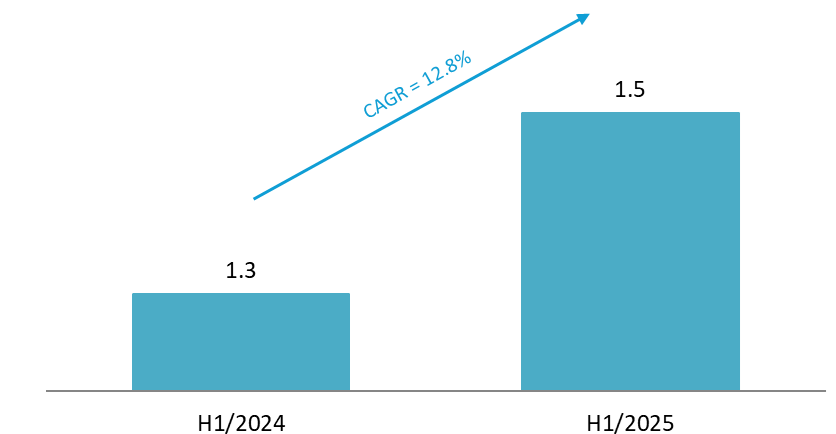
Source: B&Company synthesized from Vietnamplus [1]
In terms of market share and competitor structure, industry analysis shows that the top five players — Viettel Post, Giao Hàng Tiết Kiệm (GHTK), VNPost, J&T Express, and Giao Hàng Nhanh (GHN) — collectively command over 63 % of the express delivery market, with the remaining share distributed among numerous smaller operators. This concentration indicates a competitive field where major networks benefit from scale, infrastructure reach, and brand recognition.
Vietnam Courier, Express and Parcel (CEP) Market
Unit: Billion USD
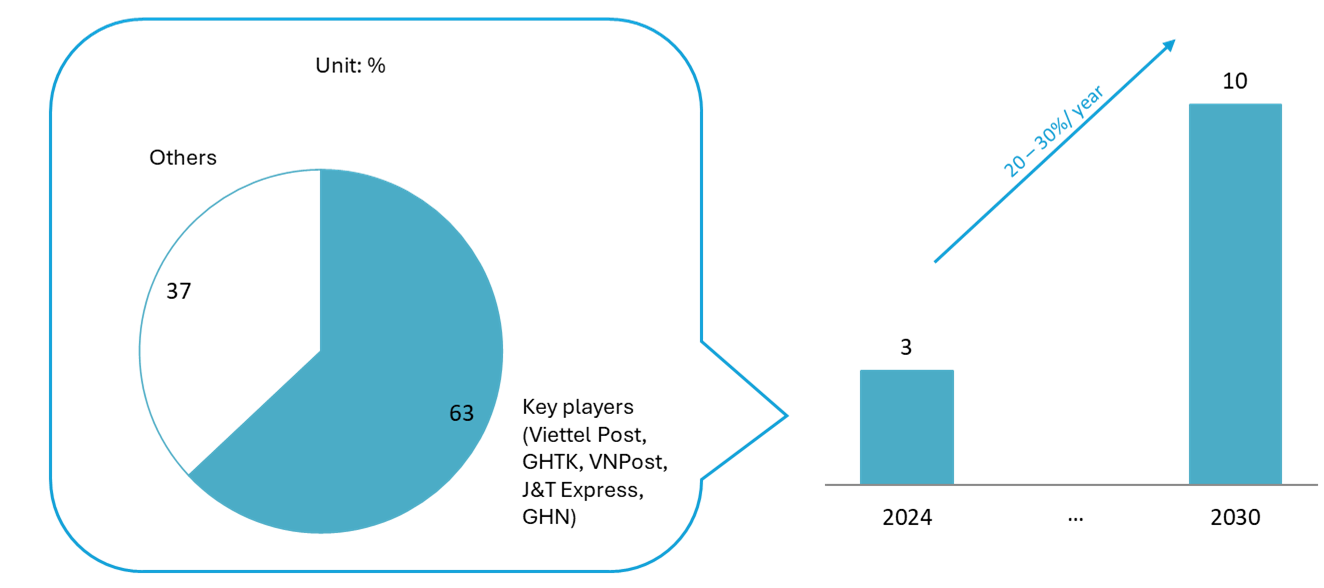
Source: B&Company synthesized from Vietnamplus and Znews [1][2]
Public disclosures show clear scale differences among major delivery players. In 2025, Viettel Post generated over 6,039 billion VND from parcel, warehousing, and logistics services, reinforcing its leading position, while GHTK reported around 2,000 billion VND in revenue amid weaker growth. VNPost continued to record stable revenue as parcel volumes increased. These figures highlight the revenue gap and competitive hierarchy among leading delivery service providers. Additionally, Vietnam’s international delivery ecosystem — though less dominant in domestic e-commerce — also contributes to competitive pressure, with global firms like J&T Express and Ninja Van rapidly expanding local footprints. Together, this competitive mix underscores both the diversity of service offerings and the market fragmentation outside the top five, indicating opportunities for service differentiation and innovation.
Impact of Xanh SM’s Electric Delivery Service
The introduction of an inner‑city delivery service using electric trucks by Xanh SM adds a crucial new dimension to Vietnam’s logistics ecosystem. By using electric vehicles for inner‑city routes, Xanh SM addresses two significant market needs: environmental sustainability and operational efficiency.
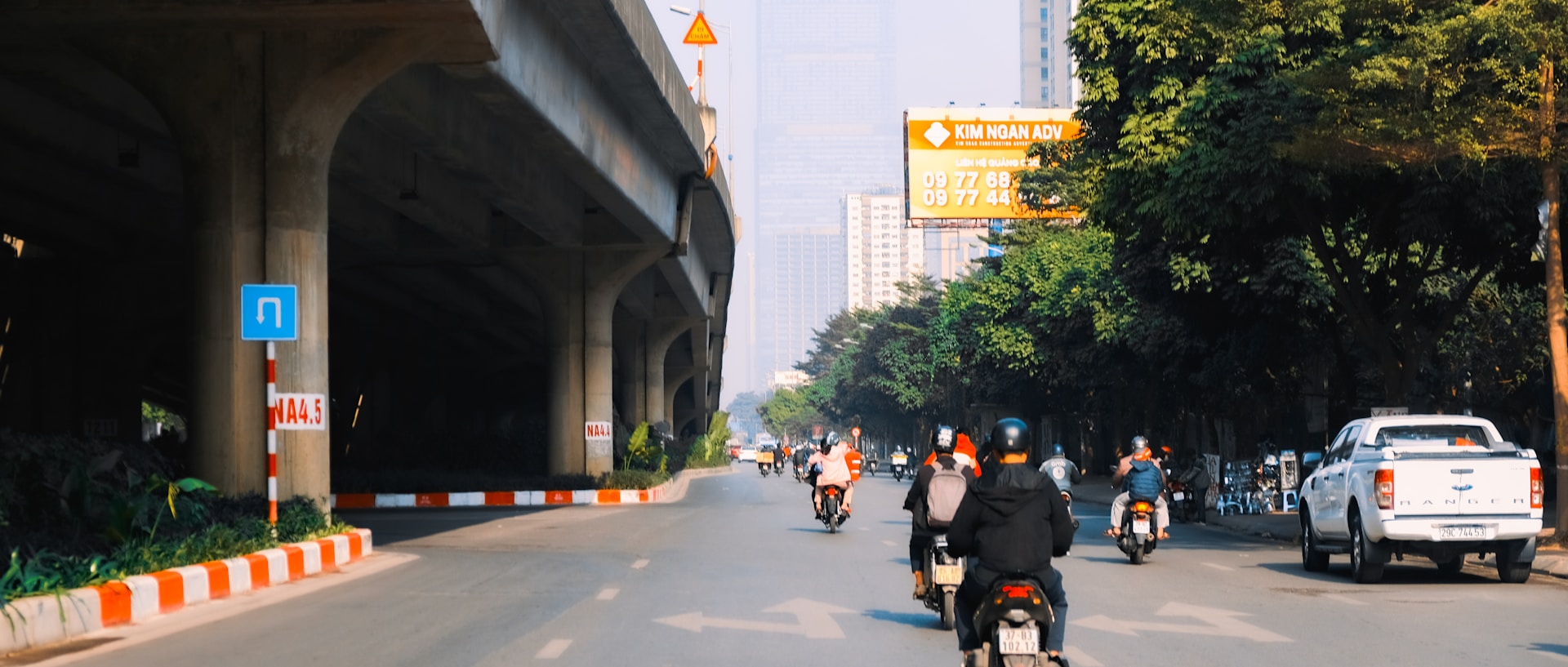
Vietnam’s government has become increasingly active in promoting clean transportation and sustainable logistics. regulatory developments such as the planned ban on fossil‑fuel motorcycles within central Hanoi by mid‑2026 could accelerate the shift toward electric delivery vehicles. This policy is part of Vietnam’s broader environmental strategy to improve air quality and reduce greenhouse gas emissions, and it directly impacts delivery providers that traditionally rely on petrol‑powered motorcycles.
The decision to phase out petrol‑powered motorcycles within central Hanoi by mid‑2026 reflects a broader commitment to reducing urban air pollution. Alongside emissions controls, authorities are exploring incentives for EV adoption, including support for electric buses and battery infrastructure. Although these initiatives also face criticism for their pace and feasibility, they send a clear signal: Vietnam’s urban logistics future is tied to electrification [4]
Infrastructure support is gradually developing, with private and public initiatives expanding EV‑friendly facilities such as charging stations and battery‑swapping networks. This infrastructure will be critical in enabling widespread adoption of electric delivery trucks, especially for logistics companies that require reliable charging solutions throughout city areas [7]
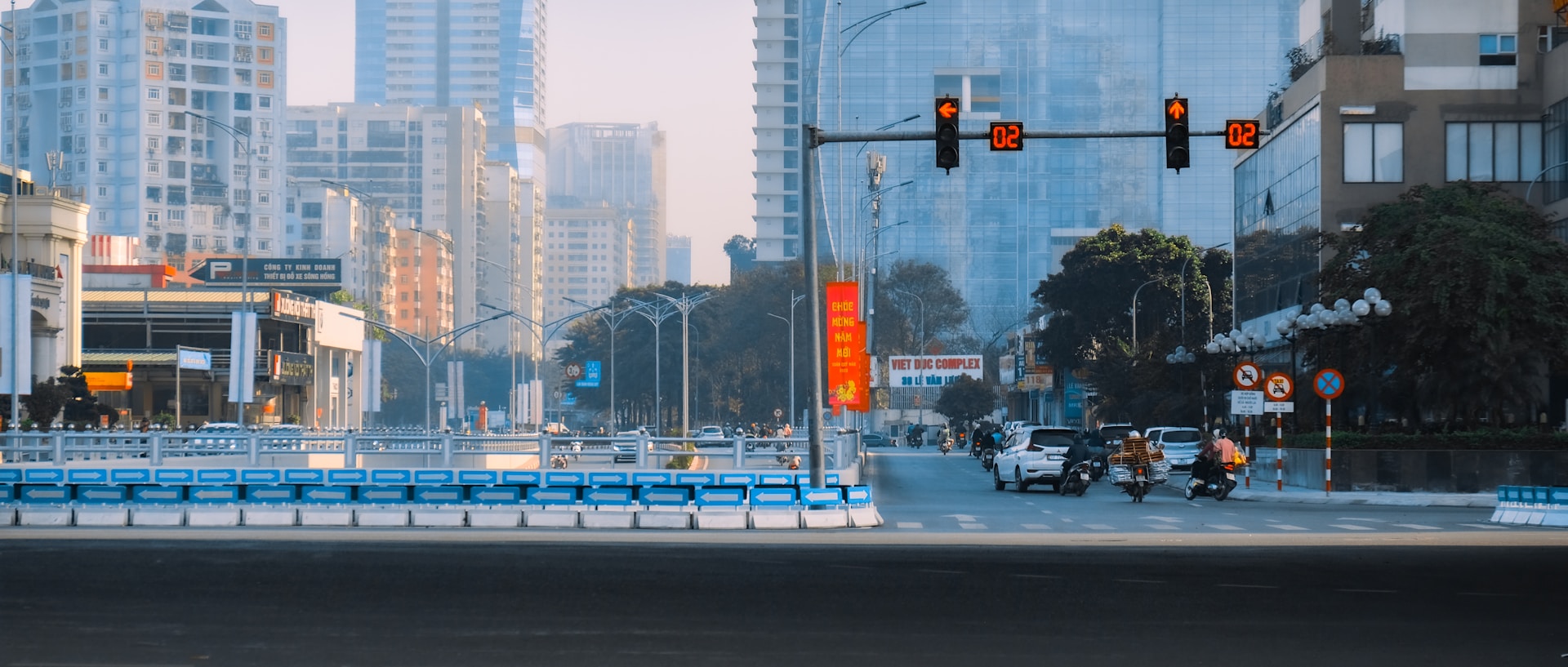
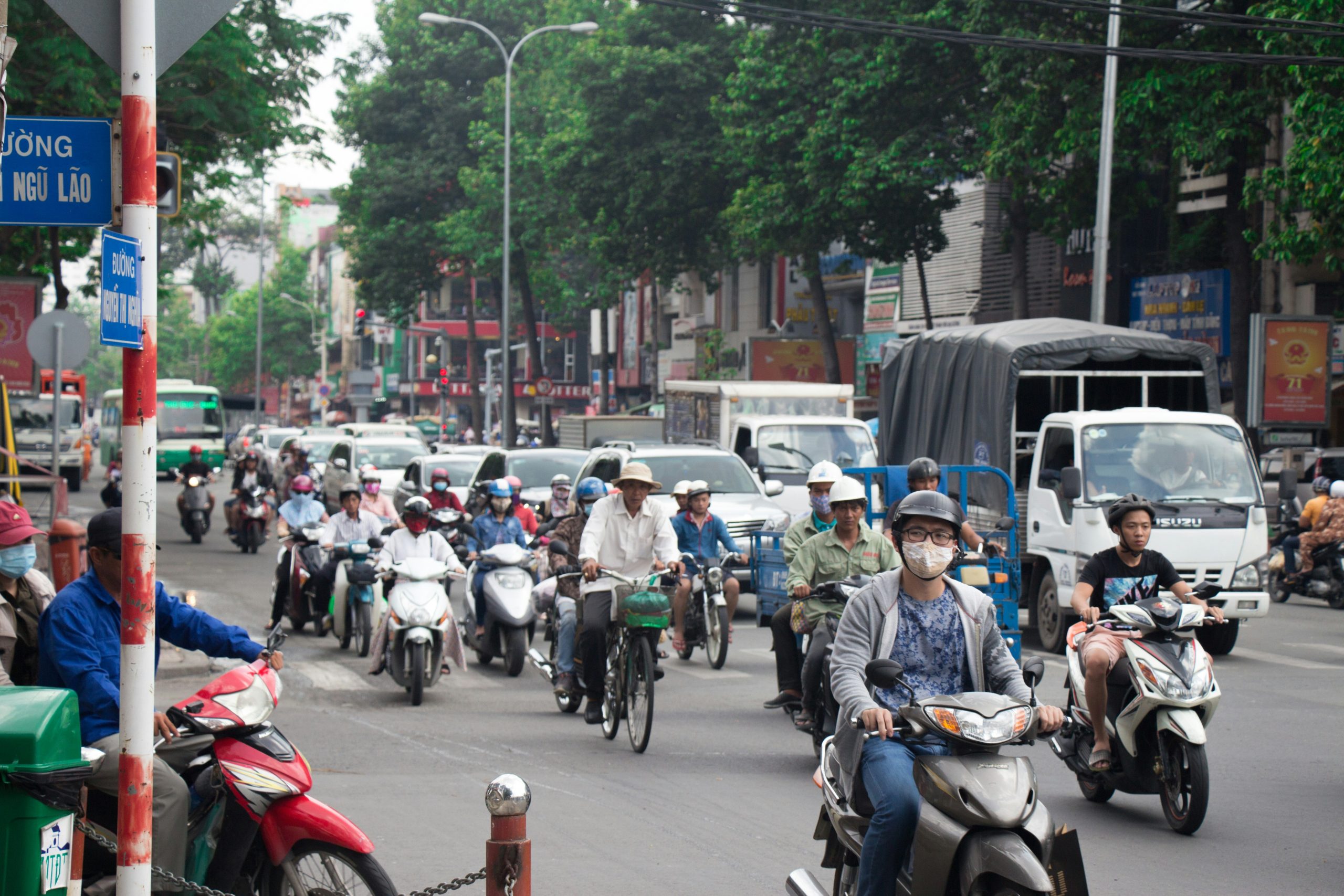
People wearing face masks wait at a traffic signal in Hanoi
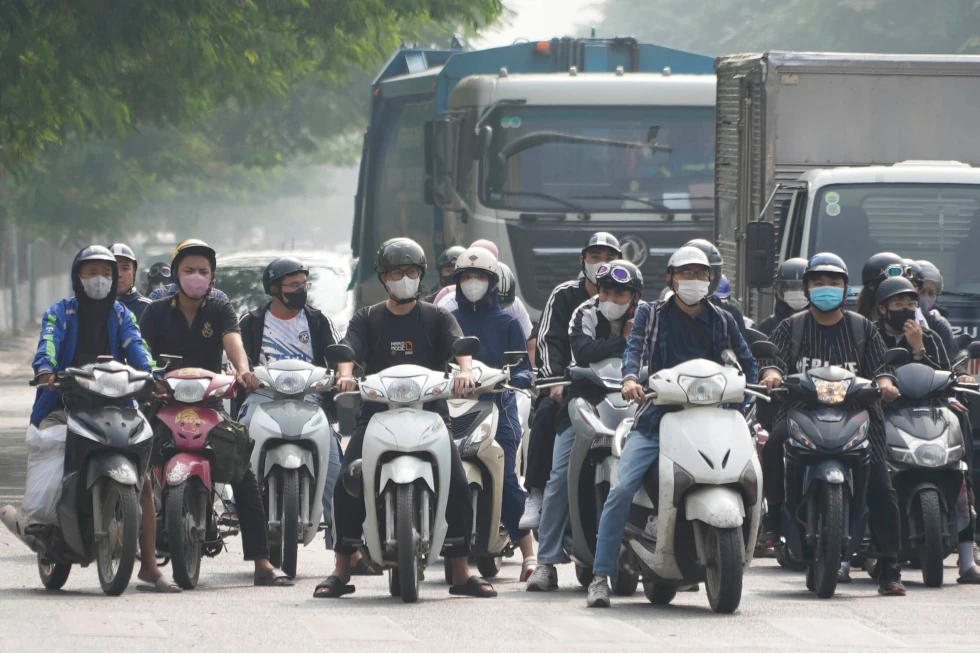
Source: AP News [4]
From a competitive perspective, Xanh SM’s electric delivery service positions the company uniquely against other players. Many competitors still use conventional gasoline or diesel‑powered vehicles, exposing them to fuel price volatility and increasing regulatory costs. In contrast, Xanh SM’s focus on electric vehicles enables cost savings over time and strengthens its appeal to eco‑conscious customers and corporate partners.
Furthermore, Xanh SM’s integration of digital logistics platforms (as seen in its existing ride‑hailing and parcel services) may offer operational benefits, such as data‑driven routing, fuel cost optimization, and improved customer visibility across delivery stages. The electric truck service thus exemplifies how digital platforms can merge sustainability with logistics efficiency.
Implications for Foreign Investors
For foreign direct investment (FDI) players, particularly those from countries with strengths in EV technology and logistics innovation—such as Japan—Vietnam’s evolving delivery market presents compelling opportunities.
Japanese companies with expertise in electric vehicle manufacturing, charging infrastructure, fleet management systems, and telematics could partner with Vietnamese firms like Xanh SM or local logistics providers. These partnerships can help accelerate the adoption of electric delivery vehicles and build integrated sustainable logistics ecosystems. For example, Japan’s leadership in electric transportation and smart logistics technology aligns well with Vietnam’s policy push toward clean mobility. With Xanh SM now expanding into electric delivery trucks, Japan‑based electric fleet solutions and software providers may find collaboration opportunities that contribute to scaling green logistics services.
FDI corporates can also explore infrastructure development, such as charging and battery‑swapping stations tailored to commercial electric fleets. As electric delivery vehicles become more widespread, reliable infrastructure becomes essential. Investments in EV support infrastructure could yield long‑term returns while aligning with Vietnam’s sustainability goals. Additionally, foreign logistics technology firms can bring innovations in route optimization, dynamic delivery pricing, and digital platforms that enhance the efficiency of last‑mile services. These technologies are essential components of modern delivery operations, especially as demand for same‑day and real‑time delivery grows.
In summary, the convergence of e‑commerce growth, government green policies, and private innovation—exemplified by Xanh SM’s electric delivery service—creates a fertile landscape for foreign investors interested in sustainable logistics and green technology. Aligning strategic investments with these trends can capture emerging market demand while supporting Vietnam’s broader goals for clean urban mobility.
Read more
Vietnam ride-hailing market 2025: Competition between Xanh SM, Grab, and Be
* If you wish to quote any information from this article, please kindly cite the source along with the link to the original article to respect copyright.
| B&Company
The first Japanese company specializing in market research in Vietnam since 2008. We provide a wide range of services including industry reports, industry interviews, consumer surveys, business matching. Additionally, we have recently developed a database of over 900,000 companies in Vietnam, which can be used to search for partners and analyze the market. Please do not hesitate to contact us if you have any queries. info@b-company.jp + (84) 28 3910 3913 |
REFERENCES:
- Cover: Xanh SM
- 1. https://en.vietnamplus.vn/postal-and-delivery-services-high-revenue-slim-profits-post323162.vnp
- 2. https://znews.vn/logistics-viet-nam-buoc-vao-cuoc-dua-chua-tung-co-post1576748.html
- 3. https://thanhnien.vn/giao-hang-nhanh-cuoc-choi-ngay-cang-khoc-liet-185250905214355871.htm
- 4. https://apnews.com/article/vietnam-hanoi-motorcycles-pollution-29bf81ec6b7bad9e8a63bd636ea34d18
- 5. https://www.kenresearch.com/vietnam-e-commerce-last-mile-delivery-platforms-market
- 6. https://www.xanhsm.com/news/xanh-sm-ra-mat-dich-vu-van-chuyen-hang-noi-do-bang-xe-tai-dien
- 7. https://vietnamnews.vn/economy/1731633/ha-noi-aims-to-build-public-ev-charging-stations.html
Related article

















Log in / Register
SUBSCRIBE NEWSLETTER