

 한국어
한국어  English
  日本語
日本語  Tiếng Việt
  简体中文
简体中文 베트남 북중부 및 중부 연안 지역의 경제는 2025년 행정구역 합병에 따라 변혁을 맞이하게 되었습니다.

136월2025
최신 뉴스 및 보고서 / 베트남 브리핑
댓글: 댓글 없음.
The economic landscape of Vietnam’s North Central and Central Coastal[1] region is poised for transformation following the 2025 administrative unit mergers. This strategic adjustment, set to take effect by August 15 per Conclusion No. 157-KL/TW[2], signed on May 25, aims to improve governance, streamline resource allocation, and foster regional connectivity for long-term development.
Overview of the North Central and Central Coastal after the 2025 Administrative Unit Mergers
Vietnam’s North Central and Central Coastal region is a major industrial-service-urban coastal center of the country and plays an important role in the development of Central Vietnam. Under Decision No. 759/QĐ-TTg[3], key changes include the merger of Quang Binh and Quang Tri provinces and the consolidation of Da Nang City and Quang Nam into a single centrally-governed city. The remaining provinces, including Thanh Hoa, Nghe An, Ha Tinh, and Hue City, maintain their administrative boundaries but are still influenced by broader regional policies.
The North Central and Central Coastal provincial-level administrative units after the 2025 mergers
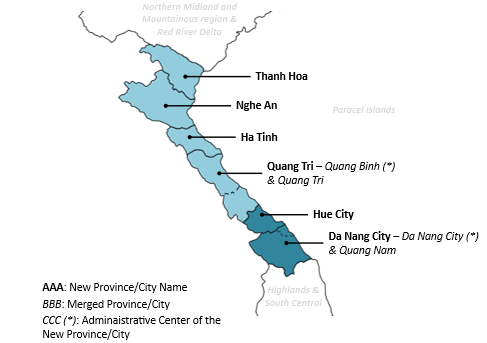
출처: B&Company Vietnam
The North Central and Central Coastal is a dynamic region due to its strategic position, long coastline, and abundance of natural resources. The region accounted for 10% of Vietnam’s total GRDP at 1,123 trillion VND, with a growth rate of nearly 9% in 2024. After the merger, the region has a mix of large and small economy localities, with Thanh Hoa leading the region with its 2024 GRDP of around 320 trillion VND, followed by Da Nang City, which overtakes Nghe An due to its merger with Quang Nam at a GRDP of 280 trillion VND. Hue City, without any mergers, posted the lowest GRDP in the region and the lowest among all centrally-governed cities, at 80 trillion VND.
Socio-economic indicators in 2024 of the North Central and Central Coastal provinces after the administrative mergers
| 아니요. | 지방 | 인구
( 단위 : 천 명) |
총면적(단위: km)2) | GRDP
(단위: 10억 VND) |
성장률
(단위: %) |
| 1 | 타인호아 | 3,764 | 11,115 | 318,752 |
12.2 |
| 2 | 다낭시 | 2,819 | 11,860 | 279,907 | 7.3 |
| 3 | 응헤안 | 3,442 | 16,487 | 216,943 | 8.0 |
| 4 | 꽝트리 | 1,584 | 12,700 | 113,688 | 6.6 |
| 5 | 하띵 | 1,330 | 5,994 | 112,855 | 7.5 |
| 6 | 후에시 | 1,236 | 4,947 | 80,000 | 8.2 |
| 총 | 14,175 | 63,103 | 1,122,145 | 8.8 | |
출처: 결의안 제60-NQ/TW호, 결정 번호 759/QD-TTg, 통계청(GSO), 지방 통계청, B&Company 종합
Regional Economic Characteristics and Investment Situation of the North Central and Central Coastal
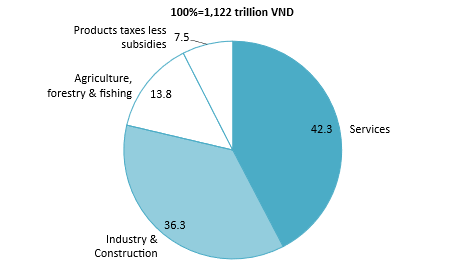
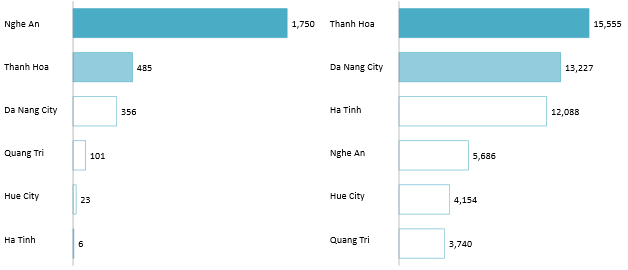
The North Central and Central Coastal region of Vietnam holds a strategic geo-economic position as a transitional zone connecting Northern Vietnam, the Central Highlands, and the East-West economic corridor, linking Laos, Thailand, and Myanmar to the Pacific Ocean. The region’s geographic diversity, bordered by mountains to the west and the East Sea to the east, shapes its development orientation toward a balanced mix of industry, services, and agriculture. The region also acts as a critical transportation and energy corridor for the country, with major highways, railway lines, and seaports facilitating regional integration. These locational strengths have attracted increasing investment into infrastructure, processing and manufacturing industries, renewable energy, and tourism, setting the stage for deeper participation in national and global value chains.

관련기사



























로그인 / 회원가입
계정 없이 계속하기
로그인 / 회원가입
뉴스레터 구독