

 English
  日本語
日本語  Tiếng Việt
  简体中文
简体中文  한국어
한국어 Vietnam retail market is moving from cost-driven growth toward customer experience as competition and consumer expectations rise.

14May2026
Latest News & Report / Vietnam Briefing
Comments: No Comments.
Abstract
Vietnam’s retail market is moving from cost-driven growth toward customer experience as competition and consumer expectations rise. With e-commerce facing higher acquisition costs and margin pressure, retailers are increasingly focusing on branding, personalisation, and omnichannel models. Coolmate’s shift from online-only to physical retail reflects this trend. For investors, long-term success will depend on companies that combine efficiency with strong customer experience and clear differentiation.
Market Evolution: From Rapid Growth to Increasing Competition
Vietnam’s retail market has grown strongly over the past decade, supported by economic expansion, a rising middle class, and digital adoption. By 2025, total retail sales reached about USD 270 billion[1], making Vietnam one of Southeast Asia’s most attractive retail markets.
Retail activity is still concentrated in key economic regions. The Red River Delta accounts for 31.3% of national retail sales, with Hanoi contributing more than half, while less developed regions such as the northern midlands and mountainous areas account for only 6.7%1, showing remaining regional gaps and future growth potential.
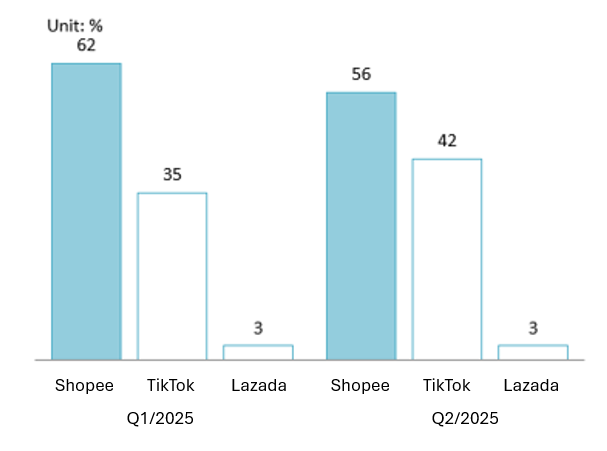
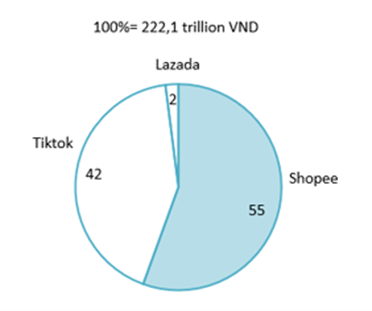
E-commerce has also become a major growth pillar, reaching around USD 31–33 billion, or about 10% of total retail sales. Platform competition is increasingly concentrated: Shopee remained the leader but declined from 62% in Q1/2025 to 56% in Q2/2025, while TikTok Shop rose from 35% to 42%. Lazada remained marginal at about 2%, suggesting an emerging duopoly between Shopee and TikTok Shop[2].
| E-commerce platform market share in the 1st half of 2025
|
Revenue of the top 3 E-commerce platforms in Vietnam in 2025
|
Source: Ecomobi
The rapid rise of TikTok Shop reflects Vietnam’s young, mobile-first consumer base and the growing influence of livestreaming and short-form video on shopping behavior. Supported by better logistics and wider digital payment adoption, e-commerce is moving beyond convenience and price toward more interactive, experience-led models.
From Cost Efficiency to Customer Experience
Cost efficiency has played a key role in shaping Vietnam’s modern retail landscape, especially through the growth of e-commerce and D2C models. By reducing dependence on physical stores, intermediaries, and large sales teams, businesses were able to operate leaner, scale faster, and offer competitive prices in a price-sensitive market. Early success was driven by logistics optimisation, inventory control, faster delivery, and efficient marketing spend, with pricing acting as a major tool for customer acquisition[3].
However, as more competitors adopted similar models, cost efficiency became a basic requirement rather than a clear advantage. Rising digital advertising costs, intense price competition, and increasing fees and operating costs on e-commerce platforms have further pressured margins[4]. At the same time, these rising online costs create new pressure on offline retail formats, pushing brands to justify physical stores through stronger customer experience, service quality, and experiential value.
As Vietnam’s retail market matures and consumer expectations rise, customer experience is becoming a new source of competitive advantage[5]. Consumers now value not only affordability but also quality, convenience, trust, personalisation, and emotional connection. This shift moves retail from a transactional model focused on short-term sales to a relational model built on retention, customer lifetime value, and brand loyalty. In this new phase, differentiation depends on delivering a seamless and engaging experience across online and offline touchpoints, while price remains important but is no longer the main driver of customer choice[6].
| Category | Standard Seller | Mall Seller | ||
| Platform commission fee before 2nd Mar 2026 | Platform commission fee from 2nd Mar 2026 | Platform commission fee before 2nd Mar 2026 | Platform commission fee from 2nd Mar 2026 | |
| Electronics | 1.47% – 9.82% | 1.47% – 9.82% | 2.00% – 12.60% | 2.00% – 12.60% |
| Fashion | 10.80% – 11.78% | 11.00% – 13.00% | 8.50% – 14.50% | 12.50% – 14.60% |
| Groceries | 6.87% – 11.78% | 6.87% – 11.78% | 11.50% – 14.20% | 11.50% – 14.20% |
| Mother & Baby | 8.84% – 11.78% | 8.84% – 12.50% | 10.50% – 14.50% | 10.50% – 14.50% |
| Health & Beauty | 10.31% – 11.78% | 10.31% – 11.78% | 11.50% – 15.80% | 11.50% – 15.80% |
| Home & Lifestyle | 3.93% – 11.78% | 1.00% – 13.50% | 1.50% – 14.50% | 1.50% – 16.30% |
New commission fees effective from March 2, 2026, on TikTok Shop. Source: Vietnambiz.com
Coolmate Case Study
The shift toward customer experience has led to the rise of omnichannel retail, where online and offline channels are integrated to create a unified customer journey. Online channels continue to provide efficiency through convenience, wider product selection, and fast delivery. However, the increasing cost of operating on e-commerce platforms, including higher commission fees, advertising expenses, and fulfilment-related costs, has placed growing pressure on brands that rely heavily on online sales. Offline channels, in contrast, offer sensory and emotional engagement by allowing customers to interact directly with products, store environments, and brand representatives.
The journey of Coolmate illustrates this transition clearly. In its early years, Coolmate operated as a fully online, direct-to-consumer brand, focusing mainly on cost efficiency. By selling basic menswear through digital channels, the company was able to optimise operations, reduce overhead costs, and offer competitive pricing. This model allowed Coolmate to scale quickly and build a strong customer base without investing heavily in physical retail.
However, as the market evolved, Coolmate began to face the broader limitations of the online-only model. Rising digital advertising costs, platform-related expenses, and per-order operational costs gradually reduced the advantages of pure cost efficiency. At the same time, the company recognised that online channels alone were not sufficient to deliver a complete customer experience, particularly as it expanded into product categories where customers value physical interaction, product trial, and stronger brand trust.
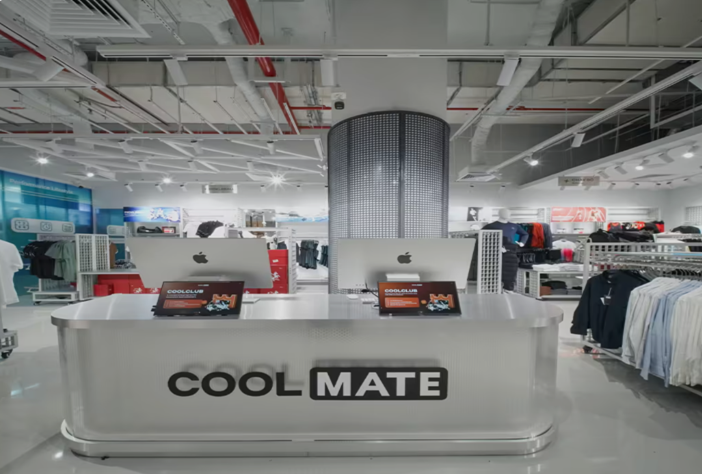
After seven years of operating exclusively online, in March 2026, Coolmate launched its first offline store at Hanoi Centre, 175 Nguyen Thai Hoc Street, Hanoi, marking an important step from an online-first D2C model toward an omnichannel strategy. This physical store was not intended to replace e-commerce, but to complement it. It helps enhance brand visibility, build consumer trust, and allow customers to experience products more tangibly before or after purchasing online[7].
Coolmate Offline Store in Hanoi
Source: Coolmate
This case reflects a broader trend in Vietnam’s retail market: even digital-native brands are increasingly investing in offline channels to strengthen customer experience and protect long-term competitiveness. As e-commerce becomes more costly and competitive, omnichannel retail is no longer simply a strategic option. It is becoming a necessary evolution for brands seeking sustainable growth, stronger differentiation, and deeper customer relationships.
Implications for Investors
The shift from cost efficiency to customer experience has significant implications for investors evaluating opportunities in Vietnam’s retail sector.
First, business models that rely heavily on price competition are becoming less attractive. As customer acquisition costs rise and margins shrink, companies that depend on discounts and aggressive promotions may struggle to achieve sustainable profitability. Strong top-line growth is no longer sufficient if it is not supported by healthy unit economics and customer retention.
Second, companies that excel in customer experience are likely to generate stronger long-term returns. Brands that invest in product quality, customer engagement, and consistent service are better positioned to build loyalty and increase customer lifetime value. These factors contribute to more stable and predictable revenue streams, which are critical from an investment perspective.
Third, omnichannel capability is emerging as a key differentiator. Retailers that can effectively integrate online and offline channels are able to capture both efficiency and experience advantages. This not only enhances customer satisfaction but also reduces reliance on any single channel, improving resilience and diversification.
Fourth, technology and data infrastructure remain essential enablers. Companies that leverage data to personalize experiences, optimize supply chains, and improve decision-making are better equipped to compete in a more complex and demanding market environment.
Finally, the market is transitioning from a growth-at-all-costs phase to a more sustainable model. Investors are increasingly prioritizing profitability, operational discipline, and brand strength over rapid but inefficient expansion. The focus is shifting toward businesses that can balance efficiency with differentiation.
Read more
Retail leasing price range situation in Hanoi and F&B business potential in 2026
* If you wish to quote any information from this article, please kindly cite the source along with the link to the original article to respect copyright.
| B&Company
The first Japanese company specializing in market research in Vietnam since 2008. We provide a wide range of services including industry reports, industry interviews, consumer surveys, business matching. Additionally, we have recently developed a database of over 900,000 companies in Vietnam, which can be used to search for partners and analyze the market. Please do not hesitate to contact us if you have any queries. info@b-company.jp + (84) 28 3910 3913 |
[1] https://theinvestor.vn/vietnams-retail-goods-and-services-market-value-hits-270-bln-in-2025-domestic-chains-dominate-d18032.html
[2] https://www.brandsvietnam.com/congdong/topic/bao-cao-thuong-mai-dien-tu-viet-nam-2025-2026-cuoc-cach-mang-content-to-commerce
[3] https://en.vneconomy.vn/e-commerce-in-upward-trend-1250945.htm?
[4] https://www.vietnam-briefing.com/news/vietnams-e-commerce-sector-outlook-in-2026.html/?
[5] https://www.tandfonline.com/doi/full/10.1080/23311975.2023.2292487?
[6] https://www.sciencedirect.com/science/article/abs/pii/S0969698923003739?
[7] https://vietnambiz.vn/thay-gi-tu-quyet-dinh-mo-cua-hang-vat-ly-cua-coolmate-sau-7-nam-chi-ban-online-2026317112653323.htm
Related article






























Log in / Register
SUBSCRIBE NEWSLETTER