

 English
  日本語
日本語  Tiếng Việt
  简体中文
简体中文  한국어
한국어 E-Commerce market has grown massively. Various developments are advancing in related sectors like logistics, fintech, and content, riding this major wave.

20Jul2026
Latest News & Report / Vietnam Briefing
Comments: No Comments.
E-Commerce (EC) market has grown massively. Various developments are advancing in related sectors like logistics, fintech, and content, riding this major wave. As more players enter, success requires adapting to Vietnam’s unique market dynamics- tailored strategies and strong partnerships. Meanwhile, addressing various issues stemming from the market’s previously unregulated, free growth has become necessary. The government is advancing regulations, forcing businesses to respond.
Market Outlook
Relating to the digital economy, the market size is estimated at 36 billion USD in 2024, equivalent to 8% of GDP[1], exceeding the Southeast Asian average of 7% and the global average of 5%. The market is projected to continue growing, reaching 42 billion USD in 2025 and 93 billion USD by 2030. The compound annual growth rate (CAGR) from 2022 to 2030 is 14%.
Digital Economy Market Size
Unit: Billion USD
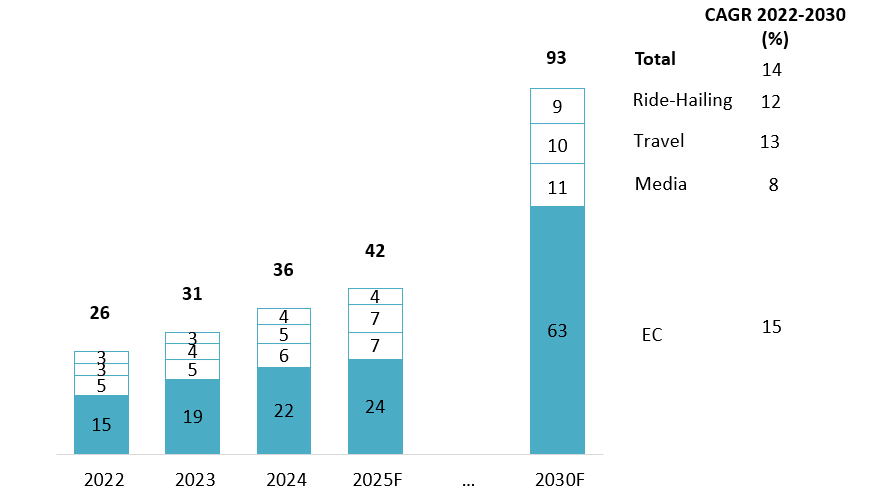
Source: Google e-Conomy SEA 2024
Within the digital economy, EC sales in 2024 reached 22 billion USD, a 16% increase year-on-year. Of this, EC platforms such as Shopee, TikTok, and Lazada accounted for 60%, while the remaining 40% came from company-owned websites/apps and social commerce. The EC market is expected to continue growing, reaching 63 billion USD by 2030 with a compound annual growth rate (CAGR) of approximately 20%. Usage is expanding beyond major metropolitan areas into regional cities.
The backdrop is the pervasive penetration of the digital economy. By 2024, 79% of the population (79 million people) were active internet users, a 4% increase compared to 2022. Over 50% of these users are under 35 years old. Many spend 3 to 5 hours per day online. Primary purposes include entertainment (59%), learning/research (48%), product information (46%), and social networking (46%). Consequently, 78% of internet users (62 million people) participate in online shopping.
Adjacent industries supporting e-commerce, such as last-mile delivery and online payments, are also developing synergistically. COVID-19 has prompted even the elderly to become accustomed to online shopping and payments, reducing barriers to internet use across society. In 2019, cash on delivery accounted for 88% of online purchases, but this decreased to 76% by 2023. Meanwhile, card payments, bank transfers, and e-wallets increased from 12% to 49%. E-wallet usage has grown significantly, with approximately 36 million users in 2023 and projections reaching 60 million by 2026[2] .
Major players
Foreign companies have entered the market through direct investment, including mergers and acquisitions (M&A) and joint ventures (JV). All major platforms are foreign-owned.
Major EC Platforms
| No | Platform | Origin | Investor | Expansion |
| 1 | Shopee | Singapore | SEA (Tencent Group) | · Founded in Singapore in 2016, expanded into Malaysia, Thailand, Taiwan, Vietnam, Indonesia, and the Philippines by 2018
· Currently holds dominant positions in Vietnam, Indonesia, and Thailand · Expanded into e-wallet Shopee Pay and food delivery Shopee Food from 2019 to 2021 |
| 2 | Lazada | Singapore | Alibaba became the largest shareholder in 2017 | · Founded in 2012, expanded into Indonesia, Malaysia, the Philippines, Thailand, and Vietnam by 2014
· After Alibaba acquisition, integrated with Alibaba services included cross-border shopping and LazMall (premium brand marketplace) · Losing market share to Shopee in Indonesia, Vietnam, and other regions |
| 3 | Tiki | Vietnam | JD.com invested in 2017 | · Launched in 2010 as an online book purchasing platform, expanded into multi-category in 2012
· A major EC platform known for fast delivery and genuine product guarantees. Since 2019, faced funding shortages and declining market share due to price competition with Shopee and Lazada |
| 4 | TikTok Shop | China | ByteDance | · Launched in 2022; over 50,000 domestic sellers registered by 2023[3] |
Source: B&Company
Market Challenges: Tightening Regulations and Profit Compression
Strengthened VAT taxation
Since 2022, all sellers with annual sales exceeding 100 million VND are required to issue electronic invoices. Additionally, all online sellers must file tax returns. Crackdowns have also intensified on counterfeit goods, products without quality labels, and goods lacking certificates of origin or invoices. The government is working to increase transparency in commercial transactions. However, for micro-enterprises and sole proprietors, who make up the majority of EC sellers, profits are shrinking.
Furthermore, starting July 1, 2024, based on Decree 69/2024/ND-CP, enterprises (including foreign business owners) are required to register a VNeID account for their person responsible. This is required for tax-related tasks such as filing, payment, and inquiries. While this is expected to improve transparency, simplify administrative procedures, and strengthen tax management in the online business environment, companies unfamiliar with electronic procedures may struggle to fulfill their tax obligations. Companies with incomplete or unclear tax records, especially those with past delinquencies, may face difficulties renewing their registration.
Businesses without a VNeID cannot access the electronic tax system

Source: VOV
| Exit of Small-Scale EC Sellers
Some stores are raising prices to maintain profits. However, this is difficult to achieve given the high number of price-sensitive consumers. According to Metric.vn, while major sellers are expanding their scale in Vietnam’s EC market, small-scale businesses are gradually exiting. In Q1 2025, the number of active stores decreased by over 38,000 compared to the same period last year. |
Platform Revenue
EC has become a place for low-price purchases. EC platforms attract consumers with various sales campaigns, discount coupons, and free shipping. Over 50% of online shoppers cite “low prices and many discounts” as their reason for purchasing via EC. Platform operators are prioritizing market share and scale expansion even while operating at a loss.
Major Platform Profitability
| No | Platform | Profit/Loss Status |
| 1 | Shopee | – In 2022, it recorded a profit of 120 million USD for the first time. This was achieved with revenue of 440 million USD.
– Profit margin declined in 2023. Revenue of approximately 700 million USD, profit of 56 million USD |
| 2 | Lazada | – Still operating at a loss across Southeast Asia
– Vietnam: 2022 revenue over 260 million USD, loss of 9 million USD[4] |
| 3 | Tiki | – Has not turned a profit since launch
– 2022 revenue of approximately 200 million USD, loss of 93 million USD[5] |
Source: B&Company
Shortage of distribution centers
Another challenge in Vietnam’s EC market is weak logistics infrastructure, particularly distribution centers and warehouses. While many players like NinjaVan, Giao Hang Tiet Kiem (GHTK), Giao Hang Nhanh (GHN), and Lalamove have entered the e-logistics market, they cannot keep up with demand. This tendency is especially pronounced during large-scale campaigns and year-end periods. By late 2023, GHTK halted accepting new orders into its warehouses, with processing times exceeding 10 days and sometimes stretching to a month. This imposed additional logistics costs on sellers, leading to buyer dissatisfaction and cancellations[6].
To reduce reliance risks on logistics providers, platforms are building hybrid delivery networks combining in-house and external capabilities. Shopee has built two distribution hubs, each exceeding 100,000 square meters, in Hanoi and Binh Duong, respectively, and is partnering with GHTK, GHN, and Ninja Van to optimize spoke warehouses and improve last-mile delivery. Improving logistics efficiency leads to cost reductions and service improvements for sellers, attracting many sellers and creating a virtuous cycle of market share expansion for the platform.
Transition to Green EC
Packaging and delivery have a negative impact on the environment. In 2023, EC used 332,000 tons of packaging materials, of which 171,000 tons were plastic[7]. If no measures are taken, plastic waste from EC could reach 800,000 tons by 2030. Delivery vehicles cause large amounts of carbon dioxide emissions, and express delivery further exacerbates this problem. In recent years, companies like Lazada, Grab, and Viettel Post have implemented measures such as introducing recyclable packaging and promoting slower delivery options.
Governments are working to establish national sustainability standards for EC, helping companies assess and improve their environmental impact. Businesses need to continuously gather information on evolving environmental regulations and adopt initiatives like energy-saving technologies and low-emission delivery methods. While the initial investment is significant, aligning with global sustainability standards enables companies to respond to the growing demand for environmentally conscious products and services.
Read more
Vietnam’s new E-commerce Law 122/2025/QH15: Key provisions and implications
From views to orders: How Social commerce is rewiring Vietnam’s retail
* If you wish to quote any information from this article, please kindly cite the source along with the link to the original article to respect copyright.
| B&Company
The first Japanese company specializing in market research in Vietnam since 2008. We provide a wide range of services including industry reports, industry interviews, consumer surveys, business matching. Additionally, we have recently developed a database of over 1,000,000 companies in Vietnam, which can be used to search for partners and analyze the market. Please do not hesitate to contact us if you have any queries. info@b-company.jp + (84) 24 3978 5165 |
[1] Indonesia, Malaysia, Philippines, Singapore, Thailand, Vietnam (6 countries)
[3] Tuoi Tre News (2024) <Access>
[4] The Leader (2024) <Access>
Related article






Log in / Register
SUBSCRIBE NEWSLETTER