

 English
  日本語
日本語  Tiếng Việt
  简体中文
简体中文  한국어
한국어 B&Company was recently featured on VTV’s Vietnam Today to share insights into how AI is applied across Vietnam’s fashion and garment industry

18Aug2026
Highlight content / Highlight Content JP / Highlight content vi / Latest News & Report
Comments: No Comments.
B&Company was recently featured on VTV’s Vietnam Today to share insights into how artificial intelligence (AI) is being applied across Vietnam’s fashion and garment industry, from design and manufacturing to retail. The program was broadcast on August 12, 2026.
Key takeaways
From B&Company’s perspective, AI is increasingly becoming a practical tool for Vietnam’s fashion and garment industry, supporting faster product development, more efficient manufacturing, demand forecasting, and personalized customer experiences.
However, AI does not replace human creativity or decision-making. Its business value depends on how effectively companies combine technology with quality data, skilled people, clear management processes, and a distinctive brand identity.
B&Company on Vietnam Today about AI in the fashion and garment industry
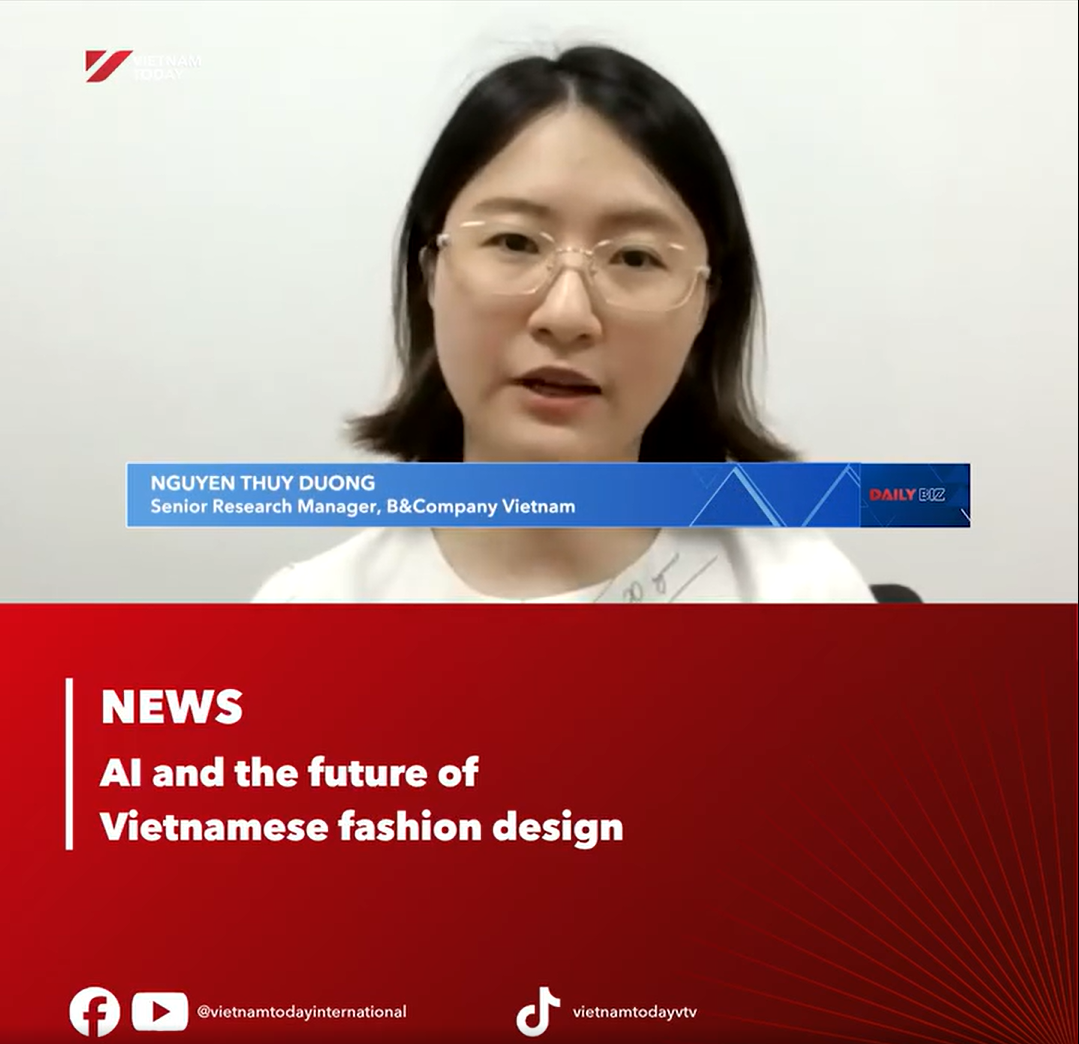
Watch the full news on Vietnam Today:
Source: Vietnam Today
Founded in Japan in 2001 as a market research and overseas investment consulting company based in Tokyo, B&Company has expanded into Vietnam since 2008, with offices in Hanoi and Ho Chi Minh City. For nearly two decades, we have supported clients across various industries in understanding the Vietnamese market and making strategic business decisions.
If you are planning to enter or expand in Vietnam’s fashion, textile, garment, retail, or AI-related markets, B&Company can support your business through market research, industry interviews, consumer surveys, market entry consulting, and business matching.
Interview content about AI adoption in Vietnam’s fashion industry
Ms. Duong Nguyen – Senior Research Manager at B&Company

Question 1: How is AI changing Vietnam’s fashion industry?
Answer:
According to B&Company’s analysis, the impact of AI is becoming most visible in three areas: design, manufacturing, and retail.
– In design, AI can support trend analysis, recommend colors and patterns, generate initial design concepts, and create 3D simulations before physical samples are produced. AI is also being explored as a tool to digitize and reinterpret traditional patterns and cultural elements. However, designers continue to play the central role in determining silhouettes, materials, production feasibility, brand storytelling, and the final creative direction.
– In manufacturing and management, several pioneering Vietnamese companies have reported improvements in specific processes after adopting AI and automation. Việt Thắng Jean, for example, has reported significant reductions in data-management workload and operating costs, as well as a substantial shortening of sample-development time. May 10 has reported higher productivity in certain automated processes, while Vinatex has highlighted shorter production times through process optimization, supply-chain management, and demand forecasting.
– In retail, AI is being applied to product recommendations, chatbots, customer-behavior analysis, personalized experiences, and virtual fashion visualization. Vietnamese companies are also experimenting with AI-generated fashion images and virtual try-on solutions. At the same time, publicly available evidence on the direct impact of these technologies on sales conversion or product return rates in Vietnam remains limited.
Question 2: What opportunities and challenges do Vietnamese fashion companies face when adopting AI?
Answer:
One of the biggest opportunities is the ability to shorten the cycle from idea to finished product.
AI and 3D simulation can reduce the number of physical sampling rounds, while demand forecasting can help companies improve inventory planning. AI can also support personalized shopping experiences and allow businesses with well-structured data to make better use of historical designs, patterns, sales information, and customer feedback.
However, the gap between awareness and large-scale implementation remains significant.
According to information cited by the Ho Chi Minh City Association of Garment, Textile, Embroidery and Knitting, only around 20% of textile and garment companies have adopted digital transformation to varying degrees, while many small and medium-sized enterprises remain at the awareness or preparation stage.
A broader 2025 survey by ITviec also illustrates the challenge facing Vietnamese businesses. While 73% of surveyed companies had integrated AI to some extent, only 13.8% had reached the scaling or full-adoption stage. Shortages of internal AI skills and experienced personnel were among the key barriers.
Data quality, privacy, intellectual property, and governance are also becoming increasingly important.
Virtual try-on and personalization solutions can involve customer images, body measurements, and purchasing histories. Businesses therefore need clear processes for managing personal data and ensuring compliance with Vietnam’s data protection requirements.
For AI-assisted design, companies should also keep records of data sources, human involvement, and the processes used to review and modify AI-generated outputs. Businesses should not assume that AI-generated content will automatically receive full intellectual property protection.
Question 3: What will determine competitiveness in the AI era?
Answer:
From B&Company’s perspective, four factors will be particularly important.
– First, internal data. Companies need sufficiently structured data on designs, materials, sales, inventory, and customers. More importantly, this data should be integrated into actual business processes rather than using AI only for isolated tasks.
– Second, human capabilities and management direction. Leadership needs to establish clear objectives for AI adoption, while designers and operational teams must be able to define requirements, evaluate feasibility, identify errors or bias, and remain responsible for final decisions.
– Third, brand identity and intellectual property. As AI tools become increasingly accessible, competitive advantage is unlikely to come from the software itself. Differentiation will increasingly depend on proprietary data, design language, understanding of customers, and the ability to interpret cultural elements in an authentic and well-managed way.
– Fourth, measurable operational impact. Companies should clearly define whether AI is being introduced to shorten sampling time, reduce defects, optimize inventory, improve productivity, or increase conversion rates, and then track these objectives using specific indicators.
Early adoption alone does not guarantee competitive advantage if the underlying data is poor, business processes remain unchanged, or AI-generated outputs are not properly controlled.
B&Company’s perspective
AI is likely to become an increasingly important productivity and experimentation tool for Vietnam’s fashion and garment industry.
Its greatest potential lies not in replacing designers or employees, but in helping companies analyze information more quickly, test more alternatives, shorten development cycles, optimize operations, and respond faster to changes in consumer demand.
At the same time, widespread access to similar AI tools may make human capabilities, proprietary data, operational know-how, and brand identity even more important sources of differentiation.
The companies that are best positioned to compete will therefore be those that successfully combine the speed and scalability of AI with quality data, capable teams, clear governance, measurable business objectives, and a consistent brand identity.
Ultimately, AI can expand what fashion companies are able to create and test, but the responsibility for direction, selection, and final decision-making remains with people.
Read more
B&Company featured on VTV’s Vietnam Today: Insights on Vietnam’s AI-integrated home appliance market
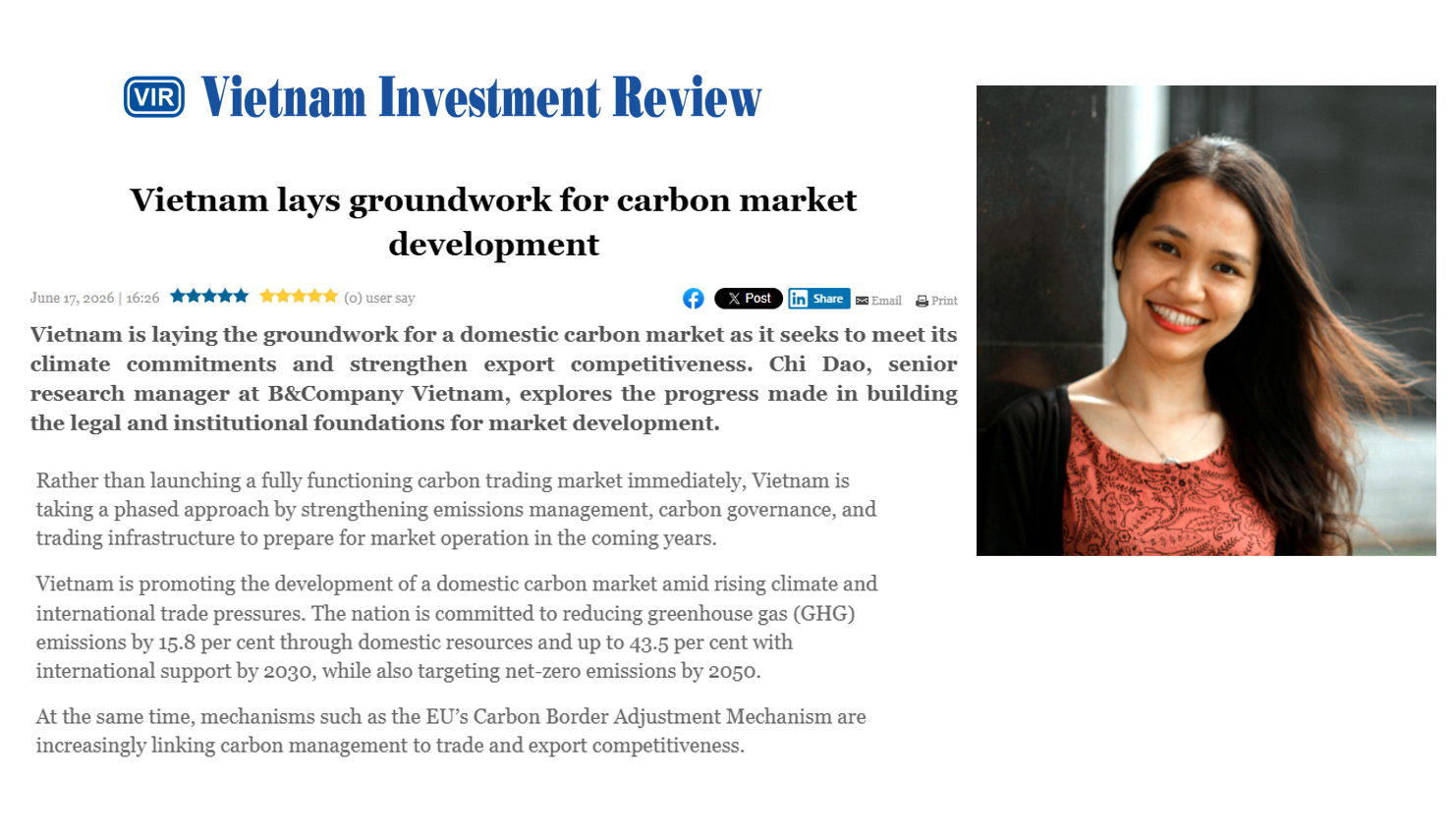
Interview with B&Company on Vietnam’s emerging Carbon market
* If you wish to quote any information from this article, please kindly cite the source along with the link to the original article to respect copyright.
| B&Company
The first Japanese company specializing in market research in Vietnam since 2008. We provide a wide range of services including industry reports, industry interviews, consumer surveys, business matching. Additionally, we have recently developed a database of over 1,000,000 companies in Vietnam, which can be used to search for partners and analyze the market. Please do not hesitate to contact us if you have any queries. info@b-company.jp + (84) 24 3978 5165 |
Related article






















Log in / Register
SUBSCRIBE NEWSLETTER