English
  日本語
日本語  Tiếng Việt
  简体中文
简体中文  한국어
한국어 
25Jul2024
Highlight content / Industry Reviews / Latest News & Report
Comments: No Comments.
Functional foods- An immerging market, but yet a very modest online encounter
Vietnamese people are becoming more health conscious, especially after the outbreaks of COVID-19. Besides paying attention to a healthy lifestyle (such as maintaining a balanced routine and a good diet), using supplements is one increasing solution that consumers are seeking frequently. Statistics show that the total market doubled in 2019 (the year when the pandemic started) and kept a steady growth over the years.
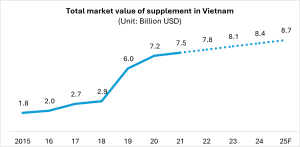
(Source: L.E.K Research & Analysis, Viet Nam Association of Functional Food (VAFF), Euromonitor’s research)
Obviously, e-commerce does not step away from this boom. A report published by British Chamber of Commerce pointed out that back to 2021, up to 30% of supplement sales were distributed via direct sales or online channels (website, SNS, EC platforms). With O2O (Offline-to-Online) trends, many traditional store-based distributors are also opening their virtual points of sales. And yet, consumers are still reluctant to purchase online supplements. A survey conducted early 2024 by B&Company Vietnam revealed that less than 10% of functional foods buyers consider online channels as reliable purchase sources, while over a half prefer to buy hand-carried products through their friends or acquaintances, and the rest 42% stick to physical stores (pharmacies, healthcare shops).
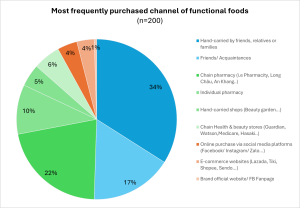
(Source: Consumer survey conducted 01/2024 among 200 functional foods consumers in Hanoi and HCMC – by B&Company Vietnam)
It poses a big question: Despite its popularity and considerable transaction amount, selling supplements online is not trustworthy. Why is that?
There are several factors to explain for the question:
(a) Functional food and supplement market in Vietnam is still very fragmented. According to the Vietnam Association of Functional Foods (VAFF), as of 2021, there were total 12.77 thousands products being sold in Vietnam, and in 2022, it escalated to nearly 30 thousand products with certificate for circulation (reported by the Vietnam Food Safety Authority). The huge number of products easily drives consumers confused and lost in the forest due to the insufficiency of public information and appropriate advertisements from brand manufacturers.
(b) Not only the lack of promotion, but massively false advertisements also put consumers at doubts and skepticism. Unlike prescript medicines with clear instructions by doctors, functional foods are mostly bought spontaneously, so consumers are much afraid of fake or low-quality products that may bring harmful effects to their body and health. Therefore, they turn to recommendations from family, friends and people around as the safest sources of information. Online channels, on the other hand, are also widely used to gain information, but the trust level is quite lower. However, it should not be overlooked that most familiar online channels (search engines, SNS) and KOLs still seize a noticeable influence (nearly equal to advices of medical experts).
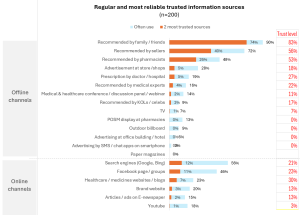
(Source: Consumer survey conducted 01/2024 among 200 functional foods consumers in Hanoi and HCMC – by B&Company Vietnam)
Social commerce and online advertising are a double-edged sword
Sadly, this fear of consumers is resulted by many scams and false advertising, of which a majority are rooted from online advertising and social commerce. There are two most popular and severe kinds of false advertising that have been raised strongly and constantly by related organizations such as Ministry of Health and VAFF: