

 English
  日本語
日本語  Tiếng Việt
  简体中文
简体中文  한국어
한국어 The nationwide rollout of E10 biofuel in Vietnam from June 2026 marks a major change in the country’s gasoline market.
08Jul2026
Latest News & Report / Vietnam Briefing
Comments: No Comments.
Vietnam’s nationwide rollout of E10 biofuel from June 2026 marks a major change in the country’s gasoline market. The transition affects fuel retail operations, ethanol sourcing, vehicle-user confidence and mobility strategy. This article reviews how E10 is being implemented in practice, what early sales and price data show, and the implications for fuel retailers, mobility companies and Japanese businesses.
From mineral RON95 to E10
For many Vietnamese drivers, the choice at fuel stations was previously straightforward: E5RON92 or RON95 gasoline. Since June 1, 2026, that market structure has changed.
Under Circular No. 50/2025/TT-BCT, issued by the Ministry of Industry and Trade in November 2025, unleaded gasoline must be blended into E10 for gasoline engines nationwide from June 1, 2026. E5RON92 may continue to be supplied until the end of 2030. Before the transition, E5RON92 and mineral RON95 were the two common gasoline products on the market.
E10 is gasoline blended with around 10% fuel-grade ethanol. One point is important: E10 does not mean lower-octane fuel. “E10” refers to the ethanol blend ratio, while “RON95” refers to the Research Octane Number. Products such as E10RON95-III therefore remain 95-octane fuels while containing a bioethanol component.
The change is significant because biofuel has moved from a secondary option to the standard product for most gasoline users. It also affects a much wider commercial system, from fuel terminals and blending facilities to retail stations, vehicle dealers and fleet operators.
From pilot stations to nationwide coverage
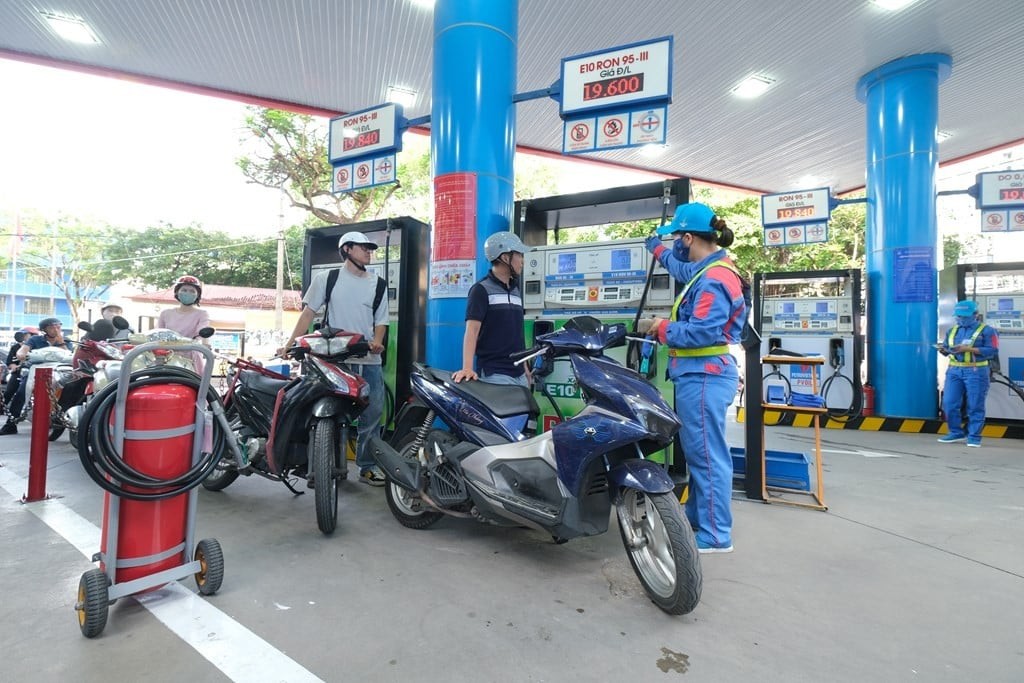
Vietnam prepared for the transition through pilot sales. Vietnam Oil Corporation (PVOIL) began selling E10RON95 on August 1, 2025, at six stations: four in Hanoi and two in Hai Phong. On the first day, the stations sold nearly 10,000 liters in total. PVOIL then expanded the product more widely; by May 13, 2026, 715 stations in its network were already selling E10.
PVOIL pilot sales in Hanoi and Hai Phong
Source: Vietnam
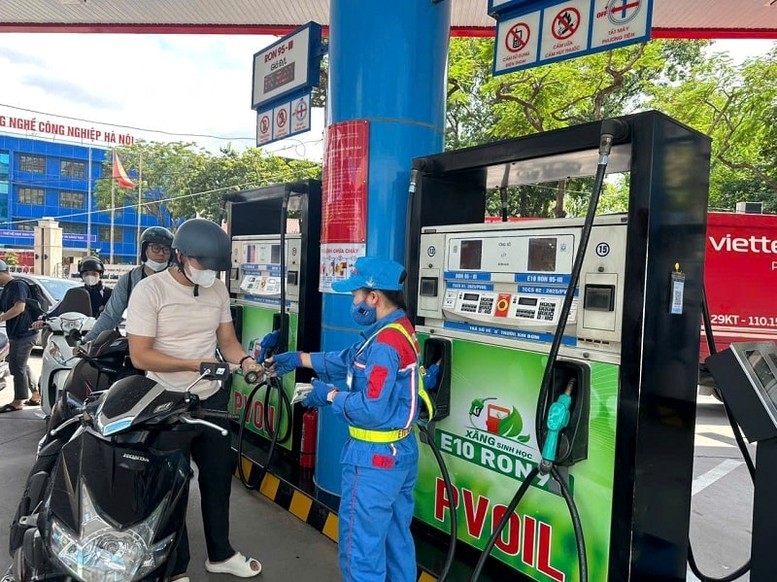
The rollout accelerated before the national deadline. By mid-June, Vietnam had more than 17,000 fuel retail stations, and the Ministry of Industry and Trade reported that all stations selling gasoline had converted to biofuel products in accordance with the roadmap. More than 26 wholesale fuel traders were supplying E10.
This means E10 is not a pilot concentrated in Hanoi or Ho Chi Minh City. It has become a nationwide retail product. The scale also creates a more demanding operating environment: product conversion must be managed consistently across urban stations, provincial networks and smaller independent retailers.
What do the first sales results show?
Early data indicates a rapid market conversion.
During the first eight days of June 2026, total biofuel gasoline consumption reached approximately 310.6 million liters, including 290.5 million liters of E10 and 20.1 million liters of E5. For the full month, combined E5 and E10 consumption exceeded one billion liters, broadly comparable with the volume of mineral gasoline previously consumed each month. E10 accounted for nearly 95% of June biofuel sales.
The earlier pilot period also provides useful evidence on local uptake. On August 1, 2025, PVOIL’s four Hanoi stations sold nearly 6,300 liters of E10, while its two Hai Phong stations sold more than 3,400 liters. At Tân Dương station in Hai Phong, E10 represented 27% of gasoline sales that day; at Châu Can station in Hanoi, the share reached 23%.
Vietnam’s E10 rollout moved rapidly from pilot to nationwide adoption
| Indicator | Timing | Value |
| PVOIL pilot stations | Aug 1, 2025 | 6 stations |
| PVOIL stations selling E10 | May 13, 2026 | 715 stations |
| Fuel retail stations nationwide | Mid-Jun 2026 | More than 17,000 |
| Total biofuel sales | Full Jun 2026 | More than 1 billion liters |
| E10 share of biofuel sales | Full Jun 2026 | Nearly 95% |
Source: Ministry of Industry and Trade and PVOIL
Price likely supported initial adoption. On the first PVOIL pilot day, E10RON95 was sold at VND 19,600 per liter, VND 240 lower than mineral RON95-III and only VND 200 higher than E5RON92. In other words, during the pilot, E10 was indeed cheaper than conventional RON95, although the discount was modest.
However, E10 should not be assumed to remain permanently cheaper than mineral RON95. The difference depends on mineral gasoline prices, ethanol costs, taxes, blending costs and price policy. Moreover, after nationwide conversion, a direct current comparison became less meaningful because mineral RON95 largely disappeared from the mainstream retail mix. As of July 2, 2026, the maximum retail price was VND 20,415 per liter for E10RON95-III and VND 19,730 for E5RON92.
Starting on June 1, 2026, E10 gasoline will officially be used nationwide
Source: Baochinhphu
Early customer feedback was generally positive, although it should be treated as anecdotal evidence rather than a representative consumer survey. During PVOIL’s pilot, interviewed customers said they noticed little difference from RON95 and highlighted the lower price, environmental positioning and guidance from station staff.
Media interviews on the first nationwide sales day showed a similar picture. Some drivers reported normal engine operation and no noticeable change, while others remained concerned about fuel economy or stopped to ask about compatibility before refueling. One technology driver said his vehicle had operated normally after earlier E10 use, while another user suspected slightly higher consumption but acknowledged that more driving would be needed before drawing a conclusion.
Is Vietnam’s supply chain ready?
The rollout has so far been supported by sufficient supply, but ethanol sourcing remains an important strategic issue.
Vietnam’s gasoline market consumes roughly one million cubic meters per month. Ministry data shows that combined domestic and imported mineral gasoline supply reached 982,616 cubic meters in June 2026, meeting biofuel blending and broader market requirements. E100 fuel ethanol supply also exceeded current blending demand in June, although the Ministry warned that the projected supply buffer would narrow in July.
Vietnam’s E10 rollout: monthly market requirement and supply readiness
Unit: m³/month
| Indicator | Volume | Unit |
| Estimated national petrol consumption | 1,000,000 | m³/month |
| E100 required for E10 blending | 100,000 | m³/month |
| Domestic E100 supply | 25,000 | m³/month |
| Imported E100 supply | 75,000 | m³/month |
| Reported potential blending capacity | 1,178,600 | m³/month |
Source: Ministry of Industry and Trade
Domestic ethanol capacity remains limited. According to the Ministry’s July update, three operating plants supplying E100 for E5 and E10 blending had a combined design capacity of 23,300 tons per month and were operating at approximately 67.2% of that level.
This creates both a constraint and a business opportunity. Stable imports, diversified procurement and domestic ethanol production remain important. For energy companies, the market opportunity extends beyond retail gasoline to ethanol sourcing, storage, blending systems, fuel testing, transportation and quality assurance.
What changes for fuel retailers?
E10 is not simply a new label on the pump. Retailers must manage tank conversion, pipeline and pump readiness, inventory turnover, labeling and quality control. Ethanol-blended gasoline also requires attention to water contamination and long-term storage conditions.
Large networks have an advantage because they can standardize procedures across terminals and stations. Smaller retailers may face greater pressure to maintain consistent operating practices, increasing the value of centralized quality systems and stronger supply-chain management.
Communication is equally important. Even after nationwide conversion, some customers continued looking for E5, particularly for older vehicles. After the first month, 1,585 stations nationwide were still selling E5, and a government-supported location application was used to help consumers find them.
What does this mean for mobility companies?
For most recent vehicles, the immediate compatibility issue appears manageable. The Ministry of Industry and Trade states that most cars and motorcycles operating in Vietnam can use E10, although older or specially modified vehicles may require greater caution.
Honda Vietnam has taken a particularly clear position. On June 19, 2026, it announced that all cars and motorcycles officially produced, assembled, imported and distributed by Honda Vietnam are compatible with E10 under international standards. Honda further stated that its officially supplied automobiles from 2006 and motorcycles from 1997 were designed to be suitable for E10 use.
Honda Vietnam E10 compatibility announcement
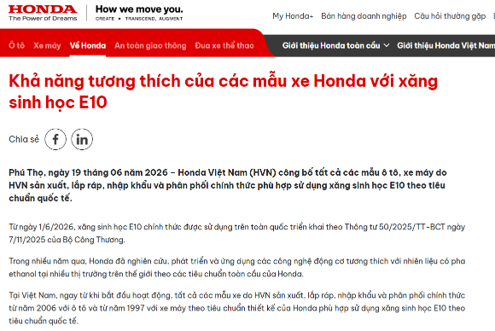
Source: Honda Vietnam
For Japanese mobility brands, this illustrates a practical response: confirm compatibility, train dealers, provide maintenance guidance and reduce customer uncertainty. The shift may not require a major redesign of current models, but it increases the importance of after-sales communication.
Fuel economy remains a concern for some users. Ministry information notes that ethanol has lower energy content than mineral gasoline and that differences of around 2–3% may occur under some conditions, depending on vehicle and usage. Fleet operators should therefore monitor actual consumption rather than assume either no impact or a major penalty.
E10 should also be viewed alongside electric mobility, not as an alternative to it. Electric vehicles may gradually reduce gasoline demand, especially in cities, while E10 lowers the fossil-fuel share of the existing internal-combustion fleet. This is an inference from Vietnam’s parallel biofuel and transport-decarbonization policies.
Implications for Japanese businesses
For Japanese vehicle manufacturers, the immediate priorities are compatibility communication, dealer readiness and monitoring of older vehicle segments. Honda’s public confirmation provides one example of proactive market reassurance.
For Japanese trading houses, engineering companies and energy businesses, the larger opportunity may lie upstream. Vietnam’s need for stable E100 supply, blending infrastructure, testing equipment and quality control can create demand for sourcing, logistics and technical services. This is an inference based on the Ministry’s published supply and domestic production data.
For fleet operators and automotive suppliers, the practical task is to review fuel guidance, maintenance routines and real-world consumption. Vietnam’s E10 shift is therefore not only an environmental policy change; it alters how gasoline is sourced, distributed, priced and supported across the mobility value chain.
B&Company support
Vietnam’s E10 rollout creates new questions for fuel distributors, mobility companies, component suppliers, energy businesses and investors. The impact can differ by sector, vehicle segment, region and distribution model.
B&Company supports companies in Vietnam through policy monitoring, market research, competitor analysis, consumer surveys, partner search and business matching. For biofuel-related projects, support can include assessment of fuel retail networks, ethanol supply chains, blending and storage infrastructure, vehicle-user behavior, price positioning and potential local partners.
For Japanese companies, B&Company can also assess how Vietnam’s fuel transition may affect product strategy, dealer communication, fleet operations and new business opportunities across the energy and mobility value chain.
Read more
Hanoi’s petrol motorbike restrictions: What it means for Japanese mobility brands
Vietnam fuel price – Regular updates: Rising volatility and implications for business
* If you wish to quote any information from this article, please kindly cite the source along with the link to the original article to respect copyright.
| B&Company
The first Japanese company specializing in market research in Vietnam since 2008. We provide a wide range of services including industry reports, industry interviews, consumer surveys, business matching. Additionally, we have recently developed a database of over 1,000,000 companies in Vietnam, which can be used to search for partners and analyze the market. Please do not hesitate to contact us if you have any queries. info@b-company.jp + (84) 24 3978 5165 |
Related article





















Log in / Register
SUBSCRIBE NEWSLETTER