

 English
  日本語
日本語  Tiếng Việt
  简体中文
简体中文  한국어
한국어 Vietnam’s manufacturing industry has become a key driver of economic growth, contributing roughly one-fourth of the nation’s GDP.
20Aug2025
Latest News & Report / Vietnam Briefing
Comments: No Comments.
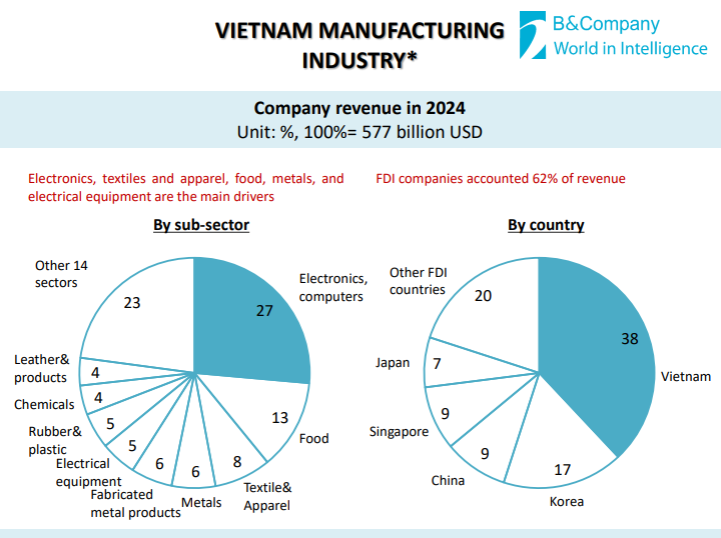
Vietnam’s manufacturing industry has become a key driver of economic growth, contributing roughly one-fourth of the nation’s GDP[1]. Foreign direct investment (FDI) continues to pour into the sector, attracted by Vietnam’s low labor costs and pro-trade policies. The government actively promotes industrial expansion and has opened most manufacturing fields to 100% foreign ownership[2]. This overview from B&Company presents data-driven insights into the market’s size and forecasts, industry characteristics and FDI trends, the regulatory environment, and profiles of major players.
Market size and forecast of the Vietnam manufacturing industry
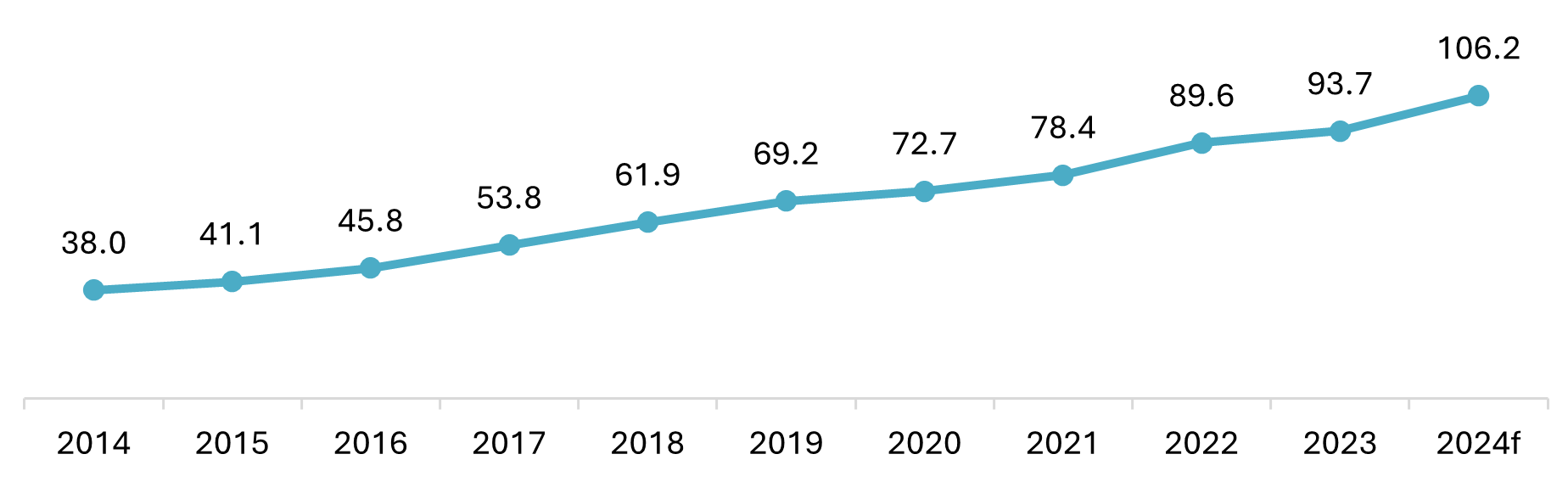
Vietnam’s manufacturing sector has experienced strong and steady growth since 2005, becoming one of the largest contributors to the national economy. Data indicates that the sector’s production value increased by 29% from 2019 to 2023, rising from USD 79.53 billion in 2019 to USD 102.6 billion in 2023. With Vietnam’s total GDP estimated at about USD 430 billion in 2023[3], manufacturing accounted for roughly 24–25% of national output, underscoring its central role in economic growth. The government has set a target of maintaining manufacturing’s share at around 25% of GDP by 2025 and raising it to 30% by 2030[4].
Vietnam’s Manufacturing Industry Output at Current Prices (2014–2024)
Unit: billion USD
Source: NSO[5]
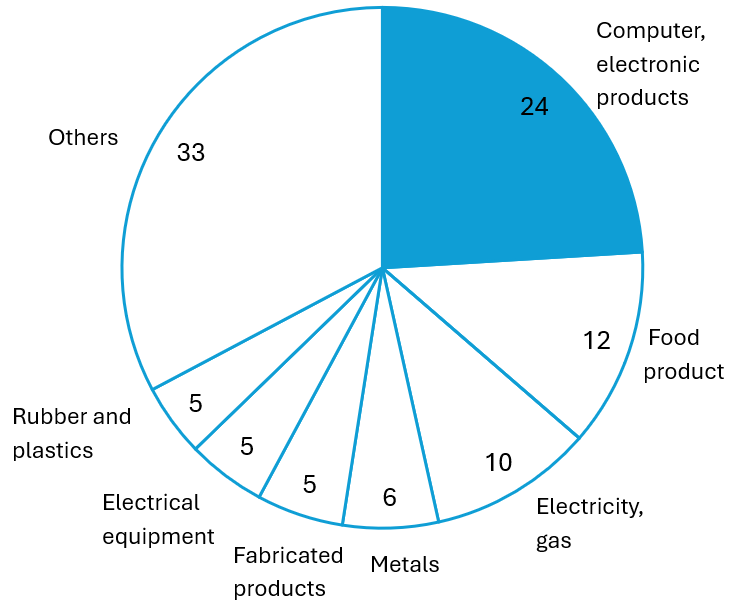
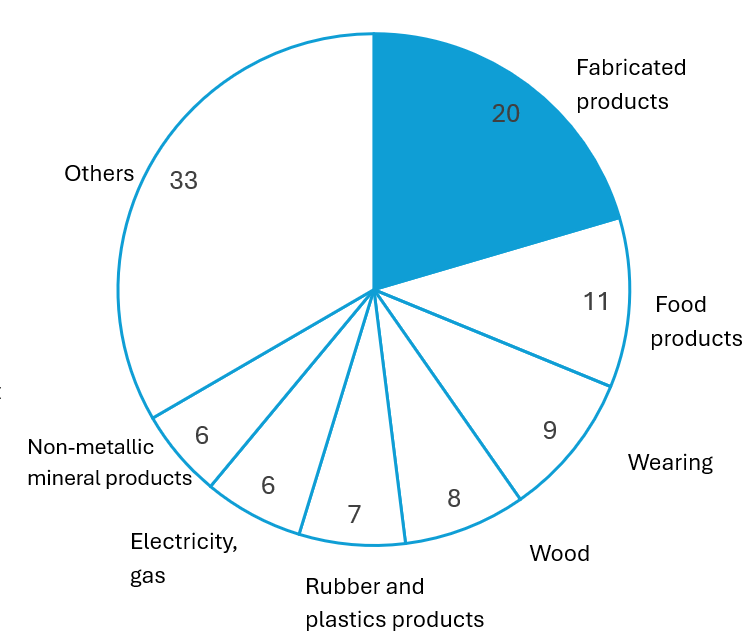
Based on B&Company’s enterprise database, the charts below illustrate the 2023 distribution of manufacturing revenue and enterprises by sub-sector. Electronics and food products dominate in revenue, whereas fabricated metal products, food, and apparel lead in enterprise numbers, underscoring the diversity of Vietnam’s manufacturing base.
| Revenue of Manufacturing by sub-sector, 2023 Unit: 100% = 538 billion USD |
Number of Manufacturing Companies by sub-sector, 2023 Unit: 100%= 135,642 Companies |
 |
 |
Source: B&Company’s EDB
Market characteristics of the Vietnam manufacturing industry
Vietnam’s manufacturing market is shaped by its strong export orientation and sectoral specialization. Domestic enterprises hold competitive positions in industries such as steel, chemicals, agribusiness, and consumer goods, while high-tech segments, including electronics, mobile phones, textiles, footwear, and machinery, are primarily driven by large-scale production for export.
FDI-Driven Growth
Vietnam’s manufacturing industry is strongly fueled by foreign investment. From 2015 to 2024, annual registered FDI into processing and manufacturing ranged between USD 7–10 billion, before surging to over USD 20 billion in both 2023 and 2024. Even during the pandemic years, inflows into the sector remained resilient as global companies sought to diversify supply chains. In 2024, manufacturing accounted for the largest share of disbursed FDI at about USD 20.6 billion. The momentum has carried into 2025, with the first seven months attracting USD 24.1 billion in registered FDI, of which 61% (~USD 12.1 billion) went to manufacturing. Recent projects include new electronics plants, renewable energy equipment factories, and automotive assembly facilities. Major investors continue to come from South Korea, Singapore, China, Japan, and Taiwan, reflecting both high-tech expansion and regional supply chain shifts.
FDI into the Manufacturing Sector by Year (2015–2024)
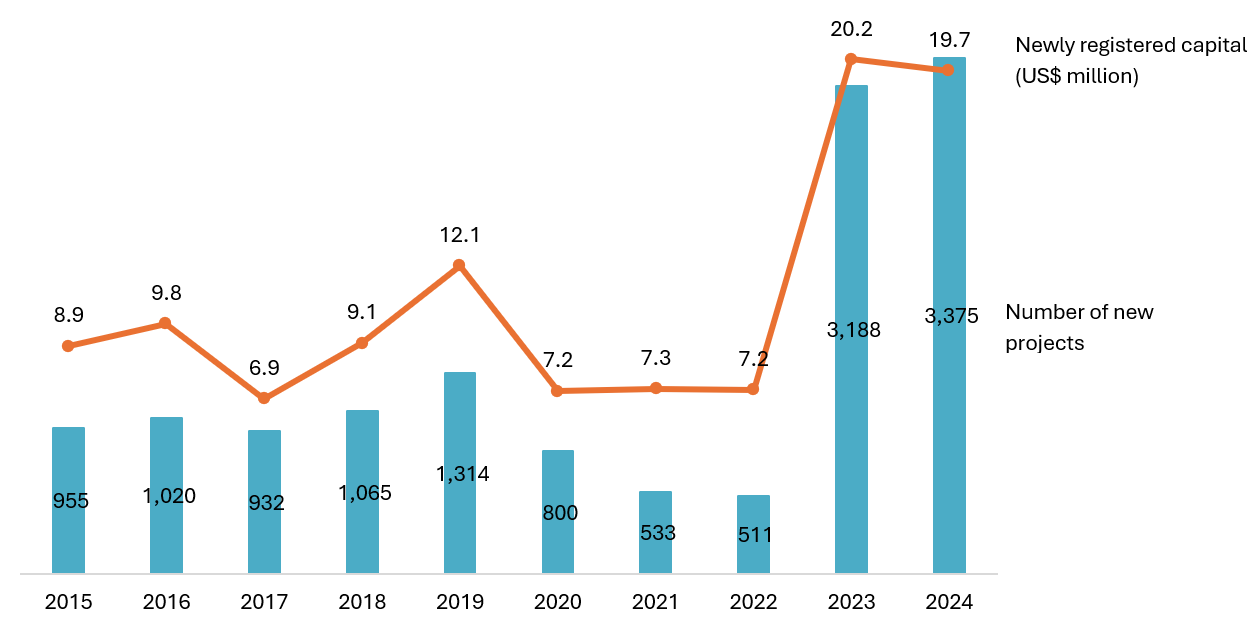
Source: Open Development Vietnam/MPI[6]
Competitive Labor and Costs
Vietnam maintains a significant cost advantage in manufacturing. The average factory worker earns around USD 3 per hour, less than half the rate in China[7]. Combined with a young workforce, this attracts labor-intensive manufacturing such as apparel, footwear, and electronics assembly. In 2023, the manufacturing workforce reached 12 million people, accounting for about 23% of total employment[8]. Wages are rising gradually, so productivity improvements are critical to sustaining competitiveness.
At the same time, rising costs and geopolitical uncertainties in China have accelerated the trend of relocating factories to Southeast Asia, with Vietnam emerging as one of the primary beneficiaries. Investors are drawn by Vietnam’s competitive wages, stable investment policies, and extensive trade agreements, which make it an attractive alternative production base. This shift has reinforced Vietnam’s position in global supply chains, although it also increases the need for infrastructure upgrades and productivity gains to sustain long-term competitiveness.
Diversified Industrial Base
Vietnam’s manufacturing spans several key industries, from high-tech electronics to traditional labor-intensive sectors. Electronics, phones, and machinery together account for over 40% of Vietnam’s total export turnover, driven largely by multinational firms like Samsung, LG, and Intel. Meanwhile, textiles, garments, and footwear remain strong traditional pillars, supported by skilled labor and extensive trade agreements. Emerging segments such as semiconductor, transport equipment, and high-value wood products also show steady growth, reflecting the country’s ongoing shift toward a more diversified industrial base. Notably, semiconductor assembly and testing have begun to attract significant foreign investment, positioning Vietnam as a potential hub in the global semiconductor supply chain.
Vietnam Manufacturing Export Breakdown (2024)
100%= 356.7 billion USD[9]
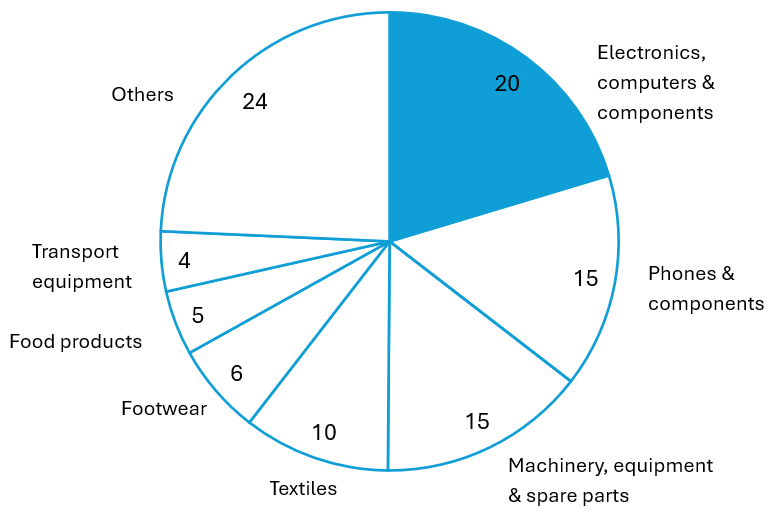
Source: Trading economics[10], GSO
In 2024, manufacturing exports dominated Vietnam’s trade performance, reaching USD 356.74 billion and accounting for 88% of the country’s total exports. Within this, electronics, computers, and components led the sector with USD 72.6 billion, representing over 20% of all manufacturing exports. This underscores the dual importance of manufacturing as the backbone of Vietnam’s export economy and electronics as its single largest and most competitive driver.
Pro-Trade Policies
Vietnam’s manufacturing growth benefits from integration into global trade networks through more than 15 free trade agreements, including the CPTPP and the EU–Vietnam FTA, which provide preferential access to international markets. The country operates over 380 industrial parks and offers tax incentives for high-tech and supporting industries, creating a favorable ecosystem for investors[11].
Dependent on imported raw material and intermediate goods
Much of current production remains concentrated in basic assembly stages, resulting in relatively low domestic content compared with regional peers. The industry also faces infrastructure bottlenecks, such as occasional power shortages and port congestion, along with persistent skills gaps in advanced manufacturing. Labor productivity, while improving, continues to trail some neighboring countries. To address these issues, the government is investing in infrastructure upgrades, promoting Industry 4.0 adoption, and expanding vocational training to enhance workforce capabilities. Despite these challenges, Vietnam’s manufacturing industry combines rapid growth, strong FDI reliance, and increasing diversification, and is gradually moving from low-tech, labor-intensive production toward more complex, higher-value activities such as electronics and vehicles. With continued reforms and investment, Vietnam is well-positioned to solidify its role as a leading manufacturing hub in Southeast Asia.
Regulations and investment environment of the Vietnamese manufacturing industry
Vietnam’s manufacturing sector is largely open to foreign investors, backed by clear regulations and competitive incentives, while maintaining control over a small number of strategic industries. Registration is streamlined, and most factories are located in industrial parks with ready infrastructure and expedited customs.
Under the Investment Law 2020 and Enterprise Law 2020, foreign investors can typically establish manufacturing businesses with 100% ownership, and there is no blanket joint-venture requirement as in some neighboring countries. Certain activities remain “conditional” under Vietnamese law (Appendix IV of the Investment Law and Decree 31/2021/ND-CP), requiring local partners or foreign ownership caps—for example, manufacturing of automobiles with 29+ seats, aircraft, tobacco, and specific chemicals. Fully prohibited manufacturing is rare, covering only sensitive items such as narcotics, certain chemicals, and defense-related weapons.
Incentives include preferential corporate tax rates, tax holidays, and land-use benefits for high-tech and export-oriented projects. Special zones such as Export Processing Zones (EPZs) and Supporting Industrial Parks provide additional advantages, such as duty exemptions on imported inputs. Policies like Decision 1658/QD-TTg promote green growth, advanced manufacturing, and energy efficiency.
Vietnam’s WTO commitments and trade agreements (e.g., CPTPP, EVFTA) further liberalize market access, though certain products remain subject to specific regulations (e.g., Decree 70/2018 on vehicles). Labor, safety, and environmental laws apply across the board, with environmental impact assessments required for higher-risk projects.
While Vietnam’s investment framework is generally open, certain limitations remain in manufacturing. A number of activities are classified as “conditional” under the Investment Law, such as automobile production, tobacco, pharmaceuticals, and chemicals, where foreign ownership is capped or joint ventures with local partners are required. Investors also face additional licensing for high-risk sectors, as well as compliance with stricter environmental and labor regulations. Moreover, tax and land-use incentives are concentrated in industrial zones and high-tech projects, meaning that manufacturers outside these zones may not benefit equally.
Main players of the Vietnam manufacturing industry
Vietnam’s manufacturing sector is shaped by a mix of leading foreign-invested corporations and competitive domestic enterprises. Multinationals such as Samsung, LG, and Intel dominate high-tech segments like electronics and semiconductors, while local champions such as VinFast, Vinamilk, and Hoa Phat Group play pivotal roles in automotive, consumer goods, and heavy industry.
Some main players in Vietnam’s Manufacturing Industry
| Company | Country | Founded | Headquarters | Website | Sector |
| Samsung Electronics Vietnam | South Korea | 2008 | Bac Ninh | https://www.samsung.com/vn | Phones & electronics |
| LG Display Vietnam | South Korea | 2016 | Hai Phong | https://www.lgdisplay.com | OLED display |
| Intel Products Vietnam | USA | 2006 | Ho Chi Minh City | https://www.intel.com | Computer chips |
| VinFast | Vietnam | 2017 | Hanoi | https://vinfastauto.com | Automotive |
| Vinamilk | Vietnam | 1976 | Ho Chi Minh City | https://www.vinamilk.com.vn | Dairy product |
| Hoa Phat Group | Vietnam | 1992 | Hanoi | https://www.hoaphat.com.vn | Steel |
| Masan Consumer | Vietnam | 1996 | Ho Chi Minh City | https://www.masanconsumer.com | Food & beverages |
| Pou Chen Vietnam | Taiwan | 1994 | Dong Nai | https://www.pouchen.com | Footwear |
| Formosa Ha Tinh Steel | Taiwan | 2008 | Ha Tinh | https://www.fhs.com.tw | Steel |
| Nestlé Vietnam | Switzerland | 1995 | Dong Nai | https://www.nestle.com.vn | Food & beverages |
Source: B&Company enterprise database
Conclusion
Vietnam’s manufacturing industry stands as a cornerstone of the national economy, fueled by rapid growth, foreign investment, and an increasingly diversified industrial base. The sector’s integration into global supply chains and strong policy support have positioned Vietnam as one of Southeast Asia’s leading production hubs. However, limitations remain: heavy reliance on imported inputs, low domestic value-add due to concentration in assembly, infrastructure constraints, and skill shortages in advanced manufacturing. Addressing these challenges through stronger supply chain localization, infrastructure upgrades, and workforce development will be crucial for Vietnam to sustain competitiveness and move further up the global value chain.
[1] National Statistics Office, Socio-economic situation in the fourth quarter and 2022 <Assess>
[2] Lexology, Time to Establish Manufacturing Operations in Vietnam<Assess>
[3] General Statistics Office of Vietnam <Assess>
[4] Lexology, Time to Establish Manufacturing Operations in Vietnam<Assess>
[5] National Statistics Office <Assess>
[6] Vietnam Briefing, Vietnam Manufacturing Tracker: Update to July 2025 <Assess>
[7] Market Research Vietnam, Breaking Down Vietnam Manufacturing Sector Trends in 2025 <Assess>
[8] Vietnam Briefing, Vietnam Manufacturing Tracker: Update to July 2025<Assess>
[9] NSO,Socio-economic situation in the fourth quarter and 2024 <Assess>
[10] Trading Economics, Vietnam Manufacturing PMI <Assess>
[11] Mckinsey, Boosting Vietnam’s manufacturing sector: From low cost to high productivity<Assess>
* If you wish to quote any information from this article, please kindly cite the source along with the link to the original article to respect copyright.
| B&Company
The first Japanese company specializing in market research in Vietnam since 2008. We provide a wide range of services including industry reports, industry interviews, consumer surveys, business matching. Additionally, we have recently developed a database of over 900,000 companies in Vietnam, which can be used to search for partners and analyze the market. Please do not hesitate to contact us if you have any queries. info@b-company.jp + (84) 28 3910 3913 |
Related article



























Log in / Register
SUBSCRIBE NEWSLETTER