

 English
  日本語
日本語  Tiếng Việt
  简体中文
简体中文  한국어
한국어 Vietnam has presented to Japanese companies the opportunities in the semiconductor market across multiple research and manufacturing fields.

10Jun2026
Latest News & Report / Vietnam Briefing
Comments: No Comments.
Executive summary
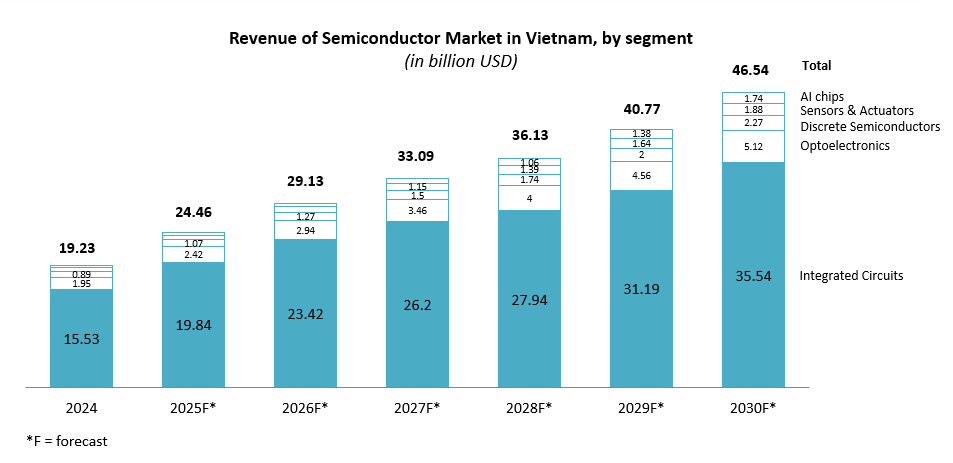
– Vietnam’s semiconductor market is projected to reach USD 24.46 billion in 2025, growing to USD 46.54 billion by 2030 at a CAGR of 15.7% (2024–2030).
– Vietnam is increasingly positioned as Southeast Asia’s leading “China+1” semiconductor destination, benefiting from global supply-chain diversification and geopolitical realignment.
– The country remains strongest in Assembly, Packaging and Testing (OSAT), while actively developing upstream chip-design capabilities.
– The Vietnamese government aims to develop 50,000 semiconductor engineers by 2030, creating one of the region’s largest semiconductor talent pools.
– For Japanese firms, Vietnam presents opportunities across R&D and IC design, semiconductor materials and equipment supply, OSAT partnerships, and automotive semiconductor value chains.
Vietnam semiconductor market landscape & value chain mapping
Vietnam’s semiconductor market is forecast to expand from USD 19.23 billion in 2024 to USD 46.54 billion in 2030, representing a CAGR of approximately 15.7%. Growth is driven by electronics exports, increasing FDI inflows, and Vietnam’s strategic role in global semiconductor supply chains.
Source: Statista
The Integrated Circuits segment is the structural backbone, contributing USD 15.53 billion, roughly 81% of total revenue in 2024, projected to reach USD 35.54 billion by 2030. This is directly linked to OSAT throughput expansion: Amkor’s Bac Ninh facility is scaling to 3.6 billion units per year by Q4 2025, a ninefold increase from its 2021 commissioning capacity[1].
AI Chips is the highest-conviction growth segment from USD 0.28 billion in 2024 to USD 1.74 billion by 2030, approximately a 35% CAGR. This is driven by Nvidia’s USD 200 million AI Factory with FPT[2], Qualcomm’s AI R&D center in Ho Chi Minh City (its third largest globally)[3], and explicit government prioritization under Decision 1018/QD-TTg[4]. For Japanese firms, this segment’s materials and test equipment requirements represent an immediately accessible revenue opportunity.
Sensors & Actuators (USD 0.58 billion in 2024 to USD 1.88 billion by 2030) will receive a structural catalyst from Vietnam’s automotive electronics buildout. VinFast’s EV production ramp and government motorbike phase-out policies[5] in Hanoi and Ho Chi Minh City (beginning in 2025–2026) will progressively shift demand into power semiconductors, ADAS sensors, and MCUs; these are the exact product segments where Japanese firms hold a global competitive advantage.
| Value Chain Stage | Vietnam Position | Key Players | Assessment |
| Upstream | IC Design | Renesas, Marvell, Synopsys, FPT Semiconductor | Growing |
| Midstream | Wafer Fabrication | None | Weak |
| Downstream | OSAT | Intel, Amkor, Hana Micron | Strong |
B&Company’s synthesis
Upstream: IC design & Semiconductor R&D
Vietnam is rapidly building capabilities in semiconductor design, particularly in AI-related applications. Design activities generate significantly higher value-added than assembly operations and represent the first step toward moving up the semiconductor value chain. The country’s AI chip segment is forecast to expand from USD 280 million in 2024 to USD 1.74 billion by 2030, making it the fastest-growing semiconductor category.
Growth is supported by increasing investment from global design leaders, including Marvell, Synopsys, Qualcomm, and Nvidia’s AI ecosystem partnerships. For example, Synopsys has widened its Vietnam talent pool (about 500 engineers across HCMC and Da Nang) by training microchip designers[6], and Marvell has employed over 500 engineers (Vietnam’s 3rd‑largest R&D center), making Ho Chi Minh City and Da Nang the primary design hubs[7]. Japanese companies had already had a significant foothold as Renesas Electronics Vietnam operated its largest R&D design center outside Japan in Ho Chi Minh City, focusing on automotive, industrial, and IoT semiconductor solutions[8].
Midstream: Wafer fabrication
No domestic wafer fabs are operational yet, although Viettel broke ground in January 2026 on Vietnam’s first domestic semiconductor fabrication plant, with trial production targeted for late 2027 and process optimization through 2030. Vietnam’s policy roadmap acknowledges that building fabs is a long-range goal rather than a current investment opportunity. Current strategy envisions one small pilot fab by 2030, but the target of a USD 100 billion semiconductor industry by 2050 is aspirational[9]. In practice, the lack of local fabrication means Vietnam remains reliant on imported wafers; most chip plants are OSAT-focused. This gap highlights where Vietnamese and Japanese firms might partner (e.g., joint R&D on compound wafers or mini-fab incubation)
Downstream: OSAT
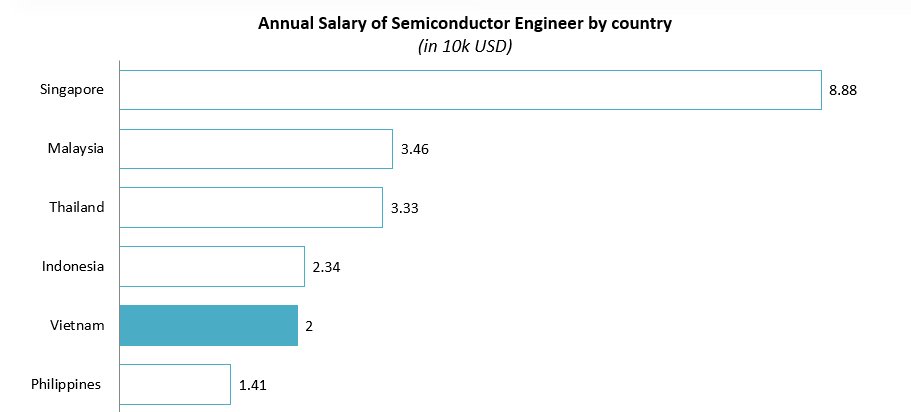
Annual salary of a Semiconductor Engineer by country (
Source: Economic Research Institute
This segment is Vietnam’s strength and largest share. Major OSAT players (Intel, Amkor, Samsung, Hana Micron) already run large facilities here. For example, Intel built its largest worldwide hub – a USD 1.5 billion chip packaging and testing factory in Ho Chi Minh City[10], Amkor was expanding its Bắc Ninh site to USD 1.6 billion[11] and Samsung’s newly announced USD 1.5 billion semiconductor testing facility in the north of Hanoi[12]. The country’s cost-competitive workforce and established electronics manufacturing ecosystem continue to attract advanced packaging and testing activities, reinforcing Vietnam’s position as an emerging semiconductor back-end hub.
The competitive landscape
The semiconductor ecosystem in Vietnam is anchored by three distinct player groups. US and Korean firms dominate the capital-intensive OSAT and memory manufacturing tier. Japanese firms hold a narrow but strategically important position in IC design and advanced materials. Domestic players are state-backed early-stage champions building Vietnam’s indigenous capability. For Japanese investors, mapping where each group sits and where white space remains is the core strategic question.
Group A – US & Korean firms: OSAT & Manufacturing Leaders (Dominant in downstream; capital-intensive)
| Company | Country | Founded | Segment | Vietnam Role | VN Investment |
| Intel Products Vietnam intel.com |
USA | 1968 | OSAT | Largest IC assembly & test facility in VN; Ho Chi Minh City; operating since 2006 | ~USD 1.5B |
| Amkor Technology Vietnam amkor.com |
USA | 1968 | OSAT | Bac Ninh plant; 3.6B units/year target by Q4 2025; one of the largest OSAT facilities globally | USD 1.6B |
| Samsung Electronics Vietnam samsung.com |
Korea | 1969 | OSAT | Multi-plant complex, Thai Nguyen & Bac Ninh; handset + semiconductor packaging; deepest manufacturing footprint in VN | ~USD 1.5B (semiconductor) |
| Hana Micron Vina hanamicron.com |
Korea | 2001 | OSAT | Packaging & testing, Bac Giang; expanding toward DRAM and advanced packaging formats | USD 900M (by 2026)[13] |
| Marvell Technology Vietnam marvell.com |
USA | 1997 | Design | Chip design R&D center, Ho Chi Minh City; data infrastructure and networking SoCs; local engineer upskilling | – 500+ engineers
– Vietnam’s 3rd largest global R&D hub |
Group B – Japanese firms: IC Design & Advanced Materials (Vietnam’s “home team” for Japanese investors, white space remains large)
| Company | Country | Founded | Segment | Vietnam Role | Revenue |
| Renesas Design Vietnam (RVC) renesas.com |
Japan | 2004 (in VN) | Design | Largest Renesas design center outside Japan; HCM City (2004) + Da Nang (2024); automotive SoC & MCU design; strategic partnership with VinFast for EV chips | Parent ~USD 8.3B (2025)[14] |
| Kyocera Vietnam kyocera.com |
Japan | 1959 (VN ops) | Materials | Advanced ceramic packages, semiconductor substrates, and components; supplies into Vietnam’s OSAT cluster and broader Asia semiconductor supply chain | Global ~USD 12.96B (3/2026)[15] |
Group C – Domestic Players: State-Backed IC Design Champions (Early stage; government-prioritized; potential partnership targets for Japanese firms)
| Company | Country | Founded | Segment | Vietnam Role | Backing |
| FPT Semiconductor semiconductor.fpt.com |
Vietnam | 2022 | Domestic Design | First domestically owned IC design company; TSMC-fabbed PMIC chips; USD 200M Nvidia AI Factory | FPT Group + Nvidia partnership |
| Viettel High Technology (VHT) vht.com.vn |
Vietnam | 2019 | Domestic Design | Military-telecom conglomerate’s semiconductor arm; 5G chip design; state-sponsored national security semiconductor agenda | State / Viettel Group |
B&Company’s synthesis
Regulatory framework & “Green Lane” incentives
Vietnam has constructed one of Southeast Asia’s most investor-friendly regulatory environments for semiconductor and high-technology projects. The architecture is organized around two functional pillars: fast-track FDI procedures and long-term talent development mechanisms, supplemented by a risk flag that large-revenue multinationals must factor into their tax planning.
Green Lane – FDI Procedures & Tax Incentives
| Effective Date | Policy | Key Impact on Foreign Investors |
| Feb 2025 | Decree 19/2025/ND-CP | Fast-track approval process (15 working days), reducing project setup time by ~260 days and accelerating market entry. |
| Jan 2026 | Digital Technology Industry Law | Offers 10% CIT for up to 15 years, plus import duty and land-rent exemptions, significantly lowering operating costs. |
| 2025 onward | Special Investment Incentive Framework (Law on Investment 2025, Law 90/2025/QH15, Digital Technology Industry Law 2025) | Provides additional tax, R&D, and investment incentives for strategic semiconductor projects, enhancing ROI for foreign investors. |
| 2025–2026 | Law 57/2024/QH15 & Law 90/2025/QH15 | Streamlines licensing and administrative procedures, shortening project implementation timelines by 250–300 days. |
| 2021 | Law on Investment: 100% Foreign Ownership Policy | Allows full foreign ownership of semiconductor manufacturing and design businesses, enabling complete operational control and profit retention. |
Human capital strategy – The talent pipeline
| Effective Date | Policy | Key Impact for Foreign Investors |
| Sep 2024 | Decision 1017/QD-TTg – Semiconductor Talent Development Program | Expands the semiconductor workforce through government-backed training of 50,000 engineers and 1,000 researchers by 2030. |
| Sep 2024 | Decision 1018/QD-TTg – Semiconductor Industry Strategy 2030 | Provides a clear roadmap for ecosystem expansion, including semiconductor design, fabrication, and OSAT capacity. |
| Jun 2023 | Resolution 98/2023/QH15 (HCMC Pilot Mechanism) | Supports industry–university collaboration and R&D activities, strengthening access to local innovation resources. |
| 2025–Present | Vietnam–Japan Semiconductor Cooperation Initiatives | Facilitates talent development and R&D partnerships, improving access to skilled labor and research capabilities. |
B&Company’s synthesis
Risk flag: Global minimum tax transition
Vietnam adopted the OECD Global Minimum Tax (15% floor) under Resolution 107/2023/QH15, effective 2024. This partially erodes traditional CIT incentives for multinationals with global revenue exceeding EUR 750 million. In response, Decree 182/2024/ND-CP (December 2024) established an Investment Support Fund to compensate qualifying investors for top-up tax liabilities through direct fiscal grants. However, the Fund’s operational precedents are still being established, creating near-term administrative uncertainty. Japanese parent companies with large global revenues must model both scenarios: with and without Fund compensation before finalizing Vietnam investment structures.
Implications & Action plan
Vietnam’s semiconductor opportunity for Japanese firms is about fitting precisely into the three gaps that the current FDI wave has left open: IC design talent leverage, advanced materials supply, and automotive chip integration. Each of these aligns with established Japanese strengths and requires materially less capital than OSAT greenfield construction.
Expand R&D and IC design centers
Japanese semiconductor companies should build or enlarge Vietnam-based design hubs as Vietnamese engineers are abundant and cost-effective. Specifically, an entry-level semiconductor engineer in Vietnam makes about 16,255 USD[16], compared to about 43,231 USD in Japan[17], indicating that Vietnamese labor costs are about 60–65% lower than those in Japan, while there are many STEM graduates. Renesas has demonstrated success here; its Vietnam design centers (HCMC + Da Nang) now total ~500 engineers. These local teams develop SoCs for global products. By following Renesas’s model (e.g., public-private R&D incubators, university partnerships), Japanese firms can tap Vietnam’s “young techie” workforce. Establishing R&D labs in Vietnam offers a dual benefit: cheaper development and proximity to local markets.
Supply materials & equipment to OSAT clusters
Japanese firms with semiconductor components or tools have a big opportunity. Vietnam will need imported materials, equipment, and specialty parts for its fabs/OSAT plants due to the lack of domestic suppliers of high-quality semiconductor components. For instance, Kyocera’s actions hint at this demand; it is ramping investment globally and plans to deepen its Vietnam footprint in ceramic chip packages. Likewise, makers of lithography machines, specialty chemicals, test equipment, etc. can expand sales to Vietnam. Japanese suppliers should position themselves as partners for building Vietnam’s chip facilities, such as Japanese ceramic substrates, silicon wafers, or automated testers, which could fill existing gaps.
Capture the automotive chip supply chain
Vietnam’s electric vehicle industry (led by VinFast) is a new chip market as the development of the EV/auto sector and the need of thousands of chips (motor controllers, batteries, and infotainment) for this sector. Renesas’s partnership with VinFast exemplifies this opportunity[18]. In 2022, Renesas agreed to provide VinFast with SoCs, microcontrollers, and power semiconductors to support EV development. This shows a path: Japanese chipmakers can collaborate with local automakers on smart car electronics. As Vietnam pushes EV adoption, demand for automotive-grade semiconductors will rise. Japanese firms should align their supply chains (e.g., automotive MCUs, sensors) with Vietnamese OEM needs, possibly via joint development or localized testing centers.
Read more
Semiconductor industry in Vietnam and recent investment moves
* If you wish to quote any information from this article, please kindly cite the source along with the link to the original article to respect copyright.
| B&Company
The first Japanese company specializing in market research in Vietnam since 2008. We provide a wide range of services including industry reports, industry interviews, consumer surveys, business matching. Additionally, we have recently developed a database of over 1,000,000 companies in Vietnam, which can be used to search for partners and analyze the market. Please do not hesitate to contact us if you have any queries. info@b-company.jp + (84) 28 3910 3913 |
[1] https://en.vneconomy.vn/amkor-technology-proposes-to-double-capacity-of-its-semiconductor-plant-in-bac-ninh.htm
[2] https://fptsoftware.com/newsroom/news-and-press-releases/press-release/fpt-to-shape-the-future-of-ai-and-cloud-on-a-global-scale-in-collaboration-with-nvidia
[3] https://www.vietnam.vn/en/qualcomm-ra-mat-trung-tam-nghien-cuu-va-phat-trien-ai-dau-tien-tai-viet-nam
[4] https://b-company.jp/vietnam-semiconductor-market-key-updates-investment-activities-in-h1-2025/
[5] https://vietnamnet.vn/en/electric-motorbikes-surge-as-vietnam-prepares-for-gas-bike-phase-out-2428875.html
[6] https://plo.vn/ky-nguyen-so/synopsys-tang-toc-dao-tao-nhan-luc-vi-mach-viet-nam-post870088.html
[7] https://investor.marvell.com/news-events/press-releases/detail/994/vietnam-becomes-third-largest-marvell-global-rd-hub-as-engineering-workforce-surpasses-500-employees
[8] https://www.renesas.com/en/about/newsroom/renesas-electronics-semiconductor-design-subsidiary-vietnam-receives-excellence-award-ministry?srsltid=AfmBOoqUjIXio1sj3Te_zuBY240rDjbJDtMoWpuwKdLrY6Nt-xQKXUcK
[9] https://datafiles.chinhphu.vn/cpp/files/vbpq/2024/9/1018-ttg.signed.pdf
[10] https://en.vietnamplus.vn/intel-eyes-investment-in-vietnam-chip-manufacturing-plant-post260884.vnp
[11] https://www.sourceready.com/blog/vietnam-electronics-high-tech-hub
[12] https://www.reuters.com/world/asia-pacific/samsung-plans-15-billion-chip-testing-plant-vietnam-document-shows-2026-05-27/
[13] https://nguoiquansat.vn/intel-amkor-hana-micron-du-kien-dau-tu-hang-ty-usd-vao-viet-nam-cho-linh-vuc-kiem-thu-va-dong-goi-chip-176997.html
[14] https://www.renesas.com/en/about/newsroom/renesas-reports-financial-results-year-ended-december-31-2025
[15] https://stockanalysis.com/quote/tyo/6971/revenue/
[16] https://www.salaryexpert.com/salary/job/semiconductor-engineer/vietnam/hanoi
[17] https://www.salaryexpert.com/salary/job/semiconductor-engineer/japan
[18] https://www.renesas.com/en/about/newsroom/vinfast-and-renesas-sign-strategic-partnership-advance-automobile-technology
Related article



























Log in / Register
SUBSCRIBE NEWSLETTER