

 English
  日本語
日本語  Tiếng Việt
  简体中文
简体中文  한국어
한국어 Vietnam’s semiconductor industry is on a growth trajectory, supported by government initiatives and rich in mineral resources.
01Apr2025
Highlight content / Industry Reviews / Latest News & Report
Comments: No Comments.
Vietnam’s semiconductor industry is on a growth trajectory, supported by government initiatives and rich in mineral resources. While still in the early stages of development, the industry is gradually establishing itself as a key player in the region.
Overview of the semiconductor industry in Vietnam
The semiconductor market is projected to reach a revenue of around 21 billion USD in 2025, marking an 18% increase from 2024 and an impressive 49% growth over the past five years, The market is expected to continue expanding at a CAGR of 10% from 2025 to 2029, ultimately reaching a total value of 31 billion USD by 2029[1].
Semiconductor revenue in Vietnam from 2020 to 2050 by product type
Unit: Billion USD
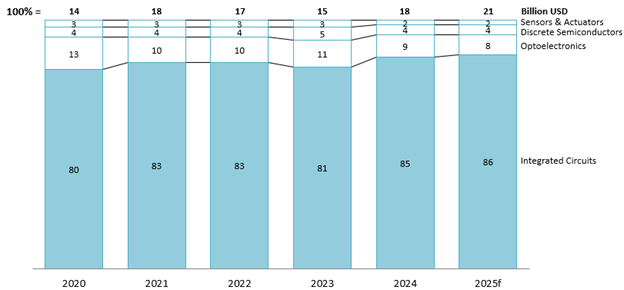
Source: Statista
From 2020 to 2024, integrated circuits (ICs) continued to dominate the market and show an increase in trend when accounting for 81% of revenue in 2020 to 85% of the total market by the end of 2024. While ICs are widely applied across various industries, including electronics appliances, automotive, healthcare, and more, other semiconductor components such as optoelectronics, discrete semiconductors, and sensors & actuators remain limited in use. As a result, market revenue for these components stayed consistently low, making up only 15% of the total market in 2024, with little fluctuation over the period.
In addition, 2024 has also recorded an all-time high in FDI disbursement, reaching approximately 25 billion USD, an overall 9% increase year-over-year[2]. This positions Vietnam as a high-value market for investment, not only for the economy as a whole but particularly for the semiconductor industry.
Main player in the industry
The semiconductor industry is divided into three main stages: design and research, manufacturing, and assembly–testing–packaging[3]. Overall, Vietnam’s semiconductor market is largely driven by international companies, primarily operating in the design and research stages. In contrast, the manufacturing and assembly–testing–packaging segments have only a limited number of players. Vietnam’s domestic participation in the industry remains minimal, with local companies mainly involved in design and research, while lacking the capability to engage in manufacturing and assembly processes.
In terms of design and research, numerous companies are operating in this sector, primarily located in major cities such as Hanoi and Ho Chi Minh City. While most of these companies are foreign-owned, coming from countries like Japan, Germany, China, South Korea and the US, Vietnam also has a domestic representative—FPT Semiconductor. The company operating in this stage focuses on developing chipsets, and electronic devices.
Conversely, the manufacturing segment is currently dominated by companies from countries with strong semiconductor industries, such as Samsung and Hana Micron from South Korea, and Micro Commercial Components from China. These manufacturing facilities are primarily located in major industrial zones, producing key semiconductor products such as printed circuit boards, integrated circuits, and semiconductor components.
Related article





























Log in / Register
Continue without an account
Log in / Register
SUBSCRIBE NEWSLETTER