

 English
  日本語
日本語  Tiếng Việt
  简体中文
简体中文  한국어
한국어 Seaport network in Vietnam is undergoing a transformative shift toward smart, sustainable, and technology-integrated development.
21Oct2025
Latest News & Report / Vietnam Briefing
Comments: No Comments.
Vietnam’s seaport network is undergoing a transformative shift from traditional expansion toward smart, sustainable, and technology-integrated development. Supported by government policies such as Resolution No. 81/2023/QH15[1] (the National Assembly’s Resolution on the National Master Plan for 2021–2030, with a vision to 2050) and Decision No. 442/QĐ-TTg (2024)[2] (approving adjustments to the Master Plan for the Development of Vietnam’s Seaport System for 2021–2030, with a vision to 2050), Vietnam’s port strategy emphasizes automation, green energy, and 5G-enabled logistics systems. This shift unlocks significant long-term investment potential across infrastructure, technology, and renewable energy, positioning Vietnam’s smart-port sector as a strategic hub in Southeast Asia despite ongoing challenges.
Overview of Vietnam’s Seaport System
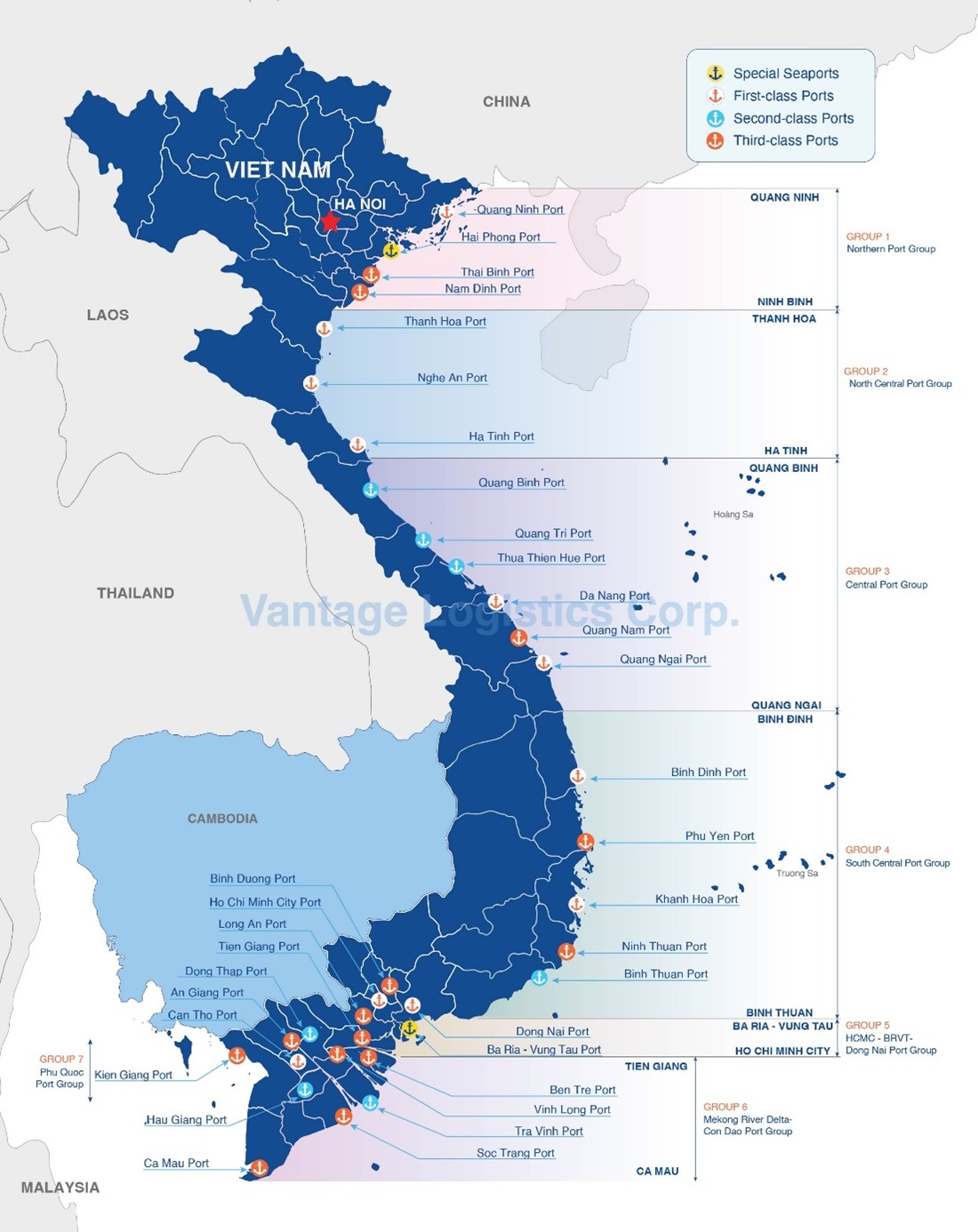
Vietnam has one of Southeast Asia’s most extensive seaport systems, spanning over 3,260 kilometers of coastline. Under Decision No. 804/QĐ-TTg (2022)[3], the national network includes 34 seaports, classified as follows:
- a/ By cluster: Six regional clusters from Quang Ninh in the North to Ca Mau in the South.
- b/ By scale:
– 2 special-class ports: Hai Phong and Ba Ria–Vung Tau (main international gateways)
– 11 first-class ports (regional hubs)
– 7 second-class ports (provincial logistics nodes)
– 14 third-class ports (local trade and industrial support)
This system forms the backbone of Vietnam’s maritime trade and logistics connectivity.
Map: List and classification of Vietnam seaports
Source: Vantage-logistics.com.vn
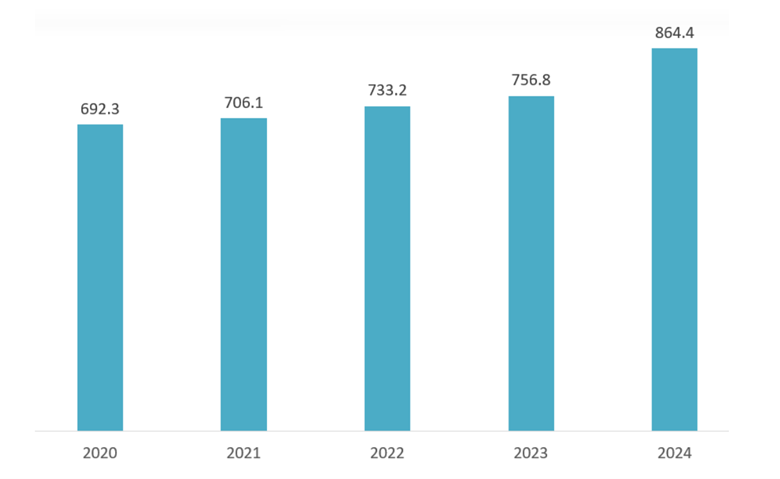
As the nation’s port infrastructure expands, the scale of cargo throughput reflects this growing dynamism. Between 2020 and 2024, the total volume of goods passing through Vietnam’s seaports increased steadily from 692.3 million tons to 864.4 million tons, marking an overall growth of about 25% in just five years[4]. This upward trend underscores Vietnam’s rising role in global supply chains and the strong linkage between port expansion, industrial growth, and export diversification. It also reinforces the country’s strategic push toward smart and green port transformation, which aims to enhance efficiency, reduce logistics costs, and position Vietnam as a competitive maritime hub in Asia for decades to come.
Volume of goods passing through seaports in the period 2020-2024 in Vietnam
Unit: Million tons
Source: dnse.com.vn
Vietnam’s Smart Port Evolution: From Capacity to Intelligence
In recent years, Vietnam has redefined its maritime development strategy, moving beyond the goal of merely expanding port capacity to prioritizing efficiency, automation, sustainability, and digital integration. The Vietnam Seaports Association (VPA) and maritime authorities now consider the development of smart and green ports as a cornerstone of national competitiveness[5]. Under the Seaport Development Plan 2021–2030, with a vision toward 2050, Vietnam targets handling between 1.14 and 1.423 billion tonnes of cargo, including 38 to 47 million TEUs, by 2030. To achieve this, investments are being channeled into key gateway clusters such as Lach Huyen in the north, Cai Mep–Thi Vai in the south, and the proposed Can Gio transshipment port near Ho Chi Minh City, which are set to become the main pillars of a modern and interconnected smart port network[6].
To support these ambitions, Vietnam has aligned its port development agenda with national goals for environmental protection and digital transformation. Since 2022, the government has implemented a roadmap for maritime eco-transformation and established national green port standards. These policies promote the use of electric and low-emission equipment, efficient energy and water management, waste treatment, IT-based logistics systems, and continuous emissions monitoring[7]. Several ports, such as Tan Cang–Cat Lai, have already achieved APEC Green Port certification, while newer terminals like Gemalink are being constructed with full electrification and smart management systems[8].
Complementing these initiatives, the government has committed approximately USD 13 billion from both public and private sources to upgrade port infrastructure through 203013. This funding is aimed not only at expanding physical capacity but also at driving digitalization, green retrofitting, and systemic modernization. Together, these policies and investments mark a decisive transition from capacity-driven growth to a technology-oriented and sustainable maritime ecosystem, strengthening Vietnam’s competitiveness in global trade.
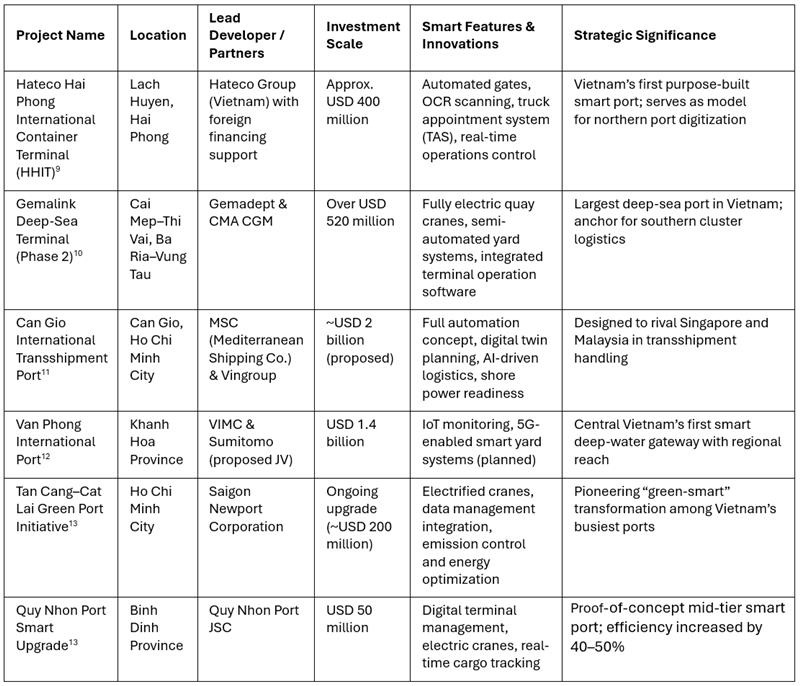
Reflecting this strategic shift, a number of flagship smart port projects are now taking shape across the country. These projects combine advanced technology, sustainable design, and strategic geographical positioning to create a digitally connected, environmentally responsible, and globally integrated maritime network. Each initiative contributes to a specific role within the national logistics framework, forming the foundation of Vietnam’s emerging smart port system. The following table outlines some of the most prominent projects, their investment scale, key innovations, and strategic significance within Vietnam’s maritime landscape.
Table 1. Flagship Smart Port Projects in Vietnam
Source: B&Company’s synthesis
The above flagship projects demonstrate Vietnam’s growing capability to integrate technology, sustainability, and logistics efficiency, creating a strong foundation for continued investment and innovation across the maritime sector.
Investment Landscape and Key Challenges
Vietnam’s smart port sector offers strong investment potential supported by rapid trade growth, strategic geography, progressive policies, and advancing technology. As global supply chains diversify, Vietnam has become a major manufacturing hub, creating sustained demand for efficient maritime logistics. In 2023, its ports handled about 756 million tonnes of cargo[14] and nearly 25 million TEUs[15], reflecting both scale and room for growth. Located along key East–West shipping routes, Vietnam’s northern and southern ports are positioned to capture regional transshipment flows through developments such as Can Gio[16] and Van Phong[17], which aim to attract higher-value cargo traffic.
However, realizing these opportunities depends on addressing key challenges. Limited hinterland connectivity[18], complex regulations[19], and gaps in workforce skills[20] can slow progress. Low port tariffs[21] and regional competition may also constrain returns, while cybersecurity[22] and system integration risks require careful management. Success will depend on coordinated planning, workforce development, flexible business models, and strong data protection. With the right strategy, investors can participate in Vietnam’s transformation into a modern, sustainable, and high-performing maritime hub.
Strategic Outlook: 2025–2030 and Beyond
From 2025 to 2030, Vietnam plans to accelerate the modernization of its major port clusters such as Lach Huyen, Cai Mep Thi Vai, and Can Gio. These ports will adopt smart systems supported by 5G, fiber connectivity, and Port Community Systems that link logistics operators, customs, and shipping companies. By 2030, all ports are expected to meet green and smart standards, handling up to 1.42 billion tonnes of cargo and nearly 47 million TEUs annually[23].
Beyond 2030, Vietnam aims to build a fully integrated logistics network connecting ports with factories and inland transport through artificial intelligence and real-time data management[24]. Although countries such as Singapore and Malaysia are more advanced, Vietnam’s rapid growth, policy commitment, and rising investment place it in a strong position to close the gap. For investors, the coming years offer significant opportunities in infrastructure, digital systems, renewable energy, and logistics services that support this transition toward a modern and sustainable maritime network.
Conclusion
Vietnam’s smart port development marks a pivotal stage in the country’s maritime modernization and economic transformation. With a strong policy framework, rising trade flows, and increasing private–public investment, the foundation for a digitally enabled, sustainable, and globally connected port system is now firmly in place. The country’s strategic position along major shipping routes, coupled with its ambition to develop green and smart port infrastructure, positions it as a future logistics hub in Southeast Asia.
For investors, the opportunity lies not only in port construction but also in the broader ecosystem of technology integration, renewable energy, logistics, and data-driven services that will define the next generation of maritime infrastructure. While challenges remain in connectivity, regulatory harmonization, and workforce readiness, the government’s commitment to reform and innovation signals long-term growth potential. As Vietnam advances toward its 2030 and 2050 goals, early investors and technology partners stand to play a defining role in shaping one of Asia’s most promising smart port landscapes, turning policy vision into a profitable, sustainable reality.
* If you wish to quote any information from this article, please kindly cite the source along with the link to the original article to respect copyright.
| B&Company
The first Japanese company specializing in market research in Vietnam since 2008. We provide a wide range of services including industry reports, industry interviews, consumer surveys, business matching. Additionally, we have recently developed a database of over 900,000 companies in Vietnam, which can be used to search for partners and analyze the market. Please do not hesitate to contact us if you have any queries. info@b-company.jp + (84) 28 3910 3913 |
[1] https://english.luatvietnam.vn/xay-dung/resolution-81-2023-qh15-national-overall-master-plan-for-the-2021-2030-period-241503-d1.html
[2] https://vanban.chinhphu.vn/
[3] https://english.luatvietnam.vn/decision-no-804-qd-ttg-dated-july-8-2022-of-the-prime-minister-promulgating-the-list-of-vietnams-seaports-225299-doc1.html
[4] https://www.dnse.com.vn/senses/tin-tuc/nganh-cang-bien-viet-nam-nhung-sieu-cang-ket-noi-chuoi-cung-ung-toan-cau-va-tam-nhin-vuon-xa-34094273
[5] https://en.vcci.com.vn/vietnam%E2%80%99s-seaport-system-a-vital-link-in-global-supply-chains
[6] https://www.vpa.org.vn/vietnams-seaports-set-handle-1-14-1-42-billion-tonnes-cargo-2030/
[7] https://vietnamnews.vn/economy/1338567/roadmap-to-develop-green-ports-in-viet-nam.html
[8] Vietnam’s Green Maritime Sector Sails the Growth Tide: An Industry Guide
[9] https://hhit.com.vn/
[10] https://reallogistics.vn/insights/market-updates/official-gemalink-port-gmd-licensed-to-welcome-232000-dwt-mega-vessels-elevating-vietnams-maritime-position
[11] https://vimc.co/en/can-gio-intl-container-transhipment-port-project-a-boost-for-hcm-citys-port-system/
[12] https://www.sumitomocorp.com/
[13] https://saigonnewport.com.vn/en/article/operation-news/tan-cang-hiep-phuoc-cat-lai-terminal-d-welcomes-the-new-service-line-of-sinolines-cvt1.html
[14] https://en.vneconomy.vn/cargo-transport-via-seaports-up-5-in-2023.htm
[15] https://container-news.com/shipping-titans-top-container-handling-countries-by-teu-volume/
[16] https://theinvestor.vn/bright-prospects-for-maritime-giant-vimc-with-can-gio-super-port-d14402.html
[17] https://vinalift.vn/en/vietnams-seaport-development-plan-2021-2030-with-a-vision-for-2050/
[18] https://www.researchgate.net/
[19] https://www.oecd.org/
[20] https://www.researchgate.net/
[21] https://container-news.com/vietnam-shipping-sector-navigates-trade-turbulence/
[22] https://www.eeas.europa.eu/esiwa-roundtable-hanoi-0925_en
[23] https://www.vpa.org.vn/vietnams-seaports-set-handle-1-14-1-42-billion-tonnes-cargo-2030/
[24] https://www.trade.gov/market-intelligence/vietnam-seaport-development
Related article


















Log in / Register
SUBSCRIBE NEWSLETTER