

 English
  日本語
日本語  Tiếng Việt
  简体中文
简体中文  한국어
한국어 As Vietnam integrates deeper into global markets and embraces Industry 4.0, its agricultural sector is undergoing a profound transformation.
30Jul2025
Latest News & Report / Vietnam Briefing
Comments: No Comments.
As Vietnam integrates deeper into global markets and embraces Industry 4.0, its agricultural sector is undergoing a profound transformation. Traditional practices are being reshaped by digital technologies, with traceability systems emerging as a key pillar of modernization. Once optional, these systems are now critical—spurred by export requirements, domestic food safety concerns, and rising consumer expectations. This shift not only challenges smallholder farmers and cooperatives to adapt but also opens up new opportunities for technology providers, policymakers, and investors seeking to shape the future of Vietnamese agriculture.
The Rise of Smart Consumers and Pressure from the Market
Vietnam’s domestic market of nearly 100 million people is undergoing a profound shift in consumer behavior. Tech-savvy and increasingly aware, modern consumers care not only about price but also demand strict standards for product quality, food safety, and especially origin transparency. Around 80% of Vietnamese consumers are willing to pay more for clean and safe products [1]. This creates strong opportunities for businesses that can credibly verify their product traceability.
Vietnam is a major net exporter of agriculture forestry and fishery, with export value rising from 41.2 billion USD in 2020 to 62.5 billion USD in 2024, and reaching 33.8 billion USD in just the first 6 months of 2025 [2]. Key exports include fruits, vegetables, coffee, rice, cashew nuts, and seafood—mainly to China, the U.S., Japan, and the EU. As these markets raise standards on certifications and traceability, Vietnamese producers face mounting pressure to adopt more transparent and accountable systems.
Vietnam agriculture, forestry and fishery export value 2020 – until 6M/2025
Unit: Billion USD
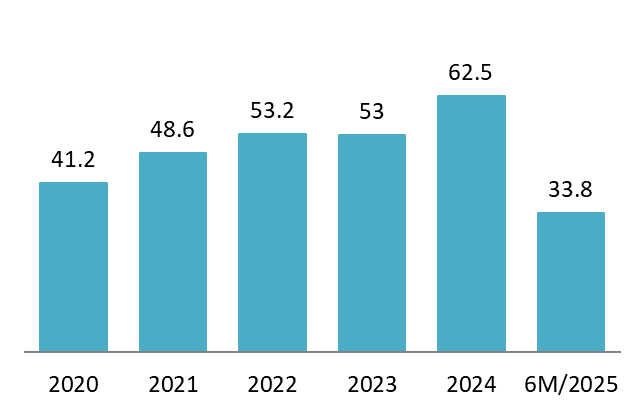
Source: VnEconomy
Non-Tariff Barriers and Mandatory Export Market Requirements
For Vietnam—a leading agricultural exporter—compliance with international standards has become decisive. Traceability has emerged as a key non-tariff technical barrier, a mandatory “passport” for accessing high-value yet demanding markets.
Major markets are tightening regulations. China, once considered lenient, now requires traceability for many Vietnamese fruits such as jackfruit and durian [3]. The EU and the U.S. have long mandated compliance with strict food safety standards like esticide residue limits, phytosanitary requirements, and mandatory traceability systems [4]. Failing to meet these criteria can mean losing competitiveness—or exclusion from the market altogether.
Legal Foundation and Strategic Government Push
Recognizing the strategic role of traceability, the Vietnamese government is taking an active lead by building a comprehensive legal framework.
Decision 100/QĐ-TTg (2019) sets ambitious targets to institutionalize traceability systems nationwide. By 2025, at least 30% of Vietnamese enterprises are expected to adopt national or international traceability standards. A unified national traceability portal will also link all related ministries and sectors, enabling interoperable data ecosystems and affirming Vietnam’s economic sovereignty [5].
Circular 17/2021/TT-BNNPTNT specifies traceability requirements under the Ministry of Agriculture. It mandates the “one step forward – one step back” principle, detailed record-keeping, and product coding across stages, ensuring full backward and forward traceability in the supply chain [6].
The combination of market-driven pull (consumer demand) and policy-driven push (government regulations and export standards) is generating unprecedented momentum—driving Vietnam’s agricultural sector toward transparent production.
Available Traceability Solutions
To enable supply chain transparency, Vietnamese enterprises now have access to a wide range of digital traceability technologies. The key is not to rely on a single tool, but to build an integrated technology stack—where each solution serves a specialized role, forming a robust and adaptive traceability system aligned with market scale, product type, and investment capacity.
Comparison of Traceability Technologies
| Criteria | QR Code | RFID | Blockchain |
| How it works | Each product or batch has a unique QR code. Consumers scan it with a smartphone to see product details instantly. It’s a simple, low-cost way to access traceability information at any point along the supply chain. | RFID systems use tags and readers. Tags are attached to goods, while readers send radio waves to read data from a distance—no contact or direct view needed. It enables quick, automatic tracking during storage or transport. | Blockchain is a shared digital ledger. Information like transactions or production logs is stored in encrypted blocks linked in a chain. The data is copied across many computers and cannot be changed or deleted by a single party. |
| Implementation Cost | Low | High | Very High |
| Security Level | Low
Data can be altered on a central server |
Medium–High
Encrypted tags |
Very High
Immutable, decentralized |
| Storage Capacity | Medium
Stores URLs, basic text |
High
Stores complex data on chip |
Very High
Stores complete transaction history |
| Use Cases | Consumer interaction, basic anti-counterfeiting, marketing | Inventory management, logistics, container tracking, livestock care | Absolute trust, smart contracts, supply chain finance |
| Example | Checkee, TraceVerified | SATO Vietnam, Ha Phan JSC | TE-FOOD, HCM57 TECHNOLOGY |
Source: B&Company Compilation
Challenges
Limited Tech Skills Among Farmers
Another major challenge is the limited digital skills and usage habits of many Vietnamese farmers. Although smartphone ownership is widespread, most farmers use them mainly for communication and entertainment rather than production tools. Shifting from traditional practices to recording field data in mobile apps is often seen as unnecessary and burdensome. As noted by the Ministry of Agriculture’s Digital Transformation Department in late 2024, low digital awareness remains a key bottleneck. Without accurate input data, the traceability system becomes weak and unreliable, regardless of the technology used.
Fragmented, Small-Scale Production
One of the most fundamental barriers is the fragmented and small-scale nature of agricultural production. Vietnam is still characterized by millions of smallholder farmers operating on a limited scale and in scattered locations. This fragmentation makes it extremely difficult to apply technology consistently, ensure uniform quality standards, and collect accurate data for traceability. Vietnam’s agriculture is characterized by small-scale, fragmented production. Smallholder farmers own most agricultural land, accounts for 90% of the total agricultural production area and the average cultivating area of a farming household is under 0.68 ha [7]. Although cooperatives could help coordinate efforts, their role remains limited. A 2023 survey found only 26% had adopted digital traceability, due to weak infrastructure, governance, and technical capacity [8]. Many cooperatives lack the technical infrastructure, governance capacity, and training to coordinate data collection or to enforce quality standards effectively. This fragmentation makes it extremely difficult to apply technology consistently, ensure uniform quality standards, and collect accurate data for traceability.
Lack of Interoperability Across Systems
In addition, the traceability landscape is fragmented due to the lack of interoperability among systems developed by various solution providers. Each platform follows different technical standards and data structures, resulting in confusion, inefficiencies, and duplication of efforts—particularly for farmers and cooperatives navigating multiple requirements. Some experts argue that the core of the problem lies in the absence of a centralized, cross-sector data infrastructure [9]. Traceability data remains siloed across ministries and agencies, with no unified identification system to link production, inspection, and distribution stages. For example, The Ministry of Agriculture and Rural Development (MARD) is implementing traceability systems for agricultural products and fresh foods through platforms such as CheckVN and the planting area code system [10]. Meanwhile, the Ministry of Industry and Trade (MOIT) manages separate platforms for tracing industrial goods, processed foods, and export products, such as itrace247 [11]. As a result, most traceability implementations remain surface-level, failing to reflect the full journey of products through the supply chain.
Turning Fragmentation into Opportunity
As Vietnam’s agriculture sector embraces digital transformation, traceability is fast becoming a cornerstone of food safety, export compliance, and consumer trust. Yet, the path to effective traceability remains complex—marked by fragmented production, limited digital literacy, and siloed data systems across ministries.
This landscape, while challenging, presents a compelling opportunity for forward-thinking technology providers. Those who design smart, localized, and interoperable solutions will not only gain a competitive edge but also contribute meaningfully to modernizing Vietnam’s agri-food system. For providers, this is more than a challenge—it’s an open opportunity for solutions that:
– Go Mobile-First: Design user-friendly apps tailored to low-tech farmers and cooperatives.
– Keep It Modular: Build scalable tools that work for both a 0.7-hectare rice farm and cooperatives
– Integrate & Align: Ensure compliance with national platforms like itrace247 and CheckVN, and support GS1 or equivalent global standards.
– Think Local, Sync Global: Support Vietnamese crops, local languages, offline use, and seamless API-based data exchange.
– Leverage Best Practices: Japanese systems offer lessons in user-centered design and cross-agency integration—adapt them to Vietnam’s context.
[1] Vietnam Plus, Green consumption – key for plastic waste reduction <Access>
[2] VnEconomy, The agriculture sector makes a breakthrough, agro-forestry-fishery exports surpass targets. <Access>
[3] Rural Enterprise and Brand Magazine, As China Tightens Regulations, How Are Vietnam’s Agricultural Exports Adapting? <Access>
[4] Vietnam Plus, Vietnam’s agricultural exports face stricter requirements <Access>
[5] Vietnam Government Portal, Decision No. 100/QĐ-TTg by the Prime Minister: Approval of the Scheme on Implementation, Application, and Management of the Traceability System <Access>
[6] Vietnam Government Portal, Circular No. 17/2021/TT-BNNPTNT issued by the Ministry of Agriculture and Rural Development: Regulations on traceability, recall, and handling of unsafe food under the management scope of the Ministry of Agriculture and Rural Development. <Access>
[7] Portal of the Ministry of Agriculture and Rural Development: Current situation of rice cultivation land and proposed amendments in the Draft Revised Land Law related to the management and use of rice land to ensure food security <Access>
[8] Le Anh Hoang, Nguyen Dinh Tinh, Vu Duong Quynh, Pham Quang Ha, Status and Solutions of the Application of Digital Traceability Technologies for the Production and Business of Agricultural Cooperatives in Vietnam <Access>
[9] VnExpress, Challenges in Product Traceability in Vietnam <Access>
[10] VCCI, Digitization in traceability: A platform for agricultural products to join the global supply chain <Access>
[11] Ministry of Industry and Trade, Ministry of Industry and Trade Launches Blockchain‐Based Traceability System for Trade Promotion <Access>
| B&Company
The first Japanese company specializing in market research in Vietnam since 2008. We provide a wide range of services including industry reports, industry interviews, consumer surveys, business matching. Additionally, we have recently developed a database of over 900,000 companies in Vietnam, which can be used to search for partners and analyze the market. Please do not hesitate to contact us if you have any queries. info@b-company.jp + (84) 28 3910 3913 |
Related article


































Log in / Register
SUBSCRIBE NEWSLETTER