
 English
  日本語
日本語  Tiếng Việt
  简体中文
简体中文  한국어
한국어 
04Dec2024
Latest News & Report / Vietnam Briefing
Comments: No Comments.
Potential of AI in Vietnam
In the past few years, AI has been emerging as one hot topic with profound impacts on multiple socio-economic aspects. Not only providing new powerful tools for work and business, but AI has also brought in many predictions such as changing work structure or even replacing human labor.
In Vietnam, AI caught the government’s attention from very soon. In January 2021, the National Strategy for Research, Development and Application of AI until 2030 was issued, which points out the important goals to make Vietnam become “top 4 among ASEAN countries and top 50 among the globe in leading AI research, development and application”. International reports also evaluate Vietnam with high potential for growing AI. In particular, the report “Government AI Readiness Index” made by Oxford Insights ranked Vietnam the 5th in South East Asia and 59th among 193 countries worldwide, with high scores for government, infrastructure and data components, while the Technology is still incomplete.
| Vietnam index | Global ranking | Total score | Government index | Technology index | Infrastructure & Data index |
| 2023 | 59 | 54.48 | 69.04 | 37.82 | 56.58 |
| 2022 | 55 | 53.96 | 66.77 | 39.18 | 55.93 |
| 2021 | 62 | 51.82 | 70.81 | 32.78 | 51.87 |
| 2020 | 76 | 42.82 | 39.00 | 29.77 | 59.70 |
Source: Oxford Insights Government AI Readiness Index report
Another report measuring the AI Readiness Index in private sector produced by Cisco also shows that Vietnamese enterprises are more ready than the world’s average. There is to say, Vietnam is on the right track of achieving the proposed targets.
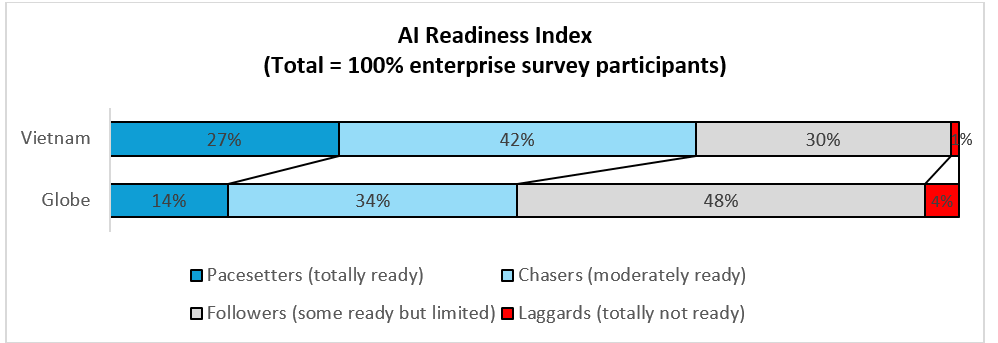
Source: CISCO AI Readiness Index report
Actual readiness situation
Nevertheless, the pace should be assessed directly and comprehensively. Although a number of activities have been called and deployed in both public and private sectors, as well as the high receptivity of end-users towards open AI sources such as ChatGPT, Gemini etc., after nearly 4 years, AI in Vietnam still hovers around pilot phases or individual utilization, without specific products being applied in a mass scale. In addition, the levels of application witness big gaps between different geographical regions (by provinces) and professional industries.
In the latest research project conducted in October 2024, B&Company Vietnam interviewed and discussed with several government agencies and AI solution developers in Vietnam; from which some key evaluations have been concluded about the ready components and drivers for AI growth in Vietnam in the coming phase.
– In terms of governance, Vietnam government showed general directions to promote AI from very early days. However, until now, there have not been official laws addressing AI besides some related regulations such as Cybersecurity Law or and the Decree on Protection of Personal Data. This creates a grey zone, on the one hand, enterprises face no clear barriers or boundaries to study a new technology or solution; on the other hand, they must take possible changes or future enforcements into consideration. Interviewing experts shares one common opinion that Vietnam will gradually establish a complete legal framework which is favorable for AI, instead of forbidding or constraining.
In addition to an incomplete regulation system, the implementation of the AI National Strategy is also dispersed significantly across different localities. Of which, Ho Chi Minh City has been taking lead in many aspects: from releasing provincial documents (for example, Decree no. 575/QD-UBND on the program of “Research and developing AI applications” in Ho Chi Minh City from 2020-2030, Decree no. 2426/QD-UBND about the Master plan of education and training programs for internationally qualified HR and shared universities”, which emphasizes 8 majors including AI; Plan no. 6497/KH-UBND about Promoting AI research and development from research to experiment and socially wide-scale pilot in Ho Chi Minh City until 2025-2030, including building and operating a shared AI database etc.) to organizing conferences, contests, incubators etc. Ha Noi Capital is also taking initiatives with the issuance of Plan no. 57/KH-UBND about building Hanoi’s Smart City, including digital development and AI applications; and is planning to form a Council for AI consultation. Nonetheless, all the actions have just been under preparation phases and will need at least 3 to 5 years to generate actual results, and even more lagging time to reach specialty departments in farther localities or remote provinces.
– ICT infrastructure in Vietnam for access and software such as the Internet connectivity, broad bandwidth, cloud services etc. is highly appraised for AI applications. Private companies have their own freedom to select either local or international service providers to satisfy their needs without any clear restrictions. Conversely, hardware infrastructure such as servers, GPUs with high computing power, strong and fast capacity still much rely on international providers. This situation, in addition to the huge and constant investment needed for hardware upgrade, is the most challenging concern for AI developers.
Vietnam government also announces programs to step-by-step improve the infrastructure for serving the digital socio-economy in general and AI applications in particular. For instance, Ho Chi Minh City is planning to build an infrastructure for digital transformation and AI until 2030, but such plans are still awaiting approval before going into actual deployment. Besides, requirements for AI infrastructure are distinguished for each industry. For example, medical fields may need a lot of precision equipment and robots to carry out inspections on human bodies, while agricultural sector involves the mobilization of satellite devices and images to collect information of natural weather, air, soil etc. Those needs vary vastly from each industry’s characteristics as well as from specific solutions being developed, which the local market may not be able to satisfy at present.