

 English
  日本語
日本語  Tiếng Việt
  简体中文
简体中文  한국어
한국어 Post-reform, Hanoi and Ho Chi Minh City remain the country’s two most important economic and governance centers, shaping national development.

02Dec2025
Latest News & Report / Vietnam Briefing
Comments: No Comments.
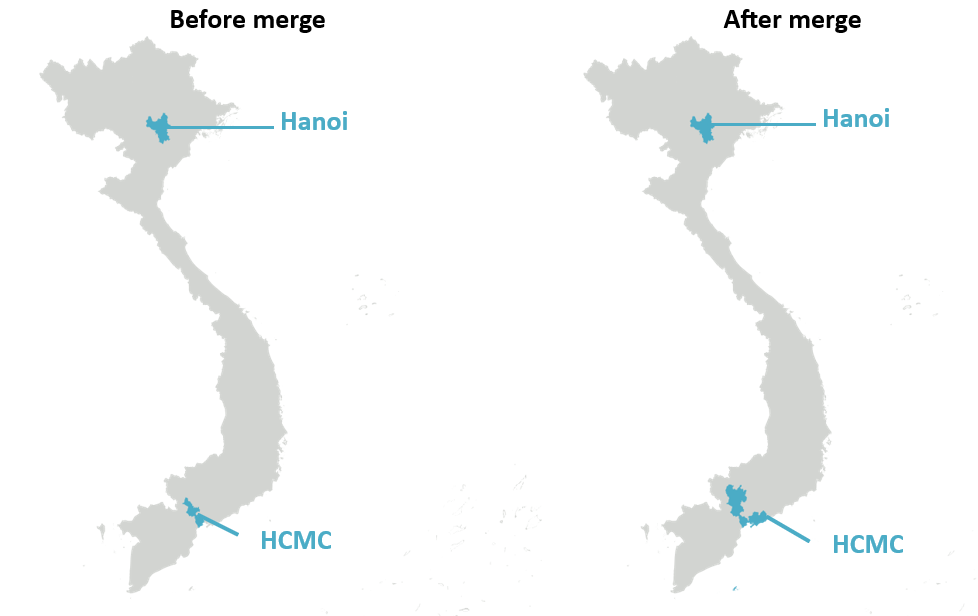
Vietnam’s 2025 national administrative merger aimed to streamline governance, reduce fragmentation, and enhance regional competitiveness by consolidating key economic zones. Within this new structure, Hanoi and Ho Chi Minh City (HCMC) remain the country’s two most important economic and governance centers, shaping national development. Post-reform, Hanoi focuses on innovation, digital governance, human-capital development, and cultural–heritage preservation, while HCMC expands into a mega-city integrating industrial, logistics, and coastal economic strengths. Together, the two cities create complementary opportunities for foreign investors across various fields.
Hanoi and HCMC in Vietnam’s Map
B&Company’s synthesis
Hanoi after the national administrative merger
Hanoi was not merged with other provinces during Vietnam’s 2025 administrative reforms. In 2008, Hanoi expanded by merging with Ha Tay province, Me Linh district from Vinh Phuc, and parts of Hoa Binh. This left ample room for growth without needing further mergers, unlike denser cities facing infrastructure bottlenecks[1]. Keeping Hanoi intact preserves its role as the political and administrative capital while allowing focus on internal efficiencies like the new two-tier governance model.
In the period of 2020-2024, Hanoi has an average GRDP growth rate of 7.1%/year, higher than the national level (6%/year)[2]. In the first nine months of 2025, Hanoi has reached a growth rate of 7.92% and is expected to have an annual growth of 8.5%[3]. During 2026 – 2030, Hanoi targets to have GRDP growth of over 11% per year, an increase in the human development and well-being index. The city explicitly aims to be “Văn hiến – Văn minh – Hiện đại” (Heritage – Civilized – Modern), positioning itself as a top national centre for culture, education, health, science, technology and innovation
The Hanoi government has recently emphasized building a smart, modern capital. The city also accelerates the implementation of digital governance and public-service digitization: local authorities have issued directives to deploy information-technology staff at all administrative levels to support citizens and businesses in online public services[6]. The city is working to build an innovation ecosystem, leveraging the existing high-tech zone (e.g., Hoa Lac High-tech Park)[7].
Hanoi also sets a new record for its FDI inflows: in the first seven months of 2025, Hanoi attracted USD 3.8 billion of FDI investment, accounting for 15.6% of national FDI. This places Hanoi in the third rank compared to other cities/provinces in the country, behind HCMC and Bac Ninh[8]. Key sectors include real estate, manufacturing, R&D, tech transfer, and high-quality training[9].
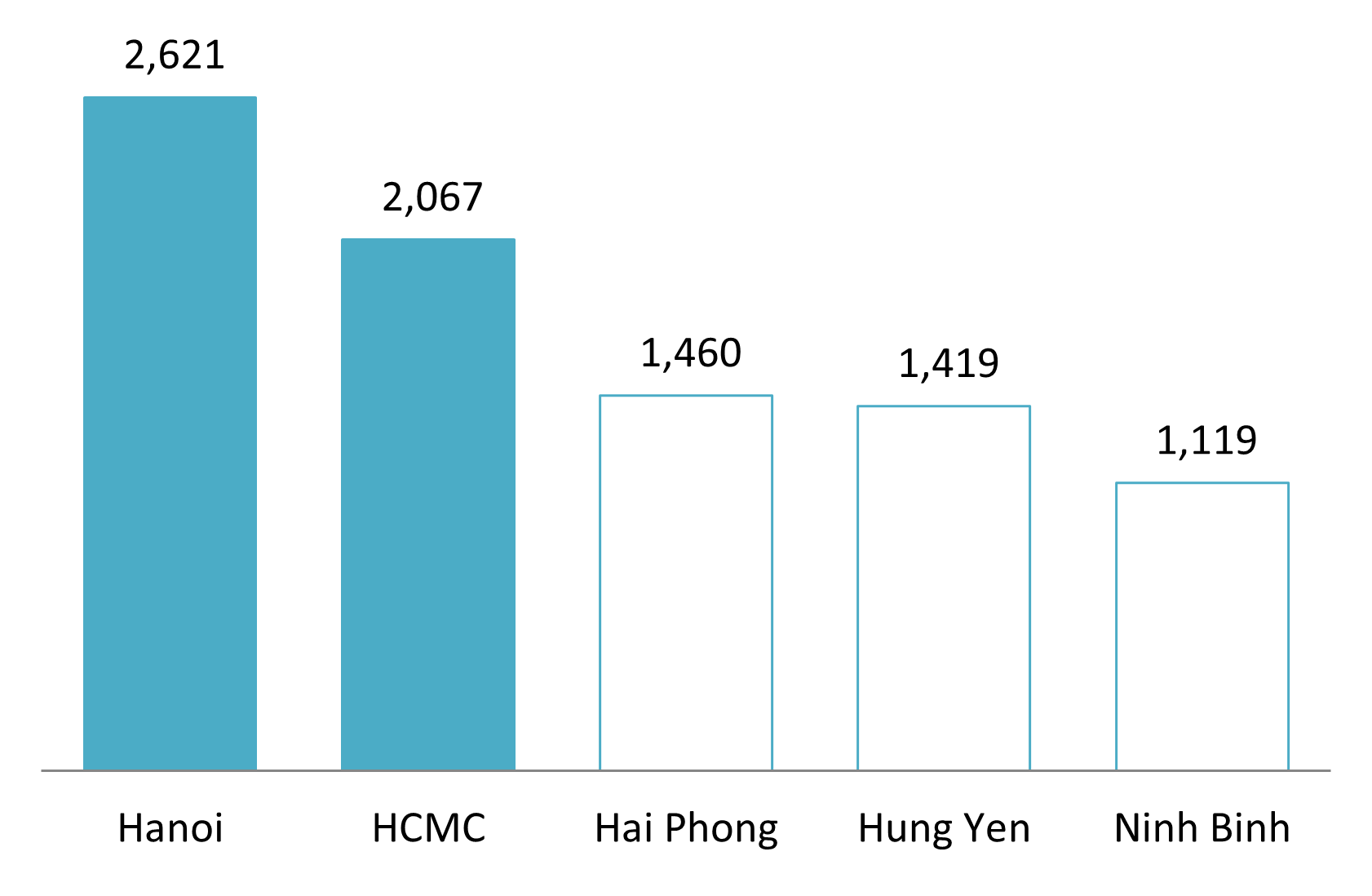
However, Hanoi faces several challenges. After the national administrative merger, Hanoi has the highest population density among 34 cities and provinces. This high population density, particularly inthe central area, creates congestion, strains infrastructure, and drives up real estate and living costs. Rapid urbanization risks putting pressure on transport, utilities, and public services, while balancing modern development with heritage preservation remains difficult. Additionally, although the city is prioritizing innovation and digital transformation, the absorption and effective deployment of capital and talent in these sectors still lag behind targets[10].
Top 5 Vietnamese Cities/Provinces with the highest Population Density after merger (2024)
Unit: People/km2
Source: B&Company
Ho Chi Minh City after the national administrative merger
From 1 July 2025, HCMC officially merged with Binh Duong and Ba Ria – Vung Tau. Previously, HCMC had 2,095 km2 in area with 10 million people. The new HCMC covers an area of about 6,772 km² and encompasses a population of approximately 14 million people, making it by far the largest city in Vietnam by population and a megacity on a national scale. The merged entity aims to integrate the complementary strengths of the three former units: HCMC’s strengths in commerce, finance and services; Binh Duong’s smart manufacturing and industrial base; Ba Ria – Vung Tau’s ports, coastal logistics, energy (e.g., petrochemical), and tourism[11].
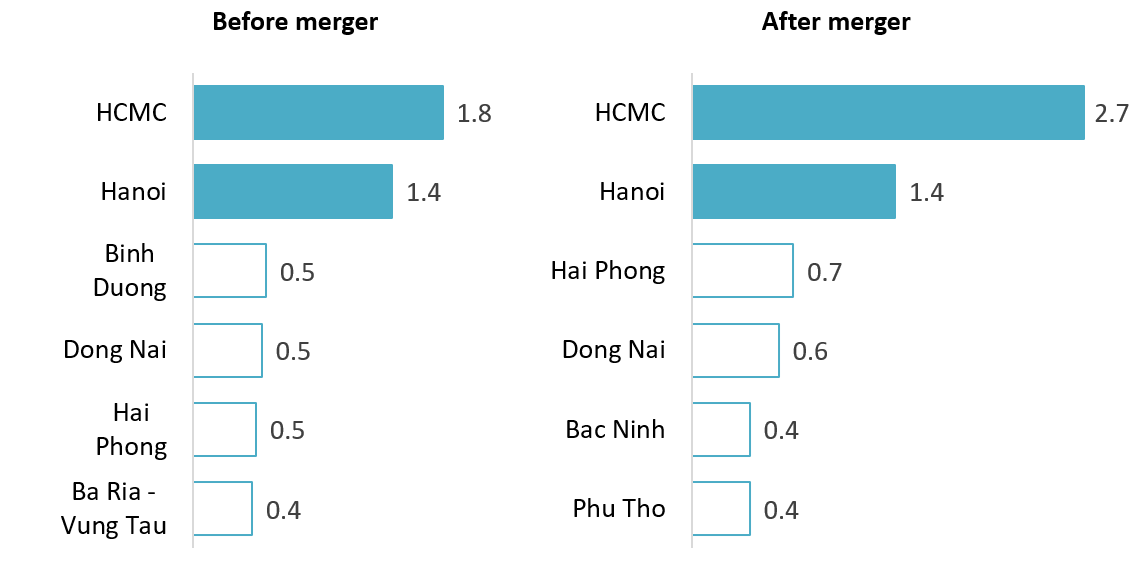
The new HCMC is merged from 3 of the top 6 cities/provinces with the highest GRDP in 2024, thus making the combined GRDP of the merged HCMC account for nearly 24% of Vietnam’s total GDP[12]. HCMC is also the location for 278,000 enterprises, 220,000 household businesses, and hosts more than 2,000 startups (roughly half of the national total), making it Vietnam’s leading startup and private‑sector hub[13]. During the period of 2026-2030, the city authorities project steady GRDP growth of 10-11%, driven by manufacturing modernization, high-value services, and export-oriented industries.
Top Vietnamese Cities/Provinces with the highest GRDP (2024)
Source: B&Company
With population rise after the merger, HCMC faces significant urban and social planning demands. Authorities are expanding public transportation networks, including metro lines, bus rapid transit, and integrated transport hubs connecting the former provinces[14]. Investments in healthcare, education, and smart-city initiatives aim to enhance quality of life. Urban planning also focuses on sustainable development, balancing industrial growth with environmental management, green spaces, and coastal area protection, to accommodate population growth and support long-term liveability.
In the first seven months of 2025, the new HCMC attracted more than USD 4 billion in FDI, accounting for 16.7% of the national total value. This meant HCMC had attracted the most FDI among all cities/provinces in Vietnam. Much of this investment flowed into export‑processing zones, industrial parks and crucially, into high‑tech sectors (including semiconductor manufacturing, data centers, and pharmaceuticals), marking a clear shift toward value‑added, technology-driven growth in the city’s economy[15].
Despite its growth potential, HCMC faces several challenges. Integrating three former jurisdictions involves aligning regulations, administrative procedures, and urban planning frameworks, which may cause temporary inefficiencies. Urban sprawl and environmental pressures, such as coastal erosion and industrial pollution, require careful management. Additionally, social inequality and disparities between former urban and rural areas could affect workforce distribution and service delivery, creating risks that investors need to monitor carefully.
Business Implication
Vietnam’s 2025 national administrative restructuring has created two distinct yet highly complementary economic centers, each offering unique opportunities for foreign investors. Understanding the structural differences between these cities is essential for investment decision-making, market entry strategies, and long-term portfolio planning.
Hanoi and HCMC Comparison
| Hanoi | HCMC | |
| Strategic Role | Political & administrative center | National largest megacity |
| Governance Advantage | Direct access to central ministries, favorable for investors needing regulatory coordination | · Strong autonomy in economic management and business facilitation
· Unified governance after merger may take time to harmonize |
| Investment Opportunities | Real estate, manufacturing, services, tech transfer, R&D and innovation, smart-city infrastructure | Industrial parks, export-oriented manufacturing, high-tech production, logistics and urban infrastructure |
| Risk and Challenges | pressure on public services and infrastructure, heritage – modernization conflict | Integration of three jurisdictions, regulatory harmonization, urban sprawl, environmental pressure, inequality between merged areas |
B&Company’s Synthesis
Comparatively, Hanoi offers strengths in public administration, innovation policy, R&D, and knowledge-driven sectors, while HCMC provides unmatched opportunities in manufacturing, logistics connectivity, and the private sector. Many investors will find value in dual-city strategies, such as locating headquarters or research activities in Hanoi while establishing manufacturing, distribution, and commercial operations in HCMC.
Additionally, both cities are accelerating digitalization, sustainability, and infrastructure upgrades, which reflect Vietnam’s broader commitment to aligning with global supply chain shifts. This creates openings in green energy, environmental technology, smart transport, digital services, and ESG-compliant manufacturing, aligning well with the strategic priorities of institutional investors and multinational corporations.
Overall, Vietnam’s administrative restructuring enhances regional competitiveness and diversification, offering foreign investors a clearer pathway to align long-term strategies with the unique strengths of each city. By leveraging Hanoi’s role as the national governance and innovation hub alongside HCMC’s expanded industrial–logistics ecosystem, investors can secure a balanced, future-oriented presence in one of Southeast Asia’s fastest-growing economies.
* If you wish to quote any information from this article, please kindly cite the source along with the link to the original article to respect copyright.
| B&Company
The first Japanese company specializing in market research in Vietnam since 2008. We provide a wide range of services including industry reports, industry interviews, consumer surveys, business matching. Additionally, we have recently developed a database of over 900,000 companies in Vietnam, which can be used to search for partners and analyze the market. Please do not hesitate to contact us if you have any queries. info@b-company.jp + (84) 28 3910 3913 |
[1] Tien Phong, Expanding 4 major cities: How to manage megacities? (https://tienphong.vn/mo-rong-4-thanh-pho-lon-quan-li-sieu-do-thi-the-nao-post1729583.tpo)
[2] Hanoi Times, Hanoi focuses on new growth phase (https://kinhtedothi.vn/ha-noi-don-luc-cho-giai-doan-tang-truong-moi.923171.html)
[3] People’s Army Newspaper, Hanoi’s gross regional domestic product (GRDP) increased by 7.92% (https://www.qdnd.vn/kinh-te/tin-tuc/tong-san-pham-tren-dia-ban-grdp-cua-ha-noi-tang-7-92-856302)
[4] Vietnam Government Portal, Hanoi builds 2026-2030 development plan with spirit of innovation and breakthrough (https://thanglong.chinhphu.vn/ha-noi-xay-dung-ke-hoach-phat-trien-2026-2030-voi-tinh-than-doi-moi-but-pha-103251104174046379.htm)
[5] Hanoi Department of Culture and Sports, Hanoi implements cultural development strategy to 2030 (https://sovhtt.hanoi.gov.vn/en/hanoi-implements-cultural-development-strategy-2030/)
[6] Vietnam Government Portal, Hanoi is a pioneer in implementing the Central Government’s policy on digital transformation. (https://thanglong.chinhphu.vn/ha-noi-tien-phong-trong-thuc-hien-chu-truong-cua-trung-uong-ve-chuyen-doi-so-103251023110803362.htm)
[7] Hanoi People’s Committee E-Portal, Hanoi promotes policies to attract high-tech human resources (https://hanoi.gov.vn/tin-tuc-su-kien-noi-bat/ha-noi-thuc-day-chinh-sach-thu-hut-nhan-luc-cong-nghe-cao-4250619140859396.htm)
[8] Vietnam Investment Review, After the merger, which locality is leading in attracting FDI capital? (https://www.tinnhanhchungkhoan.vn/hau-sap-nhap-dia-phuong-nao-dan-dau-ve-thu-hut-von-fdi-post374769.html)
[9] Communist Review, Hanoi capital attracts FDI in the context of international economic integration (https://www.tapchicongsan.org.vn/web/guest/ha-giang/-/2018/1161702/thu-do-ha-noi-thu-hut-fdi-trong-boi-canh–hoi-nhap-kinh-te-quoc-te.aspx)
[10] Ministry of Justice, Hà Nội chuẩn bị chi hơn 9.000 tỷ đồng cho khoa học – công nghệ và chuyển đổi số trong năm 2026 (https://dx.moj.gov.vn/ha-noi-chuan-bi-chi-hon-9000-ty-dong-cho-khoa-hoc–cong-nghe-va-chuyen-doi-so-trong-nam-2026-1160.htm)
[11] HCMC Law Newspaper, What is the size of Ho Chi Minh City after the merger? (https://plo.vn/thanh-pho-ho-chi-minh-sau-sap-nhap-co-quy-mo-ra-sao-post844390.html)
[12] Znews, Megacity’ Ho Chi Minh City after merger accounts for 1/4 of the country’s GDP (https://znews.vn/sieu-do-thi-tphcm-sau-sap-nhap-chiem-14-gdp-ca-nuoc-post1545731.html)
[13] People’s Deputies Online, Ho Chi Minh aims to become international megacity (https://en.daibieunhandan.vn/ho-chi-minh-aims-to-become-international-megacity-10387237.html)
[14] VnExpress, 10 metro and railway lines will be prioritized for investment by Ho Chi Minh City after the merger. (https://vnexpress.net/10-tuyen-metro-duong-sat-se-duoc-tp-hcm-uu-tien-dau-tu-sau-sap-nhap-4942509.html)
[15] Vietnam Investment Review, After the merger, which locality is leading in attracting FDI capital? (https://www.tinnhanhchungkhoan.vn/hau-sap-nhap-dia-phuong-nao-dan-dau-ve-thu-hut-von-fdi-post374769.html)
Related article














Sidebar:
SUBSCRIBE NEWSLETTER