

 English
  日本語
日本語  Tiếng Việt
  简体中文
简体中文  한국어
한국어 Hanoi’s F&B market is transitioning from traditional city-center clustering to a more distributed model shaped by multiple factors.
25Nov2025
Latest News & Report / Vietnam Briefing
Comments: No Comments.
Vietnam’s food and beverage market has expanded rapidly over the past decade and continues to be one of Southeast Asia’s most promising consumer sectors. Among all local markets, Hanoi stands out due to its dense urban population, strong middle-class growth, and vibrant dining culture. Yet, the same qualities that make Hanoi attractive also make it highly competitive, particularly for new entrants with limited room for error. Choosing the right F&B location has become one of the most strategic decisions a restaurant, café, fast-casual brand, or dessert chain must make.
Vietnam F&B Market Overview
Vietnam’s F&B services industry is large and still growing. Statista estimates that the sector was valued at more than USD 24.77 billion in 2025 and is projected to reach US$36.86 billion by early 2027[1], translating to a compound annual growth rate (CAGR) of 9.7 percent. By the end of 2024, Vietnam had approximately 323,010 establishments in operation, marking a 1.8% year-on-year rise. Total sector revenue in 2024 was estimated at VND 688.8 trillion (US$26.96 billion), reflecting a growth of 16.6% compared to 2023[2].
In the first half of 2025, a survey of about 3,000 eateries and cafes reports that 54.0% maintained stable revenue or achieved growth, showing a more positive outlook compared with the same period last year, which is 40.2%. However, the market is still undergoing strong filtering, with 17.9% of businesses suffering severe declines and an additional segment continuing to face operational challenges[3]. These figures suggest that while overall demand is recovering, many operators remain vulnerable to rising costs and competitive pressure.
Business Performance of F&B Enterprises (first half of 2025)
100% = 3,000 eateries and cafes
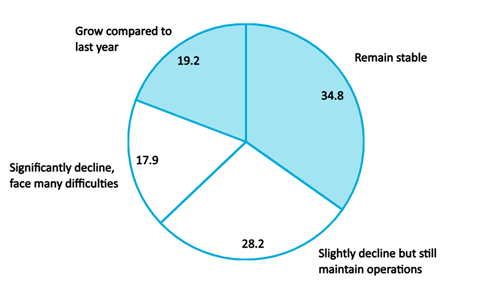
(Source: iPOS.vn and Nestlé)
Additionally, before 2020, most brands expanded aggressively, targeting any available retail space with high foot traffic. That era has ended. According to the Ministry of Planning and Investment, more than 51,000 restaurants, cafés, street-food shops, and F&B kiosks closed across Vietnam in just the first nine months of 2024[4]. This wave of closures reflects rising rent, inflation pressure, intense competition, and an increasingly selective consumer base.
In major cities, sit-down dining continues to dominate expenditure, but food delivery now accounts for 10-12% of total F&B transaction value, according to Decision Lab’s 2024 Online Food Delivery Report, up from only 3% in 2018. High delivery adoption also implies operators should avoid overpaying for premium central locations if a significant share of revenue can be captured through delivery within a 3-5 km radius.
The Critical Role of Location Strategy in Hanoi’s F&B Market
Hanoi is not only the political and administrative capital of Vietnam; it is also one of its most consumption-driven cities. The General Statistics Office estimates that in 2024, Hanoi accounts for over 22% of Vietnam’s total food service spending, despite representing a much smaller share of the national population. More than 67% of residents are under age 40, creating a favorable demographic profile for cafés, dessert chains, casual dining restaurants and delivery-friendly food formats. At the same time, household income is rising quickly. To be specific, according to B&Company, between 2020 and 2024, Hanoi’s average household income rose from 15.2 million VND to 22.8 million VND per month, an increase of 45%. Key urban districts such as Ba Dinh, Tay Ho, Cau Giay, and Thanh Xuan now report monthly incomes above 24-28 million VND, reflecting a rapidly expanding middle-class consumer base with a stronger willingness to spend on dining-out and premium F&B formats.
Rental pressure and rising operational costs
As urban retail matures, landlords have responded to demand by increasing rental prices, especially in core business districts where foot traffic and brand exposure are strongest. CBRE Vietnam’s 2024 Retail Market Outlook reports that prime street front rental prices in the busiest districts of Hanoi rose by 8-15% over the previous year[5], and in some cases, rates continued to increase despite weak macroeconomic sentiment.
The average ground-floor rental prices in central districts of Hanoi, such as Hoan Kiem and Hai Ba Trung, reached USD 172.7/m²/month in 2024[6], while premium malls like Vincom, Lotte, Aeon, and Trang Tien Plaza can charge much higher rates. As a result, rent alone now absorbs 20-55% of total revenue for many operators, which is 2-3 times higher than the global benchmark[7]. This means a poor location can destroy profitability even when customer demand exists, because revenue may not compensate for the fixed cost burden.
Retail Occupancy and Rental Price Trends (Hanoi, 2021-Q1 2025)
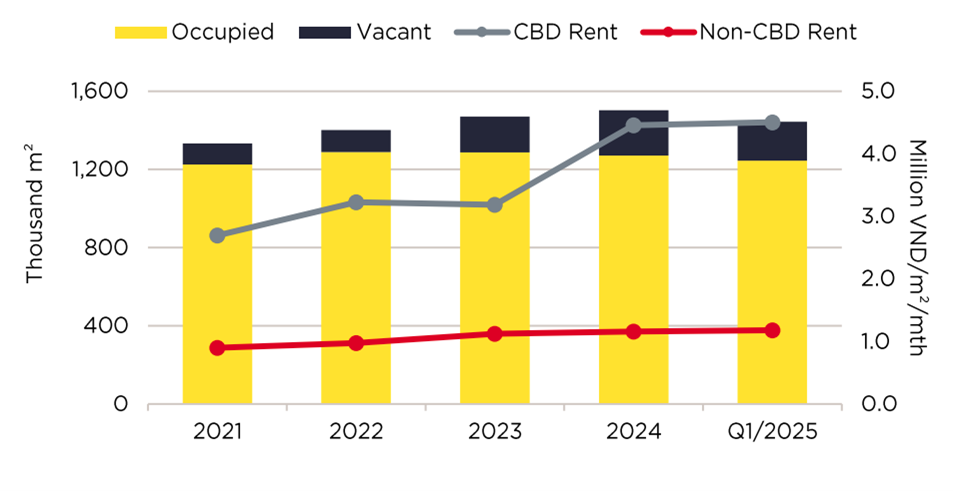
Source: Savills Vietnam
According to Savill Vietnam, from 2021 to Q1/2025, Central Business Districts (CBD) rents surged sharply to nearly 4.6-4.7 million VND/m²/month, reflecting strong competition for prime locations, while non-CBD rents also increased steadily as suburban consumption and delivery demand expanded[8]. This widening rent gap suggests that future F&B growth will increasingly shift toward affordable non-CBD districts where rising population density supports sustainable unit economics.
Additionally, Vietnam’s F&B market has also become one of the most saturated F&B battlegrounds in Southeast Asia. Euromonitor estimates that hundreds of new outlets have opened in the city between 2022 and 2024, a trend visible in key streets such as Cầu Giấy, Xuân Thủy, Times City, and the Old Quarter. Alongside these new openings, many smaller independent operators are exiting due to rising rental costs, low customer retention, and expensive marketing.
Delivery-driven consumption is reducing Dependence on Street visibility
The second driver is the shift toward online food delivery, which reduces the traditional advantage of being located on a busy street. Decision Lab’s Online Food Delivery Report 2024 indicates that delivery revenue accounts for nearly 12% of total F&B spending nationwide, compared to just 3% five years ago. Food delivery platforms such as GrabFood, ShopeeFood have intensified competition, meaning restaurants can no longer rely solely on physical foot traffic to drive sales. As a result, restaurants must think beyond pedestrian traffic. A popular address no longer guarantees performance if the location does not support fast pick-up, efficient rider access, optimized kitchen throughput, or good delivery radius coverage. Stores that cannot integrate delivery operations effectively tend to underperform, even when situated on premium streets.
Location as a Component of Brand Positioning
The third driver is the branding value of the location. A high-end concept only succeeds if its surroundings communicate premium positioning. A family-casual restaurant performs best near schools, offices, or apartment clusters, where foot traffic is regular and predictable. Dessert and coffee chains rely heavily on youth-dense zones filled with students and young professionals. Vietnamese consumers increasingly associate brand quality with the F&B location itself. This is why a premium restaurant placed in a low-income neighborhood, or conversely, a high-rent mall store selling low-margin menu items, often struggles to break even. Choosing the wrong trade area creates a mismatch between price, perception, and spending power.
Location Strategies for Different F&B Models in Hanoi
Hanoi’s F&B market is transitioning from traditional city-center clustering to a more distributed model shaped by suburban expansion, population shifts, and digital consumption. As purchasing power spreads outward and large-scale residential townships mature, the most profitable locations for the next 3-7 years will look very different from the past decade.
Premium Dining and Destination Concepts
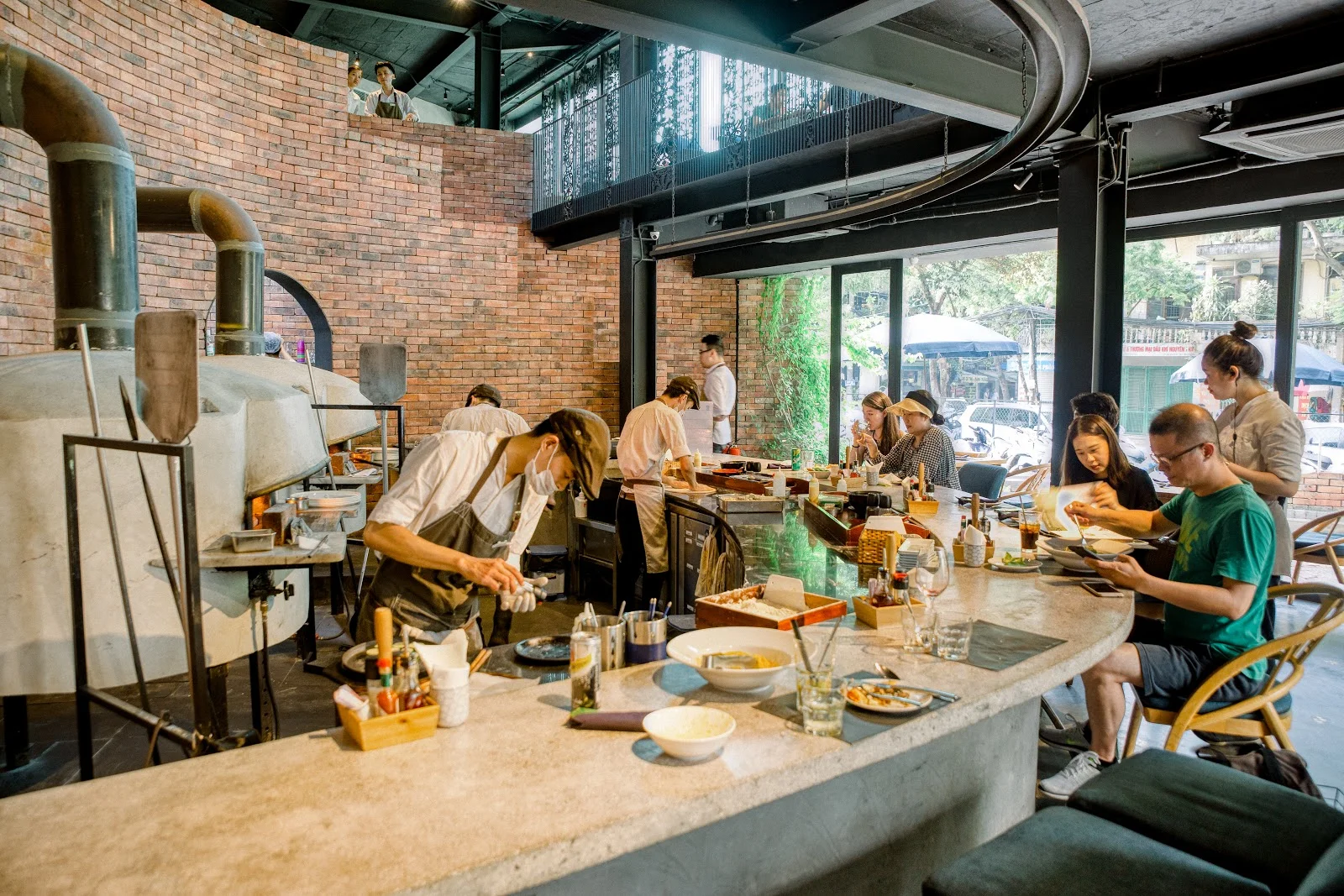
Fine Dining Restaurant in Hanoi

Source: GU Bistronomy
Premium dining and destination concepts such as fine-dining restaurants, experiential cafés, wine bars, and Japanese/Korean BBQ venues still performed strongly in Hoàn Kiếm, Tay Ho, Ba Dinh, Ciputra, Starlake, and Grade-A malls like Vincom Metropolis, Lotte Center, and Aeon Mall Long Bien. These zones maintain a high concentration of affluent residents, tourists, and office executives. Savills Retail Insight Q4/2024 reports that elite malls in Hanoi reached 93%+ occupancy, with F&B among the highest-demand tenant categories[9]. According to the Vietnam Restaurant Association (2023), 75-90% of revenue for premium restaurants still comes from dine-in, meaning physical positioning remains a core value driver.
However, the future is shifting beyond historic districts. New luxury townships such as Vinhomes Ocean Park (Gia Lam), The Manor Central Park (Hoang Mai – Thanh Tri), Ciputra, and Starlake are developing into high-income hubs supported by international schools, premium condos, and commercial streets. These areas are capturing younger, wealthy households and expat communities moving away from congested city centers. For premium brands, entering these districts early offers a first-mover advantage and lower rental risk before pricing escalates.
Mid-Casual, Fast-Casual, and Lifestyle Café Chains
Mid-casual restaurant in Hanoi
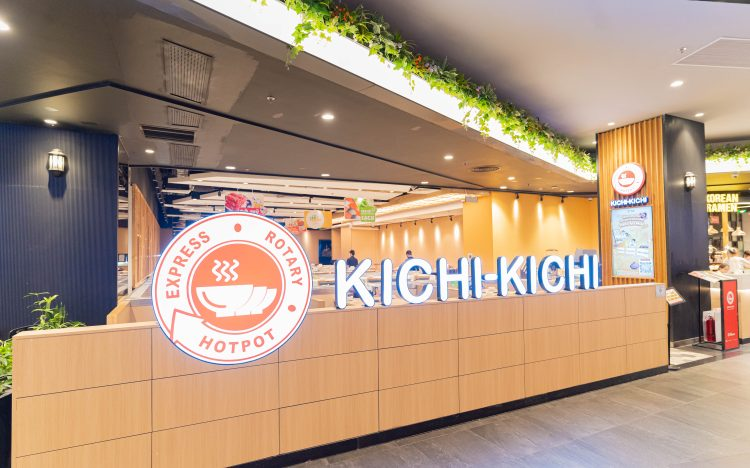
Source: Aeon Mall Ha Dong
Fast-casual restaurants and lifestyle café chains, including milk-tea, pizza/burger brands, Korean hotpot, and most coffee franchises, have historically concentrated in Cau Giay, Ha Dong, Thanh Xuan, and Hai Ba Trung. These districts provide dense daily foot traffic from students and office employees. iPOS.vn and Nestlé show that 30% of Hanoians aged 18-30 dine out or purchase café drinks 3-4 times per week[10]. Rents in these districts remain 20-40% lower than prime Hoàn Kiếm locations, creating a more sustainable cost structure for chains that depend on high visit frequency rather than luxury pricing.
Future growth for this segment is strongest in fast-urbanizing corridors instead of traditional commercial streets. First, the Hòa Lạc High-Tech Park axis, where new universities, R&D hubs, and tech employers are clustering, is expected to bring tens of thousands of young consumers. Second, Long Biên – Gia Lâm, fueled by Vinhomes Ocean Park, Aeon Mall Long Biên, and smart-city projects, is becoming a lifestyle-driven residential hub. As hybrid work reduces commuting, consumption will shift toward local neighborhood cafés and quick-service dining near homes. By 2022-2028, these “lifestyle neighborhoods” may rival Cầu Giấy and Thanh Xuân in consumer spending.
Value-segment, High-volume, and Delivery-first formats
Value-segment, high-volume, and delivery-first formats, including noodle shops, rice and chicken chains, beverage kiosks, and cloud kitchens, are undergoing the biggest geographic relocation. These models no longer require visible street fronts. Instead, they rely on low rent, dense populations, and logistics accessibility. Districts such as Hoàng Mai, Bắc Từ Liêm, Đông Anh, and Thanh Trì offer rents that are 40-60% cheaper than the urban core while experiencing rapid apartment growth. According to Statista, Vietnam’s online food delivery market reached USD 1.3 billion in 2023 and is projected to hit USD 2 billion by 2027. GrabFood and ShopeeFood report the fastest delivery-order growth in suburban Hanoi due to high-rise residential zones and young families.
The most strategically important corridor for delivery-led operations over the next decade is the Nội Bài – Nhật Tân Bridge – Đông Anh development belt. Under Hanoi’s 2030 expansion plan, Đông Anh is expected to transition into a major new urban center. Early F&B entrants will gain access to a large delivery radius serving new residential areas, airport workers, and industrial parks.
Moreover, the rapid income growth in near-suburban districts like Hoai Duc, Gia Lam, Dong Anh, and Quoc Oai, where monthly income now reaches 20-23 million VND compared with only 11-15 million VND in 2020, witnessing the fastest income growth (+60-80%), suggests rising demand for mid-priced F&B concepts. These areas are increasingly populated by young families living in new apartment clusters, making them attractive for cafés, bakeries, and delivery-oriented formats with moderate rental costs.
Conclusion
Across all segments, the definition of an optimal F&B location is changing. The future belongs to engineered consumer ecosystems: mega-townships, university corridors, tech parks, and delivery-optimized suburbs rather than heritage commercial streets. The brands that succeed will be those that map where population, disposable income, and delivery patterns are accelerating, not where they used to be. In this context, leading operators are already analyzing infrastructure pipelines, housing forecasts, and retail development plans instead of relying solely on foot-traffic observations.
* If you wish to quote any information from this article, please kindly cite the source along with the link to the original article to respect copyright.
| B&Company
The first Japanese company specializing in market research in Vietnam since 2008. We provide a wide range of services including industry reports, industry interviews, consumer surveys, business matching. Additionally, we have recently developed a database of over 900,000 companies in Vietnam, which can be used to search for partners and analyze the market. Please do not hesitate to contact us if you have any queries. info@b-company.jp + (84) 28 3910 3913 |
[1] Singh, S. (2025, September 12). Foreign food chains thrive in Vietnam’s growing F&B market. Vietnam Briefing. Retrieved from https://www.vietnam-briefing.com/news/foreign-food-chains-thrive-in-vietnams-growing-fb-market.html/
[2] VietNamNet. (2025, March 21). Vietnam’s F&B market focuses on sustainable growth. VietNamNet Global. Retrieved from https://vietnamnet.vn/en/vietnam-s-f-b-market-focuses-on-sustainable-growth-2382873.html (vietnamnet.vn)
[3] iPOS.vn & Nestlé Professional. (2025, October 12). Thông cáo báo chí: iPOS.vn và Nestlé Professional công bố Báo cáo Thị trường Kinh doanh Ẩm thực tại Việt Nam 6 tháng đầu năm 2025. Retrieved from https://ipos.vn/thong-cao-bao-chi-ipos-vn-va-nestle-professional-cong-bo-bao-cao-thi-truong-kinh-doanh-am-thuc-tai-viet-nam-6-thang-dau-nam-2025/
[4] B&Company. (2025, November 4). The trend of mass closure of F&B stores in the first half of 2025. https://b-company.jp/the-trend-of-mass-closure-of-fb-stores-in-the-first-half-of-2025/ (b-company.jp)
[5] CBRE Vietnam. (2024, January 24). Vietnam market outlook 2024. Retrieved from https://www.cbrevietnam.com/insights/books/vietnam-market-outlook-2024
[6] CBRE Vietnam. (2024, October 29). Hanoi figures Q3 2024. Retrieved from https://www.cbrevietnam.com/insights/figures/hanoi-figures-q3-2024 (cbrevietnam.com)
[7] iPOS.vn. (2025, May 16). Bức tranh toàn cảnh & xu hướng kinh doanh F&B năm 2025 – 2026: Doanh nghiệp bị “vỡ mộng” hay khai phá hướng đi riêng? iPOS.vn. https://ipos.vn/buc-tranh-toan-canh-xu-huong-fb-2025-2026/ (ipos.vn)
[8] Savills Vietnam. (2025). Hà Nội market report Q1 2025 [PDF]. Retrieved from https://www.savills.com.vn/pdf-folder/hanoi-mrq12025-en-1.pdf
[9] Savills Vietnam. (2024, April 2). Retail real estate market in Viet Nam: Q4/2024 performance and 2025 outlook. Retrieved from https://www.savills.com.vn/blog/article/220402/vietnam-eng/retail-real-estate-market-in-viet-nam–q4-2024-performance-and-2025-outlook.aspx savills.com.vn
[10] VietNamNet Global. (2024, April 13). More Vietnamese going out to eat despite economic difficulties. VietNamNet Global. https://vietnamnet.vn/en/more-vietnamese-going-out-to-eat-despite-economic-difficulties-2269252.html
Related article























Log in / Register
SUBSCRIBE NEWSLETTER