

 English
  日本語
日本語  Tiếng Việt
  简体中文
简体中文  한국어
한국어 The restructuring of provincial-level administrative units in Vietnam represent a significant overhaul of the administrative framework.

22Apr2025
Latest News & Report / Vietnam Briefing
Comments: No Comments.
The restructuring of provincial-level administrative units and the implementation of a two-tier local governance system in Vietnam represent a significant overhaul of the country’s administrative framework, aimed at enhancing governance efficiency and accountability.
The need for restructuring of provincial-level administrative units
Since its reunification, Vietnam has undergone several phases of administrative restructuring to better align governance with socio-economic development goals. In 1975, the country had approximately 72 provincial-level administrative units, which were consolidated into just 38 units in 1976 to centralize administration and improve efficiency[1]. However, in the following decades, Vietnam adopted a more decentralized approach to foster regional development. This led to the gradual re-establishment and separation of provinces, increasing the number to 53 by 1991, 61 by 1997, 64 by 2003, and eventually 63 by 2008 – a figure that remains today following the expansion of Hanoi City[2].
Throughout this period, Vietnam maintained its three-tier administrative structure – provinces and centrally-governed cities, districts, and communes or wards. This model ensured consistent government control and oversight across regions. Yet, rapid expansion and the creation of new administrative units also led to issues of fragmentation, inefficiency, and failure to meet national standards[3] [4]. These challenges prompted policymakers to reassess the structure of the public administration system.
In response, the Sixth Plenum of the 12th Central Committee issued Resolution No. 18-NQ/TW in 2017[5], calling for a comprehensive reform of the political system’s organizational structure. The resolution emphasized the need to streamline governance by reducing overlapping units, minimizing intermediary levels, and consolidating functions for greater effectiveness and efficiency. Building on this momentum, the 13th Central Committee adopted Conclusion No. 121-KL/TW in 2025[6], reaffirming the objectives of Resolution 18 and approving a nationwide administrative overhaul.
General Secretary To Lam at the second meeting of the Central Committee on the review of the implementation of Resolution No. 18-NQ/TW dated January 21, 2025
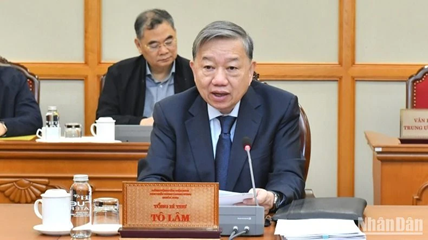
Source: Nhan Dan
Plan for Restructuring of Provincial-Level Administrative Units and Implementation of a Two-tier Local Governance System
After multiple discussion since early 2025, on April 12, Vietnam’s 13th Party Central Committee approved the proposal on the reorganization of administrative units and the development of a two-tier governance system locally, as outlined under Resolution No. 60-NG/TW of the 11th Conference of the 13th Party Central Committee[7].
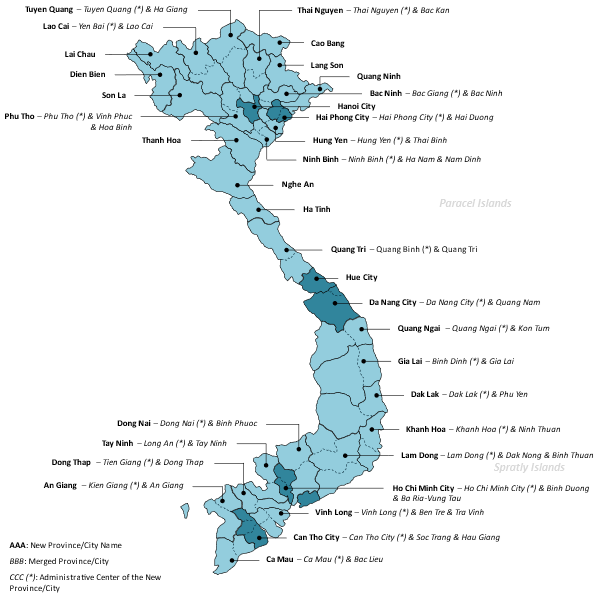
Resolution No. 60-NG/TW highlights that 11 provinces and centrally-governed cities will remain unchanged. On the other hand, 52 provinces and centrally-governed cities, together with around 9,996 commune-level units, will be merged. As a result, the country will only have:
– 34 provincial-level administrative units (down from 63 units);
Related article






































Log in / Register
Continue without an account
Log in / Register
SUBSCRIBE NEWSLETTER