

 English
  日本語
日本語  Tiếng Việt
  简体中文
简体中文  한국어
한국어 This article examines the current public - private healthcare landscape and considers the implications for healthcare providers and investors.

28Sep2026
Latest News & Report / Vietnam Briefing
Comments: No Comments.
Abstract
Public healthcare remains the backbone of Vietnam’s healthcare system, accounting for most hospital capacity and playing a central role in essential and insured healthcare services. At the same time, private healthcare is gradually expanding, particularly in major urban areas, as rising incomes and higher service expectations reshape demand. Recent policy direction, anchored in Politburo Resolution 72-NQ/TW issued in September 2025[1], reinforces the shift toward prevention and grassroots healthcare while encouraging greater private–sector participation. This article examines the current public – private healthcare landscape and considers the implications of this evolving balance for healthcare providers, investors, and solution suppliers.
Vietnam’s healthcare system is expanding amid rising service demand
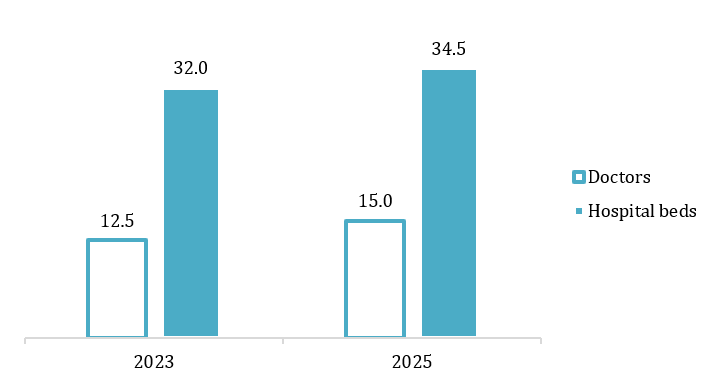
Both demand for care and system capacity are growing. Insured visits reached about 195.5 million in 2025, up 6.5% from a year earlier, and health insurance covered 95.16% of the population. By the end of 2025, the country had 15 doctors and 34.5 hospital beds per 10,000 people, up from 12.5 and 32 in 2023.[2] Growth in insured visits has since slowed to about 2.1% in the first eight months of 2026, while insured treatment costs rose by around 11%[3].
Doctors and hospital beds per 10,000 people, 2023 vs 2025
Unit: Per 10,000 population
Source: Tuoitrevn
Public providers still carry most of the capacity, but the private sector is now a sizable part of the network. At the end of 2024, the Ministry of Health counted 1,665 hospitals nationwide, of which 384 were non-public, or 23.1%.[4] Yet private hospitals held only 5.8% of hospital beds. Many private hospitals are smaller-scale facilities, resulting in a much lower average bed capacity compared with public hospitals.[5]
Public vs private hospitals in Vietnam, 2024
Unit: number of hospitals; % of total
| Indicator | Public hospitals | Private (non-public) hospitals |
| Number of hospitals | 1,281 | 384 |
| Share of all hospitals | 76.9% | 23.1% |
| Share of hospital beds | 94.2% | 5.8% |
Source: Ministry of Health via Nhan Dan Newspaper; Deputy Minister of Health via Tuoi Tre Newspaper
Strengthening public healthcare through prevention and grassroots healthcare development
Vietnam’s healthcare policy continues to position the public healthcare system as the foundation for ensuring broad access to healthcare services. Recent policy direction places greater emphasis on prevention, early detection, and grassroots healthcare, while continuing to strengthen treatment capacity across the system.
A major focus of this direction is strengthening the role of commune–level healthcare facilities. Instead of relying mainly on hospitals for treatment after illness occurs, Vietnam aims to expand preventive services, regular health screening, disease management, and primary care at the community level. Resolution 72 sets concrete targets for this level of care. By 2027, every commune health station is to have at least four to five doctors, backed by the rotation of at least 1,000 doctors a year to commune stations during 2025–2030. The share of insured visits handled at commune health stations is to rise above 20%. From 2026, every resident is to receive a free periodic health check or screening at least once a year, together with an electronic health record[6].
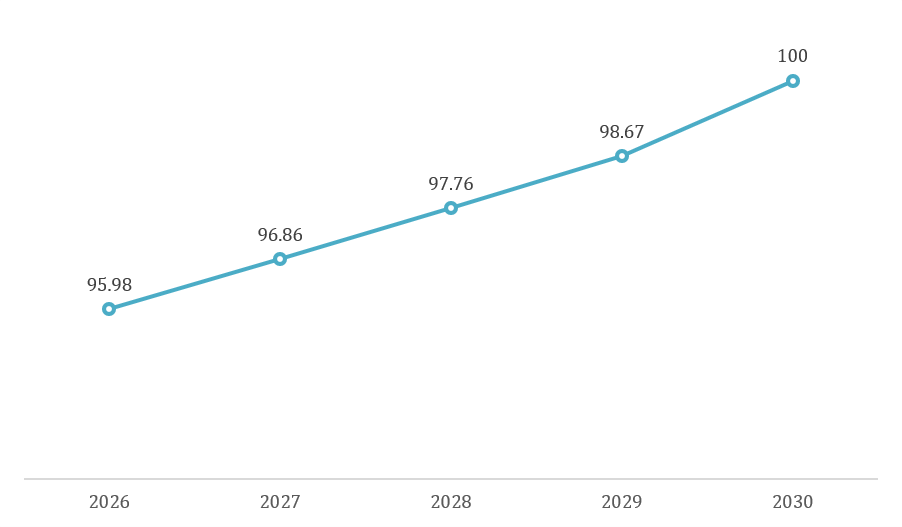
Health insurance expansion remains another important pillar of public healthcare development. By the end of 2025, health insurance covered 95.16% of the population, or about 97.57 million people, with more than 12,300 healthcare facilities under contract to provide insured treatment nationwide — a network that spans both public and private providers. Under Decision 1468/QĐ-TTg, issued on 31 July 2026, the government set a five-year roadmap toward full coverage: 95.98% in 2026, rising to 96.86% in 2027, 97.76% in 2028, 98.67% in 2029, and 100% by 2030[7]. Alongside this expansion, the government continues to prioritize financial protection, including reducing direct out-of-pocket healthcare spending and expanding access to essential healthcare services.
Vietnam’s health insurance coverage, 2026 – 2030
Unit: % of population covered
Source: Vietnam Social Security
Encouraging private-sector participation to expand healthcare capacity and services
Vietnam’s policy direction increasingly recognizes the role of private providers in expanding healthcare capacity and improving service diversity. Rather than replacing the public system, private healthcare is expected to complement public services by mobilizing additional investment, introducing new service models, and addressing growing demand for higher-quality and specialized healthcare.
Recent policy documents have highlighted the importance of attracting private-sector resources into healthcare development. Politburo Resolution 72-NQ/TW (2025) calls for stronger development of private healthcare, encouraging investment in areas such as hospitals, specialized medical services, pharmaceuticals, medical devices, healthcare technology, and research and development.
Vinmec Healthcare System

Source: Laodongvn
Vietnam’s long-term healthcare planning also sets targets to increase private–sector capacity within the healthcare system. Under the national healthcare network planning for 2021 – 2030, with a vision toward 2050, the government aims for private hospital beds to account for at least 10% of total hospital beds by 2025, 15% by 2030 and 25% by 2050[8]. The interim target for 2025 has not been reached: private hospitals held only about 7% of beds in August 2026.[9] These targets indicate a long – term strategy to expand healthcare capacity through greater participation from non – state providers. Private–sector participation is expected to be particularly important in segments requiring specialized capabilities and higher investment, including advanced diagnostics, high-quality treatment, preventive healthcare, rehabilitation, and elderly care.[10]
Recent investments in private hospitals in Vietnam
| Hospital / group | Location | Scale | Investor | Recent milestone |
| Vinmec Smart City International General Hospital | Hanoi | Capacity of about 70,000 visits a year; 14 specialties | Vingroup (Vietnam) | Opened in October 2024 |
| Vinmec Cần Giờ International General Hospital | Ho Chi Minh City (Vinhomes Green Paradise) | 500 beds on 7.4 hectares; about 500,000 visits a year planned | Vingroup (Vietnam) | Construction began in September 2026; opening planned for December 2027 |
| FV Hospital | Ho Chi Minh City | More than 200 beds; almost 250,000 patient visits a year | Thomson Medical Group (Singapore), which paid US$381.4 million | Acquisition completed in January 2024 |
| Xuyên Á hospital system | Southern Vietnam; flagship in Củ Chi, Ho Chi Minh City | Four large general hospitals | Warburg Pincus (US); amount undisclosed | Investment announced in April 2024 |
| Hoàn Mỹ hospital chain | From Nghệ An to Cà Mau | 14 hospitals and 2 clinics; about 2,900 beds | Clermont Group (Singapore) | Reported 2025 profit after tax of about VND 679 billion |
Source: Tuoi Tre (Oct 2024), Tuổi Trẻ (Apr 2024), VnExpress (Jan 2024), Nguoi Quan Sat (Sep 2026), Markettimes (Sep 2026)
Market implications for healthcare businesses and investors
The gradual evolution of Vietnam’s healthcare system toward a more balanced public – private model will have implications for different stakeholders across the healthcare ecosystem.
Main market implications across Vietnam’s public and private healthcare segments
| Segment | Current landscape and key drivers | Market implications |
| Public healthcare | • Remains the foundation of Vietnam’s healthcare system, providing large – scale access through public hospitals and grassroots healthcare facilities.
• Policy priorities focus on expanding access, strengthening primary care, improving service quality, and enhancing operational efficiency. |
• Demand will continue for solutions supporting healthcare capacity expansion and system improvement, including medical equipment, infrastructure, diagnostics, and healthcare IT.
• Companies need to consider public procurement processes, technical requirements, and reimbursement mechanisms when entering this segment. |
| Private healthcare | • Continues to expand, particularly in major urban areas, driven by rising incomes, demand for higher-quality services, shorter waiting times, and specialized treatment[11].
• Private providers are increasingly developing differentiated service models and healthcare networks[12]. • Foreign investors have entered mainly by acquiring or taking stakes in established operators, such as Thomson Medical Group’s purchase of FV Hospital and Warburg Pincus’s investment in the Xuyên Á hospital system.[13] |
• Growth areas are likely to emerge in specialized care, advanced diagnostics, preventive healthcare, and premium healthcare services.
• Companies targeting this segment need to focus on service differentiation, operational efficiency, patient experience, and investment returns. • For foreign investors, acquiring or partnering with existing operators offers a faster route into the market than building new hospitals. Operators also face heavy ongoing spending on facilities, equipment and staff, so profit growth can lag revenue growth[14] [15]. |
Source: B&Company’s synthesis
Conclusion
Vietnam’s healthcare system is entering a period of structural development, driven by rising healthcare demand, expanding insurance coverage, demographic changes, and evolving expectations for healthcare quality. While public healthcare will continue to serve as the foundation of healthcare access and population health management, private providers are expected to play an increasingly important complementary role by expanding capacity and introducing more specialized and diversified services. The future development of Vietnam’s healthcare market will therefore depend not on a shift from public to private healthcare, but on how effectively both sectors can contribute to a more comprehensive healthcare ecosystem.
Read more
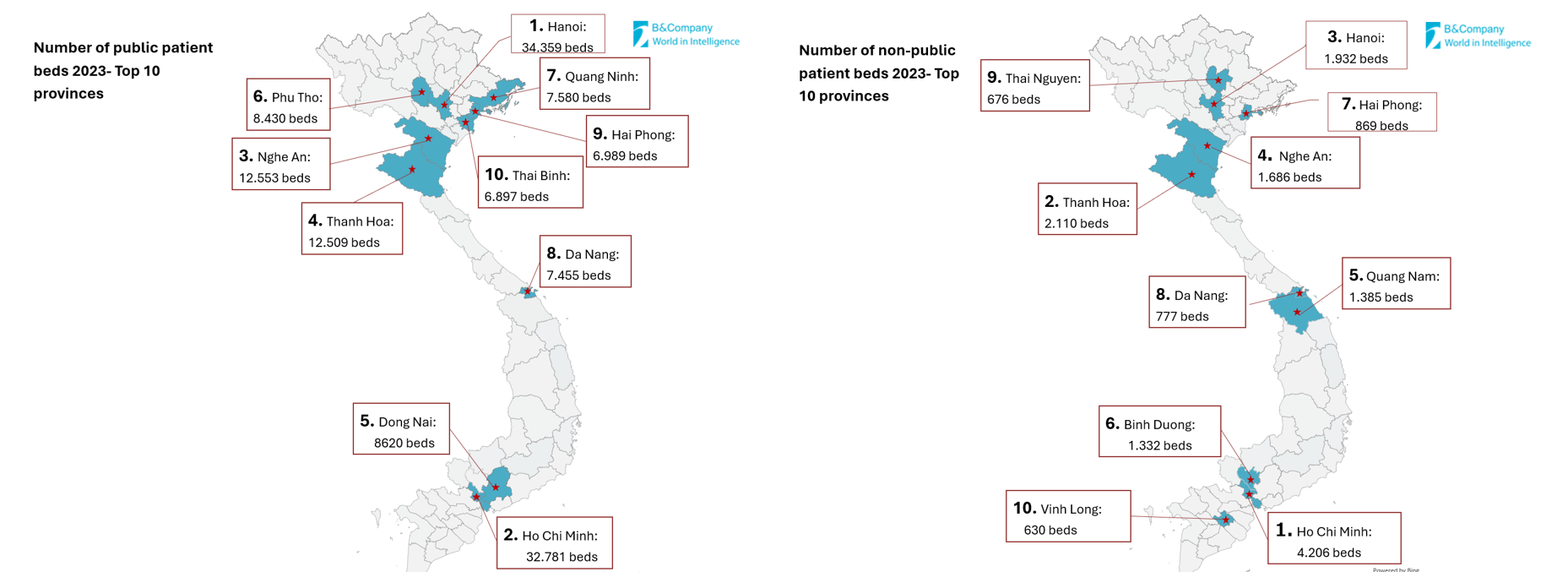
[Infographic] Provinces with the highest concentration of patient beds in Vietnam
* If you wish to quote any information from this article, please kindly cite the source along with the link to the original article to respect copyright.
| B&Company
The first Japanese company specializing in market research in Vietnam since 2008. We provide a wide range of services including industry reports, industry interviews, consumer surveys, business matching. Additionally, we have recently developed a database of over 1,000,000 companies in Vietnam, which can be used to search for partners and analyze the market. Please do not hesitate to contact us if you have any queries. info@b-company.jp + (84) 24 3978 5165 |
[1] https://xaydungchinhsach.chinhphu.vn/nghi-quyet-72-nq-tw-cua-bo-chinh-tri-ve-mot-so-giai-phap-dot-pha-tang-cuong-bao-ve-cham-soc-va-nang-cao-suc-khoe-nhan-dan-119250912060746502.htm
[2] https://tuoitre.vn/plo/hang-loat-thay-doi-quan-trong-cua-nganh-y-te-nam-2025-109889000.htm
[3] https://ansinh.tapchikinhtetaichinh.vn/quyet-liet-trien-khai-cac-giai-phap-kiem-soat-chi-phi-bao-hiem-y-te-167562.html
[4] https://nhandan.vn/phat-trien-he-thong-y-te-phu-hop-ky-nguyen-moi-cua-dat-nuoc-post864088.html
[5] https://tuoitre.vn/ti-le-giuong-benh-tu-nhan-con-rat-thap-so-voi-quy-hoach-cua-chinh-phu-20241021144231291.htm
[6] https://xaydungchinhsach.chinhphu.vn/nghi-quyet-72-nq-tw-cua-bo-chinh-tri-ve-mot-so-giai-phap-dot-pha-tang-cuong-bao-ve-cham-soc-va-nang-cao-suc-khoe-nhan-dan-119250912060746502.htm
[7] https://baohiemxahoi.gov.vn/tintuc/Pages/linh-vuc-bao-hiem-y-te.aspx?CateID=169&ItemID=26882
[8] https://datafiles.chinhphu.vn/cpp/files/vbpq/2024/3/201-ttg.signed.pdf
[9] https://dantri.com.vn/suc-khoe/thu-truong-bo-y-te-y-te-tu-nhan-khong-nen-chay-theo-so-luong-20260820214920404.htm
[11] https://b-company.jp/bridging-the-healthcare-gap-urban-growth-and-rural-needs-in-vietnam/?
[12] https://b-company.jp/expansion-and-growth-strategy-of-private-hospital-chains-in-vietnam-and-international-cooperation-trends/
[13] https://tuoitre.vn/quy-dau-tu-my-rot-von-vao-benh-vien-tu-nhan-20240415183539069.htm
[14] https://znews.vn/nhieu-dai-gia-ngoai-muon-dau-tu-benh-vien-tai-viet-nam-post1461550.html
[15] https://viettimes.vn/cuoc-dua-mo-rong-cua-ong-lon-benh-vien-tu-doanh-thu-tang-nhung-loi-nhuan-chua-duoi-kip-post206271.html
Related article




































Log in / Register
SUBSCRIBE NEWSLETTER