

 English
  日本語
日本語  Tiếng Việt
  简体中文
简体中文  한국어
한국어 Vietnam presents a promising and dynamic market for medical device investment, with an aging population and rising expenditure for healthcare

22Jan2025
Industry Reviews / Latest News & Report
Comments: No Comments.
The overall situation of Vietnam’s medical devices market
Vietnam, with an aging population and rising expenditure for healthcare from both citizens and the government, presents a promising and dynamic market for medical device investment.
Vietnamese citizens are growing older as the proportion of the elderly increased from 11.9% in 2019 to 13.9% in 2023[1] and is expected to make up a fourth of the total population by 2050[2]. The restructuring of the population signifies a need for a better healthcare system[3]. While this elderly group poses the greatest demand and spending potential, the increasing demand for healthcare services is shared among the general population. In particular, from 2020 to 2022, annual total expenditure per capita decreased by 3.3% nationwide and 13.5% in urban areas [4], but spending on healthcare increased by nearly 25%, from 153 USD to 189 USD.
Annual total expenditure and healthcare expenditure per capita in Vietnam in 2014-2022
Unit: USD
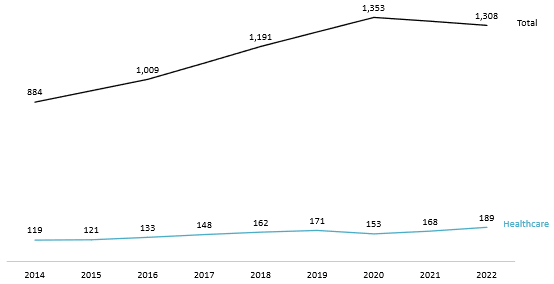
Source: WHO Global Health Expenditure Database, GSO, B&Company’s Synthesis
To meet the domestic needs, the Vietnam government plans to allocate nearly one billion USD from 2021 to 2025 as medium-term investment capital for the healthcare sector to develop infrastructure, facilities, and equipment to support and improve the general health services for the public[5]. With such drivers, Vietnam’s medical equipment market expects substantial growth soon. The market is estimated at 1.67 billion USD at the end of 2023, making it the 8th largest in the Asia-Pacific region[6], and is projected to reach 2.1 billion USD by the end of 2026[7], with a CAGR of 8%.
However, the supply of medical devices in Vietnam faces many challenges to meet the rising demand. The Ministry of Health (MoH) reported in 2022 that shortages of medicine and medical devices occurred at 90% of central-level hospitals, especially for emergency care, intensive care, cardiology, and surgery equipment[8]. Low domestic supply is one attribute of such insufficiency. Products manufactured locally are mainly of basic and common categories while high-tech medical products are scarce[9] due to the low technological level of Vietnamese companies[10] and modest high-tech inward investment[11]. This forces the country to rely heavily on overseas imports, which account for up to 90% of the total supply[12]. The shortages are further amplified due to complicated regulations from the government[13]. It is required that manufacturers must register their products with the Infrastructure and Medical Device Administration (IMDA) before circulation[14]. However, the authorization process is inefficient, with approximately 3,000 out of 11,300 applications remaining unread and unapproved in 2024[15], heavily disrupting both domestic and international supply.
Market share of medical devices in Vietnam
Vietnam’s domestic production of medical devices is highly dominated by companies with foreign investment. According to the B&Company enterprise database, in 2022, the ten biggest medical device manufacturing companies were all foreign direct investment (FDI) companies and accounted for nearly 75% of the industry’s revenue. Japanese companies have actively invested in Vietnam and have been leading manufacturers in the country (See Table 1). Meanwhile, domestic companies face significant challenges in competing with imported products and FDI firms. The MoH highlighted that local suppliers are mainly small and micro-sized businesses[16], limiting their capability in R&D investment and high-tech production[17]. Competition in the basic medical device segment is intense when imported products benefit from subsidies from their home countries while domestic producers feel more pressure on their costs by high import taxes on raw materials[18]. A lengthy authorization process hampers the development of local companies as it takes longer for them to respond to the market[19].
Table 1: Top medical device manufacturing companies in 2022
| No. | Company Name | Source of investment | City/Province |
| 1 | Sonova Operations Center Vietnam Co., Ltd. | Switzerland | Binh Duong |
| 2 | Terumo BCT Vietnam Co., Ltd. | Japan | Dong Nai |
| 3 | Terumo Vietnam Co., Ltd. | Japan | Ha Noi |
| 4 | Hoya Lens Vietnam Co., Ltd | Japan | Binh Duong |
| 5 | Omron Healthcare Manufacturing Vietnam Co., Ltd. | Japan | Binh Duong |
| 6 | B.Braun Vietnam Co., Ltd. | Malaysia | Ha Noi |
| 7 | Asahi Intecc Hanoi Co., Ltd. | Japan | Ha Noi |
| 8 | Matsuya R&D (Vietnam) Co., Ltd. | Japan | Dong Nai |
| 9 | Mani Hanoi Co., Ltd. | Japan | Thai Nguyen |
| 10 | Nikkiso Vietnam, Inc. | Japan | Ho Chi Minh City |

Related article































Log in / Register
Continue without an account
Log in / Register
SUBSCRIBE NEWSLETTER